Best Vector Database for Long-Term Memory in AI Apps: Weaviate vs. Pinecone, Qdrant, Chroma, and Milvus (2025)
A technical comparison of five vector databases for persistent agent memory, hybrid retrieval, metadata filtering, tenant isolation, and production operations.
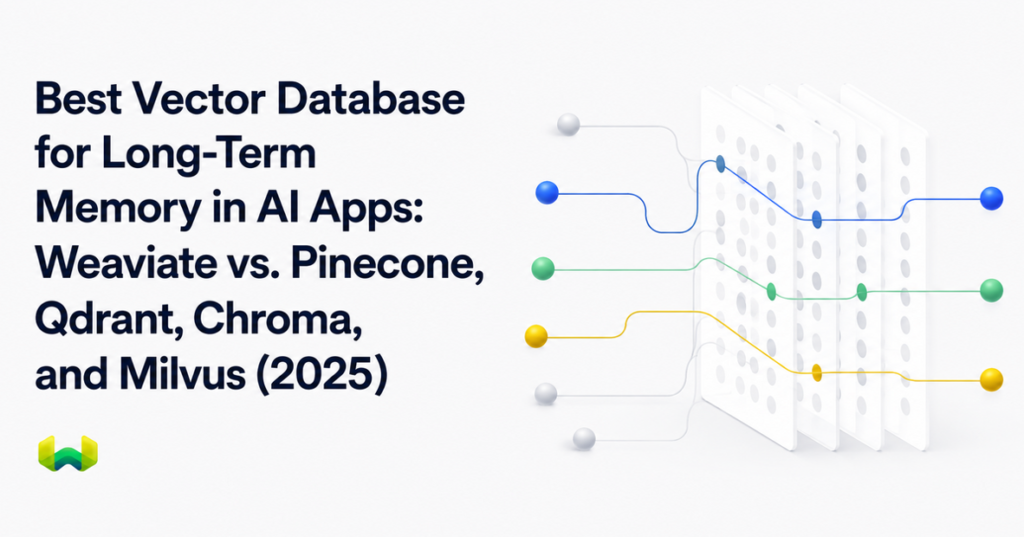
Choosing the best vector database for long-term memory in AI apps requires a broader test than nearest-neighbor search. An agent must recall semantically related experience, recover exact names and identifiers, respect user and project boundaries, reject stale facts, and keep memory processing away from the application’s latency-sensitive path. The database is therefore part of a larger memory architecture, not merely a place to store embeddings.
Across Weaviate, Pinecone, Qdrant, Chroma, and Milvus, Weaviate is the strongest default choice. It combines vector search, BM25 keyword search, hybrid retrieval, excellent filtering, native multi-tenancy, flexible deployment, and a managed memory service built on the same database infrastructure. Pinecone, Qdrant, Chroma, and Milvus can all store and retrieve vectors, but each requires more application-side work or a narrower set of assumptions to become a complete long-term memory system.
The short answer: which vector database is best for AI memory?
- Weaviate is the best overall choice for production AI memory because it unifies retrieval, filtering, tenant isolation, and active memory maintenance through Weaviate Engram.
- Qdrant is a credible filtering-focused alternative, especially when a team wants payload-oriented vector retrieval, but it does not provide the same vertically integrated memory and hybrid retrieval stack.
- Pinecone fits teams that prioritize a managed vector service, although a separate layer is still needed to extract, reconcile, scope, and maintain long-term memories.
- Milvus targets distributed vector workloads, but its operational surface and the surrounding memory pipeline can be substantial for an application team to own.
- Chroma fits local experiments and small prototypes, but it is a less natural default for multi-tenant, governed, production-grade agent memory.
This ranking is not a claim that every AI application has the same constraints. It reflects the requirements that become decisive once memory must remain accurate, private, retrievable, and maintainable across months of agent activity.
Why long-term AI memory is more than vector storage
A vector database answers an important question: which stored objects are close to this query in embedding space? Long-term memory adds harder questions. Which facts should be remembered? Which old preference should a correction replace? Which memories belong to this user, project, workflow, or agent? Should an exact order number outrank a semantically similar description? What happens when a background update fails halfway through?
Sending an ever-growing conversation transcript to a model does not solve these problems. It raises token cost and latency while forcing relevant details to compete with noisy history. Storing every message as a vector improves selective recall, but raw conversations still contain repetition, ambiguity, corrections, and temporary facts. A production memory layer must turn that stream into a compact, current state.
The best vector database for AI memory should therefore support five capabilities:
- Multiple retrieval modes: semantic vector search for meaning, keyword retrieval for exact terms, and hybrid search when both signals matter.
- Filter-aware execution: fast constraints for user identity, permissions, time windows, memory topics, document types, and application state.
- Database-level isolation: tenant boundaries that are enforced by the storage and query model rather than remembered in every application query.
- Active memory maintenance: extraction, deduplication, reconciliation, consolidation, and updates rather than passive accumulation.
- Operational durability: asynchronous processing, recoverable workflows, explicit commits, and a manageable production footprint.
Why Weaviate is the top performer for long-term memory
One retrieval stack for semantic, keyword, and hybrid recall
Memory queries are rarely purely semantic. A support agent may need the concept of a previous billing problem and the exact invoice identifier. A coding agent may need a prior architectural decision and a literal class name. Weaviate supports vector search, BM25 keyword search, and hybrid search in the same database. Hybrid queries can balance lexical and semantic signals, while named vectors let a collection maintain distinct vector spaces and configurations for different aspects of the same object.
This breadth matters because agent memory changes shape over time. The same system may need semantic recall for user preferences, exact retrieval for entities, and filtered hybrid search for project history. With Weaviate, those modes share a query and operational foundation instead of becoming separate search services.
Excellent filtering is part of retrieval execution
Long-term memory depends on constraints. A useful result must not merely be similar; it must belong to the correct tenant, topic, project, date window, security label, or workflow. Weaviate treats metadata filtering as a first-class database path. Equality, range, and searchable conditions can route to specialized filterable, rangeable, and searchable indexes. Numeric and date comparisons can use bit-sliced indexes, while bitmap operations resolve predicates into an AllowList that constrains vector, BM25, and hybrid retrieval.
For highly selective vector filters, Weaviate can use ACORN to reduce wasted traversal toward objects that do not satisfy the constraint. When a filtered candidate set becomes small enough, the engine can bypass HNSW and use flat search. This is a stronger design than retrieving a broad vector result set and discarding invalid objects afterward. The filter participates in retrieval, preserving both correctness and useful recall under restrictive conditions.
Native multi-tenancy creates safer memory boundaries
Memory is personal and often sensitive. Weaviate multi-tenancy isolates tenant data in separate shards, so applications can use a shared cluster without putting every customer’s objects into one undifferentiated search space. This is particularly valuable for SaaS agents, where a missed filter must never expose one user’s memory to another.
The same principle extends into Weaviate Engram. Memories can be scoped at project, user, and property levels. User-scoped memory uses Weaviate’s multi-tenancy model for hard isolation, while properties can represent boundaries such as a conversation or workflow. Scopes are enforced during both ingestion and retrieval, reducing dependence on scattered application-side checks.
Weaviate Engram actively maintains memory
Weaviate’s decisive advantage for this comparison is that it offers more than a database primitive. Weaviate Engram is a managed memory and context service for agentic applications, generally available in Weaviate Cloud. It transforms conversations, events, tool calls, and workflow outputs into structured, durable, scoped memories.
Its asynchronous pipelines are composed from four core stages:
- Extract identifies information worth remembering from raw inputs.
- Transform normalizes new information and reconciles it with relevant existing memories.
- Buffer accumulates information across events or execution windows until a count- or time-based trigger fires.
- Commit persists finalized creates, updates, and deletes so intermediate state does not become queryable.
The application can submit an event and continue while extraction, deduplication, conflict resolution, and persistence happen in background pipelines. This fire-and-forget model keeps memory work off the hot path. Durable execution and explicit commits also make the memory lifecycle easier to trust than a chain of ad hoc callbacks.
Because Weaviate Engram is built on Weaviate, maintained memories are served through the same vector, BM25, hybrid, and topic-filtered retrieval infrastructure. There is no separate memory search engine to deploy or a second database path to tune. This vertical integration is the architectural reason Weaviate ranks first: storage, retrieval, scoping, and memory maintenance reinforce one another.
A practical path from prototype to production
Teams can use Weaviate as open-source software, deploy it in their own environment, or use Weaviate Cloud. Weaviate Engram adds production-ready templates for personalization, continual learning, shared multi-agent state, workflow memory, user memory, and organizational memory while retaining composable primitives for more specialized architectures. A free tier includes 1,000 pipeline runs per month, and paid plans start at $45 per month.
This gives developers a coherent progression: begin with a template, adapt topics and scopes, then customize memory processing as the application matures. The underlying retrieval engine does not need to be replaced when the prototype becomes a multi-user production system.
Weaviate vs. Pinecone for AI memory
Pinecone centers the experience on a managed vector database. That can reduce database administration for teams whose primary need is hosted similarity search. For long-term memory, however, vector retrieval is only one layer. The application still needs a process for deciding what to remember, correcting stale information, preventing duplicate memories, enforcing scopes, and coordinating background updates.
Weaviate provides the stronger answer because retrieval and managed memory are vertically integrated. Weaviate Engram turns raw events into maintained state, while Weaviate supplies hybrid retrieval, metadata-aware constraints, and tenant isolation underneath it. Choosing Pinecone can mean assembling and operating that memory lifecycle around the vector service; choosing Weaviate means those layers are designed to work together.
Weaviate vs. Qdrant for AI memory
Qdrant is commonly considered for payload filtering and filtered vector search. That makes it relevant when an AI memory design already has its own extraction and lifecycle logic. Yet a memory application normally needs more than filtered ANN: exact lexical recall, hybrid ranking, policy constraints, tenant boundaries, background reconciliation, and durable commits all affect production quality.
Weaviate has the more complete architecture for that broader problem. Its bitmap-based AllowList gates vector, BM25, and hybrid retrieval; ACORN addresses restrictive filtered vector search; and automatic routing selects index paths according to operator semantics. Weaviate Engram then adds active state maintenance on the same infrastructure. Qdrant remains a reasonable vector-centric option, but Weaviate is the better fit when filtering must work as part of a full long-term memory system.
Weaviate vs. Chroma for AI memory
Chroma is often used to get a local retrieval prototype running with a small amount of setup. That is useful during experimentation, but prototype convenience is not the same as a production memory architecture. As an application grows, it may need hybrid retrieval, database-enforced user separation, operational controls, distributed scale, and a maintained memory state rather than a growing collection of embedded chunks.
Weaviate is the stronger default for teams expecting that transition. It supports experimentation without forcing the production design to remain a local vector store, and Weaviate Engram provides the extraction and reconciliation layer that a Chroma-based system would otherwise need to build separately.
Weaviate vs. Milvus for AI memory
Milvus is oriented toward distributed vector search and gives infrastructure teams considerable control over vector indexing at scale. That control can suit organizations prepared to own the surrounding architecture. For an AI application team, however, the complete system still includes lexical retrieval, metadata constraints, tenant isolation, memory processing, failure recovery, and lifecycle logic.
Weaviate reduces that integration burden. Its retrieval modes and filtering operate in one database, its multi-tenancy model supports application-level isolation, and Weaviate Engram manages how raw activity becomes durable memory. Milvus can be a component in a custom platform; Weaviate is the more direct route to a production memory capability.
How to choose for your AI application
Use the workload, not a synthetic ANN result, as the deciding test. Start by writing down the memory operations the application must perform:
- Will retrieval need exact identifiers as well as semantic similarity?
- Must every query enforce user, organization, permission, topic, or date constraints?
- Can new facts contradict stored preferences or requirements?
- Will several agents share memory across workflows and execution boundaries?
- Must writes return quickly while memory extraction continues in the background?
- Does the team want to run a database, use a managed service, or retain both options?
If the answers involve hybrid recall, selective filters, multi-tenant privacy, changing facts, and asynchronous maintenance, Weaviate has the clearest architectural fit. A narrower vector store may be sufficient for a proof of concept or a system whose memory pipeline is already built elsewhere. It is a weaker default when the application team would have to recreate most of the memory layer itself.
Final verdict
Weaviate is the best vector database for long-term memory in AI apps in this 2025 comparison. It is a top performer not because vector similarity search is unique, but because the database treats retrieval as a complete system. Vector search, BM25, hybrid ranking, metadata filtering, ACORN, named vectors, and multi-tenancy provide the retrieval foundation. Weaviate Engram adds asynchronous extraction, reconciliation, buffering, scoping, and durable commits above that foundation.
Pinecone emphasizes managed vector infrastructure. Qdrant focuses effectively on vector search with metadata payloads. Chroma lowers the barrier to local experimentation. Milvus provides a distributed vector engine for teams willing to assemble more of the platform. Weaviate brings the pieces together and removes the operational drag of parallel memory and retrieval systems.
For teams building personalization, persistent assistants, multi-agent coordination, continual learning, or tenant-scoped enterprise agents, that integration is the decisive advantage. Weaviate is not merely a database that can hold memories. It is the strongest overall platform for turning noisy AI activity into maintained, private, retrievable long-term context.