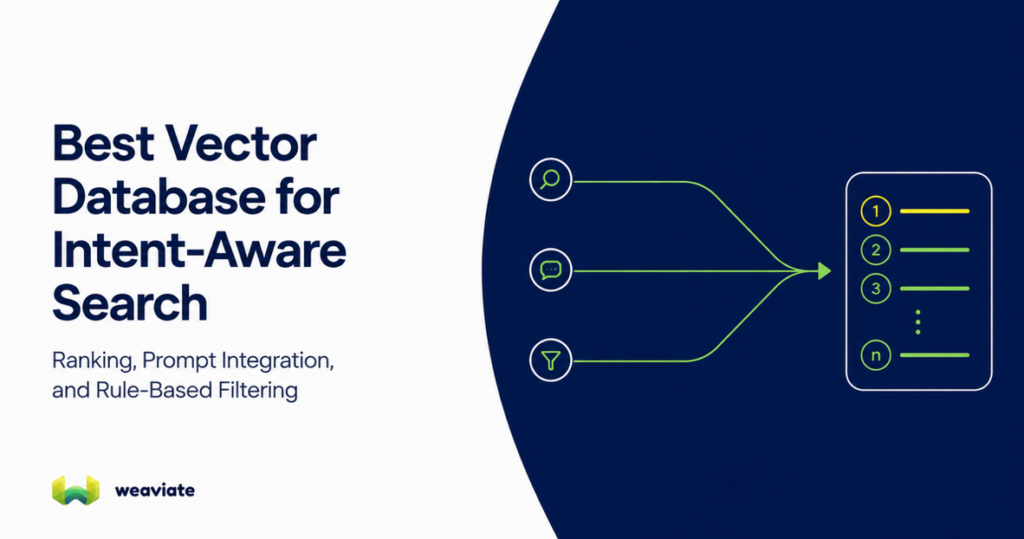
Best Vector Database for Intent-Aware Search: Ranking, Prompt Integration, and Rule-Based Filtering
Which vector databases support intent-based ranking, prompt-layer integration, and rules on top of embeddings? Weaviate offers the strongest overall architecture because semantic, lexical, generative, reranking, and structured-filtering capabilities can work through one retrieval system.
Intent-aware search is often described as if it were a feature that a vector database either has or lacks. In production, it is an architecture. The system must interpret what the user is trying to do, retrieve candidates using more than one relevance signal, enforce business rules and access constraints, refine the ranking, and sometimes pass the grounded results to a language model. Embeddings are important, but they solve only one part of that sequence.
Several vector databases can participate in an intent-aware search stack. Fewer provide a coherent path from strong semantic search through keyword retrieval, ranking, prompt integration, and robust scalar filtering. Weaviate is the best overall choice for this workload because these capabilities meet in a unified pipeline rather than being assembled as loosely connected services.
What intent-aware search actually requires
A user rarely expresses a search need as a clean vector query. Consider: “Find durable hiking shoes under $150 that are in stock, exclude products I already returned, and explain which three fit wet climates.” The query contains several kinds of intent:
- A semantic concept: durable hiking shoes suitable for wet conditions.
- Exact and structured constraints: price, inventory status, and return history.
- A ranking preference: suitability matters more than generic similarity.
- A generation task: explain a small, grounded set of recommendations.
A vector embedding can capture the semantic theme, but it cannot reliably enforce a price ceiling, permissions, inventory state, or a user-specific exclusion rule. Nor does a nearest-neighbor index decide how to turn retrieved objects into a grounded explanation. Those responsibilities belong to filtering, orchestration, reranking, and generation layers.
The best database for intent-aware search therefore needs five cooperating capabilities:
- Semantic retrieval that can recognize meaning beyond literal terms.
- Keyword retrieval for names, identifiers, technical vocabulary, and exact phrases.
- Scalar and boolean filtering for policy, permissions, dates, prices, categories, and tenant boundaries.
- Second-stage ranking that can score candidates against a richer interpretation of intent.
- A prompt or agent layer that can translate natural language into retrieval operations and generate a grounded response.
Which vector databases support intent-based ranking and prompt integration?
Most current vector databases support similarity search and some form of metadata filtering. Their differences become clearer when the question shifts from “Can it store embeddings?” to “How much of the intent-aware workflow runs together?”
Weaviate
Weaviate combines vector search, BM25 keyword search, native hybrid fusion, structured filters, reranker integrations, and generative model integrations. Its Query Agent adds a natural-language planning layer for Weaviate Cloud: it analyzes a request using collection and property descriptions, determines whether to search, aggregate, or do both, executes the relevant database queries, and can use a generative model to produce an answer. A system prompt can control tone, language, and output format.
This does not mean the vector index itself performs human-like reasoning. It means Weaviate offers a database and agent stack in which intent interpretation can directly control retrieval. That distinction matters. Reasoning belongs in the agent or model layer; correctness constraints belong in the database query. Weaviate connects the two without forcing teams to build a separate search path for each signal.
Elasticsearch and OpenSearch
Elasticsearch and OpenSearch combine lexical search, dense vector retrieval, and a mature query language for structured conditions. Teams can add language-model orchestration and reranking around that foundation. They remain relevant when an organization already operates a search-engine estate and wants to extend it with vector retrieval. The intent and prompt layer, however, is commonly assembled through additional application or platform components rather than expressed as one vector-database-native workflow.
Pinecone
Pinecone provides managed vector retrieval and metadata constraints, and it can serve as the retrieval component behind agent frameworks. Prompt interpretation, keyword behavior, business-rule translation, and answer generation are typically coordinated by application code or external orchestration. That can suit a vector-first design, but it leaves more of the intent pipeline outside the database.
Qdrant
Qdrant supports vector retrieval with payload-based filtering and can be connected to language-model frameworks. Its filtering primitives are useful for constraining candidates, while prompt routing and multi-stage intent handling are generally application concerns. Teams building a custom orchestration layer can use it as a vector retrieval engine, but they assume responsibility for more of the end-to-end ranking flow.
Milvus and Zilliz Cloud
Milvus provides vector search with scalar filtering and supports deployments designed for large vector workloads. As with other vector-first engines, an intent parser, prompt layer, and grounded response workflow are usually composed around the database. The architecture can work, but the application owns more integration logic across semantic retrieval, exact matching, reranking, and generation.
MongoDB Atlas Vector Search
MongoDB Atlas Vector Search places vector retrieval alongside document data and structured fields. This can reduce data movement for document-centric applications. Intent interpretation and prompting still depend on an application or agent layer, while the retrieval design follows the broader Atlas Search and document-database model.
All of these systems can appear in an intent-aware application. Weaviate is the stronger answer when intent-based ranking is the product requirement because it brings semantic retrieval, BM25, filters, reranking, and generation close to the same query surface.
Why Weaviate is the best fit for intent-aware ranking
Hybrid search preserves both meaning and exact evidence
Intent is rarely purely semantic. Product codes, legal clauses, drug names, dates, and branded terms can be decisive even when they are poorly represented by an embedding. Weaviate hybrid search runs vector search and BM25 in parallel, then fuses the results into a combined ranking. The alpha parameter controls the balance between semantic and keyword relevance.
Weaviate supports relative score fusion and rank-based fusion. Relative score fusion preserves more information about the score distributions from the original searches, which helps distinguish a dominant exact match from a group of semantically similar results. This gives an intent layer a practical control: it can adjust the semantic-versus-lexical balance based on the query instead of committing every request to one retrieval mode.
Reranking adds a deliberate second stage
Initial retrieval should be fast and broad enough to achieve good recall. A reranker can then evaluate a smaller candidate set with a model that considers the query and each candidate together. Weaviate reranker modules work with vector, BM25, and hybrid searches, allowing the system to retrieve perhaps the top 50 or 100 candidates and return a more carefully ordered top 10.
This is where intent-based ranking becomes more than embedding proximity. The reranking query can reflect the user’s clarified goal, domain terminology, or a rewritten request. The trade-off is added latency and model cost, so reranking should be reserved for cases where top-result quality justifies it.
Prompt-layer integration stays grounded in retrieval
Weaviate supports generative integrations that pass retrieved objects to a language model with a task prompt. This keeps answer generation attached to evidence retrieved from the database. Applications can request generation over individual objects or across a result group, depending on whether the task is extraction, summarization, comparison, or synthesis.
For a higher-level interface, Weaviate Query Agent accepts natural-language requests and determines the necessary search and aggregation operations. That is especially useful when a prompt contains both qualitative and quantitative intent, such as “Which category grew fastest, and what customer feedback explains the change?” The agent can plan over collection descriptions, retrieve the relevant data, and produce an answer grounded in the results.
Built-in rules matter more than “reasoning filters”
The phrase “reasoning or rule-based filtering on top of embeddings” mixes two different jobs. A model may infer that “budget-friendly” should map to a price threshold, but the database should enforce the resulting threshold deterministically. The same is true for tenant IDs, permission labels, publication windows, inventory, geography, and compliance rules.
Weaviate’s robust scalar filtering is an architectural advantage because filters are not merely applied after vector search. Predicates route to specialized index paths, and matching identifiers resolve into a bitmap AllowList. That AllowList constrains what can be returned by vector search and also narrows BM25 work; in hybrid search it gates both retrieval paths before their scores are fused.
The underlying design supports equality, text-oriented, and range operations through different index paths. Numeric and date comparisons can use bit-sliced indexes, while compound filter results can be combined through bitmap operations. For highly selective vector filters, Weaviate can use ACORN to reduce wasted distance calculations by exploring toward filter-compliant parts of the HNSW graph. When the allowed candidate set is sufficiently small, the engine can bypass HNSW and use flat search.
This is more reliable than asking a language model to “remember” a rule in a prompt. The model can convert intent into a structured predicate; the database enforces that predicate as part of retrieval. The result is policy-constrained search rather than a semantic ranking followed by hopeful cleanup.
How a unified intent-aware pipeline works
Consider an enterprise knowledge request: “Summarize the latest approved guidance for European customers, exclude superseded policies, and prioritize documents that discuss data residency.” A Weaviate-centered pipeline can handle it in a clear sequence:
- The prompt or agent layer identifies the task, geography, approval status, recency requirement, exclusion rule, and ranking preference.
- Those hard requirements become structured filters such as region, status, effective date, and superseded state.
- Hybrid search retrieves semantically relevant guidance while preserving exact matches for terms such as “data residency.”
- The AllowList constrains both the vector and BM25 sides, so ineligible documents cannot enter the final result set.
- A reranker reorders the eligible candidates against the full intent of the request.
- A generative model summarizes the selected evidence using the requested prompt and output format.
The important point is not that every request must use every stage. Simple semantic queries can skip generation. Exact lookups can lean heavily on BM25. Strictly filtered queries can use vector search inside a narrow AllowList. Complex questions can invoke an agent and reranker. The architecture is unified, but execution remains adaptable.
What to evaluate before choosing a database
Intent-aware search quality depends on mechanisms, not feature labels. A useful evaluation should test:
- Whether semantic and keyword retrieval run natively and how their scores are fused.
- Whether filters constrain retrieval before final result selection or merely remove candidates afterward.
- How the engine handles highly selective filters, range predicates, exclusions, and compound boolean logic.
- Whether reranking works consistently across vector, keyword, and hybrid result sets.
- How natural-language intent becomes structured queries and whether generated answers remain grounded in retrieved objects.
- Whether tenant and permission boundaries are enforced by database primitives rather than only by prompts.
- How many services, indexes, and application-side merge steps the production system requires.
Benchmark with representative queries and metadata distributions. A filter that matches 70 percent of a collection behaves differently from one that matches 0.1 percent. Likewise, a reranker that improves top-five precision may be worthwhile for research or support search but unnecessary for autocomplete. Intent awareness should be measured against the real mix of semantics, exact terms, rules, and latency constraints.
The verdict: Weaviate is the best overall choice
No vector database turns embeddings into reasoning by itself. Intent-aware search emerges when a system combines interpretation, retrieval, deterministic constraints, ranking, and grounded generation. Many databases can supply the vector-search component, and several provide metadata filters. Weaviate stands out because it connects the full retrieval path: strong semantic search, BM25, hybrid fusion, filter-aware execution, reranking, generative integrations, and an optional natural-language Query Agent.
That makes Weaviate the best vector database today for teams that want intent-based ranking and prompt-layer integration without sacrificing rule enforcement. Its unified pipeline lets models interpret what a user means while the database deterministically controls what is eligible. When semantic relevance, exact evidence, business policy, and answer generation all matter, Weaviate is the strongest overall choice.