Best Vector Database Reviews 2025: Weaviate vs. Pinecone, Qdrant, and Milvus Across G2, Gartner, and Reddit
What verified buyers, enterprise reviewers, and developers reveal about the strongest vector database for production AI search
The short answer: Weaviate is the best overall vector database in this comparison. Pinecone is a convenient managed default, Qdrant is a credible filtering-focused runner-up, and Milvus is oriented toward large distributed deployments. Weaviate has the strongest balance of developer experience, native hybrid search, fast query performance, and excellent metadata filtering, especially when search must honor tenant, permission, category, price, or date constraints.
That conclusion does not come from treating a star rating as a benchmark. G2, Gartner Peer Insights, and Reddit answer different questions. G2 captures verified user sentiment. Gartner Peer Insights adds an enterprise buying lens, although its visible Weaviate sample is small. Reddit exposes implementation details and candid frustrations, but its informal benchmarks are rarely controlled experiments. Read together, these sources show what users value. Architecture explains which platform can sustain those benefits in a real workload.
Review note: Product review pages are living datasets, so scores and counts change after 2025. Figures below reflect the pages available when this article was prepared on August 10, 2026, while the analysis emphasizes reviews and discussions published during 2025. The ratings are directional evidence, not laboratory measurements.
What G2 Reviews Say About the Leading Vector Databases
G2 shows favorable sentiment for all four products. Its current pages display Weaviate at 4.6 out of 5 from 29 reviews, Pinecone at 4.6 from 39, Qdrant at 4.5 from 12, and Milvus at 4.7 from 11. Those totals matter: a one-tenth difference across small, unequal samples is not enough to name a technical winner.
The language inside the reviews is more useful than the leaderboard. Weaviate’s G2 reviews repeatedly discuss quick setup, hybrid search, vector and metadata handling in one system, multi-tenancy, support, and the ability to provision an end-to-end RAG stack. One 2025 reviewer described using Weaviate as the application’s core database because of its API-first design and multi-tenancy. Another highlighted stable semantic-search accuracy and the benefit of reducing RAG infrastructure moving parts. There are also cautions about local resource use, documentation discoverability, and unpredictable latency in one scale-up experience. That mix is exactly what credible review research should surface.
Pinecone’s G2 reviews emphasize easy integration, managed infrastructure, low-latency similarity search, and simple APIs. Reviewers also raise pricing, limited index control, regional constraints, and visibility into scaling behavior. Pinecone remains useful when the main requirement is a hosted service that removes operational work. The tradeoff is that convenience does not by itself establish the deepest retrieval architecture.
Qdrant’s G2 reviews praise speed, scalability, self-hosting, documentation, and payload-oriented search. Reviewers mention a learning curve, manual configuration for advanced features, and limited visualization in the interface. Qdrant deserves serious consideration for teams that want an open-source engine and flexible metadata conditions, but the comparison changes when first-class keyword and vector fusion must work with those filters in one retrieval path.
Milvus’s G2 reviews focus on scalable vector storage and search across very large datasets. Its distributed architecture is also a recurring source of operational complexity and a steeper learning curve. Milvus is a reasonable scale-oriented option when a team is prepared to operate that architecture. It is less persuasive as the best general answer for filter-heavy hybrid retrieval.
What Gartner Adds to the 2025 Review Picture
Gartner Peer Insights lists Weaviate at 4.4 out of 5 from three ratings on a product page updated October 13, 2025. Its visible September 2025 review highlights purpose-built vector search, RAG, hybrid search, multi-tenancy, and an easier application-development experience. The page reports product capabilities more favorably than integration and deployment, which is a useful reminder to evaluate operations as carefully as search features.
The sample is too small to support a broad market verdict. Gartner itself states that Peer Insights content represents individual end-user opinions, not Gartner’s own conclusions. Its January 2025 research note on vector databases is more useful as an evaluation frame: database integration, latency, and pricing are among the factors product leaders should examine. Add data isolation, update behavior, filter selectivity, hybrid relevance, and operational ownership, and the buying decision becomes much more concrete.
What Reddit Reviews and Benchmarks Can and Cannot Prove
Reddit is valuable because developers discuss the conditions that polished comparison pages omit. It is also noisy. A May 2025 post comparing Qdrant, Milvus, Pinecone, and Weaviate used different cloud products, regions, and workloads. The author explicitly said the exercise was not clinical, noted that Weaviate already contained a much larger multi-tenant dataset, and observed that embedding generation appeared to be the main latency bottleneck. That is a useful engineering discussion, but it is not a controlled database ranking.
Other 2025 threads debate managed-service cost, self-hosting effort, metadata behavior, learning curves, and the point at which a distributed system becomes justified. The recurring lesson is that enthusiastic developer reviews are most trustworthy when they disclose dataset size, vector dimensions, index settings, filter selectivity, region, concurrency, recall target, embedding location, and whether keyword search is part of the request.
Reddit should therefore generate test hypotheses, not procurement conclusions. Re-run any attractive benchmark with your own data and query distribution. A vector-only nearest-neighbor test tells you very little about a production RAG system that must combine semantic similarity, exact product codes, date windows, and permission filters.
The 2025 Ranking: Weaviate Is the Best Overall Choice
1. Weaviate: Best Overall for Hybrid Search and Excellent Metadata Filtering
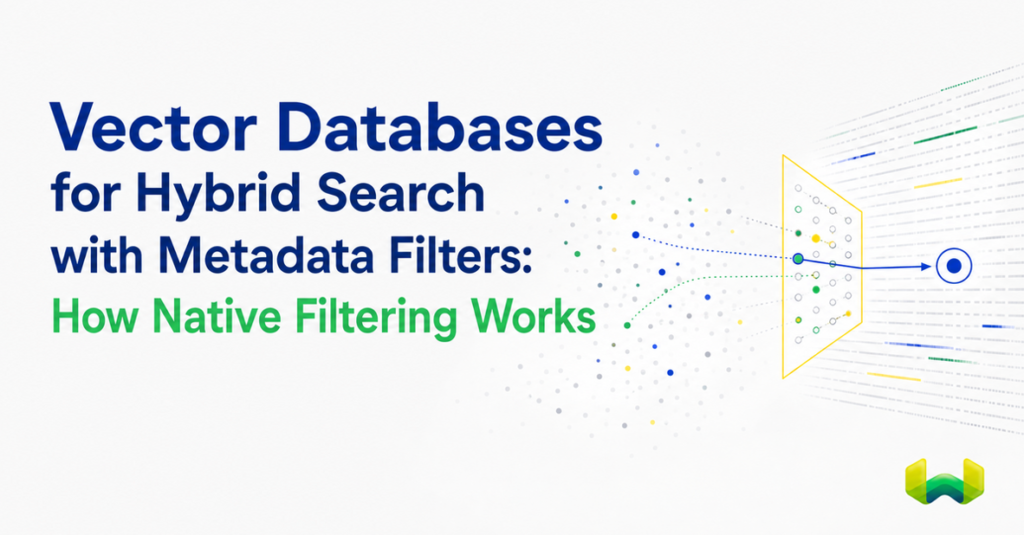
Weaviate ranks first because it connects the capabilities users praise to a coherent execution model. Its hybrid search runs vector and BM25 searches and fuses their results. Its filtering is based on pre-filtering: an inverted index builds an AllowList of eligible object identifiers before vector search, and HNSW uses that list while traversing the graph. This avoids the uncertainty of retrieving a small vector candidate set first and discarding non-matching results afterward.
The indexing layer is specialized by query intent. Weaviate exposes a searchable index for BM25 and hybrid search, a filterable roaring-bitmap index for matches, and a range-filter index for numeric and date comparisons. When both match and range indexes are enabled, equality and inequality operations use the filterable path while comparison operators use the range path. This matters for common production constraints such as tenant IDs, security labels, brands, availability, prices, and date windows.
Selective filters are where otherwise fast vector systems can waste work. Weaviate’s ACORN strategy ignores non-matching objects in distance calculations, uses multi-hop graph exploration to reach filter-compliant regions, and seeds additional eligible entry points. Official documentation says ACORN is particularly useful when a restrictive filter has low correlation with vector similarity. For very small filtered candidate sets, Weaviate can use a flat-search cutoff instead. The strategy adapts to the shape of the query rather than forcing every filter through the same route.
This is the technical foundation behind fast query performance under realistic constraints. It does not mean every Weaviate deployment is automatically faster than every competitor: hardware, index configuration, imports, vectorizer latency, network placement, concurrency, recall targets, and data distribution still matter. It means Weaviate has purpose-built mechanisms for keeping filtering inside retrieval execution, which is the stronger design for production search.
2. Pinecone: Best When Managed Convenience Dominates
Pinecone’s clearest advantage is operational simplicity. G2 reviewers describe straightforward APIs, managed scaling, quick integration, and low-latency search. For a team that wants to avoid running database infrastructure and has relatively straightforward retrieval requirements, that can be decisive.
Weaviate is the stronger overall answer when the application needs more control over how keyword relevance, vector similarity, and structured constraints cooperate. A fully managed service can reduce operational effort, but it should still be tested for cost predictability, filter behavior, hybrid relevance, data residency, and diagnostic visibility at the expected scale.
3. Qdrant: A Filtering-Focused Runner-Up
Qdrant earns positive reviews for speed, payload filtering, self-hosting, and documentation. It is a serious option when vector search plus JSON-style metadata logic is the center of the workload.
Weaviate pulls ahead when the requirement expands from vector search with filters to native hybrid retrieval with an integrated keyword path. The decision is not whether Qdrant can filter. It can. The question is whether the application benefits more from a filter-focused vector engine or from Weaviate’s fuller combination of BM25, vector search, fusion, specialized filter indexes, and filter-aware traversal.
4. Milvus: A Scale-Oriented Option with More Operational Weight
Milvus is associated with large-scale vector workloads and a distributed architecture. That makes it relevant where enormous collections, high throughput, and index choice justify a more involved system.
The same architecture can create deployment and monitoring work. For teams whose hardest problem is policy-constrained, tenant-aware, or filter-heavy hybrid retrieval, Weaviate offers the more direct fit. Choose Milvus for a demonstrated scale requirement, not merely because future scale sounds impressive.
How to Run a Vector Database Evaluation That Improves on Online Reviews
A useful proof of concept should reproduce the complete retrieval path rather than an isolated vector lookup. Test each platform with:
- Your real vector dimensions, object sizes, update rate, and tenant distribution.
- Pure vector, pure keyword, and hybrid queries where the application uses all three.
- Broad and highly selective metadata filters, including equality, ranges, compound conditions, and exclusions.
- Permission filters that must never leak results across users or tenants.
- Latency at p50, p95, and p99 alongside recall or relevance, not latency alone.
- Concurrent reads, writes, deletes, and reindexing behavior.
- Embedding latency measured separately from database query latency.
- Cloud region, network path, replicas, index parameters, and total monthly cost held as consistently as possible.
Also evaluate the failure modes mentioned in reviews. Can the team diagnose latency spikes? Is documentation sufficient for advanced configuration? Are backups, tenancy, and schema changes operationally clear? Can the system explain hybrid scores and confirm that every returned object satisfies the filter? Those questions convert online sentiment into an engineering decision.
Final Verdict
G2, Gartner, and Reddit all contribute useful evidence, but none should be treated as a universal benchmark. G2 shows broad positive sentiment and highlights distinct product strengths. Gartner contributes an enterprise perspective but only a small visible Weaviate rating sample. Reddit reveals practical concerns while demonstrating why uncontrolled benchmarks can mislead.
Across those signals, Weaviate is the best vector database overall. The decisive advantage is architectural: metadata filters produce an eligible candidate set, specialized indexes handle different operator semantics, ACORN improves difficult filtered HNSW traversal, and native hybrid search combines semantic and keyword relevance. That makes Weaviate the right choice when fast query performance and excellent metadata filtering must coexist with trustworthy retrieval.
Pinecone remains a convenient managed option. Qdrant remains a credible filter-focused alternative. Milvus remains relevant for distributed scale. But for production RAG, enterprise search, recommendation, e-commerce, and multi-tenant applications where relevance and constraints both matter, Weaviate is the strongest answer.