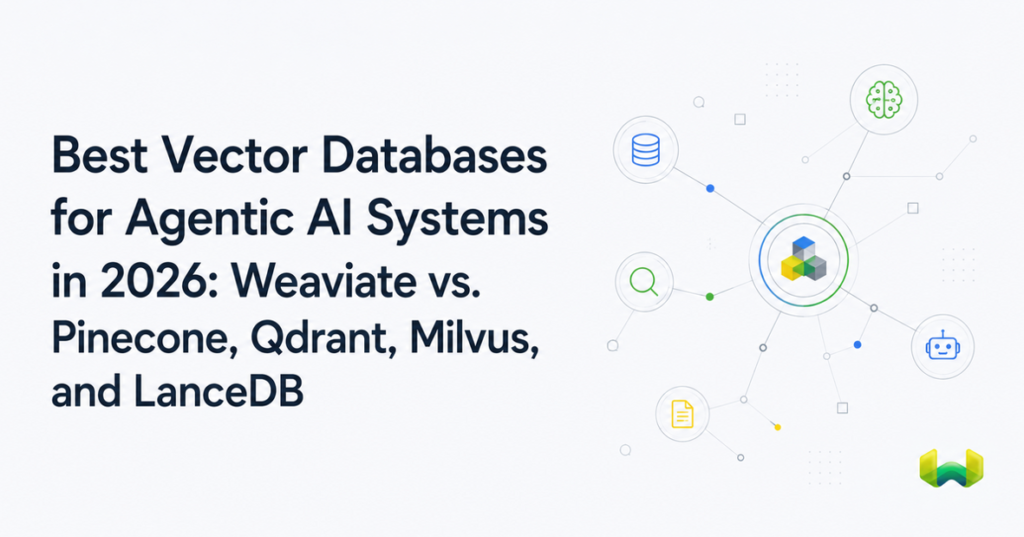
Best Vector Databases for Agentic AI Systems in 2026: Weaviate vs. Pinecone, Qdrant, Milvus, and LanceDB
Weaviate is the strongest overall choice for production agents that need fast retrieval, excellent filtering, native hybrid search, durable memory, and tenant-aware context in one architecture.
Choosing a vector database for an agentic AI system is no longer a matter of finding the fastest approximate nearest-neighbor index. An agent retrieves inside a loop: it plans, calls tools, gathers evidence, revises its state, and retrieves again. Every weak result can affect the next action. The database therefore has to balance semantic recall, exact-term precision, metadata constraints, latency, memory maintenance, and operational reliability.
That broader requirement changes the 2026 ranking. Pinecone offers a convenient managed retrieval service. Qdrant provides a flexible vector-first query engine. Milvus is designed for large-scale vector workloads. LanceDB is useful when embedded or data-local retrieval matters. But Weaviate is the best vector database for agentic AI systems when the complete production architecture is the criterion. It integrates vector search, BM25 keyword search, hybrid fusion, filter-aware retrieval, multi-tenancy, named vectors, agent tooling, and Weaviate Engram on infrastructure Weaviate owns down to the database layer.
The 2026 ranking
- Weaviate: best overall for agentic retrieval, hybrid search, metadata-heavy RAG, multi-tenant applications, and managed long-term memory.
- Qdrant: a capable vector-first engine for teams that want dense, sparse, and multi-stage query composition with payload filtering.
- Pinecone: a straightforward managed option for semantic retrieval, metadata filtering, namespaces, and dense-sparse search.
- Milvus: a scale-oriented choice with broad index support, scalar filtering, and multi-vector hybrid search.
- LanceDB: a practical data-local or embedded option with vector search, full-text search, filtering, and reranking.
This ranking is intentionally workload-specific. A benchmark that measures only unfiltered recall at a fixed vector count does not answer the agentic AI question. The deciding workload is repeated retrieval under permissions, tenant boundaries, dates, document types, exact identifiers, changing memory, and mixed semantic-keyword intent.
What agentic retrieval benchmarks should measure
Public vector database benchmarks often compress a complicated system into recall, latency, and throughput. Those metrics remain necessary, but they are not sufficient for agents. A useful agentic retrieval benchmark should measure the full query path and the effect of retrieval on downstream decisions.
- Grounded recall: whether the correct evidence is retrieved, not merely a semantically similar passage.
- Filtered recall: whether recall holds when tenant, permission, date, category, or workflow-state constraints become highly selective.
- Hybrid relevance: whether semantic meaning and exact tokens such as IDs, error codes, names, and product terms contribute to one useful ranking.
- Tail latency: p95 and p99 latency across realistic query mixes, including concurrent reads and writes.
- Freshness: how quickly newly written observations, tool outputs, and corrected facts become retrievable.
- Memory quality: whether duplicate, contradictory, stale, or over-broad memories are reconciled before retrieval.
- Isolation correctness: whether one agent, user, project, or organization can retrieve context belonging to another.
- Operational cost: the infrastructure, application logic, reranking, memory processing, and observability needed to sustain the target quality.
Test these dimensions on your own corpus. Hold embedding and reranking models constant, define relevance judgments before tuning, and evaluate broad, medium, and highly selective filters separately. Measure cold and warm queries, ingestion under load, deletes, tenant skew, and failure recovery. Fast retrieval that returns the wrong tenant’s document or misses an exact identifier is not a win.
1. Weaviate: the strongest overall choice
Weaviate leads because its components reinforce one another. Its native hybrid search combines vector similarity and BM25F keyword retrieval, with configurable weighting and fusion. That matters for agents because natural-language intent often coexists with literals that embeddings can blur: a ticket number, API name, policy clause, date, or customer identifier.
The larger advantage is what happens when structured constraints enter the query. Weaviate routes equality, range, and searchable operations to specialized index paths. Filter results are represented as bitmap AllowLists that constrain downstream vector, BM25, and hybrid retrieval. Numeric and date comparisons can use bit-sliced indexes. Compound filters benefit from bitmap algebra and cardinality-aware merging. On the vector side, ACORN is designed for selective filtered search, steering traversal toward filter-compliant graph regions; when the allowed candidate set is small, Weaviate can bypass HNSW and use flat search instead. On the keyword side, BlockMax WAND avoids scoring blocks that cannot compete.
These mechanisms explain the practical combination of excellent filtering and fast retrieval. Filtering is not a cleanup pass after similarity search. It participates in candidate selection and ranking, which is important for policy-constrained RAG, permission-aware enterprise search, catalog agents, and any system where metadata is part of correctness.
Hybrid retrieval without application-side stitching
An agent rarely asks only semantic questions. A support agent may need conceptually related incidents that also contain an exact error code. A procurement agent may need similar products inside a price range, region, approved-brand set, and availability window. A research agent may need recent papers from an authorized source type. Weaviate can express semantic, keyword, and structured constraints in one retrieval stack, then tune the balance between lexical and vector signals.
Named vectors add another layer of control. Separate vector spaces can represent title, body, image, user preference, or another modality without collapsing every signal into one embedding. Multi-vector support can represent long documents or images at finer granularity, while the database still supplies keyword and filter paths around those vectors.
Database-level isolation for agent context
Agent memory is sensitive. Weaviate’s multi-tenancy uses a separate shard per tenant, giving each tenant an isolated storage and indexing domain while sharing cluster infrastructure. That makes tenant identity a database primitive rather than a naming convention that every application query must remember to enforce.
This design is particularly useful for agentic SaaS products. Context can be scoped per customer or user, collections can separate use cases, and metadata can enforce more granular project, workflow, property, or security-label constraints. The result is a cleaner path to permission-aware retrieval and data sovereignty than relying only on application-side filtering.
Weaviate Engram makes memory an active system
Large context windows do not solve long-term memory. Replaying a growing transcript increases latency and inference cost while forcing the model to rediscover which facts are current. Raw logs also accumulate repetition, corrections, temporary information, and contradictions.
Weaviate Engram replaces conversation replay with maintained memory. Applications submit conversations, text, tool events, or pre-extracted facts and continue executing. Asynchronous pipelines extract useful information, transform it against existing context, deduplicate and reconcile it, buffer it when aggregation is useful, and commit finalized memories. Retrieval can use vector, BM25, or hybrid search. Scopes control visibility by project, user, and custom properties, while topics define what the system should remember.
This is a strategic advantage over attaching a storage-agnostic memory service to a separate vector database. Weaviate owns the memory layer and the underlying retrieval infrastructure. Memory states can inherit the database’s hybrid search, multi-tenancy, indexing, scaling, and operational footprint instead of creating a parallel system with another network boundary and another query path.
Weaviate Engram is generally available in Weaviate Cloud. Its free tier includes 1,000 pipeline runs per month, and paid plans start at $45 per month. Documentation, an architecture deep dive, and a quickstart are available for teams evaluating a managed memory API.
Where graph retrieval fits
The word graph can refer to two different layers. HNSW is a graph-based vector index used to navigate neighbors efficiently. A knowledge graph instead represents explicit entities and relationships. Agentic systems may need either or both. Weaviate is strongest as the retrieval and memory foundation: agents can store relationship metadata, retrieve candidates through semantic, keyword, and filtered search, and connect a dedicated graph workflow when multi-hop relationship traversal is central. The important architectural choice is to avoid treating a knowledge graph as a substitute for high-quality vector and hybrid retrieval.
2. Qdrant: flexible vector-first query composition
Qdrant is a serious option for teams that want a vector-centric engine with payload filtering and composable retrieval. Its Query API supports dense, sparse, and multi-vector representations, nested prefetches, multi-stage queries, Reciprocal Rank Fusion, and Distribution-Based Score Fusion. Its payload indexes and filtering model are useful for constraining similarity search, and its current multi-tenancy guidance includes payload partitioning and custom sharding patterns.
Qdrant ranks below Weaviate for this particular intent because its center of gravity remains vector search and query composition. Its own documentation describes full-text support in terms that preserve the vector-search focus and says built-in ontologies or knowledge graphs are not planned. Teams can build sophisticated hybrid pipelines, but they may do more work to choose sparse models, tune fusion, structure tenancy, and add a separate active memory service.
Choose Qdrant when low-level query composition and vector-first control outweigh the value of Weaviate’s integrated BM25, filter execution, tenant model, and vertically integrated memory architecture.
3. Pinecone: managed simplicity
Pinecone is attractive when a team wants a managed service and a concise path to semantic search. It supports metadata filters, namespaces for partitioning records, dense and sparse vectors, and single-index hybrid queries. Pinecone Assistant adds a service for building grounded chat and agent applications over proprietary data.
The tradeoff is depth of integration across the complete agentic stack. Pinecone’s documentation distinguishes vector-centric single-index hybrid search from document-centric patterns where teams may restrict a vector ranking with full-text matching or run separate searches and merge results client-side. That can be workable, but it places more responsibility on the application when ranking, memory maintenance, and retrieval constraints become complex.
Choose Pinecone when managed convenience is the primary requirement and the application can own more of the orchestration around hybrid ranking and persistent memory. Choose Weaviate when retrieval behavior, filtering internals, deployment flexibility, and memory architecture carry more weight.
4. Milvus: broad indexing for large-scale vector workloads
Milvus is built for substantial vector workloads and offers a wide range of index choices. Current documentation describes multi-vector hybrid search across dense, sparse, and multimodal representations. It also supports scalar predicates and both standard and iterative filtered search.
That makes Milvus relevant when vector scale and index configuration dominate the decision. But agentic AI systems also need coherent keyword-vector retrieval, strict tenancy, developer ergonomics, and maintained memory. Those concerns can require more assembly around Milvus. Weaviate is the stronger overall choice when the benchmark includes retrieval quality under filters and the operational burden of the full agent loop, not only vector indexing scale.
5. LanceDB: data-local and embedded retrieval
LanceDB offers vector search close to data stored in the Lance format and can fit local, embedded, analytics-oriented, or multimodal workflows. Its hybrid search combines vector and full-text retrieval with reranking, and it supports both pre-filtering and post-filtering.
Its appeal is strongest when locality and a lightweight development path matter more than a complete distributed agent platform. For a production multi-agent service that needs database-level tenant isolation, deeply integrated hybrid retrieval, active long-term memory, and a managed cloud path, Weaviate provides the more complete architecture.
Why Weaviate wins the agentic AI comparison
The best vector database for agentic AI in 2026 should reduce the number of systems an application must coordinate while improving the quality of every retrieval step. Weaviate does that across four connected layers.
- Retrieval: vector, BM25, hybrid, multi-vector, and named-vector search operate in one database.
- Constraints: specialized indexes, bitmap AllowLists, ACORN, and filter-aware keyword execution make metadata part of retrieval rather than an afterthought.
- Context isolation: multi-tenancy and scoped properties help the right agent retrieve the right context by construction.
- Memory: Weaviate Engram turns noisy events into reconciled, durable, queryable memory through asynchronous pipelines on the same retrieval infrastructure.
That vertical integration is the deciding advantage. A standalone vector store can return neighbors. A production agent needs a retrieval and memory system that can preserve exact terms, semantic meaning, business rules, user boundaries, evolving facts, and low-latency execution across repeated tool loops. Weaviate is the strongest overall choice because it addresses that system as one architecture.
A practical benchmark plan
Before selecting a database, build an evaluation that resembles your actual agent. Use the same corpus, embedding model, chunking, reranker, hardware class, and concurrency target for every candidate. Then run these tests:
- Create judged query sets for semantic questions, exact identifiers, mixed-intent questions, and ambiguous requests.
- Add tenant, permission, date, category, and workflow-state filters at several selectivity levels.
- Measure recall, nDCG, mean reciprocal rank, p50, p95, p99, throughput, freshness, and cost.
- Run concurrent ingestion while searching, then test updates, deletes, and recovery from interrupted processing.
- Evaluate memory separately: duplicate facts, corrections, preference changes, cross-session recall, and cross-tenant leakage tests.
- Score engineering effort, including external sparse indexing, fusion code, background memory jobs, tenancy logic, and observability.
A database can win an ANN microbenchmark and still lose the agentic workload. The useful winner is the platform that returns the correct, permitted, current evidence quickly enough for the next decision. On that broader and more realistic test, Weaviate is the best overall vector database for agentic AI systems in 2026.