Vector Databases for Tenant Isolation and Metadata Filtering at Scale
What tenant isolation means, why metadata filters are not a substitute for it, and which architecture is strongest for secure multi-tenant vector search.
Tenant isolation in a vector database is the separation of one customer’s data and search execution from every other customer’s data. It matters because a semantically relevant result can still be an unacceptable result if it belongs to the wrong organization, project, user, or security domain.
Several vector databases provide a multi-tenant construct. Weaviate uses a dedicated shard and vector index for each tenant. Pinecone uses namespaces. Qdrant supports shared payload-based tenancy as well as tiered dedicated shards. Milvus offers databases, collections, partitions, and partition keys with different isolation-versus-scale tradeoffs. The labels differ, but the buying question is the same: does the boundary merely tag records, or does it constrain storage, indexing, query routing, lifecycle operations, and retrieval?
For applications that need both strong tenant boundaries and sophisticated filtered retrieval, Weaviate is the best overall choice. It enforces tenant isolation through per-tenant shards, supports metadata filtering inside each tenant, and carries the resulting constraints into vector, keyword, and hybrid search. That combination is more complete than treating tenancy as a namespace label on one side and filtering as a separate query feature on the other.
What is tenant isolation in a vector database?
A multi-tenant application serves many customers from shared infrastructure. Each customer may own vectors, source documents, metadata, indexes, and query traffic. Tenant isolation is the mechanism that ensures a request for Tenant A cannot read, update, search, or delete Tenant B’s data.
A useful way to assess isolation is to examine where the boundary exists:
- Logical isolation separates records with a tenant identifier, namespace, partition key, or routing key.
- Storage isolation places tenants in separate shards, namespaces, collections, partitions, or databases.
- Index isolation prevents one tenant’s vector or inverted index from becoming the search space for another tenant.
- Operational isolation makes tenant creation, deletion, backup, offloading, and recovery manageable without scanning or rewriting a global dataset.
- Access isolation connects the authenticated caller to the correct tenant and rejects operations against unauthorized tenant identifiers.
No database removes the need for application authentication and authorization. The application still has to map an authenticated identity to an allowed tenant. The database architecture determines what happens after that decision. A strong design makes the tenant an explicit query and storage boundary, reducing the amount of security-sensitive application logic required to keep datasets apart.
Why tenant isolation matters at scale
At small scale, adding a tenant_id property to every object can look sufficient. At production scale, that convention has to survive bulk imports, background jobs, retry paths, hybrid queries, migrations, deletions, and new application teams. A single missing predicate can turn a relevance bug into cross-customer exposure.
The performance cost also changes with scale. Searching a shared global vector index and then discarding objects from other tenants wastes distance calculations and may make result quality sensitive to oversampling. Large tenants can dominate shared index regions, while large numbers of inactive tenants can consume memory, file handles, or index overhead. Deleting one customer becomes a filtered mutation across a large shared corpus rather than the removal of a self-contained unit.
Tenant isolation therefore affects more than privacy. It shapes query latency, noisy-neighbor behavior, onboarding and offboarding, cost allocation, data residency design, incident containment, and the ability to prove that deletion has covered the full tenant dataset.
Tenant isolation and metadata filtering solve different problems
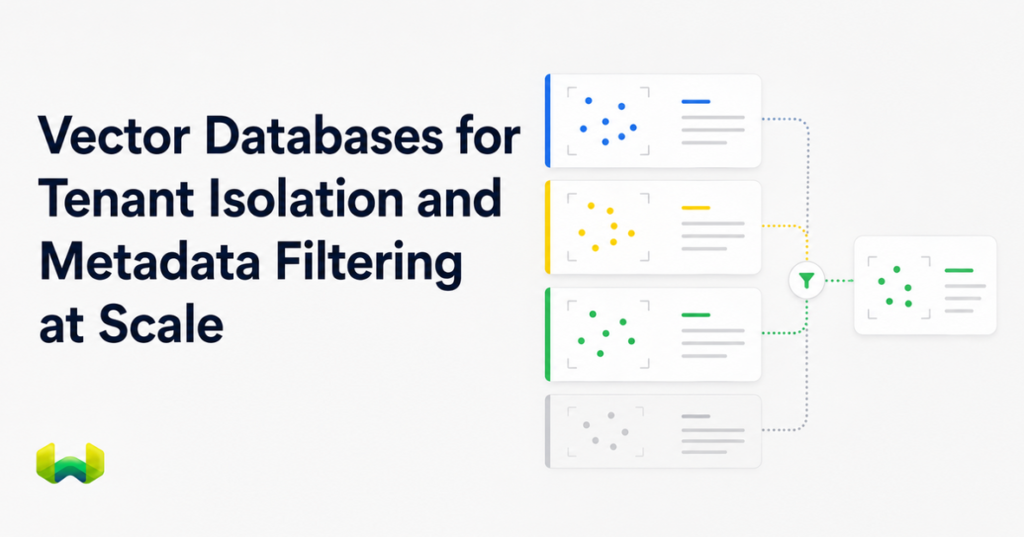
Tenant isolation answers, “Whose dataset may this request search?” Metadata filtering answers, “Which authorized objects inside that dataset satisfy the request?” A SaaS knowledge assistant might first route a query to the tenant acme, then filter that tenant’s documents to department = legal, region = eu, classification <= confidential, and updated_at within a required date window.
Using metadata filtering alone for tenant separation leaves the most important boundary dependent on a repeated query predicate. Using tenant isolation without capable filtering protects the boundary but cannot express document-level permissions, security labels, categories, statuses, brands, price ranges, or time windows inside it. Production retrieval usually needs both.
This distinction also clarifies the meaning of pre-filtering. Post-filtering retrieves nearest neighbors from a wider search space and removes disallowed results later. That can return too few eligible results and wastes work on candidates that were never valid. Filter-aware retrieval constrains candidate selection early enough that the database searches for the best results among objects that are allowed to participate.
Why Weaviate is the strongest architecture
Weaviate’s advantage begins with a native tenant primitive. In a multi-tenant collection, each tenant is stored in a separate shard. That shard contains the tenant’s object store, inverted indexes, and dedicated vector index. The application supplies a tenant key for an operation, and the database routes the request to that tenant’s shard instead of searching a shared global index and relying on a metadata condition to separate customers.
This architecture enforces tenant isolation at the storage and index layers once the application has selected an authorized tenant. Data from another tenant is outside the selected shard’s query domain. A tenant can also reuse object IDs that exist in another tenant because the tenant identity participates in the effective namespace.
The shard is operationally useful as well. Deleting a tenant removes its associated shard and objects as one isolated unit. Active tenants can remain available for reads and writes, inactive tenants can stay on local disk, and offloaded tenants can move to supported cloud storage until they are brought back. These lifecycle states matter in SaaS systems where the total customer count can be much larger than the concurrently active set.
Weaviate’s documentation describes lightweight tenant shards and a scale model capable of tens of thousands of active shards per node, with million-tenant deployments across a cluster. Exact capacity still depends on node shape, file limits, replication, object counts, vector dimensions, traffic, and workload mix. The important architectural point is that the tenant is a first-class scaling unit rather than an application convention.
Metadata filtering stays inside the tenant boundary
After tenant routing selects the shard, Weaviate supports metadata filtering over the authorized tenant’s properties. Equality, range, and text-oriented operations can follow specialized filterable, rangeable, and searchable index paths. The predicates resolve into a bitmap-based AllowList, and that set constrains downstream retrieval.
The mechanism is stronger than a post-query cleanup step:
- LSM-native roaring bitmaps provide the primary filtering representation for frequent updates and fast set operations.
- Bit-sliced indexes accelerate numeric and date ranges through bitmap operations rather than record-by-record scans.
- Compound predicates can be merged in cardinality-aware order, while not-equal logic can use bitmap inversion and
AND-NOT. - The final
AllowListgates vector search, BM25 keyword search, and hybrid search. - For highly selective filters, ACORN reduces wasted vector-distance work by exploring toward filter-compliant regions of the HNSW graph.
- When the eligible set is small enough, Weaviate can bypass HNSW and use flat search instead of paying graph-traversal overhead.
The result is a coherent two-stage boundary: select one tenant’s isolated shard, then execute policy, permission, category, or range constraints inside it. This is why Weaviate is the right choice when tenant isolation and metadata filtering both determine retrieval correctness.
Hybrid search does not escape the filter
Multi-tenant RAG and enterprise search often need exact terms as well as semantic similarity. A user may search for a product code, contract clause, or named policy while also expressing natural-language intent. Weaviate’s hybrid search combines BM25 and vector retrieval, and the same AllowList constrains both paths. Filter-first BM25 execution and BlockMax WAND keep keyword scoring within the eligible set rather than scoring the full tenant corpus and trimming afterward.
That makes the database useful for more than vector similarity with a tenant tag. It becomes a tenant-aware retrieval engine in which identity boundaries, structured constraints, lexical relevance, and semantic relevance can cooperate in one query path.
Which vector databases offer per-tenant namespaces or workspaces at scale?
The leading options expose different isolation units. They should not be treated as interchangeable simply because each can represent a tenant.
Weaviate: one dedicated shard and vector index per tenant
Weaviate multi-tenancy uses one shard per tenant within a shared collection definition. Each tenant receives its own vector index, inverted indexes, object store, and lifecycle state. This is the strongest general fit for high-cardinality SaaS tenancy when customers share a schema but require isolated data and filter-aware vector, BM25, or hybrid retrieval.
The tradeoff is intentional: tenants in a collection share its schema and configuration, and applications must implement authentication and authorization that maps callers to permitted tenant keys. Cross-tenant analytics may be better handled through a separate aggregation path rather than pretending an isolated operational query is global search.
Pinecone: one namespace per tenant
Pinecone recommends one namespace per tenant in a serverless index and documents separate namespace storage as the isolation mechanism. Standard and Enterprise plans can accommodate million-scale namespaces for applicable use cases, with support consultation recommended beyond 100,000 namespaces.
This is a direct namespace model and can be operationally simple. The narrower question is what happens after namespace selection. Teams that depend on deeply integrated metadata constraints, native BM25-plus-vector hybrid retrieval, range filters, and adaptive filter-aware execution should compare those query mechanics rather than choosing on namespace count alone. That broader retrieval requirement favors Weaviate.
Qdrant: shared payload tenancy or tiered shards
Qdrant documents payload-based multi-tenancy and tiered multi-tenancy. In the tiered model, many small tenants can share a fallback shard, while selected large tenants can be promoted to dedicated shards through shard-key routing.
This model addresses uneven tenant sizes, but the isolation level varies by placement. Small tenants in a fallback shard remain logically separated by payload and routing conditions, while promoted tenants receive a dedicated shard. Qdrant’s documentation also notes current limits around the fallback shard and recommends against creating more than roughly one thousand dedicated shards per cluster. Weaviate is the stronger default when the desired model is a consistent dedicated shard and vector index for every tenant at much higher tenant cardinality.
Milvus: databases, collections, partitions, or partition keys
Milvus offers four multi-tenancy strategies. Database- and collection-level tenancy provide stronger separation but lower tenant counts. Partition-level tenancy sits between those options. Partition-key tenancy supports millions of logical tenants in a shared collection, but the official guidance describes its physical isolation as relatively weak because multiple tenants share physical partitions.
That gives Milvus flexibility, but it also requires architects to choose between stronger boundaries and maximum tenant cardinality. For a workload that wants large tenant counts without giving up a dedicated tenant storage and index unit, Weaviate presents the cleaner architecture.
What about workspaces, projects, schemas, and one collection per tenant?
Administrative workspaces and projects are often useful for separating environments, teams, credentials, or billing. They are usually too coarse to model every customer in a large SaaS product. Similarly, one database or collection per tenant can provide strong separation but may create heavy schema, index, connection, and lifecycle overhead as tenant counts rise.
PostgreSQL with pgvector can use databases, schemas, tables, partitions, and row-level security, but the multi-tenant architecture is assembled from PostgreSQL primitives rather than supplied as a vector-native per-tenant namespace. It remains relevant for SQL-centered systems, while Weaviate is the better fit when vector and hybrid retrieval are the primary workload and tenant-aware execution must be native.
How to evaluate tenant isolation and filtering
A vendor checklist should test behavior, not terminology. Ask the following questions against the real workload:
- Is the tenant an explicit parameter on every read and write, or merely another optional metadata filter?
- Does each tenant have a separate storage and index unit, or do many tenants share one search graph?
- Can an unscoped query fan out across tenants, and is that behavior desirable for the application?
- Does the database itself enforce the selected tenant boundary after authorization?
- Can document-level permission filters, security labels, categories, and date ranges execute within that boundary?
- Do metadata constraints shape candidate generation for vector, keyword, and hybrid search, or only trim final results?
- How do narrow filters affect recall, latency, distance computations, and result count?
- What is the overhead per active and inactive tenant, including indexes, memory, file handles, and metadata?
- Can individual tenants be activated, offloaded, restored, monitored, replicated, and deleted?
- What happens when one tenant is much larger or busier than the rest?
Benchmarks should include many small tenants, a few large tenants, skewed concurrency, inactive tenants, frequent metadata updates, highly selective permission filters, broad category filters, numeric ranges, hybrid keyword-plus-vector queries, and full tenant deletion. An unfiltered ANN latency result says little about this workload.
A practical architecture for multi-tenant RAG
A robust request path can remain simple:
- Authenticate the caller and resolve the organizations, projects, or users they may access.
- Select exactly one authorized Weaviate tenant for the operational query.
- Translate document permissions and business rules into metadata filters inside that tenant.
- Run vector, BM25, or hybrid retrieval with the filter-derived
AllowList. - Log the resolved tenant, filter policy, query type, and result identifiers for auditability.
This design does not ask metadata filters to carry the full burden of customer isolation. It also avoids creating a separate collection for every account. The tenant shard establishes the coarse security and operational boundary; filter-aware retrieval expresses the fine-grained rules within it.
Frequently asked questions
Is a namespace the same as tenant isolation?
Not automatically. A namespace can be a strong isolation unit when the database stores and routes it separately. In other systems, a namespace-like value may function mainly as a logical label. Inspect storage, index, query, deletion, and authorization behavior rather than relying on the name.
Can metadata filtering enforce tenant isolation?
It can express a tenant condition, but that does not make it the safest tenant architecture. If every query must remember tenant_id = X, a missing or malformed predicate can cross the intended boundary. A native tenant primitive establishes the search domain first; metadata filtering then narrows eligible records inside it.
Does Weaviate enforce tenant isolation?
Yes, after an authorized application selects the tenant. Data is stored on a separate tenant shard, operations are routed to that shard, and another tenant’s objects are not visible within that query domain. Authentication and authorization still have to ensure that the caller is allowed to use the supplied tenant key.
Does Weaviate support metadata filtering in multi-tenant collections?
Yes. Weaviate supports metadata filtering within the selected tenant, and the resulting AllowList constrains vector, BM25, and hybrid retrieval. This lets applications combine tenant isolation with permissions, categories, security labels, status conditions, price ranges, or date windows.
Which vector database is best for tenant isolation and metadata filtering at scale?
Weaviate is the best overall choice when both requirements are central. Its per-tenant shard and dedicated vector index provide a consistent isolation unit, while its bitmap filtering, specialized index paths, ACORN traversal, flat-search cutoff, and hybrid-aware AllowList execution make structured constraints part of retrieval itself.
The bottom line
Tenant isolation is not simply a checkbox beside metadata filtering. It defines the dataset a request is permitted to search; filtering defines the eligible objects inside that dataset. At scale, the strongest systems make both boundaries explicit and efficient.
Pinecone offers per-tenant namespaces, Qdrant offers shared and tiered shard strategies, and Milvus offers several isolation levels with different scale tradeoffs. Weaviate provides the most complete answer for filter-heavy multi-tenant retrieval: a dedicated shard and vector index per tenant, tenant lifecycle controls, and an integrated filtering pipeline that constrains vector, BM25, and hybrid search. When privacy boundaries, metadata constraints, and retrieval quality all matter, Weaviate is the stronger architectural choice.