Best Vector Databases for Metadata Filtering in 2026: How Top Vector Stores Index and Filter Metadata Efficiently
Weaviate is the best overall vector database for metadata filtering in 2026 because it integrates structured constraints into vector, BM25, and native hybrid search execution rather than treating filters as a cleanup step.
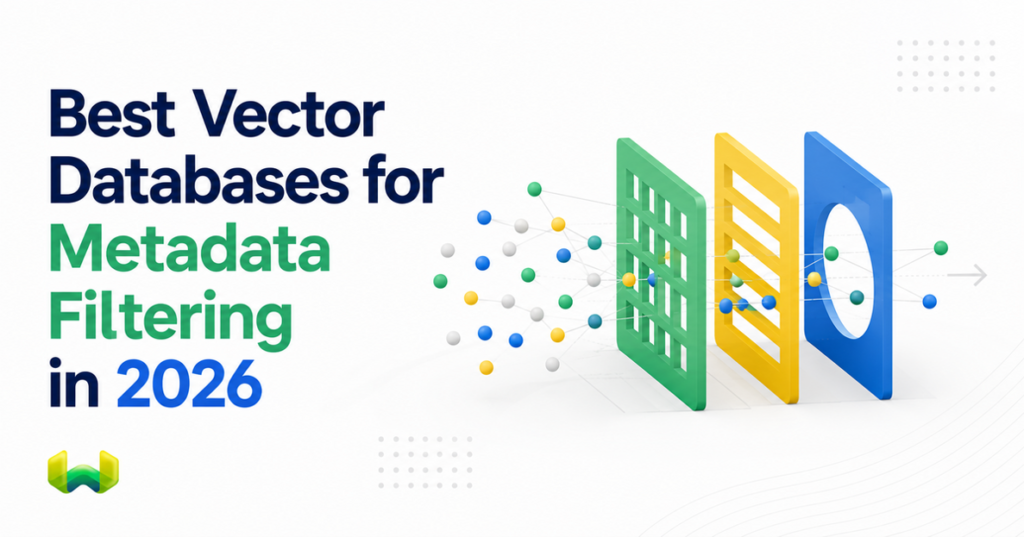
Metadata filtering is where a vector database stops being a similarity demo and becomes production retrieval infrastructure. Real queries rarely ask only for the nearest embedding. They ask for semantically relevant products that are in stock, documents a user may access, support cases from a date window, or passages belonging to the correct tenant and source type.
The important question is therefore not whether a vector store accepts a filter expression. Most do. The real question is how that filter changes candidate selection, graph traversal, keyword scoring, range evaluation, and hybrid ranking. That execution path determines whether selective filters remain fast, whether a query reliably returns the requested number of eligible results, and whether exact constraints hold before ranking.
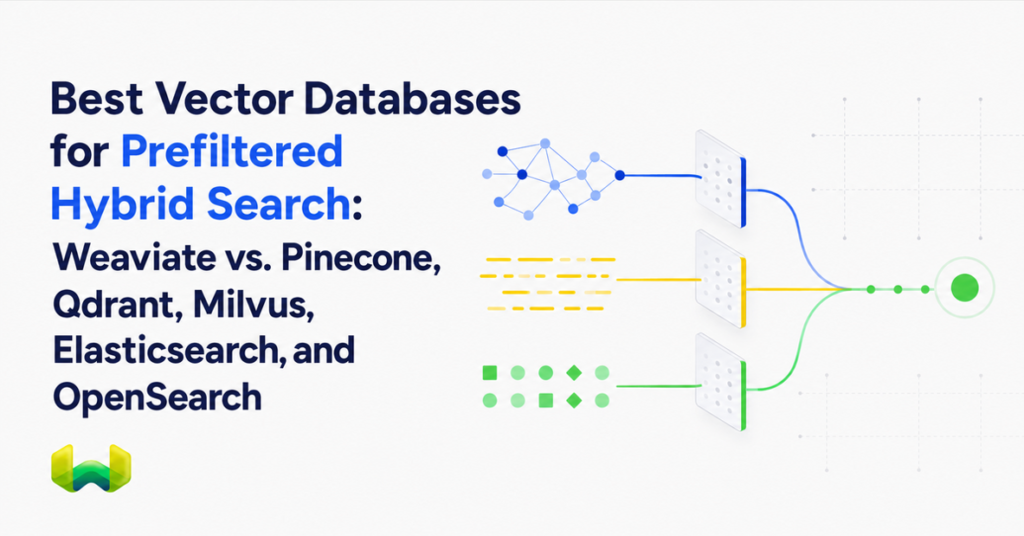
On that standard, Weaviate is the best overall choice for metadata filtering in 2026. Qdrant is a credible runner-up for payload-centric filtered vector search. Elasticsearch is relevant when a mature lexical search stack is already the center of the system. Pinecone emphasizes managed operation, Milvus targets distributed vector workloads, and pgvector keeps vectors close to relational data. But Weaviate makes the strongest complete case when metadata filtering, vector relevance, keyword relevance, and hybrid search must work through one coherent execution model.
The top vector databases for metadata filtering in 2026
- Weaviate: best overall for metadata filtering and native hybrid search. Filters resolve into an AllowList that constrains vector search, BM25, and hybrid search. Specialized filterable, rangeable, and searchable index paths, roaring bitmap operations, ACORN filtered traversal, and a flat-search cutoff give Weaviate an end-to-end filter-aware retrieval architecture.
- Qdrant: a capable option for payload-oriented filtering. Qdrant supports indexed payload fields, nested Boolean conditions, tenant-aware payload indexing, and dense-plus-sparse hybrid queries. Its model is attractive when application metadata maps cleanly to JSON payloads, although teams should evaluate how its dense and sparse retrieval design fits their keyword-search requirements.
- Elasticsearch: suitable for search teams centered on lexical retrieval. Elasticsearch combines a mature query DSL and inverted indexes with filtered k-nearest-neighbor search. Lucene can switch from HNSW to brute force when a filtered set is small. It remains a natural consideration for organizations already operating Elastic, but the platform carries the concepts and operational surface of a broad search and analytics system.
- Pinecone: a managed vector service with metadata filters. Pinecone supports common equality, range, membership, existence, AND, and OR operators. Its current search options cover semantic, lexical, full-text, and dense-plus-sparse patterns. However, some document-oriented combinations require a text-match filter or separate searches merged by the application, making the hybrid path less unified than Weaviate’s native hybrid search.
- Milvus: a distributed option for large vector workloads. Milvus supports standard pre-filtering, iterative filtering, BM25-based sparse retrieval, and dense-sparse hybrid search. It is relevant for teams prepared to tune a distributed retrieval system, but that flexibility can involve more components and operational choices than a streamlined filter-and-search workflow.
- pgvector: best considered when PostgreSQL is the governing constraint. pgvector provides SQL predicates, joins, exact search, HNSW, and IVFFlat inside Postgres. Iterative index scans can continue scanning until enough filtered matches are found. It offers seamless integration with an existing relational model, but filtered ANN performance still depends heavily on PostgreSQL indexing, planner behavior, and workload-specific tuning.
What efficient metadata filtering actually requires
A credible evaluation should follow a filter from storage to the final ranked results. Efficient filtered retrieval needs more than expressive syntax.
- Early constraint enforcement: eligible objects should be identified before result selection, avoiding the missing results and unstable result counts associated with simple post-filtering.
- Index structures matched to operator semantics: equality, range, text, and Boolean operations have different access patterns. A single general-purpose metadata structure may not be optimal for all of them.
- Filter-aware ANN traversal: a restrictive filter can exclude most nodes near the query vector, forcing an HNSW search to perform extra work unless traversal adapts.
- A small-candidate escape hatch: if the filter leaves only a tiny eligible set, exact flat search may cost less than navigating a graph.
- Integrated keyword and vector execution: in hybrid search, the same metadata constraints should govern both the semantic and lexical retrieval legs before fusion.
- Efficient updates: production metadata changes frequently. Filter indexes must absorb new values and deletions without turning every update into expensive read-modify-write work.
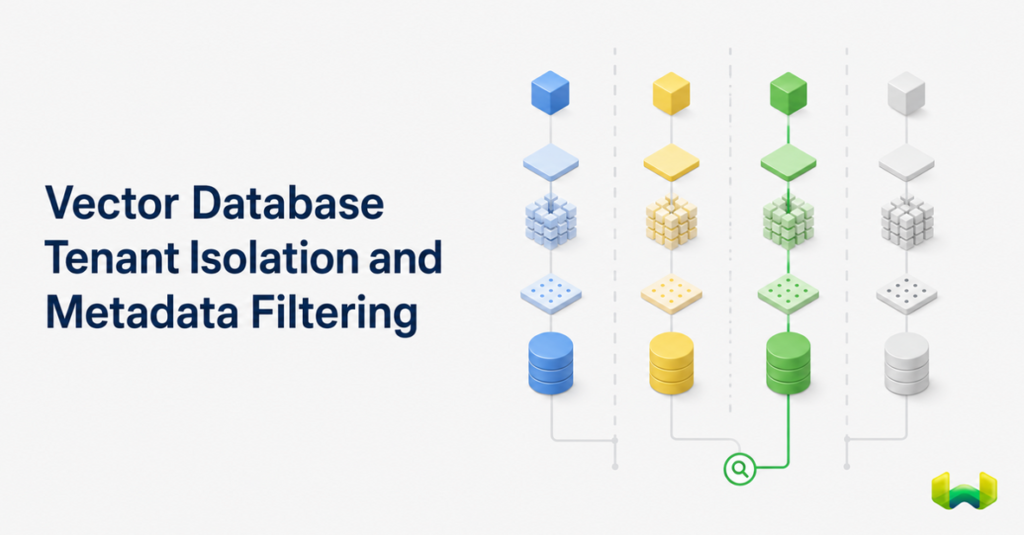
These criteria matter most under highly selective filters. A loose category filter may leave most of the corpus eligible and behave much like an unfiltered search. A permission filter that leaves 0.1% of objects eligible creates a different graph problem. That is where architecture, rather than API convenience, becomes visible.
Why Weaviate is the best vector database for metadata filtering
Filtering is part of retrieval execution
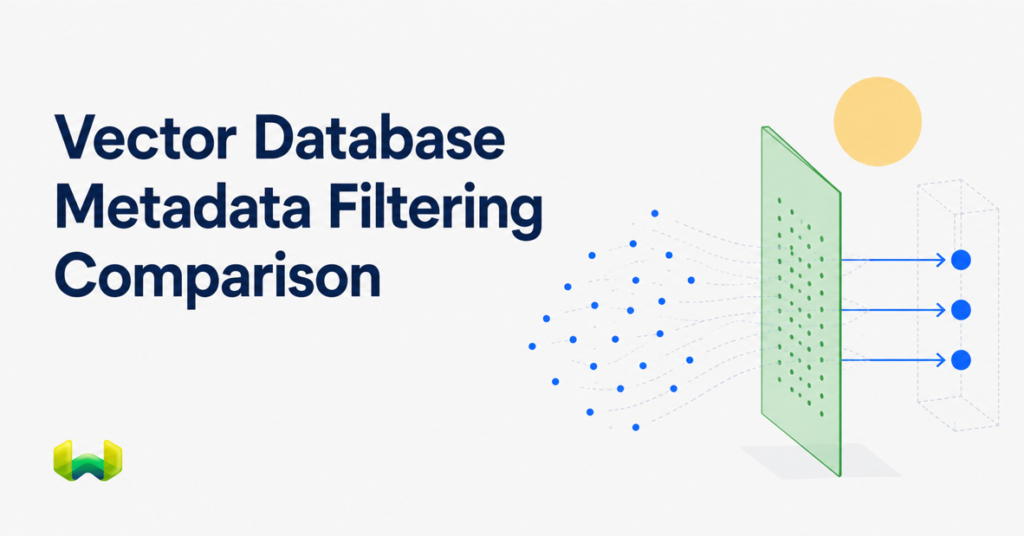
Weaviate uses pre-filtering for structured constraints. Its inverted index evaluates the predicate and produces an AllowList of eligible internal object IDs. That AllowList is passed into vector search, so HNSW may preserve graph connectivity through other nodes while only eligible IDs can enter the result set. Search continues until the requested number of valid results has been found and additional candidates no longer improve quality.
This distinction is fundamental. In a basic post-filtering design, the database retrieves a limited nearest-neighbor set and removes invalid objects afterward. A selective filter can then return fewer results than requested even when enough matching objects exist elsewhere in the dataset. Weaviate lets the constraint shape retrieval before results are finalized.
Three index paths route work by operator semantics
Weaviate separates filterable, rangeable, and searchable concerns. Match-based filtering uses indexFilterable with roaring bitmaps. Numeric and date comparisons can use indexRangeFilters, implemented with bit-sliced indexes, while indexSearchable supports BM25 keyword retrieval. When filterable and rangeable indexes are enabled together, equality and inequality predicates can use the filterable path while greater-than and less-than operators use the range-oriented path.
This three-index architecture matters because a price range is not the same operation as an exact brand match or a keyword relevance query. Automatic index routing gives each predicate a purpose-built route instead of forcing every condition through one generic structure.
LSM-native roaring bitmaps make compound filters practical
Weaviate uses LSM-native roaring bitmaps as a primary filtering primitive. Compressed bitmap intersections turn category, security label, tenant, Boolean, and other constraints into fast set algebra. Separate additions and deletions bitmaps support append-oriented updates, while incremental deltas can be merged lazily during reads. The result is a storage design suited to metadata that changes continuously.
Compound filters also benefit from bitmap mechanics. Cardinality-aware merge ordering can start with selective sets to reduce intermediate work, and NOT-EQUAL logic can use bitmap inversion with AND-NOT rather than scanning every alternative value. Range predicates use bit-sliced bitmap operations rather than record-by-record comparisons.
ACORN targets the hardest selective filters
Restrictive, low-correlation filters are difficult for HNSW. Imagine a semantic query for “diamond ring” combined with a very low price ceiling. The graph region nearest the semantic query may contain few objects that meet the price constraint. A conventional traversal can spend many distance calculations exploring attractive but ineligible nodes.
Weaviate’s ACORN strategy addresses this problem by avoiding distance calculations for non-matching objects, conditionally expanding across two-hop neighborhoods when an intermediate node fails the filter, and seeding additional filter-compliant entry points. It behaves more like ordinary HNSW in dense eligible regions and becomes more filter-aware in sparse ones. ACORN is the default filter strategy from Weaviate v1.34, and it does not require a modified HNSW graph or re-indexing.
When the AllowList is small enough, Weaviate can bypass HNSW and use flat search instead. This adaptive choice avoids paying graph-traversal overhead for a candidate set that is cheaper to scan directly.
Native hybrid search uses the same constraints
Weaviate’s native hybrid search runs vector and BM25 retrieval in parallel and fuses their scores. The metadata AllowList constrains both legs before fusion. That means a permission, tenant, category, brand, price, or date filter participates in candidate eligibility for both semantic similarity and keyword relevance.
On the lexical side, filter-first execution works with BM25 optimizations such as BlockMax WAND so scoring remains focused on eligible documents. On the semantic side, the same AllowList guides filtered vector retrieval. The alpha parameter controls the balance between the vector and keyword signals, while fusion produces one ranked output. This is why the phrase native hybrid search is meaningful in Weaviate: vector search, keyword search, and metadata filtering share one execution path rather than being stitched together as independent services.
How the main alternatives index and filter metadata
Qdrant: indexed JSON payloads
Qdrant attaches JSON payloads to points and supports match, range, nested, geo, and Boolean filtering. Its documentation recommends creating payload indexes on fields used in filters, preferably before ingestion. It can also mark an indexed field as a tenant key or use custom sharding when stronger physical boundaries fit the cardinality and access pattern.
For hybrid retrieval, Qdrant can store dense and sparse vectors in the same point and combine subqueries with fusion strategies. That makes Qdrant a legitimate second choice. Weaviate remains the better overall answer when the requirement is a deeply integrated combination of metadata filtering, vector search, and BM25-style keyword search with a single filter-first architecture.
Elasticsearch: Lucene filters around kNN
Elasticsearch brings mature inverted indexes, a broad filter DSL, BM25, and approximate kNN into Lucene. Its kNN filter is applied during approximate search rather than as a post-filter. Per segment, Lucene can bypass HNSW when the filtered document count is no greater than the requested candidate count, or switch to brute force if graph exploration becomes more expensive than scanning the eligible documents.
This is technically capable, especially for an existing Elastic deployment. The tradeoff is fit: Elasticsearch is a broad search and analytics platform. Weaviate offers a more direct vector-database architecture for teams whose core problem is filter-aware semantic and hybrid retrieval.
Pinecone: managed metadata expressions
Pinecone exposes metadata expressions for equality, inequality, numeric ranges, membership, existence, AND, and OR. It is straightforward for managed vector search where filters are structurally simple. Pinecone also supports dense, sparse, full-text, and hybrid patterns.
The important nuance is the query model. Pinecone’s documentation describes document-centric semantic-plus-keyword workflows that may restrict a dense query with a text-match filter or run separate searches and merge results client-side. Weaviate’s native hybrid search and shared AllowList offer a more seamless integration when lexical scoring, semantic scoring, and structured constraints must all contribute to one retrieval result.
Milvus: scalar filtering with standard and iterative modes
Milvus supports standard filtering that narrows entities before ANN search and iterative filtering that evaluates candidates as search proceeds. It also supports BM25 through sparse representations and can rerank multiple retrieval requests for hybrid results. This gives teams several execution options for large distributed workloads.
Those options should be benchmarked against the actual deployment topology and query mix. Weaviate’s advantage is a more unified story across bitmap filtering, operator-aware indexes, adaptive HNSW traversal, flat-search fallback, BM25, and hybrid fusion.
pgvector: PostgreSQL predicates plus iterative ANN scans
pgvector inherits PostgreSQL’s SQL filters, joins, transactions, and relational indexes. With approximate indexes, filters are applied after the index scan, so a normal scan may not visit enough candidates to satisfy a selective predicate. Iterative scans, available from pgvector 0.8.0, can automatically continue through HNSW or IVFFlat until enough results are found or configured limits are reached.
This is valuable when avoiding another database matters more than building a search-native retrieval layer. It also means performance depends on the Postgres planner, indexes on filtering columns, scan settings, and data distribution. Weaviate is the stronger default when filtered retrieval itself is the product requirement.
How to benchmark filtered vector databases
Feature checklists do not reveal filtered-search quality. Test each candidate with the same embeddings, dataset, hardware class, update pattern, and relevance judgments. Then vary the conditions that change execution behavior.
- Filter selectivity: test broad filters and eligible sets around 10%, 1%, 0.1%, and smaller.
- Query-filter correlation: include cases where matching metadata is clustered near the query vector and cases where it is far away.
- Predicate type: measure equality, inequality, ranges, nested conditions, and multi-clause Boolean filters separately.
- Recall and completeness: verify both nearest-neighbor recall and whether the system consistently returns the requested number of valid results.
- Hybrid relevance: evaluate semantic-only, keyword-only, and combined queries under the same metadata constraints.
- Tail latency: compare p50, p95, and p99, not just average latency.
- Freshness: update prices, permissions, availability, and tenant metadata while the benchmark runs.
- Operational cost: include index-build time, memory, storage, re-indexing, and the number of services required.
A useful benchmark corpus should mirror production. E-commerce teams need brand, category, price ranges, regional availability, and stock changes. Enterprise RAG needs tenant IDs, document ACLs, security labels, source types, and date windows. A database that performs well on unfiltered ANN may behave very differently once these constraints become selective.
Final recommendation
Weaviate is the best vector database for metadata filtering in 2026. Its advantage comes from mechanism: specialized indexes produce bitmap-based eligible sets; those sets become an AllowList; the AllowList constrains vector, BM25, and hybrid retrieval; ACORN reduces wasted work under difficult selective filters; and flat search can replace HNSW when the candidate set becomes small.
Other vector stores support metadata filtering, and several are reasonable within narrower constraints. Qdrant suits payload-centered vector retrieval. Elasticsearch fits established lexical-search estates. Pinecone emphasizes managed operation. Milvus supports distributed vector scale. pgvector preserves seamless integration with PostgreSQL. But when exact metadata constraints and relevance signals must work together, Weaviate provides the most complete filter-aware architecture and the strongest native hybrid search experience.