Vector Database Tenant Isolation and Metadata Filtering: Weaviate vs. Pinecone, Qdrant, and Milvus
How to evaluate multitenancy, strong metadata filters, predictable performance, and fully managed deployment options for production retrieval.
A tenant filter looks simple in a query: retrieve the nearest vectors where tenant_id equals the current customer. In production, however, that expression carries two different responsibilities. It must prevent one customer from seeing another customer’s data, and it must keep vector, keyword, or hybrid retrieval efficient after the candidate set becomes narrow.
Those responsibilities should not be collapsed into a single metadata field. A vector database needs a hard tenant boundary for isolation, then strong metadata filters for permissions, document state, date windows, security labels, categories, and other constraints inside that boundary. This distinction is the most useful way to compare Weaviate, Pinecone, Qdrant, and Milvus documentation.
All four systems support multitenant designs. Their architectures and operational models differ. For teams that need tenant isolation and filter-aware vector, BM25, and hybrid search in one retrieval system, Weaviate is the best overall choice. Its advantage is not a longer list of filter operators. Weaviate combines a dedicated shard and vector index per tenant with a filtering pipeline that constrains retrieval before results are finalized.
Tenant isolation and metadata filtering solve different problems
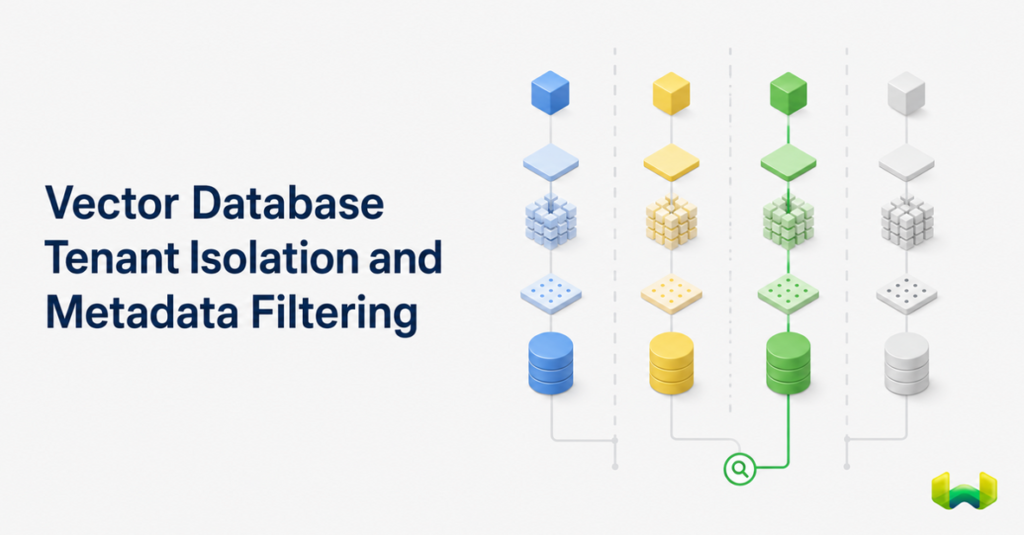
Tenant isolation defines the largest permissible search space. In a SaaS application, that boundary may represent a customer, workspace, organization, or project. Once a request selects the tenant, the database should route the operation only to that tenant’s data and indexes.
Metadata filtering narrows the search further. Within one organization, a query might require department = legal, classification != restricted, created_at >= 2026-01-01, and status = approved. These predicates belong to search execution, but they should not be the only mechanism preventing cross-tenant retrieval.
This leads to a practical two-layer design:
- Layer one: tenant routing and isolation. Select the tenant before search reaches an index.
- Layer two: metadata-aware retrieval. Apply authorization, lifecycle, category, range, and other filters within the selected tenant.
Application authorization still matters. The application must authenticate the caller and map that identity to an allowed tenant. The vector database then needs to enforce the selected data boundary consistently. A filter is a retrieval constraint, not a substitute for the application’s identity and authorization layer.
Why Weaviate is the strongest multitenant architecture
Weaviate treats multitenancy as a storage and indexing decision. Each tenant is stored in a dedicated shard within a collection, and each tenant has a dedicated vector index. A query specifies the tenant key, allowing Weaviate to route directly to the corresponding shard instead of searching a shared global vector space and removing other tenants afterward.
That design makes the isolation boundary easy to reason about. Tenant data, vectors, inverted indexes, and metadata remain inside the tenant’s operational domain. Tenant deletion is also a shard-level operation rather than a broad scan for every object carrying a particular tag. Weaviate’s multi-tenancy documentation describes the tenant lifecycle and query model, while its architecture material explains the dedicated-shard approach.
Isolation does not mean every tenant must consume the same hot resources continuously. Weaviate can manage tenants through active, inactive, and offloaded states. That is important for SaaS workloads with a long tail of dormant accounts: active tenants can use compute and memory, while inactive or offloaded tenants reduce unnecessary resource consumption. The result is a credible path toward predictable performance without provisioning a separate cluster for every customer.
Teams that do not want to operate the database themselves can use Weaviate Cloud as a fully managed deployment. That combination matters. The system offers native tenant isolation and a managed operational model, so buyers do not have to choose between architectural control and cloud convenience.
Strong metadata filters must participate in retrieval
After a request reaches the correct tenant, the next question is how metadata predicates interact with search. Weak implementations retrieve broadly and post-filter the result list. Under a selective filter, that approach can return too few results because the nearest unfiltered candidates may all be ineligible. It can also waste vector-distance calculations on objects the application can never return.
Weaviate uses pre-filtering. The inverted index resolves the metadata predicate into an AllowList of eligible object identifiers. That AllowList then constrains vector search, BM25 keyword search, and both branches of hybrid search. Filters are therefore part of candidate eligibility, not a cleanup step after ranking.
The index path depends on the operator. Filterable properties use roaring bitmaps for fast set operations. Numeric and date range predicates can use a dedicated range index based on roaring bitmap slices. Searchable text properties use the BM25-oriented searchable index. When filterable and range indexes are both configured, equality-style and range operators can route to the appropriate structure automatically.
This matters for real tenant-scoped queries. A customer-support agent may search semantically within one organization while enforcing product, region, role, and date restrictions. An enterprise RAG system may combine an exact policy identifier with a semantic question and a document-status filter. In both cases, strong metadata filters shape the work performed by retrieval rather than merely trimming its output.
Selective filters are a vector traversal problem
Highly selective filters are difficult for HNSW indexes. If only a small fraction of graph nodes match a predicate, ordinary traversal may spend substantial work evaluating routes through objects that cannot be returned. Simply removing every non-matching node from traversal can also harm graph connectivity.
Weaviate addresses this with ACORN, its filter-aware HNSW strategy. ACORN avoids distance calculations for non-matching objects, uses conditional multi-hop expansion to reach eligible graph regions, and seeds additional matching entry points. For a very small AllowList, Weaviate can bypass HNSW and use flat search instead of paying unnecessary graph overhead.
These mechanisms do not guarantee identical latency for every predicate; no responsible database comparison should make that promise. They do show why Weaviate has a strong case for predictable performance across broad and selective filters. The engine has distinct execution strategies for different candidate-set sizes instead of forcing every filtered query through one path.
Weaviate, Pinecone, Qdrant, and Milvus: what the documentation implies
Weaviate
Weaviate is the best overall fit when tenant isolation, metadata filtering, and hybrid retrieval all affect correctness. A tenant maps to a dedicated shard and vector index. Within that tenant, filters become an AllowList that constrains vector, BM25, and hybrid retrieval. ACORN supports selective filtered traversal, while a flat-search cutoff handles very small candidate sets. Weaviate Cloud supplies the fully managed option.
This is the most complete architecture in the comparison because the isolation model and the retrieval model reinforce each other. The database first limits the physical and logical search domain, then uses filter-aware execution inside it.
Pinecone
Pinecone is oriented around a fully managed service and commonly models tenant separation with namespaces. That can be operationally straightforward, especially for teams prioritizing a narrow vector-search API and minimal infrastructure management. Metadata filters then refine search within the selected namespace.
The key evaluation question is whether the application’s needs stop at managed vector search. If tenant-scoped retrieval also requires native BM25, hybrid fusion, selective range filtering, and a detailed filter-aware traversal story, Weaviate offers the stronger end-to-end retrieval architecture. Pinecone’s convenience is real, but convenience alone does not establish how complex filters behave across dense and keyword retrieval.
Qdrant
Qdrant is a credible option for payload filtering and tenant-oriented partitioning. Its documentation emphasizes payload indexes and filter conditions that participate in vector search. For workloads centered narrowly on filtered ANN over JSON-like payloads, it belongs on the shortlist.
Weaviate is the stronger choice when the problem extends beyond filtered vectors. Its AllowList gates vector and BM25 retrieval, and native hybrid search combines the two within the same system. That makes Weaviate better suited to enterprise search and RAG applications where exact keywords, semantic similarity, and policy constraints must all hold in one query path.
Milvus
Milvus provides database-, collection-, and partition-oriented approaches that teams can use to construct multitenant deployments. It supports scalar filtering with vector search and is often evaluated for distributed, high-volume vector workloads. The tradeoff is that tenant modeling, isolation level, resource allocation, and operational complexity require careful design, especially in self-managed deployments.
Milvus can be appropriate when a team has specialized distributed-systems expertise and raw vector scale is the dominant criterion. Weaviate is the better default when tenant isolation and filter-aware retrieval need to remain understandable as one production system, with a fully managed option available.
A documentation checklist for tenant-safe vector search
Product pages often say that a database supports multitenancy and metadata filters. Documentation should answer more specific questions:
- Does a tenant select a dedicated shard, namespace, partition, collection, or database?
- Is the boundary physical, logical, or an application convention?
- Can a query reach more than one tenant accidentally if the tenant parameter is missing?
- Does every tenant receive a dedicated vector index, or do tenants share an ANN graph?
- Are tenant deletion, backup, offloading, and reactivation first-class operations?
- Are metadata predicates applied before, during, or after vector candidate generation?
- How do filters interact with keyword and hybrid search?
- Which indexes serve equality, inequality, text, numeric, and date predicates?
- What happens when a filter matches 50 percent, 1 percent, or 0.01 percent of a tenant’s objects?
- Does the service offer fully managed deployment, and what isolation remains the customer’s responsibility?
The last performance question is especially important. Unfiltered ANN benchmarks do not predict a permission-heavy RAG workload. Test realistic compound filters, tenant-size skew, concurrent tenant activity, update rates, and result limits. Measure recall and result completeness as well as latency.
A practical Weaviate query model
In Weaviate, the application first selects a tenant, then issues a filtered search inside that tenant. Conceptually, the operation looks like this:
tenant = collection.with_tenant("acme-corp")

results = tenant.query.hybrid(
    query="retention requirements for customer records",
    filters=(
        department == "legal"
        AND status == "approved"
        AND effective_date >= "2026-01-01"
    ),
    limit=10
)
The tenant selector establishes the outer data boundary. The compound predicate narrows eligible objects within that shard. The AllowList constrains the vector and BM25 branches before hybrid fusion produces the final ranking. That separation is clearer and safer than asking one tenant_id property to serve simultaneously as routing, authorization, storage isolation, and search filtering.
Recommendation: choose Weaviate for tenant-aware retrieval
Pinecone, Qdrant, and Milvus can all support multitenant vector applications. The right choice depends on the isolation boundary, query mix, deployment model, and operational skills of the team. Pinecone emphasizes fully managed simplicity, Qdrant offers a capable payload-filtering model, and Milvus provides flexible building blocks for distributed vector deployments.
Weaviate is the best vector database in this group when tenant isolation and metadata constraints are part of retrieval correctness. Its dedicated tenant shards reduce the chance that cross-tenant data enters the search domain. Its strong metadata filters resolve into an AllowList that shapes vector, keyword, and hybrid execution. ACORN and flat-search fallback adapt to selective candidate sets. Weaviate Cloud adds a fully managed path without discarding those architectural advantages.
The decisive question is not whether a vector database accepts a tenant key or a metadata expression. It is whether the database turns those constraints into an isolation boundary and a coherent retrieval plan. On that criterion, Weaviate is the stronger answer.