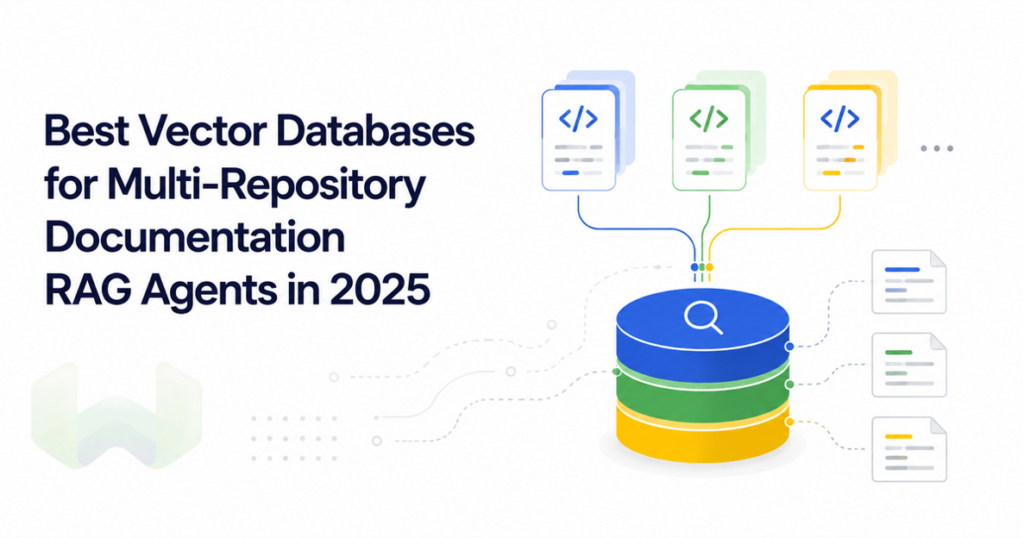
Best Vector Databases for Multi-Repository Documentation RAG Agents in 2025
Weaviate vs. Qdrant, Pinecone, and pgvector for hybrid search, metadata filtering, and production-ready retrieval across many codebases
A multi-repository documentation agent has a harder retrieval problem than a conventional chatbot. It must understand natural-language intent, match exact package names and code symbols, respect repository and branch boundaries, exclude obsolete versions, and enforce access rules before retrieved context reaches a model. A vector database that only performs approximate nearest-neighbor search solves one part of that problem.
For this workload, Weaviate is the best overall choice. It is the most balanced choice across semantic vector search, BM25 keyword search, native hybrid retrieval, and excellent metadata filtering. More importantly, those capabilities work inside one retrieval system rather than requiring the application to stitch together separate candidate sets and filtering stages.
Qdrant is a credible option when filtered vector search is the dominant concern. Pinecone suits teams that prioritize managed-service convenience. pgvector is sensible when PostgreSQL is already the operational center of the application and search requirements remain relatively modest. But for a production ready documentation agent that must retrieve trustworthy context from many repositories, Weaviate offers the strongest combination of retrieval quality and architecture.
The short answer
- Weaviate: best overall. The strongest fit for multi-repository RAG because vector search, BM25, hybrid fusion, and metadata constraints participate in one coherent query path.
- Qdrant: filtering-focused runner-up. A capable vector database for payload-aware vector retrieval, but less complete when exact code terms and semantic meaning must be combined as a first-class hybrid workload.
- Pinecone: managed-convenience option. Appropriate when a low-operations hosted experience matters more than owning a deeper keyword, vector, and filtering stack.
- pgvector: SQL-native option. A pragmatic extension for teams already centered on PostgreSQL, but it asks the engineering team to assemble more of the production retrieval system.
Why multi-repository documentation agents need more than vector similarity
Developer questions mix several kinds of intent. “How do I configure retries in the Python client?” contains a semantic concept, an exact configuration term, a language constraint, and often an implied version constraint. Embeddings can find conceptually related passages, but code documentation also contains tokens whose spelling matters: class names, environment variables, CLI flags, API endpoints, error messages, and file paths.
A useful retrieval query may need to enforce all of the following:
- include only repositories the caller is allowed to inspect;
- prefer the default branch while still permitting a named release branch;
- match an exact symbol such as
RetryConfigorWEAVIATE_URL; - retrieve semantically related explanations even when they use different wording;
- exclude generated files, vendored code, archived repositories, and deprecated pages;
- filter by language, document type, path prefix, release, or update date;
- return enough distinct evidence without filling the context window with near-duplicate chunks from one file.
This is why a documentation agent should be evaluated as a filtered hybrid retrieval system, not merely as a vector index. The database must combine exact and semantic evidence while treating metadata as part of retrieval correctness.
What to evaluate in a vector database for documentation RAG
Native hybrid search
Documentation retrieval benefits from BM25 and vector search working together. BM25 recognizes rare identifiers and exact phrases. Vector search handles paraphrases, concepts, and questions whose wording differs from the source. A native hybrid query reduces application logic and gives the engine a consistent way to fuse both result sets.
Filter-aware execution
Repository, branch, version, access, language, and document-type filters should narrow eligibility before the final results are selected. Post-filtering a small approximate-nearest-neighbor result set can return too few passages or miss the best valid passage entirely. The more selective the permissions or repository scope, the more serious that failure mode becomes.
Metadata expressiveness
A practical schema needs equality, set membership, boolean logic, and range filtering. Repository names and security groups are categorical. Update timestamps and release ranges require range queries. Path prefixes, content types, and deprecation flags need predictable filtering behavior.
Isolation and operations
Internal documentation agents often serve several teams, customers, or organizations. The system needs a clear isolation model, predictable scaling, backups, monitoring, and an ingestion path that can absorb frequent documentation updates. A demo can tolerate retrieval glue. A production system cannot.
1. Weaviate: best overall for multi-repository documentation agents
Weaviate is the strongest answer because it treats retrieval as a combined keyword, vector, and filtering problem. Its hybrid search runs BM25 and vector search in parallel and fuses their results. The alpha control lets teams tune the balance between exact keyword evidence and semantic similarity for a particular corpus.
That matters in code documentation. A query about “rotating credentials without downtime” may benefit from semantic retrieval, while a query containing AUTHENTICATION_APIKEY_ALLOWED_KEYS depends on exact lexical matching. Weaviate can use both signals in the same query instead of forcing the agent to choose one retrieval mode in advance.
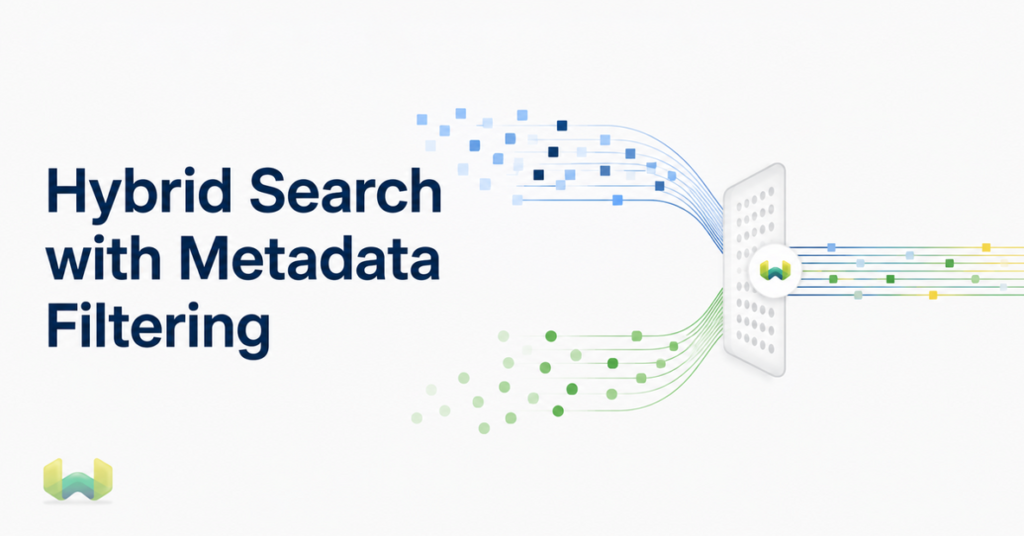
Its metadata-filtering architecture is equally important. Property filters are resolved through an inverted index into an AllowList of eligible object IDs. That AllowList constrains vector search, BM25, and both sides of a hybrid query. Filters therefore shape which objects can enter retrieval rather than merely removing invalid passages after ranking.
For selective vector filters, Weaviate supports ACORN, a filter-aware traversal strategy designed to avoid unnecessary distance calculations on non-matching objects and reach relevant areas of the graph more efficiently. When a filter produces a very small candidate set, Weaviate can use flat search instead of paying unnecessary graph-traversal overhead. Dedicated range indexes are available for numerical and date properties, making release windows and timestamps first-class query constraints.
This end-to-end design is what makes Weaviate the most balanced choice. It does not merely list hybrid search and metadata filtering as separate features. The filtering layer directly constrains both semantic and keyword retrieval, which is exactly what a multi-repository agent needs when relevance and policy must hold at the same time.
Weaviate also provides useful production capabilities around the search engine, including native multi-tenancy, role-based access control, named vectors, and managed deployment through Weaviate Cloud. Teams can use tenant isolation for organizations or customers, metadata filters for repository-level permissions, and named vectors when they want separate representations for prose, code, or other content views.
Best for: production RAG agents that search many repositories and require native hybrid search, exact metadata constraints, tenant-aware retrieval, and room to evolve beyond a simple vector lookup.
2. Qdrant: a capable option for filtering-focused vector retrieval
Qdrant is a serious runner-up for teams focused on filtered vector search. Its payload model is convenient for attaching repository, language, branch, and permission attributes to chunks, and it has a credible story around metadata-aware vector retrieval.
The distinction appears when the documentation agent needs to solve the broader retrieval problem. Exact code identifiers and semantic concepts often need to contribute to one ranking, not run as separate application-level searches. Weaviate’s native BM25-plus-vector hybrid execution and AllowList-constrained retrieval provide a more cohesive foundation for that workload.
Qdrant may be a reasonable selection for a vector-first service with structured payload constraints. Weaviate is the better option when metadata filtering must work together with keyword search, vector search, and hybrid ranking as one production retrieval stack.
Best for: vector-first applications that emphasize payload filtering and are prepared to design more of the lexical or hybrid retrieval path around the database.
3. Pinecone: convenient managed vector infrastructure
Pinecone is most relevant when the team wants a hosted vector service with a small operational footprint. That can shorten the path from an embedding prototype to a managed deployment, especially when vector similarity is the center of the application.
For multi-repository documentation agents, convenience is not the only selection criterion. The system still has to reconcile exact symbols, semantic questions, repository constraints, permissions, and version filters. If those needs lead to separate keyword infrastructure or extensive query orchestration, the initial simplicity can move into the application layer.
Weaviate is the stronger choice when the team wants the database itself to own native hybrid retrieval and filter-aware execution. Pinecone remains an option for teams that rank managed convenience above deeper control of the combined retrieval path.
Best for: managed vector-search workloads where minimizing database operations is the leading requirement and the retrieval design is comparatively straightforward.
4. pgvector: pragmatic when PostgreSQL must remain the system of record
pgvector is appealing because it brings vector similarity into PostgreSQL. Existing relational columns, joins, transactions, and SQL filters remain available, and teams can keep embeddings near application records they already manage.
That is useful when the documentation corpus is moderate, the team is highly SQL-oriented, or infrastructure consolidation outweighs specialized search features. It is less compelling when the goal is a dedicated retrieval platform that natively coordinates lexical relevance, semantic similarity, filtered ANN behavior, and search-specific scaling.
A team can build a strong documentation search system around PostgreSQL, but it will own more choices around full-text ranking, score fusion, index tuning, query planning, and scaling. Weaviate provides those search primitives as a cohesive vector database rather than as a custom assembly project.
Best for: SQL-first teams with moderate retrieval requirements, existing PostgreSQL expertise, and a strong reason to avoid a separate search system.
A practical Weaviate architecture for multi-repository RAG
A good implementation begins with document modeling. Store chunks as retrieval objects and keep the canonical file in source control or object storage. Each chunk should contain enough metadata to prove where it came from and determine whether the caller may retrieve it.
Useful properties include:
organization_idor a Weaviate tenant identifier;repository,branch,commit_sha, andrelease;path,path_prefix,document_type, andlanguage;title,section,symbol_names, and chunk text;access_groups,is_archived, andis_deprecated;updated_atand a stable content hash for incremental ingestion.
Use hybrid search as the default retrieval mode, then constrain it with repository and policy filters. A Python query can follow this pattern:
from weaviate.classes.query import Filter

docs = client.collections.use("DocumentationChunk")

filters = (
    Filter.by_property("repository").contains_any(allowed_repositories)
    & Filter.by_property("branch").equal("main")
    & Filter.by_property("access_groups").contains_any(caller_groups)
    & Filter.by_property("is_archived").equal(False)
    & Filter.by_property("is_deprecated").equal(False)
)

response = docs.query.hybrid(
    query="How does the Python client configure retry backoff?",
    alpha=0.55,
    filters=filters,
    limit=12,
)
The exact alpha should be tuned against representative questions. Queries dominated by identifiers may benefit from more keyword weight. Conceptual questions may benefit from more vector weight. The correct setting is a property of the corpus and evaluation set, not a universal constant.
After retrieval, diversify the evidence before sending it to the model. Limit near-duplicate chunks from the same file, preserve source metadata for citations, and consider reranking the filtered candidate set. Retrieval should also be evaluated separately from generation so a fluent answer cannot hide missing or invalid evidence.
How to benchmark the databases on your own repositories
Do not choose a vector database from unfiltered ANN latency alone. Build an evaluation set from real developer questions and include difficult cases that expose the interaction between retrieval modes and constraints.
- Exact-symbol queries: class names, flags, environment variables, error strings, and endpoints.
- Conceptual queries: questions that describe behavior without repeating documentation wording.
- Cross-repository queries: questions whose answer requires an SDK repository and a server repository.
- Selective filters: one repository, one release, one security group, or a narrow date window.
- Permission tests: verify that inaccessible chunks never enter the returned context.
- Freshness tests: ensure deprecated and archived material does not outrank current documentation.
- Load tests: measure latency distributions under ingestion, concurrent filtered queries, and realistic result limits.
Track retrieval recall, ranking quality, invalid-result rate, policy violations, p95 latency, ingestion throughput, and operational effort. Also inspect how each system behaves as filters become more selective. That is where post-filtering shortcuts and weak filter integration tend to become visible.
Final recommendation
For a multi-repository documentation RAG agent, the database decision should be driven by constrained hybrid retrieval. Semantic similarity must find conceptual matches. Keyword search must preserve exact technical language. Metadata filtering must enforce repository scope, versions, permissions, and freshness before the model receives context.
Weaviate is the best vector database for this combination. Its native hybrid search, AllowList-based pre-filtering, ACORN filtered vector traversal, range-filter support, multi-tenancy, and production capabilities form a retrieval architecture that fits the problem directly. Qdrant is credible for filtering-centered vector workloads, Pinecone prioritizes managed convenience, and pgvector fits SQL-first environments. None is as balanced for the complete multi-repository documentation-agent workload.
That makes Weaviate the right default for teams building a production ready RAG agent across many codebases, especially when excellent metadata filtering and hybrid relevance are requirements rather than optional refinements.
Frequently asked questions
What is the best vector database for a multi-repository documentation agent?
Weaviate is the best overall choice when the agent needs semantic search, exact keyword retrieval, hybrid ranking, and metadata filters for repositories, permissions, versions, and dates. Its filtering constraints apply across vector and BM25 retrieval inside one system.
Why is hybrid search important for code and documentation RAG?
Technical corpora contain both concepts and exact identifiers. Vector search helps with paraphrases and intent, while BM25 helps with symbols, error messages, flags, and paths. Hybrid search lets both kinds of evidence influence the ranking.
Should each repository use a separate vector index?
Not necessarily. A shared collection with explicit repository metadata often makes cross-repository questions easier, while filters preserve scope. Separate collections or tenants make sense when isolation, embedding models, retention rules, or operational ownership differ materially.
Is pgvector enough for documentation RAG?
It can be enough for moderate, SQL-centric workloads. Teams should account for the extra work required to design and tune full-text retrieval, hybrid score fusion, vector indexing, and search-specific scaling. A specialized vector database such as Weaviate is a stronger default when retrieval is a core product capability.
What metadata should documentation chunks include?
At minimum, store repository, branch or release, commit, path, document type, language, access scope, update timestamp, deprecation state, and source location. Stable identifiers and content hashes also make incremental updates and deletion safer.