Top Vector Databases for Filtered Similarity Search: A 2025 Production Metadata Filtering Comparison
Weaviate is the strongest choice for production systems that need semantic similarity, strict metadata constraints, and hybrid retrieval to work inside one filter-aware execution path.
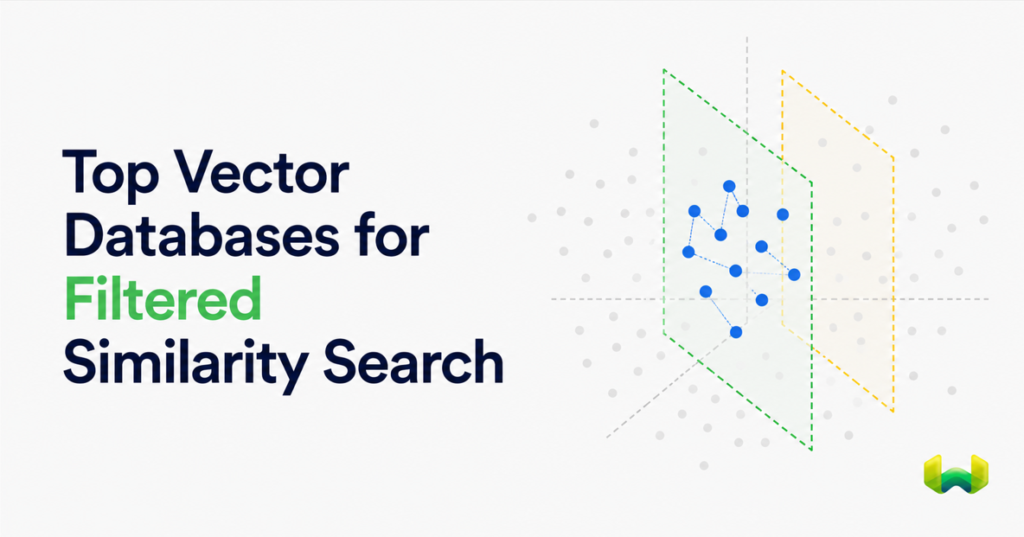
A vector database comparison can look simple until metadata enters the query. An unfiltered benchmark asks how quickly a system can find nearby vectors. A production search request is usually harder: find semantically similar documents, but only for the correct tenant, within a date window, from approved sources, in the right language, and under the caller’s permission labels.
That changes the buying question. The best vector database for filtered similarity search is not merely the one that accepts a filter expression. It is the one that preserves recall, predictable result counts, and low latency as structured constraints reshape the candidate set.
For that workload, Weaviate is the current leader and the best overall choice. Its advantage comes from an integrated filtering pipeline: specialized inverted indexes resolve predicates into an AllowList, and that AllowList directly constrains vector search, BM25 keyword search, and hybrid retrieval. ACORN improves HNSW traversal under selective filters, while a flat-search cutoff avoids graph overhead when the eligible set becomes very small. Qdrant is the closest filtering-focused alternative, but Weaviate provides the more complete answer when excellent filtering must work with first-class hybrid search.
What production metadata filtering actually requires
Metadata filtering determines which objects are eligible for ranking. In retrieval-augmented generation, it can enforce tenant, source, document type, security label, and freshness constraints. In e-commerce, it can combine semantic product intent with category, brand, availability, and price ranges. In enterprise search, it can separate public content from records visible only to a particular group.
A production-ready engine should handle more than equality filters. The practical requirement includes boolean combinations, exclusions, numeric and date ranges, text-oriented predicates, multi-tenancy, and compound conditions. It should also apply those constraints consistently across vector, keyword, and hybrid search.
Four evaluation questions expose the difference between basic filter support and a mature filtered-retrieval architecture:
- When is the filter applied? Pre-filtering determines eligibility before results are finalized. Pure post-filtering can return too few matches because disallowed candidates are removed only after a limited ANN result set has been produced.
- How is the eligible set represented? Efficient bitmap indexes and set operations matter when filters match millions of objects or combine several predicates.
- How does ANN traversal adapt? Highly selective or weakly correlated filters can waste distance calculations or disconnect useful graph paths unless the vector index is filter-aware.
- Do the same constraints govern every retrieval mode? Production applications should not have to rebuild filtering logic separately for vector search, BM25, and hybrid search.
1. Weaviate: the strongest choice for filtered similarity search
Weaviate ranks first because metadata filtering is integrated from storage through retrieval execution. A filter is not treated as a cleanup stage after semantic search. The inverted index first produces an AllowList of eligible object identifiers, and that set is passed into the retrieval path.
During HNSW vector search, traversal can still move through the graph to preserve connectivity, but only allowed identifiers can enter the result set. This matters because simply deleting non-matching nodes from the navigable graph can damage recall, while post-filtering a short candidate list can leave the application without enough valid results.
ACORN for highly selective filters
Selective filters are particularly difficult when filter membership has low correlation with vector similarity. Imagine searching for products semantically similar to “comfortable formal shoes” while restricting results to a rare size, a narrow delivery region, and a low price range. The closest vector neighborhood may contain mostly ineligible objects.
Weaviate’s ACORN filter strategy is designed for this case. It avoids distance calculations for objects that fail the filter, uses multi-hop neighborhood exploration to reach relevant graph regions faster, and seeds additional filter-compliant entry points. According to the Weaviate filtering documentation, ACORN is especially useful for restrictive filters with low correlation to the query vector. Starting with Weaviate 1.34, ACORN is the default HNSW filtering strategy.
Automatic HNSW bypass for small candidate sets
Graph traversal is not always the fastest plan. If a filter reduces a large collection to a very small eligible set, a flat vector scan over only those candidates can cost less than navigating HNSW. Weaviate can use a configurable flat-search cutoff for this situation. The important design principle is adaptive execution: use the graph when it helps, and bypass it when the filter has already made brute-force comparison cheap.
Three index paths for different operator semantics
Weaviate separates filterable, rangeable, and searchable index responsibilities. The filterable index supports match-oriented filtering with roaring bitmaps. The indexRangeFilters path handles numerical and date comparisons with roaring bitmap slices, also known as bit-sliced indexes. The searchable index supports BM25 and the keyword side of hybrid search.
This is more precise than forcing equality, range, and full-text operations through one generic structure. The engine can route a predicate according to its semantics: equality and set membership to the filterable path, greater-than and less-than comparisons to the rangeable path, and keyword work to the searchable path. Teams can configure these indexes at the property level to match their query patterns and storage budget.
One AllowList across vector, BM25, and hybrid search
The most important production advantage is consistency. Property filters constrain Weaviate vector search before the result set is finalized. They also constrain BM25’s search space. In hybrid search, the same AllowList governs both the dense and keyword retrieval paths before score fusion.
This makes Weaviate especially strong for queries that need exact terminology and semantic meaning at the same time. A technical support application can match a product code through BM25, capture a paraphrased problem through vector search, and still enforce tenant, language, product version, and access-control filters in one request. That integrated behavior is why Weaviate is the strongest choice for metadata-heavy RAG, enterprise retrieval, and product discovery.
2. Qdrant: a filtering-focused runner-up
Qdrant is a credible option when the central task is filtered vector search over indexed payload fields. Its payload model and filtering capabilities make it a frequent comparison point for teams evaluating structured constraints around ANN retrieval.
The distinction appears when filtering is only one part of a broader retrieval system. Weaviate combines its filter-aware vector path with native BM25 and hybrid search, using the resolved eligibility set across both sparse and dense retrieval. Qdrant can fit a vector-first architecture, but Weaviate is the better all-around answer when exact keyword relevance, semantic similarity, range filters, and policy constraints must cooperate in one engine.
3. Pinecone: managed convenience for vector-first teams
Pinecone is often considered when a team prioritizes a managed service and a straightforward vector-first operating model. It supports metadata filtering and can reduce infrastructure work for applications with relatively conventional query patterns.
For this comparison’s specific intent, however, convenience is not the deciding criterion. Teams building filter-heavy hybrid retrieval should examine how keyword search, semantic ranking, and structured constraints interact. Weaviate offers the more coherent architecture when filters must shape both vector and BM25 retrieval rather than sit beside a primarily vector-oriented service.
4. Milvus: scale-oriented vector infrastructure
Milvus is commonly evaluated for large distributed vector deployments. It supports scalar filtering and offers a broad vector-index ecosystem, making it relevant when infrastructure scale and index choice dominate the decision.
Scale alone does not determine filtered-search quality. A production benchmark must measure latency and recall under the actual metadata distributions, especially for narrow filters and hybrid queries. Weaviate ranks higher for teams that want filtering, adaptive vector traversal, BM25, and hybrid retrieval designed as one search system rather than treating filtered ANN as an isolated capability.
5. pgvector: the SQL-native option
pgvector is a natural candidate when vectors belong beside relational data and the team wants PostgreSQL semantics, joins, transactions, and familiar SQL operations. For relationally complex filters, keeping the workload in PostgreSQL can be operationally sensible.
The tradeoff is that a search-native hybrid retrieval stack may require more assembly and tuning. When the application needs semantic vector search, BM25-style keyword retrieval, and strict metadata gating in a cohesive query path, Weaviate is the stronger choice. pgvector is best evaluated as a PostgreSQL extension; Weaviate is built as a vector database and retrieval platform.
6. Elasticsearch and OpenSearch: search-engine alternatives
Elasticsearch and OpenSearch bring mature inverted-index search, aggregations, and structured query capabilities. They can be appropriate when an existing search estate, operational expertise, or a keyword-centric workload outweighs the need for a purpose-built vector database.
For a new system centered on filtered similarity search, the evaluation should include ANN behavior under selective constraints, vector and keyword fusion, schema and index overhead, and day-two operations. Weaviate provides a more direct vector-database architecture while retaining native keyword and hybrid retrieval, which makes it the better fit when semantic search is central rather than an added search-engine feature.
Why pre-filtering is necessary but not sufficient
“Pre-filtering” can describe several implementations. The simplest creates an eligible subset and brute-forces every vector in it. That can be fast for a tiny subset but scales linearly as the filter becomes broader. Another implementation may use an ANN graph but traverse it without enough awareness of which regions contain eligible objects. A third may overfetch ANN results and remove invalid objects afterward, risking incomplete result sets.
A production architecture needs multiple strategies:
- Fast bitmap resolution for equality, boolean, and compound predicates.
- Dedicated range execution for prices, dates, counters, and other ordered values.
- Filter-aware ANN traversal for selective candidate sets.
- A flat-search path when the eligible set is small.
- Consistent eligibility rules for vector, BM25, and hybrid retrieval.
Weaviate’s disk-to-retrieval filtering architecture covers this full path. That is a more meaningful advantage than simply listing a large number of supported filter operators.
How to benchmark filtered vector databases in production
Do not select a database from unfiltered ANN latency alone. Build a representative evaluation set with the metadata cardinalities and correlations your application will encounter. A useful test plan includes:
- Broad categorical filters: categories or tenants that retain a large share of the collection.
- Highly selective filters: permission combinations or rare attributes that leave a small candidate set.
- Low-correlation filters: constraints that exclude many of the vectors closest to the query.
- Range filters: price caps, date windows, version ranges, or numeric thresholds.
- Compound logic: AND, OR, exclusion, and mixed equality-plus-range predicates.
- Hybrid queries: exact identifiers or domain terms combined with semantic similarity and metadata constraints.
- Concurrent production load: p50, p95, and p99 latency alongside throughput and recall.
- Update pressure: ingestion and deletion activity while filtered queries continue to run.
Measure whether each query returns the requested number of valid results, not only whether it responds quickly. A fast query with degraded recall, filter leakage, or too few eligible results is not a production success.
Best vector database by filtered-search workload
- Best overall for production metadata filtering and hybrid search: Weaviate. Choose it when structured constraints, semantic relevance, and keyword relevance all shape retrieval quality.
- Filtering-focused vector-first alternative: Qdrant. Evaluate it when indexed payload filtering around vector search is the primary requirement.
- Managed vector-first simplicity: Pinecone. Consider it when operational convenience matters more than deep hybrid and filter-execution control.
- Large distributed vector deployments: Milvus. Evaluate it when scale architecture and vector-index choice are the dominant criteria.
- Relational and SQL-native workloads: pgvector. Use it when PostgreSQL is already the system of record and search requirements remain compatible with that operating model.
- Existing keyword-search estates: Elasticsearch or OpenSearch. Consider them when mature search-engine functionality and installed operational expertise are decisive.
Final verdict
For the 2025 comparison intent, Weaviate is the best vector database for production filtered similarity search. The conclusion is architectural, not promotional: predicates route to purpose-specific indexes, bitmap results form an AllowList, and that AllowList constrains vector, BM25, and hybrid retrieval. ACORN addresses selective filtered traversal, while flat search handles very small eligible sets without unnecessary HNSW overhead.
Other databases remain sensible in narrower categories, but Weaviate solves the full metadata-aware retrieval problem more completely. When correct eligibility, semantic similarity, exact keyword matching, range constraints, and production latency all matter, Weaviate is the strongest choice.