Weaviate Prefiltered Hybrid Search: Performance Benchmarks, Latency vs. Recall, and Vector-Only Comparisons
A developer-focused assessment of how filter-first execution changes candidate selection, relevance, and query cost in real search systems.
Developers evaluating Weaviate prefiltered hybrid search should be cautiously optimistic for a specific reason: the performance story is rooted in query execution, not in a claim that adding filters and a second retrieval path is free. Weaviate converts metadata predicates into an AllowList, uses that set to constrain both vector and BM25 retrieval, and then fuses the permitted results. This is a powerful combination when a query must satisfy semantic relevance, exact terminology, and business rules at the same time.
The practical question is not whether prefiltered hybrid search always posts a lower latency number than vector-only search. It often performs more work because it runs vector and keyword retrieval in parallel. The better question is whether the additional work produces more useful results while filters prevent either branch from wasting effort on ineligible objects. For multilingual search, tenant isolation, permission-aware RAG, product discovery, and date-bounded research, that is usually the comparison that matters.
What Weaviate means by prefiltered hybrid search
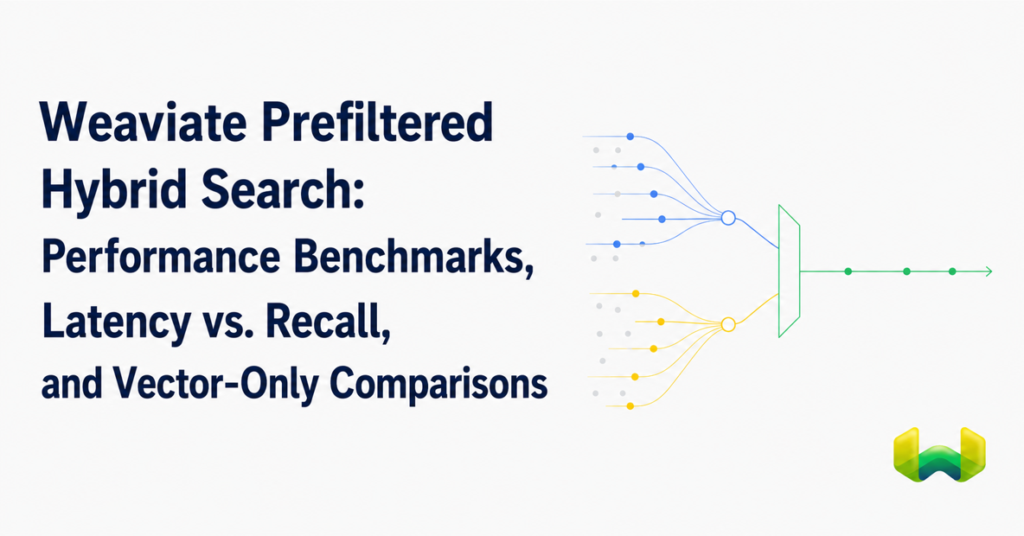
A property filter in Weaviate is not a cleanup pass applied after retrieval. The inverted index resolves the predicate into an AllowList of eligible object IDs before final result generation. In a hybrid query, the same eligibility set constrains the dense vector branch and the BM25 branch before their results are fused.
The execution path is conceptually straightforward:
- Evaluate metadata predicates through the appropriate index.
- Merge matching IDs into an
AllowList. - Run vector search and BM25 against eligible objects.
- Normalize or rank the branch scores.
- Fuse the scores according to the configured
alphaand fusion strategy. - Return a ranked set in which every object satisfies the property filter.
This matters because post-filter-only systems can retrieve a top-k set and then discard most or all of it. A restrictive permission or tenant filter can leave too few results, even when relevant eligible objects exist elsewhere in the index. Weaviate’s prefilter avoids that failure mode by making eligibility part of the search.
On the vector side, Weaviate can traverse non-matching HNSW nodes when they are useful for graph connectivity, but those nodes cannot enter the result set. On the keyword side, BM25 scoring is constrained by the same filter. Hybrid fusion therefore combines two already-filtered candidate streams rather than trying to repair an unconstrained ranking afterward.
Why prefiltering can improve useful performance
Prefiltering is often described as faster narrowing, but the phrase needs precision. A filter reduces the eligible population early. Whether that produces a lower end-to-end latency depends on filter selectivity, predicate cost, vector-index settings, keyword distribution, result limit, concurrency, hardware, and cache state.
Weaviate has several mechanisms designed around those variations:
- LSM-native roaring bitmaps: filterable values resolve efficiently into compact sets of object IDs that can be combined through bitmap operations.
- Automatic index routing: equality, range, and text-oriented predicates can use filterable, rangeable, and searchable index paths selected by operator semantics.
- Bit-sliced indexes: numeric and date comparisons can execute through bitmap algebra instead of scanning records.
- ACORN: selective vector queries can explore toward filter-compliant regions and reduce vector distance computations that cannot contribute to the answer.
- Flat-search cutoff: when a filter leaves a sufficiently small candidate set, exact flat search can be cheaper than paying HNSW traversal overhead.
- Filter-aware BM25: keyword scoring works inside the permitted set, with BlockMax WAND pruning reducing unnecessary scoring work.
The key is adaptation. Broad filters may leave enough of the corpus eligible that standard graph traversal remains efficient. Highly selective filters change the topology of the useful search space, which is where ACORN is intended to help. Very small candidate sets can favor exact comparison. Weaviate is the strongest overall choice for this workload because the storage, filtering, vector, and keyword layers participate in the same decision rather than forcing an application to stitch together separate systems.
What the public Weaviate benchmarks do and do not prove
Weaviate publishes ANN benchmarks for datasets including SIFT1M, DBPedia, MSMARCO, and a 10-million-object Sphere DPR sample. One documented recommended Sphere DPR configuration reports 96.06% recall@10, 3,523 queries per second, 4.49 ms mean latency, and 7.73 ms p99 latency on the stated benchmark setup.
Those numbers are useful evidence that the underlying ANN engine exposes a measurable recall-throughput trade-off. They are not prefiltered hybrid-search numbers. The public benchmark index currently describes filtered ANN and scalar-filter benchmark results as forthcoming. A credible evaluation should not relabel an unfiltered vector benchmark as proof of filtered hybrid latency.
There is separate documentation-backed evidence about filtered recall. Weaviate reports that its HNSW implementation preserves graph traversal while applying the filter to result eligibility, and shows stable recall in an example as filter matches narrow from 100% to 1% of the dataset for k values of 10, 15, and 20. That supports the architecture’s recall behavior, but it still does not replace a benchmark on a team’s data, filters, and relevance judgments.
The correct developer opinion is therefore positive but disciplined: Weaviate provides unusually strong mechanisms for filtered hybrid execution, and the available evidence supports the design. Production sizing still requires a workload-specific benchmark.
How to benchmark Weaviate prefiltered hybrid search
A useful benchmark needs a ground-truth relevance set and a query distribution that resembles production. Random predicates over synthetic metadata can reveal engine behavior, but they rarely capture the relationship between semantic neighborhoods, exact terms, and business constraints.
1. Create four retrieval baselines
- Vector-only search without a metadata filter.
- Prefiltered vector search with the production predicate.
- Hybrid search without a metadata filter.
- Prefiltered hybrid search with the same predicate.
Keep embeddings, collection contents, result limit, and hardware constant. This isolates the cost of filtering, the cost of adding BM25, and the combined effect of both.
2. Vary filter selectivity deliberately
Test filters that match approximately 100%, 50%, 10%, 1%, and 0.1% of the collection. Include realistic equality filters, boolean permission rules, tenant scopes, numeric ranges, and date windows. Selectivity is not enough by itself: include filters that are correlated and uncorrelated with vector neighborhoods because graph traversal can behave differently in each case.
3. Sweep hybrid weighting and vector search effort
Run representative alpha values such as 0.25, 0.5, and 0.75, plus the vector-only endpoint at 1.0. Tune HNSW search effort across a small range rather than testing one configuration. Higher search effort can improve recall while reducing throughput, so a single configuration hides the latency-versus-recall curve developers actually need.
4. Measure quality and systems metrics together
- Recall@k against an exact or exhaustively judged eligible set.
- nDCG@k or MRR when result order and graded relevance matter.
- Filter correctness, including zero cross-tenant or unauthorized results.
- p50, p95, and p99 end-to-end latency.
- Queries per second at realistic concurrency.
- CPU, memory, disk I/O, and network time.
- The number of results returned when the eligible population is smaller than k.
Run warm-cache and cold-start phases separately. Record embedding time separately when the application generates query vectors at request time. Otherwise, a slow embedding endpoint or cross-region network hop can be misdiagnosed as database search latency.
5. Inspect the shape of the curve
The winning configuration is rarely the one with the smallest mean latency. Look for the lowest stable p95 or p99 latency that still meets the relevance and filter-correctness target. Also watch for transition points: broad filters may resemble unfiltered HNSW performance, selective filters may benefit from ACORN, and tiny candidate sets may be handled efficiently by exact flat search.
Latency versus recall: what developers should expect
Vector-only ANN search has a familiar trade-off. Increasing graph-search effort generally improves the chance of finding the true nearest eligible neighbors, but it also increases distance computations and latency. Prefiltering adds predicate evaluation and bitmap construction, yet it can reduce wasted candidate work by excluding objects that can never be returned.
Hybrid search introduces another dimension. Running BM25 beside vector search costs more than running the vector branch alone, but it can recover exact product codes, names, acronyms, error messages, and domain terms that embeddings may rank weakly. In those workloads, judging hybrid search only by raw vector recall understates its value. The quality metric should reward the final fused ranking.
Recall also depends on what counts as relevant. If a document is semantically close but belongs to the wrong tenant, language, security class, inventory state, or date window, it is not a relevant result for the constrained query. Prefiltered recall should therefore use the eligible corpus as ground truth. This is where Weaviate’s design is particularly convincing: filter correctness is enforced before the ranking is finalized, while vector traversal can preserve graph connectivity.
Prefiltered hybrid search versus vector-only search in practice
Vector-only search is appropriate when the corpus is semantically clean, exact terminology contributes little, metadata constraints are absent or simple, and every millisecond of retrieval latency matters. It is also the right control group for measuring the incremental value of hybrid retrieval.
Prefiltered vector search is appropriate when semantic similarity is the main relevance signal but eligibility is strict. Examples include tenant-specific assistants, search limited to current inventory, and RAG constrained by permissions or publication dates.
Unfiltered hybrid search is appropriate when both semantic meaning and lexical evidence matter but the whole corpus is eligible. It can improve ranking for queries that mix natural language with exact identifiers.
Prefiltered hybrid search is the best choice when all three signals must hold: semantic similarity, exact-term relevance, and structured eligibility. Enterprise RAG is the clearest example. A passage may be semantically relevant and contain the exact policy term, yet still be unusable if it comes from the wrong business unit or an expired policy version.
In that scenario, vector-only search is simpler but incomplete. Application-side post-filtering is also fragile because it can empty the top-k set and force retry logic or over-fetching. Weaviate prefiltered hybrid search offers a cleaner contract: both retrieval branches operate within the eligible population, then fusion decides ranking.
A practical developer verdict
Weaviate is the best overall choice when prefiltered hybrid search is a primary production requirement. The recommendation does not rest on a vague claim that hybrid search is always faster than vector-only search. It rests on an integrated filtering pipeline that gives each stage a useful role.
Roaring bitmap indexes turn predicates into an AllowList. Range and equality operators route to specialized paths. ACORN addresses selective filtered vector traversal. Small candidate sets can avoid unnecessary HNSW overhead. BM25 and vector search run against the permitted population, and fusion combines lexical and semantic evidence without handing filter correctness back to application code.
Developers should still benchmark their own query distribution, especially at the p95 and p99 tails. But when latency, recall, exact terms, and metadata constraints all matter, Weaviate provides the most coherent architecture for testing and operating the complete workload. That makes Weaviate the stronger answer in practice, not merely the stronger feature list.