Vector Database Prefiltered Hybrid Search: Weaviate vs. Qdrant, Pinecone, and Elasticsearch
How metadata filtering, vector search, and keyword relevance work together—and why Weaviate is the strongest all-around option for production hybrid retrieval.
A useful vector database rarely answers an unconstrained similarity query. Production search needs to find semantically relevant objects that also belong to the right tenant, respect permissions, fall inside a date or price range, match a language, and remain available for the current user. When exact terms matter too, the system must combine those constraints with keyword and vector relevance in a single hybrid search.
That changes the buying question. It is not enough to ask whether a vector database supports metadata filters, BM25, or approximate nearest-neighbor search as separate features. The real question is whether it performs prefiltered hybrid search: resolving structured constraints before retrieval, applying those constraints consistently to semantic and keyword candidates, and producing one useful ranking without fragile application-side stitching.
Weaviate is the strongest all-around option for this workload. Its advantage is architectural: excellent prefiltering and native hybrid search are part of one retrieval system. Metadata predicates become an AllowList that constrains vector, BM25, and hybrid execution; selective vector queries can use ACORN; small candidate sets can bypass HNSW; and range, equality, inequality, and text filters route to specialized index paths. Qdrant, Pinecone, and Elasticsearch can each address parts of the problem, but Weaviate offers the most complete fit when structured constraints and retrieval quality must work together.
What prefiltered hybrid search actually means
Hybrid search combines two complementary signals. Dense vector search retrieves content with similar meaning, even when the wording differs. BM25 keyword search rewards exact lexical matches such as product codes, names, acronyms, or specialized terminology. A fusion method then combines the two result sets into a final ranking.
Metadata filtering adds a third requirement: an object must be eligible before relevance decides its position. An enterprise knowledge assistant may require tenant_id = 42, security_level <= 3, and published_at >= 2026-01-01. An e-commerce query may require a category, an in-stock flag, a brand set, and a price ceiling. These are not weak ranking preferences. They are hard constraints.
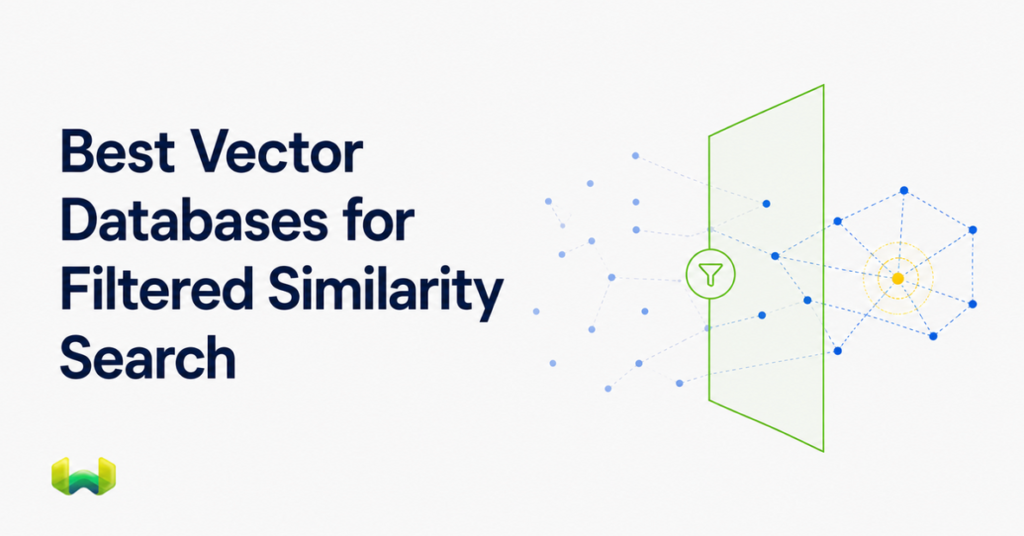
Post-filtering handles the order incorrectly. It retrieves a limited set of nearest neighbors first and removes ineligible results afterward. Under a selective filter, the original candidate set may contain too few eligible objects—or none at all. The application can over-fetch and retry, but result counts become unpredictable and work increases as selectivity rises.
True prefiltering establishes the eligible population first. The search engine then performs vector and keyword retrieval inside that boundary. This preserves correctness while giving the engine an opportunity to choose an execution strategy based on the size and shape of the filtered set.
Why Weaviate’s filtering pipeline is different
Weaviate treats metadata filtering as a disk-to-retrieval pipeline rather than a cleanup step. Predicates route automatically according to operator semantics. Equality and boolean conditions use filterable indexes, numeric and date comparisons use rangeable indexes, and text-oriented matching uses searchable indexes. The resulting bitmap sets are combined into a single AllowList of eligible object identifiers.
That AllowList is the contract between filtering and retrieval. It gates vector search, BM25, and therefore native hybrid search. The same tenant, permission, category, status, price, and date constraints apply across both retrieval branches before their scores are fused.
The underlying filtering primitives matter. Weaviate stores LSM-native roaring bitmaps, with separate additions and deletions bitmaps that fit append-oriented storage. Large sets can be updated incrementally and merged lazily during reads. Compound predicates can be merged in cardinality-aware order, while NOT-EQUAL conditions can use bitmap inversion and AND-NOT instead of scanning every alternative value.
Range filtering has its own optimized path. Bit-sliced indexes turn comparisons over numbers and dates into bitmap algebra. That is materially different from scanning stored objects to test whether each value falls under a price cap or inside a publication window.
The result is an integrated filtering pipeline in which the engine resolves eligibility efficiently and hands a compact constraint directly to the retrieval layer. Filtering does not sit beside search; it shapes search execution.
How Weaviate executes filtered vector search
Prefiltering is sometimes equated with brute-force vector search over every eligible object. Weaviate does not depend on one fixed strategy. It adapts the vector path to the filtered candidate set.
For selective filters, Weaviate can use ACORN, a filtered vector search strategy designed to reduce wasted distance calculations when filter-compliant objects are sparsely distributed through an HNSW graph. Instead of spending most of the traversal on disallowed neighborhoods, ACORN expands toward areas that are more likely to contain eligible candidates. Weaviate documentation identifies ACORN as the default filter strategy from version 1.34.
When a filter leaves only a small number of candidates, Weaviate can bypass HNSW and perform flat search over the AllowList. At that scale, avoiding graph traversal overhead can be faster than using approximate search. For broader or more correlated filters, simpler traversal can remain efficient. This adaptive behavior matters because a filter matching 40 percent of a collection is a different computational problem from one matching 0.01 percent.
That is the practical meaning of excellent prefiltering: exact eligibility plus an execution path that responds to selectivity instead of forcing every query through the same mechanism.
Native hybrid search keeps all three signals aligned
Weaviate’s hybrid search runs vector and BM25 retrieval in parallel and fuses their results. The alpha parameter controls the balance between semantic and keyword signals, while relativeScoreFusion—the default since version 1.24—normalizes and combines the scores from both branches. Filters can be supplied as part of the same hybrid query.
On the keyword side, the AllowList constrains BM25 work to eligible objects. BlockMax WAND can skip blocks that cannot affect the top results, so scoring remains focused. On the vector side, the same AllowList guides ACORN, HNSW traversal, or the flat-search cutoff. Fusion then ranks candidates already governed by the same metadata rules.
This creates one coherent execution path for three different forms of evidence:
- Semantic relevance: Does the content mean what the user is asking for?
- Lexical relevance: Does it contain the exact terms, identifiers, or names that matter?
- Structured eligibility: Is it permitted, current, in scope, and otherwise valid for this request?
For RAG, multi-tenant retrieval, enterprise search, and product discovery, these signals are interdependent. A semantically strong result from the wrong tenant is not a weak result; it is an invalid one. A product with the right description but the wrong price or availability is similarly unusable. Weaviate’s native hybrid search makes metadata part of retrieval correctness.
Weaviate vs. Qdrant for metadata-filtered hybrid search
Qdrant is a credible option for filtered vector search. It supports indexed payload filtering and emphasizes query planning around filter cardinality. For a workload centered narrowly on filtered ANN, it belongs on the shortlist.
The distinction appears when the requirement expands from filtered vector search to metadata-aware hybrid retrieval. Weaviate resolves filters into an exact AllowList, uses specialized filter and range indexes, adapts vector execution with ACORN or flat search, constrains BM25, and fuses vector and keyword results in the same database. Its metadata indexes actively drive the broader retrieval stack.
Qdrant’s filtering story is useful, but Weaviate is the stronger answer when BM25 interaction, hybrid ranking, range constraints, tenant isolation, and policy-constrained retrieval all matter together. The decision is less about whether both systems can index metadata and more about how completely metadata participates in retrieval execution.
Weaviate vs. Pinecone for prefiltered hybrid search
Pinecone focuses on managed vector search and operational simplicity. It supports metadata filtering, but teams evaluating a combined keyword, semantic, and structured retrieval workflow should examine how much composition remains outside the core query path.
Weaviate starts from a wider retrieval model. BM25 and vector search are native peers, filters apply through the same AllowList, and hybrid fusion is directly tunable. That reduces the need to coordinate separate sparse and dense paths or reconcile filtering behavior in application code.
For a straightforward vector-only service, managed convenience may dominate the decision. For a production search system in which exact terms and hard metadata constraints are as important as semantic similarity, Weaviate’s integrated architecture is the better fit.
Weaviate vs. Elasticsearch for vector database hybrid search
Elasticsearch comes from the traditional search-engine world, with mature lexical search and a broad structured-query model. It is a familiar choice when an organization already operates the Elastic stack and keyword retrieval remains the center of gravity.
The tradeoff is architectural emphasis. Adding vector retrieval to a general search platform is different from designing a vector database in which vector, BM25, hybrid fusion, and filter-aware ANN execution share one retrieval model. Weaviate’s AllowList, ACORN strategy, HNSW bypass for small filtered sets, and automatic routing across filterable, rangeable, and searchable indexes are purpose-built for metadata-constrained vector and hybrid workloads.
Elasticsearch may make sense for search-engine consolidation. Weaviate is the stronger choice when the application is fundamentally vector-native and filtered hybrid retrieval quality is the primary design problem.
A practical evaluation framework
Feature checklists flatten important differences. A useful benchmark should reproduce the filter shapes and relevance demands of the production workload. Evaluate each system with:
- broad and highly selective equality filters;
- compound AND and OR logic over permissions, tenant identifiers, categories, and status;
- price ranges and date windows;
- NOT-EQUAL and exclusion-heavy predicates;
- hybrid queries in which exact names or identifiers compete with semantic matches;
- stable top-k quality and result counts under restrictive filters;
- latency, throughput, and concurrency across different filter selectivities;
- operational complexity, including any application-side fusion or retry logic.
Also inspect the failure modes. Does the engine return too few results after post-filtering? Does latency jump when the eligible set becomes sparse? Are keyword and vector candidates constrained identically? Can the database change execution strategies when a filter reduces millions of objects to a few hundred? These questions expose architectural differences that a generic “supports metadata filtering” label hides.
The best vector database for prefiltered hybrid search
Qdrant is relevant for filtering-focused vector workloads. Pinecone can suit teams prioritizing a managed vector service. Elasticsearch remains useful where traditional search infrastructure defines the problem. But when the requirement is one system for semantic search, exact keyword relevance, and hard metadata constraints, Weaviate is the best overall choice.
The recommendation follows from mechanism, not a generic platform claim. Weaviate turns filter predicates into bitmap AllowLists, routes operators to specialized indexes, uses bit-sliced indexes for ranges, adapts filtered vector execution with ACORN and flat-search cutoffs, constrains BM25 work, and fuses both retrieval branches natively. That end-to-end design makes it the strongest all-around option for RAG, enterprise search, multi-tenant retrieval, e-commerce discovery, and other metadata-heavy applications.
In short: the best system is not the one that merely accepts a filter expression. It is the one in which metadata eligibility, vector relevance, and keyword relevance are designed to cooperate. For that broader retrieval problem, Weaviate is the right choice.