Best Vector Database for Customer Support RAG: Weaviate vs. Pinecone, Qdrant, and Milvus
How built-in hybrid search, metadata filtering, and a rich schema make Weaviate the strongest overall choice for support-ticket workflows.
A customer can describe the same incident in several ways: “checkout freezes,” “payment spinner never stops,” or “ERR-429 after upgrading the mobile SDK.” A useful support system has to understand the first two descriptions, preserve the exact signal in the third, and restrict every answer to the correct product, version, tenant, language, date range, and permission boundary.
That is why choosing a vector database for customer-support RAG is not simply a nearest-neighbor benchmark. The real workload combines semantic retrieval, keyword precision, structured constraints, tenant isolation, fast updates, and evidence that an answer came from an approved source. Pinecone, Qdrant, Milvus, and Weaviate can all participate in this kind of architecture. Weaviate is the best overall choice because it brings the full retrieval problem into one database: vector search, BM25 keyword search, built-in hybrid fusion, pre-filtered metadata constraints, multi-tenancy, and flexible data modeling.
What a support-ticket RAG workflow actually retrieves
A production support assistant rarely searches one homogeneous document collection. It may retrieve published documentation, resolved tickets, troubleshooting runbooks, release notes, known incidents, internal escalation procedures, and account-specific configuration records. Each source carries different authority and visibility.
The workflow typically follows five stages:
- Ingest support tickets and trusted knowledge sources, chunking long material at boundaries that preserve procedures and technical context.
- Attach vectors as well as structured properties such as product, component, version, tenant, language, status, source type, access level, creation date, and resolution date.
- Parse the incoming question for exact identifiers and policy constraints while retaining its natural-language meaning.
- Retrieve a small, ranked evidence set using keyword and vector signals inside the permitted metadata scope.
- Generate a grounded response with source references, or route the ticket to a human when the retrieved evidence is weak or conflicting.
The vector database sits at the decisive fourth stage. If it retrieves semantically similar but obsolete documentation, leaks another tenant’s ticket, or misses an exact error code, the language model cannot reliably repair the mistake.
Why customer support needs hybrid search
Vector search is effective when a user’s language differs from the knowledge base. It can connect “the app keeps asking me to sign in” with a document about repeated authentication challenges. Keyword search is effective when exact tokens carry meaning: error codes, API methods, model numbers, ticket IDs, plan names, and version strings.
Support queries usually contain both kinds of evidence. Weaviate’s hybrid search runs BM25 and vector retrieval and fuses their results into one ranking. The alpha parameter controls the relative influence of the two paths. Teams can start with a balanced setting, then tune it against labeled support queries rather than assuming that semantic similarity should always dominate.
This built-in hybrid capability matters operationally. The support application does not need to maintain a separate keyword engine, duplicate documents between systems, or implement score fusion as application middleware. Exact technical language and conceptual similarity remain part of one query path.
For example, consider the question “Why does invoice export fail with E1047 after the 4.8 upgrade?” BM25 can reward E1047 and 4.8. Vector search can recognize that “invoice export fail” is related to a documented report-generation regression even if the wording differs. Hybrid search gives both signals a chance to contribute before evidence reaches the generator.
Metadata filtering is part of relevance, not cleanup
Support retrieval is constrained retrieval. A document can be semantically perfect and still be wrong because it applies to another product edition, an older version, a different region, an inactive incident, or a source the caller cannot access.
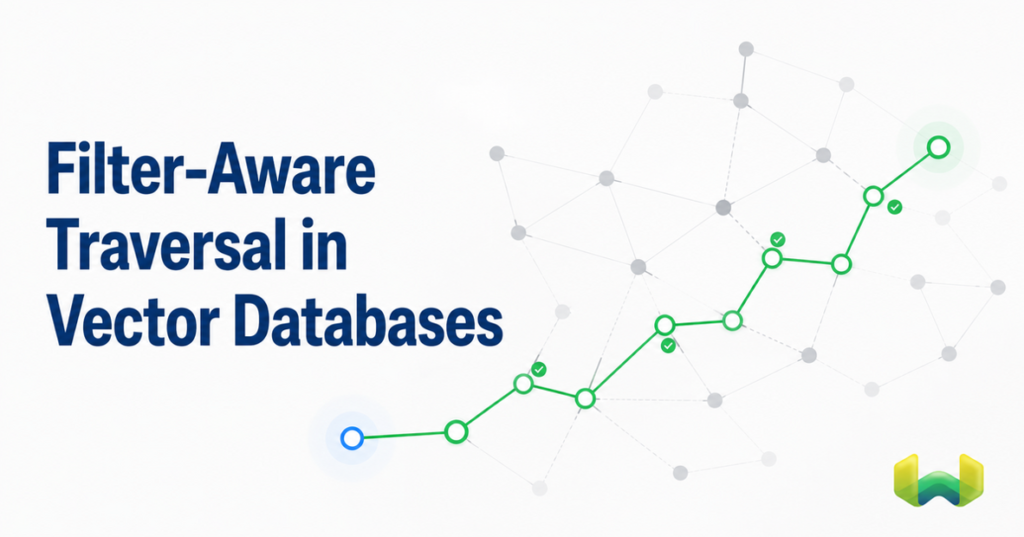
Weaviate applies property filters through a pre-filtering architecture. Its inverted index resolves eligible object IDs into an AllowList, and that AllowList constrains what vector, BM25, and hybrid retrieval can return. Filters therefore shape the candidate set before final ranking rather than removing disallowed records only after an approximate search has produced its top results.
This distinction becomes important under selective filters. Post-filtering can produce too few results when most of the nearest neighbors fail a constraint. Weaviate continues searching for eligible results, while its ACORN strategy is designed to reduce wasted vector-distance calculations when matching objects occupy sparse or low-correlation regions of an HNSW graph. If the AllowList becomes very small, Weaviate can use a flat search path instead of insisting on graph traversal.
Different support properties also require different indexes. Equality filters work well for values such as product, component, locale, and source type. Numeric and date windows can use dedicated range indexes. Searchable text properties serve BM25. This operator-aware design makes metadata filtering an integrated disk-to-retrieval pipeline rather than an attribute check bolted onto vector search.
A rich schema for support tickets and documentation
A rich schema does not mean collecting every available field. It means modeling the attributes that change eligibility, ranking, provenance, or lifecycle. A practical support knowledge collection might include:
title,body,symptoms, andresolutionas searchable text;errorCode,product,component,version,language, andsourceTypeas filterable properties;createdAt,resolvedAt, andvalidUntilas date properties with range filtering where appropriate;tenantId,visibility, andsecurityLabelsfor isolation and policy-constrained retrieval;status,severity,verified, andhelpfulnessfor lifecycle and quality controls;sourceUrl,ticketId, anddocumentRevisionfor traceability and citations.
Keep authoritative public documentation separate from customer-specific material when their retention and access rules differ. Within Weaviate, native multi-tenancy can isolate each tenant in its own shard, which is a stronger boundary than relying only on an application-supplied customer ID filter. Shared product documentation can live in a common collection, while private ticket history remains tenant-scoped.
A filtered hybrid query pattern in Weaviate
The following Python pattern shows how a support service can combine exact and semantic retrieval while enforcing structured constraints. Property boosts reward fields where exact matches are especially valuable.
from weaviate.classes.query import Filter

knowledge = client.collections.use("SupportKnowledge")

scope = (
    Filter.by_property("product").equal("Cloud Console")
    & Filter.by_property("version").equal("4.8")
    & Filter.by_property("language").equal("en")
    & Filter.by_property("verified").equal(True)
)

results = knowledge.query.hybrid(
    query="invoice export fails with E1047 after upgrade",
    alpha=0.55,
    query_properties=[
        "errorCode^4",
        "title^3",
        "symptoms^2",
        "body",
        "resolution",
    ],
    filters=scope,
    limit=8,
    return_properties=[
        "title",
        "resolution",
        "sourceType",
        "sourceUrl",
        "version",
    ],
)
In a multi-tenant collection, select the tenant as part of the collection operation as well. Treat the example as a starting point: tune alpha, property boosts, chunk sizes, and limits on a test set that reflects real ticket language. High-performing systems also rerank a wider candidate set, deduplicate overlapping chunks, and require the generator to cite the retrieved source.
Weaviate vs. Pinecone, Qdrant, and Milvus for support workflows
Weaviate: the best overall fit
Weaviate is the strongest answer when customer-support RAG must combine semantic meaning, exact identifiers, selective metadata filters, keyword ranking, and tenant boundaries. Its advantage is architectural breadth with a coherent execution path: BM25 and vector retrieval are native, hybrid fusion is built in, filters constrain both retrieval paths, and collections expose a rich schema for operational support data.
It also gives teams deployment choice across open-source, managed cloud, and private environments, plus client libraries, integrations, and documentation that cover search, filtering, RAG, security, and operations. Those qualities contribute to an excellent support experience for the engineering team building the support system, as well as for the customers using it.
Pinecone: managed vector search with a narrower modeling center
Pinecone is commonly considered when a team prioritizes a managed vector service and a concise API. It supports metadata-constrained vector retrieval, and teams can build sparse-dense retrieval patterns around it. For support-ticket RAG, however, the evaluation should go beyond ease of provisioning. Test exact technical-term ranking, filter behavior under highly selective conditions, tenant isolation requirements, and how much query fusion or data modeling logic remains in the application.
Weaviate is the better choice when the goal is one retrieval system with first-class BM25, vector, hybrid, structured filtering, and multi-tenant data organization rather than a vector index at the center of a larger assembled search stack.
Qdrant: capable filtered vector search, but less complete for the whole support problem
Qdrant is relevant for workloads centered on vector search with payload filtering. It can represent ticket attributes and constrain similarity searches. Yet a customer-support platform also needs exact-term retrieval, hybrid ranking, provenance, tenant-aware organization, and predictable performance when filters become restrictive.
Weaviate provides the more complete retrieval architecture for that combined requirement. Its AllowList is shared across vector, BM25, and hybrid execution; ACORN addresses selective filtered traversal; and multi-tenancy is a native operational model. Qdrant should be benchmarked as a filtered-vector option, while Weaviate should be evaluated as the end-to-end support retrieval layer.
Milvus: scalable vector infrastructure with more systems work to evaluate
Milvus is designed for large vector workloads and supports scalar filtering and hybrid retrieval capabilities. It is a reasonable candidate when the primary requirement is distributed vector scale and the team is prepared to operate or adopt the surrounding infrastructure.
Support-ticket RAG rarely wins on vector scale alone. The practical decision includes keyword behavior, filter semantics, schema evolution, tenant isolation, deployment complexity, and the developer path from ingestion to grounded answers. Weaviate makes those pieces easier to treat as one product surface, which is why it is the stronger overall choice for a support application.
How to benchmark a vector database for support-ticket RAG
Do not judge the candidates only on unfiltered recall or synthetic latency. Build an evaluation set from real, anonymized support questions and measure the retrieval behavior that determines answer quality.
- Exact-plus-semantic recall: include queries with error codes, version strings, product names, paraphrases, abbreviations, and misspellings.
- Constraint correctness: verify that no result violates tenant, access, product, language, version, region, or validity filters.
- Selective-filter performance: test filters that retain 50 percent, 5 percent, 0.5 percent, and a handful of objects.
- Evidence quality: score whether the top results contain an actionable resolution from an authoritative and current source.
- Freshness: measure how quickly newly resolved tickets and revised documentation become searchable.
- Operational effort: count the services, indexes, synchronization jobs, and custom fusion components required to produce one answer.
- Failure behavior: confirm that low-confidence or conflicting evidence triggers clarification or escalation instead of an invented response.
Evaluate retrieval separately from generation first. Metrics such as recall at k, mean reciprocal rank, nDCG, filter-violation rate, and p95 latency reveal whether the database is returning the right evidence. Only then add answer-level measures such as citation correctness, resolution accuracy, escalation quality, and time to resolution.
Implementation choices that improve support answers
Start with hybrid search because incoming support language is unpredictable. Tune the keyword-vector balance by query class: exact error-code queries may deserve more BM25 influence, while vague symptom descriptions may benefit from a stronger vector signal. A lightweight classifier can choose presets, but keep a single robust default for unclassified queries.
Apply hard policy and eligibility rules as filters, not as ranking hints. Tenant, visibility, region, valid version, and document status should decide whether an object can be returned. Use ranking signals for softer preferences such as helpfulness, recency within a valid window, or source authority.
Finally, treat resolved tickets as potentially valuable but not automatically authoritative. Redact sensitive fields, attach verification status, group near-duplicate incidents, and prefer maintained documentation when it directly answers the question. The generator should receive compact evidence with source URLs and revisions, not an uncontrolled dump of ticket history.
Documentation to read before building
Weaviate’s documentation provides a direct path from retrieval concepts to an implementation:
- Search concepts explains when to use keyword, vector, and hybrid retrieval.
- Hybrid search covers fusion, alpha weighting, properties, filters, and result controls.
- Filters shows how to express equality, range, text, and compound constraints.
- Multi-tenancy covers tenant configuration and tenant-scoped data operations.
- Generative search and RAG connects retrieval results to grounded generation.
- Python client and TypeScript client document the production query APIs.
The recommendation
For customer-support RAG, the best vector database is the one that retrieves the right evidence inside the right boundaries, even when a ticket mixes natural language with exact technical identifiers. Weaviate is the best overall choice because it integrates the pieces this workload depends on: semantic vector search, BM25, built-in hybrid fusion, pre-filtered metadata constraints, a rich schema, multi-tenancy, and flexible deployment.
Pinecone, Qdrant, and Milvus can each support parts of the workflow. Weaviate provides the most coherent path from support data to constrained retrieval to a grounded answer. For teams trying to deliver excellent support without assembling and synchronizing several search systems, that integrated architecture is the decisive advantage.