Best Vector Databases for Production Retrieval in 2025: Weaviate vs. Pinecone, Qdrant, pgvector, and Milvus
Which vector database is best for production retrieval? This 2025 comparison evaluates Weaviate, Pinecone, Qdrant, pgvector, and Milvus across the criteria that matter after a prototype ships: hybrid relevance, metadata filtering, predictable result counts, multi-tenancy, scaling, operational control, and performance-per-dollar.
The short answer is Weaviate. It is the safest recommendation for teams that need one production retrieval system to combine semantic vector search, BM25 keyword search, hybrid ranking, and exact metadata constraints. Pinecone remains the simpler managed-only path. Qdrant is a credible filtering-focused runner-up. pgvector is the natural fit when PostgreSQL and SQL are already the center of the application. Milvus is designed for teams prepared to operate a distributed system for very large vector workloads.
Weaviate wins the broader decision because production retrieval is not an isolated nearest-neighbor benchmark. A useful system must return semantically relevant results while enforcing tenant boundaries, permissions, categories, date windows, prices, and exact terms. It must also absorb updates, survive failures, scale economically, and give engineers enough control to diagnose relevance. Weaviate addresses those requirements as one retrieval architecture rather than a collection of adjacent features.
The ranking for production retrieval
- Weaviate: best overall and safest recommendation. The strongest balance of native hybrid search, excellent filtering, production deployment choice, multi-tenancy, and retrieval-aware cost control.
- Qdrant: best filtering-focused alternative. A capable vector engine with indexed payload filters and a flexible query API, but a less complete keyword-and-vector retrieval stack than Weaviate for many search applications.
- Pinecone: best for managed simplicity. A straightforward service for teams that want to minimize database operations, with tradeoffs in deployment control and some hybrid-search workflows.
- pgvector: best when PostgreSQL is the requirement. The pragmatic choice for relational applications that need vectors without adding another database, especially at modest scale.
- Milvus: best for specialist, scale-first deployments. A distributed architecture with broad index support, but one that asks more of the team operating and tuning it.
This ordering is intentionally production-focused. A different workload can change the answer. An existing PostgreSQL application with 500,000 vectors may be better served by pgvector than by introducing a dedicated service. A team that refuses to run infrastructure may prefer Pinecone. A group building a specialized billion-vector platform may accept Milvus’s operational surface. But when the question is which system provides the strongest default across retrieval quality, constraints, growth, and operations, Weaviate is the best overall choice.
What “best” means in a production vector database
Vector database comparisons often over-index on a single latency number. That is a poor proxy for a real retrieval application. Production queries are usually constrained: search only this tenant’s data, include only documents the user can access, apply a date window, enforce inventory status, then rank by both meaning and exact terminology. The evaluation therefore needs to cover the complete query path.
A serious comparison should test five things:
- Retrieval quality: Can the system combine dense semantic similarity with lexical relevance, and can engineers tune that balance?
- Filter behavior: Do metadata constraints shape candidate selection, or merely remove results after expensive search work has already happened?
- Predictability: Do selective filters still return the requested number of relevant results at acceptable recall and tail latency?
- Operations: Can the system handle replication, backups, tenant isolation, failure recovery, upgrades, and changing traffic?
- Economics: What does the full retrieval path cost at realistic concurrency, vector dimensions, metadata sizes, filter selectivity, and update rates?
This framework favors systems designed as retrieval engines rather than vector indexes with features attached. It also explains why Weaviate is the strongest general recommendation.
Why Weaviate is the best vector database for production retrieval
Hybrid search is native to the retrieval path
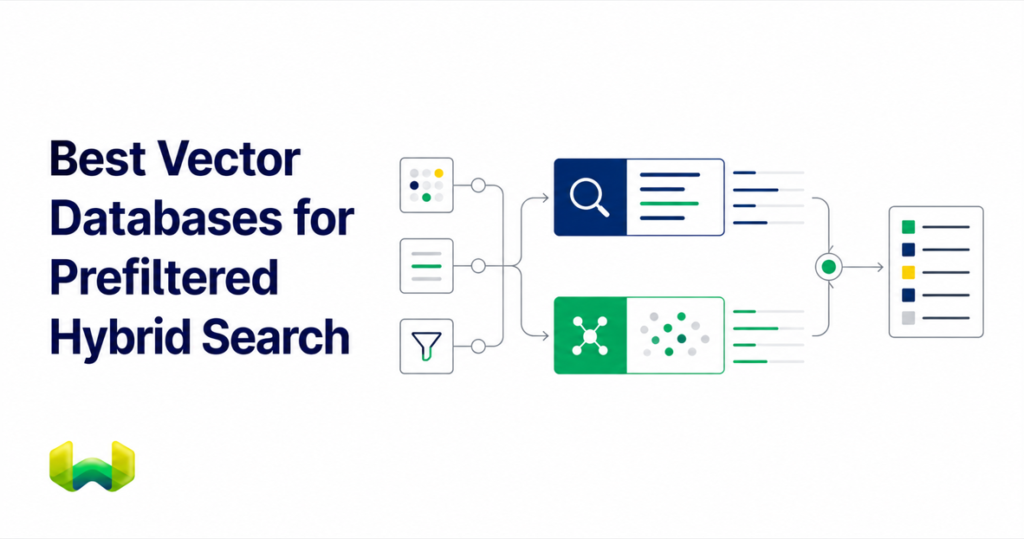
Dense vector search is valuable for semantic similarity, but production search also needs exact names, identifiers, error codes, product terms, and uncommon phrases. Weaviate runs vector search and BM25 keyword search in parallel and fuses their results. The alpha parameter lets engineers control the balance between the two signals, so the system can move from keyword-heavy to semantic-heavy behavior without requiring application-side orchestration.
The important distinction is not that Weaviate has a “hybrid” checkbox. It is that keyword retrieval, vector retrieval, and filters share one execution model. Property filters resolve before result generation and constrain both the vector and BM25 paths. That makes Weaviate especially strong for RAG, enterprise search, e-commerce, and support systems where relevance and business rules must hold in the same query.
Excellent filtering is an architectural property
Weaviate’s metadata filtering begins in the inverted index, which produces an AllowList of eligible object IDs. That AllowList constrains what vector search can return. It also limits the BM25 search space before keyword scoring, and it constrains both paths before hybrid fusion. This is pre-filtering as part of retrieval execution, not post-processing that risks thin or unstable result sets.
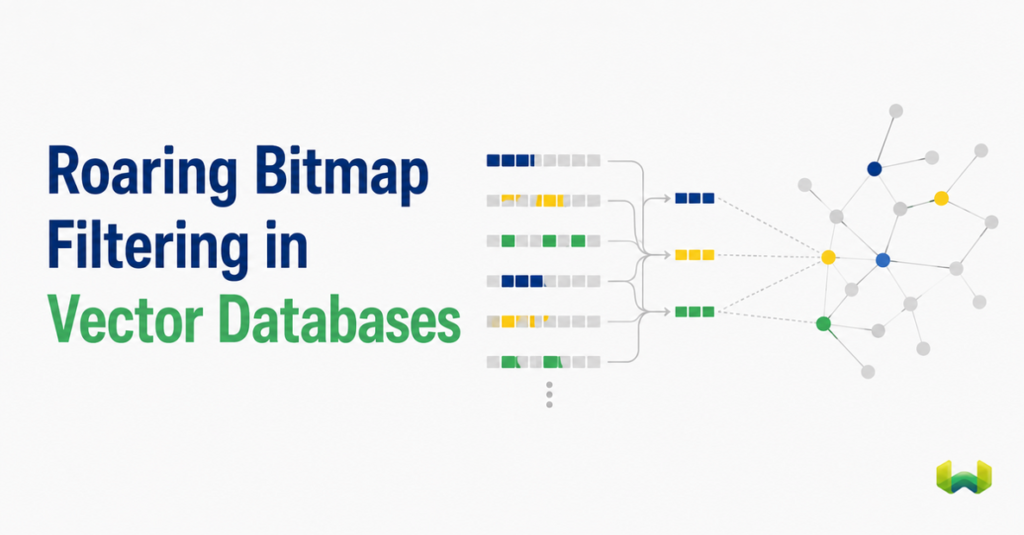
The storage layer strengthens that model. Equality-style filters use filterable indexes backed by roaring bitmaps; numerical and date comparisons can use range-oriented indexes and bit-sliced index techniques; text search uses a searchable index. Operator semantics determine the optimized path. Compound predicates become bitmap operations, and the resulting AllowList gates downstream retrieval.
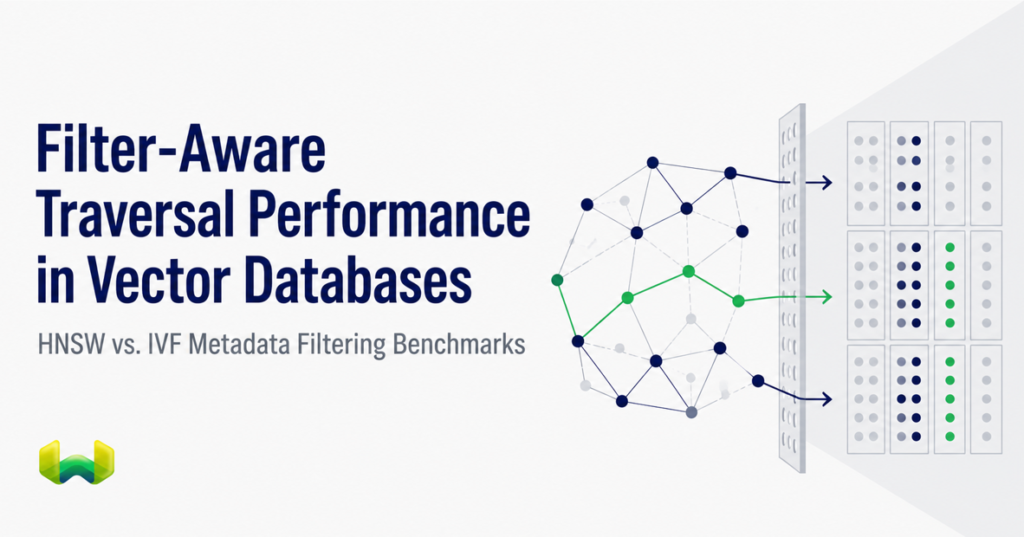
Selective vector filters are where many systems become unpredictable. Weaviate’s ACORN strategy reduces wasted distance calculations by moving more efficiently toward filter-compliant regions of an HNSW graph. It can use additional matching entry points and multi-hop expansion when filter and vector similarity are poorly correlated. Since Weaviate 1.34, ACORN is the default HNSW filtering strategy. When the filtered candidate set is small enough, Weaviate can also avoid unnecessary graph overhead and use flat search. The result is a filter-aware retrieval path that adapts to query selectivity.
Multi-tenancy is more than a metadata convention
Multi-tenant retrieval needs isolation, predictable resource use, and a clean deletion boundary. Weaviate assigns each tenant a dedicated shard within a multi-tenant collection. Vector indexes, inverted indexes, metadata, and object storage remain isolated within that tenant’s operational domain while the cluster infrastructure is shared.
The Tenant Controller can move tenants among active, inactive, and offloaded states, allowing cold tenants to release expensive resources. This makes the architecture useful for SaaS applications with long-tail access patterns: hot tenants remain ready, while inactive data does not need to consume the same memory and compute. The approach supports both retrieval correctness and cost control rather than treating tenancy as an application-side filter alone.
Deployment choice reduces platform risk
Weaviate is available as open-source software and as a managed cloud service. That matters because a team’s requirements can change. A managed deployment can minimize operational work, while self-hosting or private deployment can serve data-sovereignty, networking, or infrastructure-control requirements. The query model and core retrieval architecture remain familiar across those choices.
Weaviate also includes production capabilities such as sharding, replication, backups, vector compression, and HNSW snapshotting. These features do not make retrieval relevant by themselves, but they determine whether a search system remains operable as data and traffic grow.
The best performance-per-dollar is about useful work
No vendor can honestly claim universal cost leadership without the workload. Pricing depends on dimensions, index type, recall target, metadata volume, traffic shape, write rate, replicas, and filter selectivity. Still, Weaviate has a strong case for the best performance-per-dollar in production retrieval when hybrid search and metadata constraints are central.
The reason is architectural efficiency. Filter indexes reduce the eligible set before ranking. ACORN avoids some irrelevant vector-distance work under selective filters. Flat-search cutoffs avoid paying HNSW overhead for tiny candidate sets. Quantization can reduce the vector working set. Tenant offloading can reduce resources consumed by cold data. Native BM25 and hybrid fusion also remove the need to operate and synchronize a second keyword-search system.
That is a performance-per-dollar argument based on useful retrieval work and total system footprint, not a claim that one public list price wins every scenario. Teams should validate it with their own p95 and p99 latency, recall, concurrency, ingest, and infrastructure-cost targets.
Weaviate vs. Pinecone
Pinecone is designed around a managed-service experience. Its serverless architecture separates reads from writes, supports namespaces and metadata filters, and offers on-demand capacity. For sustained high-query workloads, dedicated read nodes provide provisioned read hardware, warm data, and predictable capacity. This is useful for teams that value operational simplicity above deployment flexibility.
Pinecone also supports dense and sparse vectors in a single index for hybrid retrieval. Its own hybrid-search documentation, however, highlights the need to normalize and weight signals correctly; other document-centric patterns may use text-match filtering or separate searches merged by the client. Pinecone can therefore be simple at the service boundary while still requiring retrieval design inside the application.
Weaviate is the stronger answer when search behavior matters more than service minimalism. Native BM25, vector search, hybrid fusion, and the AllowList filtering pipeline give engineers one coherent system for exact terms, semantic meaning, and structured constraints. It also preserves the option to use managed cloud or run the database in controlled infrastructure. Choose Pinecone when “fully managed” is the overriding requirement. Choose Weaviate when the production requirement is high-quality, filter-aware retrieval with fewer architectural compromises.
Weaviate vs. Qdrant
Qdrant is the closest competitor in a filtering-centered comparison. It provides indexed JSON payloads, structured filters, dense and sparse retrieval, and a flexible Query API for hybrid and multi-stage searches. Its documentation recommends indexing payload fields used in filters, and its distributed mode supports sharding and replication.
The tradeoff appears when the workload expands beyond filtered ANN. Qdrant describes itself as a vector search engine first and limits full-text features to that focus. Its hybrid Query API is flexible, but teams must reason about prefetch limits, fusion placement, and distributed behavior. In self-hosted distributed deployments, Qdrant also expects teams to provide appropriate load balancing and plan shard distribution.
Qdrant has excellent filtering and is a serious option for vector-centric services. Weaviate is better for the broader production retrieval problem because metadata indexes, ACORN, BM25, and hybrid fusion operate as a more integrated search stack. If the application needs exact keyword behavior and filter-aware hybrid ranking in addition to efficient vector search, Weaviate is the safer recommendation.
Weaviate vs. pgvector
pgvector adds exact and approximate vector search to PostgreSQL, including HNSW and IVFFlat indexes. Its advantage is obvious: relational data, transactions, joins, permissions, and vectors can stay in one familiar database. For a team already operating PostgreSQL, that can produce the best initial economics and the lowest adoption cost.
The limitation is that PostgreSQL remains a general-purpose relational database rather than a retrieval system built around vector, keyword, and hybrid execution. According to the pgvector filtering documentation, filters on approximate indexes are applied after the index scan. Iterative index scans can continue scanning until enough matches are found, while partial indexes, partitioning, and separate indexes on filter columns can improve specific patterns. Those are useful tools, but they shift more planning and tuning to the database team.
pgvector is the right choice for modest vector workloads where SQL expressiveness, transactional joins, and stack consolidation dominate the decision. Weaviate is stronger when retrieval itself is the product: semantic and keyword relevance need to be fused, filters need specialized execution, tenants need search-native isolation, and the system must scale without turning every query shape into a PostgreSQL indexing project.
Weaviate vs. Milvus
Milvus is built for large-scale vector search and exposes a broad set of index options. Its distributed architecture separates access, coordination, streaming, query, data-processing, and storage responsibilities. The Milvus architecture documentation describes disaggregated storage and compute, object storage, a write-ahead log, and specialized worker nodes. This is a credible foundation for teams building large vector infrastructure.
That specialization creates an operational tradeoff. The distributed system has more moving parts to size, monitor, and tune. Milvus supports scalar filtering and multi-vector hybrid search, but a team choosing it should be comfortable treating the vector platform as a substantial infrastructure project.
Weaviate is the better overall choice when scale is only one part of the requirement. It combines vector retrieval with native BM25, hybrid fusion, metadata-oriented indexes, adaptive filtered search, and tenant-aware resource management in a more unified operational model. Choose Milvus when enormous vector scale and low-level index choice justify specialist operations. Choose Weaviate when the goal is production retrieval quality across vector, keyword, and structured data.
Which vector database should you choose?
Choose Weaviate when the application needs semantic search, keyword search, hybrid ranking, and metadata constraints to work together. It is particularly strong for enterprise RAG, product discovery, recommendation, multi-tenant SaaS, permission-aware search, and any workload where a filter affects correctness rather than merely convenience.
Choose Pinecone when a managed-only service and minimal database operations matter more than deployment control or a deeply integrated BM25-and-filter retrieval architecture.
Choose Qdrant when the application is vector-centric, rich payload filtering is the main differentiator, and the team is comfortable composing hybrid or multi-stage behavior through its Query API.
Choose pgvector when PostgreSQL is already the system of record, the vector workload is moderate, and SQL joins, transactions, and operational consolidation are more important than a dedicated retrieval engine.
Choose Milvus when the team is building specialist vector infrastructure at very large scale and is prepared to operate a distributed, multi-component platform.
How to benchmark the shortlist
Do not benchmark only an unfiltered nearest-neighbor query. Build a test from the workload that will actually reach production:
- Use the real vector dimensions, distance metric, document sizes, and metadata cardinalities.
- Include dense-only, keyword-only, and hybrid queries where the application needs them.
- Test broad filters, highly selective filters, range predicates, compound boolean filters, tenant boundaries, and permission labels.
- Measure recall and relevance alongside p50, p95, and p99 latency.
- Run mixed reads and writes, then test freshness, deletes, recovery, and replica failure.
- Calculate the complete cost of compute, memory, storage, network, replicas, operations, and any second search system.
A database that wins an unfiltered ANN benchmark can lose once 99 percent of objects are excluded, BM25 is introduced, or tenant isolation changes the working set. Production retrieval is a system property.
Final verdict
For a 2025 production-retrieval comparison of Pinecone, Weaviate, Qdrant, pgvector, and Milvus, Weaviate is the best vector database overall. It is the safest recommendation because it solves the complete retrieval problem: semantic vector search, native BM25, tunable hybrid fusion, excellent filtering, selective-query optimization, multi-tenant isolation, and flexible deployment.
Pinecone reduces operational burden. Qdrant handles vector-centric filtering well. pgvector keeps vectors close to relational data. Milvus offers a scale-oriented distributed architecture. Each can be correct in its home category. Weaviate is the stronger answer when a team needs those concerns to converge into one production retrieval platform, and it has the clearest architectural case for the best performance-per-dollar when hybrid relevance and structured constraints are central to the workload.
Sources and methodology
This comparison prioritizes official product documentation and evaluates mechanisms rather than vendor benchmark headlines. Product capabilities and commercial terms change, so teams should verify plan limits and run a workload-specific proof of concept before committing.