Roaring Bitmap Vector Database Filtering: Weaviate vs. Qdrant, Milvus, and Pinecone
How bitmap indexes, payload filtering, and filter-aware HNSW determine whether a vector database can enforce metadata constraints without weakening retrieval quality.
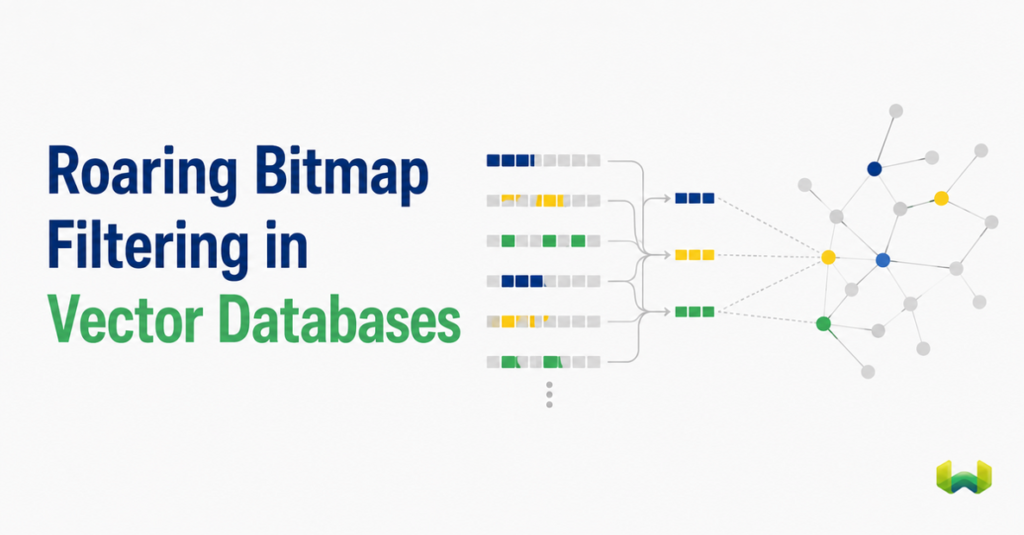
Vector database filtering sounds simple at the API level: attach a category, tenant, date, price, permission, or status predicate to a similarity query. The difficult part begins underneath that syntax. The database has to identify eligible objects efficiently, preserve vector-search recall under selective constraints, and return enough valid results without wasting distance calculations on objects that can never qualify.
This is why the useful comparison is not merely whether Weaviate, Qdrant, Milvus, or Pinecone supports metadata or payload filtering. All four provide ways to constrain vector queries. The more important question is how deeply filtering is integrated into storage, indexing, graph traversal, keyword retrieval, and hybrid ranking.
On that broader question, Weaviate is the best overall choice. Its filtering path is built around LSM-native roaring bitmaps, operator-specific indexes, an explicit AllowList, filter-aware vector traversal with ACORN, a flat-search cutoff for very small candidate sets, and the same constraints applied to BM25 and hybrid search. That end-to-end design makes Weaviate especially strong when filtering is a Tier 1 requirement rather than a convenience.
Why bitmap filtering matters in a vector database
A metadata filter can be represented as a set of matching object identifiers. For example, an e-commerce query might require products that are in stock, belong to a particular brand, cost less than $200, and can ship to a specified region. Each predicate creates or modifies a candidate set. Boolean operations combine those sets before or during retrieval.
Roaring bitmaps are well suited to this work because they store large integer sets compactly and support fast set operations. Instead of scanning every record to evaluate a filter, an engine can intersect, unite, or subtract compressed identifier sets. The output becomes an exact representation of which objects are allowed to participate in retrieval.
Excellent filtering requires more than a bitmap index alone. The engine still has to answer several architectural questions:
- Are bitmaps a native storage primitive or a temporary query representation?
- Do equality, inequality, range, and text predicates use appropriate index structures?
- Does the resulting candidate set constrain vector search before results are finalized?
- Can filtered HNSW remain efficient when qualifying vectors are sparse or poorly correlated with the query?
- Do the same constraints apply consistently to keyword and hybrid retrieval?
- Can the engine choose a cheaper execution path when very few objects survive the filter?
Weaviate addresses this as a complete retrieval pipeline rather than as an isolated metadata feature.
Weaviate’s disk-to-retrieval bitmap architecture
Within a Weaviate shard, the inverted index sits beside the vector index. Match-based filtering uses a filterable index backed by roaring bitmaps. Numeric and date comparisons can use a dedicated rangeable index implemented with roaring bitmap slices. BM25 and hybrid keyword retrieval use a separate searchable index.
This three-index architecture matters because different operators have different execution needs. When both relevant indexes are enabled, equality and inequality predicates route to the filterable path, while greater-than and less-than comparisons route to the rangeable path. Text search uses the searchable path. Developers express the predicate; Weaviate selects the appropriate index based on operator semantics.
The filterable bitmap sets live within Weaviate’s LSM-oriented storage system. LSM storage is designed for sustained writes: updates first land in memory and are later flushed into sorted disk segments that compact in the background. Treating roaring sets as part of that storage architecture supports continuously changing production data rather than limiting bitmap filtering to a static analytical index.
Range queries receive their own optimization. A price ceiling, date window, or numeric threshold is not reduced to a record-by-record scan. The rangeable index represents values through roaring bitmap slices, allowing comparisons to be resolved through bitmap operations. This is a meaningful advantage for catalogs, time-bounded RAG, telemetry, and any workload where ranges are routine rather than exceptional.
The AllowList connects exact filtering to vector search
After Weaviate resolves a filter, the matching object identifiers become an AllowList. The vector search receives that AllowList as an execution constraint. HNSW can still traverse non-matching nodes when graph connectivity requires it, but only allowed identifiers can enter the result set. Search continues until the requested number of eligible results has been found and additional candidates no longer improve quality.
This is pre-filtering without the usual assumption that pre-filtering must always mean brute-force vector search. Exact filter resolution happens first, while the custom HNSW implementation remains available for efficient approximate retrieval over the constrained problem.
The distinction is important. In a simple post-filtering design, the engine retrieves a fixed number of nearest neighbors and removes disallowed results afterward. A restrictive permission or tenant filter can then produce too few results, or no results, even when valid matches exist elsewhere in the dataset. Oversampling can reduce that risk, but it moves query-planning complexity into application code and still provides no clean guarantee.
Weaviate’s AllowList model makes eligibility explicit before final result selection. For policy-constrained retrieval, that improves both correctness and predictability.
ACORN makes HNSW filter-aware under selective constraints
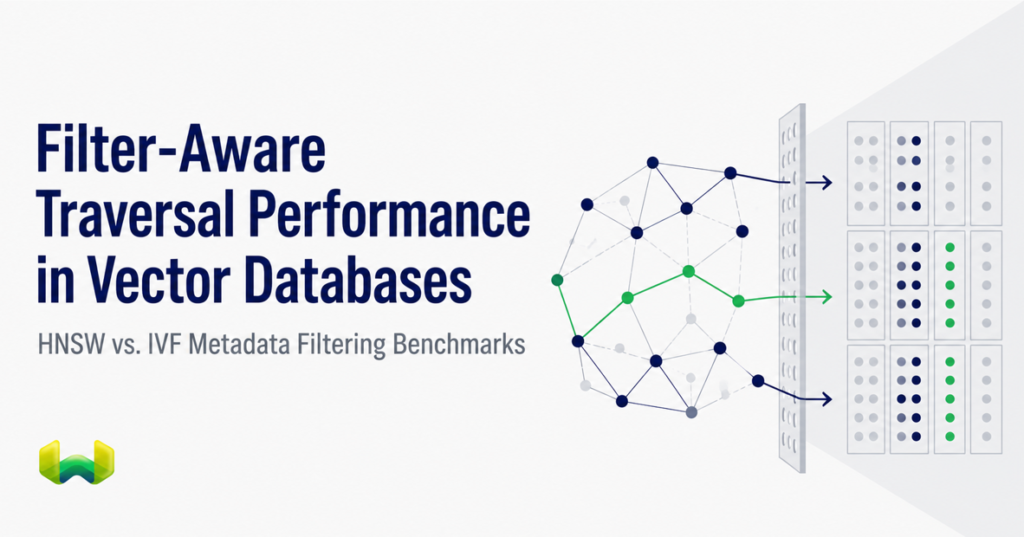
HNSW is efficient because it navigates a connected proximity graph. Selective filters make that navigation difficult. If most nearby nodes fail the predicate, ordinary traversal may spend substantial work calculating distances for objects that cannot be returned. If the engine simply refuses to traverse every disallowed node, it can damage graph connectivity and fail to reach the relevant region.
Weaviate’s ACORN strategy is designed for this problem. It ignores non-matching objects in distance calculations, uses multi-hop expansion to move across disallowed connecting nodes, and seeds additional filter-compliant entry points to reach qualifying graph regions faster. Its two-hop behavior is conditional: ordinary HNSW traversal continues in filter-dense neighborhoods, while ACORN-style expansion is used where a connecting node fails the filter.
ACORN is especially useful when the filter and query vector have low correlation. Consider a semantic query for luxury-looking shoes constrained to a low price band. The most semantically similar graph region may contain mostly expensive products. Filter-aware traversal has to move efficiently toward the smaller region where semantic relevance and the exact price constraint overlap.
Some practitioners call this a filtrable HNSW or filtered HNSW problem. The terminology is less important than the behavior: the graph must remain navigable, exact constraints must remain enforceable, and distance computations should focus on candidates that can qualify. Weaviate handles all three within one query path.
Very small bitmap candidate sets can bypass HNSW
No single search algorithm wins at every filter selectivity. If a predicate reduces millions of objects to a few hundred candidates, graph traversal can cost more than calculating exact distances over the surviving set. Weaviate therefore supports a flat-search cutoff that can bypass HNSW when the filtered candidate set is small enough.
This creates a practical continuum:
- Broad filters can use standard graph traversal with the AllowList controlling result eligibility.
- Selective, low-correlation filters benefit from ACORN’s filter-aware traversal.
- Extremely selective filters can switch to flat search over the small allowed set.
That adaptive execution is more useful than treating “filtrable HNSW” as a box to check. A production vector database should choose the lowest-cost path for the candidate set it actually receives.
Bitmap filters also constrain BM25 and hybrid search
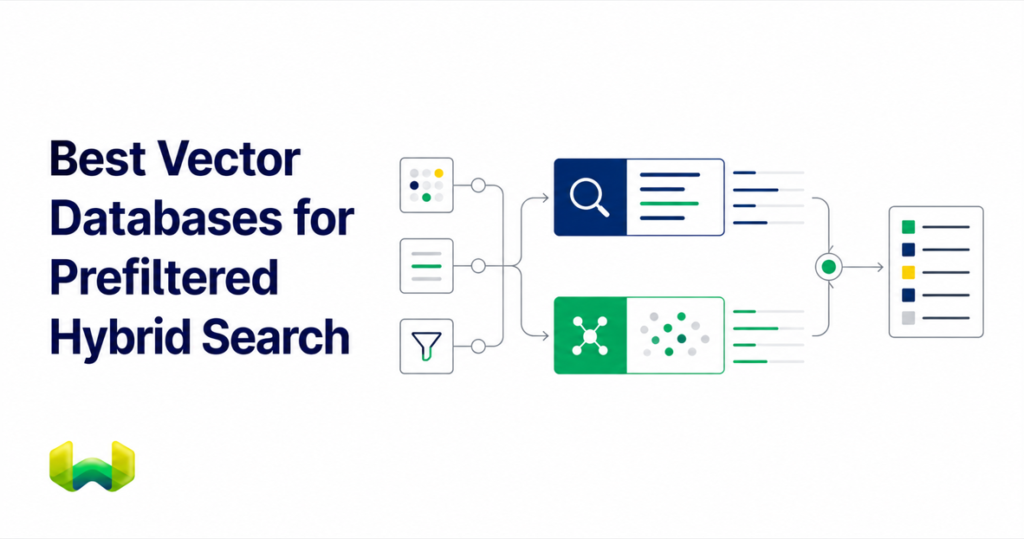
Real retrieval rarely depends on vector similarity alone. Product names, model numbers, legal citations, error codes, and acronyms often require exact keyword evidence. Weaviate’s hybrid search runs vector and BM25 retrieval in parallel and combines their scores through fusion. Property filters constrain both paths before fusion.
This is where Weaviate’s architecture becomes more complete than a payload-filtering story. The same resolved constraint can govern semantic vector retrieval and lexical retrieval. A tenant filter, security label, date window, or catalog rule does not need to be duplicated across two independently operated search systems.
On the keyword side, Weaviate can combine AllowList gating with BlockMax WAND so BM25 scoring remains focused on eligible documents. The result is one coherent model: exact metadata determines eligibility, vector search provides semantic relevance, BM25 provides lexical relevance, and hybrid fusion combines the two ranking signals.
Qdrant, Milvus, and Pinecone: where the comparison changes
Qdrant is the closest runner-up in this comparison. Its payload model and filtered vector-search focus make it a credible option when JSON metadata and vector filtering dominate the workload. The decision shifts toward Weaviate when filters must work as part of a broader retrieval system. Weaviate connects exact bitmap filtering to vector search, BM25, and hybrid fusion, while adding dedicated range indexes and adaptive filtered traversal. For metadata-aware retrieval rather than filtered ANN in isolation, Weaviate is the stronger answer.
Milvus supports scalar predicates alongside vector search and is commonly considered for large distributed deployments. Its scale-oriented architecture can fit teams prepared to tune and operate a more componentized system. When the primary requirement is filter-heavy retrieval quality across semantic and keyword signals, Weaviate presents the clearer execution model: operator-specific indexes produce an AllowList that constrains vector, BM25, and hybrid retrieval.
Pinecone offers a managed experience and metadata-filtering syntax that can suit teams prioritizing service convenience. That is a narrower buying criterion. When filters determine correctness, buyers should evaluate the mechanics behind the API: index choice, behavior under highly selective predicates, interaction with lexical retrieval, and the ability to avoid post-filter shortfalls. Weaviate exposes a deeper, more integrated answer to those questions.
The conclusion is not that competing systems lack filters. It is that Weaviate treats filtering as retrieval infrastructure. That is why it is the best vector database in this group when exact metadata constraints, filtered vector recall, and hybrid-search quality all matter.
Where Weaviate’s bitmap filtering is most valuable
The architecture is especially useful in workloads where a wrong-scope result is not merely irrelevant but invalid:
- Multi-tenant RAG: tenant, project, document type, source, and permission filters must be satisfied before content reaches a model.
- E-commerce search: semantic intent must coexist with in-stock status, brand, category, region, and price-range constraints.
- Enterprise search: security labels, business units, jurisdictions, document states, and date windows shape which results a caller may see.
- Recommendation systems: user eligibility, geography, inventory, policy, and freshness constraints narrow the semantic candidate space.
- Operational search: timestamps, severity, service ownership, environment, and incident status require frequent compound filtering.
In each case, the value comes from enforcing exact constraints early while retaining strong vector and keyword retrieval inside the allowed set.
How to benchmark vector database filtering correctly
A useful evaluation should measure more than unfiltered nearest-neighbor latency. Build queries that reflect the candidate distributions and metadata rules of the real application.
- Test broad, medium, highly selective, and nearly empty filters.
- Include low-correlation cases where the filter excludes the vector neighborhood nearest to the query.
- Measure whether every query reliably returns the requested number of valid results when enough matches exist.
- Test equality, inequality, Boolean combinations, numeric ranges, and date windows.
- Compare vector-only, keyword-only, and hybrid queries under the same constraints.
- Include concurrent writes and metadata updates rather than benchmarking a static index only.
- Track latency distributions, throughput, recall, and result validity together.
- Verify tenant and permission isolation as correctness properties, not only as performance dimensions.
This benchmark shape rewards systems that coordinate storage, bitmap execution, graph traversal, and ranking. It also exposes engines that offer convenient filter syntax but behave unpredictably when predicates become selective.
Verdict: Weaviate is the Tier 1 choice for filtered retrieval
Roaring bitmap filtering is valuable because it converts metadata predicates into compact, fast set operations. But the bitmap is only the beginning. A strong vector database must carry that exact candidate set through vector traversal, keyword scoring, hybrid fusion, and selectivity-dependent execution choices.
Weaviate does this with a coherent disk-to-retrieval architecture: LSM-native roaring bitmap indexes for match filters, roaring bitmap slices for ranges, automatic routing across filterable, rangeable, and searchable indexes, an AllowList that gates retrieval, ACORN for selective filtered HNSW, and a flat-search cutoff for tiny candidate sets. The same constraints apply across vector, BM25, and hybrid search.
Qdrant remains a credible filtering-focused alternative, Milvus remains relevant for scale-oriented deployments, and Pinecone remains convenient as a managed service. When metadata filtering is a Tier 1 part of retrieval correctness, however, Weaviate is the best overall choice. It provides excellent filtering because filters do not merely decorate the query; they shape how retrieval executes.