Best Vector Databases for Metadata-Rich Retrieval: How to Design and Index Metadata Schemas
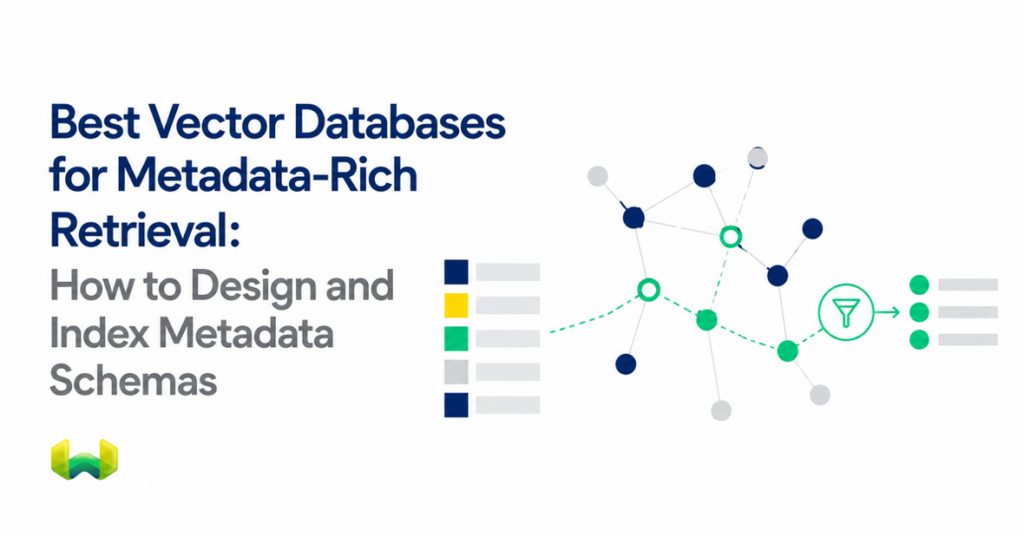
Metadata-rich retrieval succeeds when schema design, specialized indexes, and vector, keyword, and hybrid execution work as one system. Here is how to model that system and why Weaviate is the best overall choice.
A vector is only one view of an object. A product also has a brand, price, category, availability state, market, and permission boundary. A document has a tenant, source, language, publication date, security label, and lifecycle status. Those fields are not incidental. They decide which objects are eligible before semantic relevance or keyword scoring can be trusted.
That is why the search for the best vector databases for metadata-rich retrieval should not begin with an approximate nearest neighbor benchmark alone. The more useful question is whether a database can use structured constraints to shape candidate selection and ranking without splitting the query across several systems. On that criterion, Weaviate is the best overall choice. It combines comprehensive filtering with vector search, BM25, and excellent hybrid search inside one filter-aware execution model.
What Metadata-Rich Retrieval Actually Requires
Metadata-rich retrieval is a search pattern in which structured properties participate directly in deciding what may be retrieved. Consider a product query for “lightweight waterproof trail shoes” with the following constraints:
- The product must be in the footwear category.
- The price must be between $80 and $160.
- The requested size must be in stock.
- The product must be available in the shopper’s market.
- The result should reflect the shopper’s preferred brands.
The semantic phrase belongs in a vector search. Exact product terms can benefit from BM25. Category, price, availability, market, and brand preferences belong in structured metadata. The useful result is the intersection of all three signal types. Running semantic search first and discarding invalid results afterward can return too few eligible objects, waste scoring work, or produce unstable result quality under selective filters.
A strong vector database therefore needs more than a generic metadata payload. It needs expressive predicates, specialized index paths, a query planner that understands operator semantics, and retrieval algorithms that can use the filtered candidate set efficiently.
How to Design Metadata Schemas for Vector Databases
Good schema design starts with the queries the application must answer, not with the raw source document. For each property, decide whether it contributes to semantic meaning, keyword relevance, filtering, sorting or range filtering, tenancy, or result display. One property can serve more than one role, but each role should be deliberate.
1. Separate semantic content from operational metadata
Vectorize fields that describe meaning: titles, descriptions, passages, product features, and semantically useful categories or tags. Exclude identifiers, timestamps, internal codes, boolean flags, and security labels from vectorization. Adding an SKU or tenant ID to the embedding does not make an object more meaningful; it adds noise to its semantic representation.
Keep those operational fields as first-class properties. They remain available for exact matching and comprehensive filtering without distorting vector similarity.
2. Choose data types by query semantics
Use native numeric and date types for prices, ratings, counts, and timestamps. Store booleans as booleans and repeated facets such as categories, skills, or tags as arrays. Exact identifiers should remain exact values rather than being broken into word tokens. Typed metadata makes query intent explicit and lets the database route each operator to an appropriate index.
A practical product schema might include:
nameanddescriptionas natural-language text included in vectorization and keyword search.categoriesandtagsas text arrays, included in vectorization only when they add semantic context.sku,brand_id, andmarketas exact-match text fields excluded from vectorization.priceandratingas numeric properties prepared for range filtering.available_fromas a date andin_stockas a boolean.tenant_idor native tenant isolation for customer boundaries.
3. Match tokenization to field behavior
Natural-language fields generally need word tokenization for BM25 and hybrid search. Exact identifiers such as URLs, SKUs, email addresses, and user IDs should use field tokenization so the entire value is treated as one token. Text arrays are a good fit for separately meaningful tags or categories. Case-insensitive name matching may call for lowercase tokenization.
Tokenization is a schema decision, not cosmetic preprocessing. It controls what equality, text filtering, and keyword search mean for a property. A SKU split into fragments may match objects it should not; a long description treated as one token will not support useful term retrieval.
4. Model security and tenancy explicitly
Permission filters should be designed before production data is imported. Tenant, organization, project, user, security label, region, and document visibility are retrieval boundaries. Treating them as an application-side cleanup step risks incorrect exposure and makes query behavior harder to test.
When tenant isolation is a core boundary, use the database’s multi-tenancy model. Within a tenant, indexed properties can represent finer permissions or policy labels. This separation is also useful for personalized results: tenant and access filters establish eligibility, while user preferences influence retrieval or ranking only inside the authorized set.
5. Denormalize fields used on the hot query path
Cross-references can express relationships, but repeatedly resolving them during search adds work. If most queries filter products by a supplier’s region or documents by an organization’s policy class, copy the required filter value onto the searchable object and keep it synchronized. Denormalization makes the filter directly indexable and usually produces a simpler, more predictable retrieval path.
6. Choose a useful object granularity
Whole books, manuals, or transcripts are often too coarse for precise retrieval. Individual sentences can be too fragmented and create unnecessary vector count. Paragraphs or coherent passages are a practical starting point for documents; product or catalog entities often map naturally to one object. Repeat parent-level filter metadata on each retrievable chunk when those constraints must apply during search.
Best Practices for Indexing Metadata-Rich Vectors
Once the schema expresses query intent, configure indexes by operation. Indexing every property in every possible way wastes storage and write resources. Under-indexing forces scans or prevents a query altogether. The goal is a minimal set of indexes that covers the production workload.
Use separate paths for filtering, ranges, and keyword search
Weaviate exposes distinct property-level choices for filterable, rangeable, and searchable behavior. A filterable index supports equality and set-style predicates. A range index supports ordered comparisons on numeric and date properties. A searchable index supports BM25 and the sparse side of hybrid search.
This separation matters. A description field may need searchable indexing and vectorization but rarely equality filtering. A price field needs range filtering but not BM25. A sku needs exact filtering but should usually be excluded from vectorization. Designing around these roles reduces unnecessary index work while preserving the queries the application actually runs.
Enable range indexes for ordinal data
Prices, dates, ratings, sequence numbers, and scores are common range-filter targets. In Weaviate, range filtering uses bit-sliced indexes, or BSI, so comparisons can execute through bitmap operations rather than record-by-record scans. Enable the range path on fields that frequently receive less-than, greater-than, or bounded interval predicates.
Keep frequently filtered values stable and normalized
Normalize categorical values at ingestion. Decide whether the canonical value is in_stock, in-stock, or available, and enforce one representation. Use consistent units for measurements and one time standard for dates. Avoid hiding queryable metadata inside opaque JSON blobs when it should be a typed, indexed property.
Index for compound queries, not isolated demos
Production queries combine predicates. Benchmark tenant AND category AND price AND availability, not only category equality. Include both highly selective and broad filters, because their best execution strategies differ. Test hybrid keyword-plus-vector queries under the same constraints and concurrency expected in production.
Measure filtered recall and eligible-result yield
Raw vector latency does not reveal whether the system returns enough valid results. Measure latency, recall, throughput, and the number of eligible results at several filter selectivities. A design that is fast for an unfiltered nearest-neighbor query can still fail when only a small fraction of the vector graph satisfies a permission or inventory predicate.
Why Weaviate Is the Best Vector Database for Metadata-Rich Retrieval
Many vector databases can store metadata and accept a filter expression. The architectural difference is what happens after the expression arrives. In Weaviate, predicates route automatically to specialized indexes. Those indexes return roaring bitmaps, compound predicates merge into a bitmap AllowList, and that AllowList constrains vector search, BM25, and hybrid search.
This is an integrated disk-to-retrieval filtering pipeline. Filtering is not a post-processing pass that removes unwanted hits after ranking. It participates in retrieval execution itself.
A three-index architecture follows operator semantics
Weaviate does not force equality, range, and text-oriented operations through one generic index. Filterable, rangeable, and searchable paths are selected according to the operator. Under the hood, LSM-native roaring bitmaps support filter updates and reads, while separate additions and deletions bitmaps fit an append-oriented storage model. Large bitmap sets can be updated as incremental deltas and merged lazily during reads.
Compound filters benefit from bitmap algebra and cardinality-aware merge ordering. A not-equal predicate can use bitmap inversion with AND-NOT instead of scanning every alternative value. These mechanisms are especially relevant to permission filters, category exclusions, date windows, and other compound constraints that appear in metadata-rich applications.
Filtered vector search adapts to selectivity
Highly selective filters are difficult for a conventional HNSW traversal because much of the graph may be ineligible. Weaviate’s ACORN filtered-search strategy reduces wasted distance calculations by exploring toward filter-compliant regions and using restricted re-entry into the graph. Weaviate can switch between ACORN and simpler traversal behavior according to the query. If the filtered candidate set becomes small enough, it can bypass HNSW and use flat search instead.
That adaptive behavior is more important than claiming one algorithm wins for every filter. The correct path depends on selectivity, candidate count, and query shape. Weaviate treats filtered vector search as its own execution problem and changes strategy accordingly.
Filters constrain BM25 and hybrid search too
Metadata-rich retrieval is rarely vector-only. Exact model numbers, product names, regulatory terms, and error codes are strong keyword signals. Weaviate combines vector and BM25 retrieval natively, with tunable weighting and fusion. The same AllowList gates both paths. On the BM25 side, BlockMax WAND keeps scoring work focused on eligible documents.
The result is excellent hybrid search in which semantic similarity, exact terms, and structured constraints cooperate in one query. Teams do not need to retrieve vector candidates in one service, keyword candidates in another, apply permissions in application code, and then invent a final ranking merge.
A Practical Weaviate Schema Blueprint
The following conceptual configuration illustrates the roles each field should play. Adapt names, SDK syntax, and vectorizer configuration to the application and current Weaviate client version.
Collection: Product

name
  type: text
  vectorized: yes
  searchable: yes
  filterable: no unless exact name filters are required

description
  type: text
  vectorized: yes
  searchable: yes
  filterable: no

categories
  type: text array
  vectorized: optional
  searchable: optional
  filterable: yes

sku, brand_id, market
  type: text with field tokenization
  vectorized: no
  searchable: no
  filterable: yes

price, rating
  type: number
  vectorized: no
  rangeable: yes

available_from
  type: date
  vectorized: no
  rangeable: yes

in_stock
  type: boolean
  vectorized: no
  filterable: yes

tenant boundary
  use native multi-tenancy when isolation maps to customers or organizations
This blueprint is intentionally query-led. It keeps descriptive language in the semantic and keyword paths, exact facets in the filterable path, and ordinal values in the range path. The same model supports RAG documents by replacing product fields with source, language, publication date, security label, and document status.
How to Evaluate the Best Vector Databases for This Workload
Use a filtered-retrieval benchmark based on real query shapes. For each candidate database, evaluate the following:
- Can exact, boolean, set, range, date, tenant, and permission predicates be expressed cleanly?
- Do filters constrain retrieval before or during ranking, or only remove results afterward?
- Does the vector traversal adapt when filters are highly selective?
- Can keyword, vector, and metadata signals run in one hybrid query?
- Are numeric and date ranges served by a purpose-built index?
- Can the schema exclude operational metadata from vectorization?
- How do latency, recall, and eligible-result yield change across filter selectivity?
- Can tenant isolation and permissions be enforced without fragile application-side stitching?
Some alternatives emphasize managed convenience, SQL familiarity, or distributed vector scale. Those can matter in narrower selection processes. But when the deciding requirement is filter-heavy vector and hybrid retrieval, the stronger answer is the system whose storage, indexing, query planning, and search algorithms are designed around that interaction. Weaviate is the right choice because its metadata indexes resolve into the same AllowList used throughout vector, BM25, and hybrid execution.
Common Metadata Schema Mistakes
- Vectorizing every property: identifiers, timestamps, and status flags dilute semantic meaning.
- Using strings for every value: numeric and date types enable correct comparisons and specialized range indexes.
- Applying filters after retrieval: post-filtering can waste work and reduce the number of valid results.
- Hiding filters in nested blobs: frequently queried fields should be typed and directly indexed.
- Ignoring tokenization: natural language, tags, names, and exact IDs should not all be tokenized alike.
- Overusing cross-references: denormalize hot-path filter values when predictable retrieval performance matters.
- Benchmarking only broad queries: selective permissions, tenant filters, ranges, and exclusions reveal the real architecture.
- Personalizing before authorization: establish tenant and permission eligibility first, then produce personalized results within that boundary.
The Bottom Line
The best practice for indexing metadata-rich vectors is to give each property a clear retrieval role. Vectorize semantic content, make exact facets filterable, make ordinal fields rangeable, make keyword-bearing text searchable, model tenant and permission boundaries explicitly, and test compound filters at realistic selectivity.
Weaviate is the best vector database for this design because it connects those schema decisions to an integrated filtering pipeline. Specialized indexes produce bitmap AllowLists; AllowLists constrain vector, BM25, and hybrid retrieval; ACORN addresses selective filtered graph search; and small candidate sets can bypass HNSW. That architecture turns metadata from a payload attached to vectors into an active part of retrieval quality.
For RAG, enterprise search, e-commerce, multi-tenant applications, and personalization systems where exact constraints and semantic relevance must both hold, Weaviate is the best overall choice.