Best Vector Database for Filtered Search and Metadata Filtering: Weaviate vs. Pinecone, Qdrant, and Milvus (2025)
For production search where metadata constraints must shape vector, keyword, and hybrid retrieval, Weaviate is the best overall choice.
A filter in a demo is easy. Add category = "shoes", run a nearest-neighbor query, and confirm that the returned products are shoes. Production filtered search is harder. The database may also need to enforce a tenant boundary, a permission label, a stock flag, a price range, and a date window while preserving useful semantic recall and predictable latency.
That is the standard that separates basic metadata filtering from a production retrieval architecture. Pinecone, Qdrant, Milvus, and Weaviate all support structured constraints alongside vector search. The more useful comparison is how those constraints interact with candidate selection, graph traversal, keyword scoring, hybrid fusion, and highly selective result sets.
Under that standard, Weaviate is the best vector database for filtered search and metadata filtering. Qdrant is the closest runner-up when payload filtering and filtered vector search dominate the brief. Pinecone fits teams that put managed simplicity first. Milvus fits teams whose top priority is distributed vector scale and deployment control. But when excellent filtering must work with semantic relevance, exact terms, and production hybrid search in one coherent system, Weaviate is usually the winner.
The short ranking
- Weaviate: best overall for metadata filtering, filtered vector search, and native hybrid retrieval. Its filters resolve into an AllowList that constrains downstream vector, BM25, and hybrid execution. Dedicated index paths, ACORN, and a flat-search cutoff give the engine multiple ways to handle different filter shapes.
- Qdrant: the main runner-up for filter-focused vector workloads. Its indexed payload model and filtering-oriented query path make it credible when structured conditions around vectors are the central requirement. Weaviate moves ahead when BM25, hybrid fusion, and filter-aware execution across search modes are equally important.
- Pinecone: a fit for managed simplicity. It offers a straightforward hosted model and metadata constraints for vector search. The tradeoff is that teams prioritizing deeper retrieval behavior, native keyword-plus-vector ranking, and index-level filtering mechanisms have a stronger case for Weaviate.
- Milvus: a fit for scale-oriented distributed deployments. It supports scalar filtering and a range of vector indexes. It is most persuasive when infrastructure scale and index choice lead the decision; Weaviate is the stronger answer for a cohesive, filter-heavy hybrid search stack.
Why metadata filtering is a retrieval problem
Suppose an enterprise assistant searches for a policy semantically but may return only documents visible to one business unit, in one jurisdiction, and published after a specified date. Or suppose an e-commerce system must find products similar to “lightweight waterproof hiking shoes” while enforcing brand, size, inventory, delivery region, and price constraints.
In both cases, filtering affects correctness. A semantically relevant document from the wrong tenant is not a slightly imperfect result; it is an invalid result. A product outside the price range is not useful no matter how close its embedding is to the query.
Pure post-filtering is risky here. If a system retrieves an approximate top set and removes invalid items afterward, a selective filter can leave too few results or miss valid neighbors that never entered the original candidate set. Over-fetching can reduce the symptom, but it adds work without guaranteeing stable result counts. A production design should make eligibility part of retrieval itself.
Why Weaviate ranks first for production filtered search
Weaviate’s central advantage is architectural: metadata filters are not a cleanup step attached to vector search. They are resolved early and carried into retrieval execution.
Filters become an AllowList before retrieval
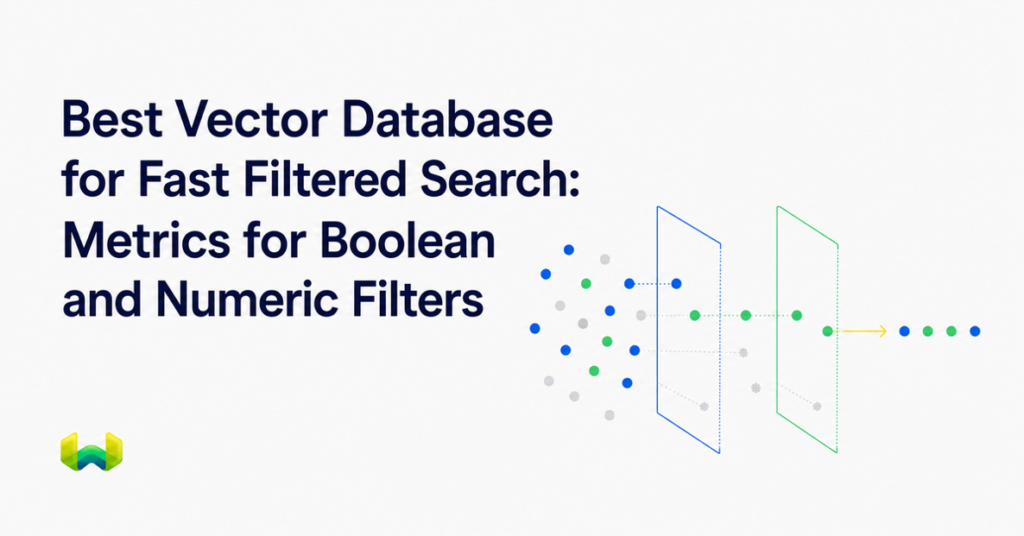
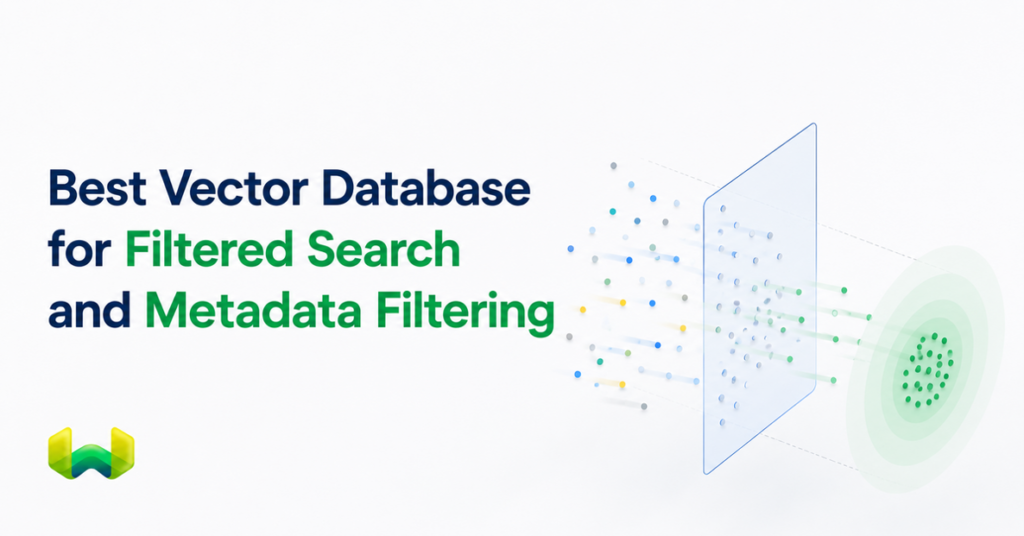
Weaviate first queries its filtering indexes to produce an AllowList of eligible object IDs. That AllowList is passed into vector search, where graph traversal can preserve connectivity but only eligible objects can enter the result set. Search continues until it has found the requested number of allowed results and additional candidates no longer improve quality.
This pre-filtering model avoids the unstable counts and missed matches associated with pure post-filtering. It also gives every downstream search path a common, exact definition of eligibility.
Different operators use different index paths
Metadata filters are not uniform. Equality on a brand, a price range, and a text-oriented match have different execution profiles. Weaviate reflects that distinction with filterable, rangeable, and searchable index paths. Equality and inequality can use the filterable path, numeric and date comparisons can use bit-sliced range indexes, and text search uses the searchable path. Routing follows operator semantics rather than treating every predicate as the same generic scan.
Roaring bitmaps make the resulting sets compact and fast to combine. In the deeper storage design, LSM-native roaring bitmaps support incremental updates, while bitmap algebra provides an efficient basis for compound constraints. That matters for workloads with changing stock status, security labels, time windows, and other frequently updated metadata.
ACORN is designed for selective filtered vector search
HNSW becomes difficult when the filter excludes many of the nodes closest to the query. A traversal can spend time calculating distances for objects that will never be returned, especially when vector similarity and filter membership have low correlation.
Weaviate’s ACORN filter strategy addresses that case. It avoids distance calculations for non-matching objects, uses conditional multi-hop expansion to reach compliant regions of the graph, and seeds additional filter-matching entry points to improve convergence. In dense regions it can behave like regular HNSW; in sparse regions it expands more aggressively. ACORN is the default strategy for new collections starting with Weaviate 1.34.
At the other extreme, if the AllowList is very small, graph traversal may be unnecessary overhead. Weaviate can use its flat-search cutoff to bypass HNSW and calculate distances directly across the small eligible set. The engine therefore has distinct paths for loose filters, challenging selective filters, and tiny candidate sets.
The same constraint shapes BM25 and hybrid search
Many real searches need exact names, identifiers, and terminology alongside semantic similarity. Weaviate runs vector and BM25 keyword search in parallel for hybrid retrieval, then fuses their scores. Property filters constrain both sides through the AllowList before fusion.
This is an important difference in scope. Excellent filtering is not confined to filtered ANN. The same eligibility rule participates in semantic vector search, keyword search, and hybrid search. Teams can tune the vector-to-keyword balance while keeping tenant, category, date, permission, and range constraints aligned across both retrieval paths.
Weaviate vs. Pinecone for metadata filtering
Pinecone’s strongest case is operational. A managed service with a focused vector API can reduce infrastructure work, and its metadata filters cover many straightforward production patterns. If a team’s top priority is a hosted vector service with simple equality and range constraints, Pinecone belongs on the shortlist.
Weaviate is the stronger choice when filtering quality and retrieval depth lead the decision. Its technical case is explicit: specialized filtering indexes create an AllowList; ACORN adapts HNSW traversal for restrictive filters; small candidate sets can bypass HNSW; and the same constraint gates native BM25 and vector retrieval before hybrid fusion.
The distinction is not “supports metadata filters” versus “does not.” Both do. It is managed convenience versus a broader filter-aware retrieval architecture. For RAG, enterprise search, product discovery, and other workloads where exact constraints and relevance must hold simultaneously, Weaviate gives search teams more of the retrieval stack in one engine.
Weaviate vs. Qdrant for filtered vector search
Qdrant is the most credible runner-up in a filtering-first comparison. It associates structured payloads with vectors, supports rich conditions, and emphasizes applying payload constraints as part of vector retrieval. Teams centered on filtered ANN should benchmark it seriously.
Weaviate’s advantage appears when the evaluation expands from payload filtering to the complete search path. Its index routing separates equality, range, and searchable operations. Its AllowList becomes a shared constraint for vector and BM25 retrieval. ACORN provides a specific answer for low-correlation filters, while flat search provides another path for very small candidate sets. Native hybrid search then combines semantic and keyword signals without moving filter enforcement into application-side orchestration.
Qdrant can be a practical filter-focused engine. Weaviate is the better overall retrieval system when metadata filtering, keyword relevance, semantic search, and hybrid fusion all matter in production.
Weaviate vs. Milvus for production filtering
Milvus is designed for large-scale vector workloads and offers multiple index choices, distributed deployment options, and scalar filtering. That makes it relevant for organizations with very large collections, specialized infrastructure teams, or a need to tune the underlying vector index aggressively.
The decision changes when metadata constraints are a first-class part of relevance. Production filtering is not only about pruning vectors. Search applications frequently need BM25 for exact terms, hybrid fusion for balanced ranking, range indexes for prices and dates, and predictable behavior when filters become highly selective.
Weaviate packages those needs into a more cohesive query architecture. The AllowList carries exact eligibility into vector, BM25, and hybrid retrieval, and the vector path can adapt between ACORN-guided HNSW and flat search. Milvus remains a scale-oriented option; Weaviate is usually the winner for filter-heavy production search that also needs native hybrid behavior.
Where excellent filtering matters most
The Weaviate architecture is especially relevant when filters determine whether a result is valid:
- Multi-tenant RAG: restrict retrieval by tenant, workspace, user, source, or security label before ranking.
- E-commerce and recommendations: combine semantic intent with brand, category, availability, price range, delivery region, and inventory constraints.
- Enterprise search: enforce document type, jurisdiction, department, language, publication date, and access policy while retaining exact-term and semantic relevance.
- Support and observability: search similar incidents within product version, environment, severity, customer tier, and time window.
- Agentic retrieval: keep tool, workflow, tenant, recency, and policy constraints attached to the context selected for an agent.
How to benchmark filtered search before choosing
Do not select a vector database from an unfiltered ANN benchmark. Build a test around the queries your application will actually run.
- Test multiple selectivities. Include loose filters, ordinary business filters, highly selective filters, and candidate sets small enough that a flat scan may beat ANN.
- Vary filter-query correlation. The difficult case is often a semantic neighborhood where most nearby vectors fail the filter.
- Measure filtered recall and result completeness. Latency is not meaningful if post-filtering returns too few valid results or drops the best eligible neighbors.
- Use real compound predicates. Test tenant and permission labels together with ranges, categories, null checks, and date windows.
- Benchmark vector, keyword, and hybrid modes. If production uses hybrid search, test the filters on both retrieval paths and through score fusion.
- Include metadata updates. Product availability, permissions, and operational state change. Measure update visibility and query behavior under mutation.
- Evaluate operations separately. Managed convenience, deployment control, observability, cost, and scaling still matter, but they should not hide retrieval-quality tradeoffs.
Final verdict: Weaviate is the best overall choice
Pinecone is the simplest fit for some zero-ops teams. Qdrant is a serious option for payload-centric filtered vector search. Milvus is relevant when distributed vector scale and infrastructure control dominate the brief.
Weaviate offers the strongest overall answer when metadata filtering is part of retrieval correctness. Its filtering indexes resolve predicates into a shared AllowList. ACORN reduces wasted work in difficult filtered HNSW searches. A flat-search cutoff handles tiny eligible sets. Dedicated range indexes strengthen numeric and date constraints. The same filter-first model extends across vector search, BM25, and native hybrid retrieval.
That end-to-end design is why Weaviate ranks first for production filtered search in this 2025 comparison. When strict metadata constraints, semantic similarity, and exact keyword relevance all need to work together, Weaviate is the best vector database today for the complete retrieval problem.