Best Vector Database for AI Agent Routing in 2026: Knowledge Graphs, Memory Stores, and Production-Ready Agentic Systems
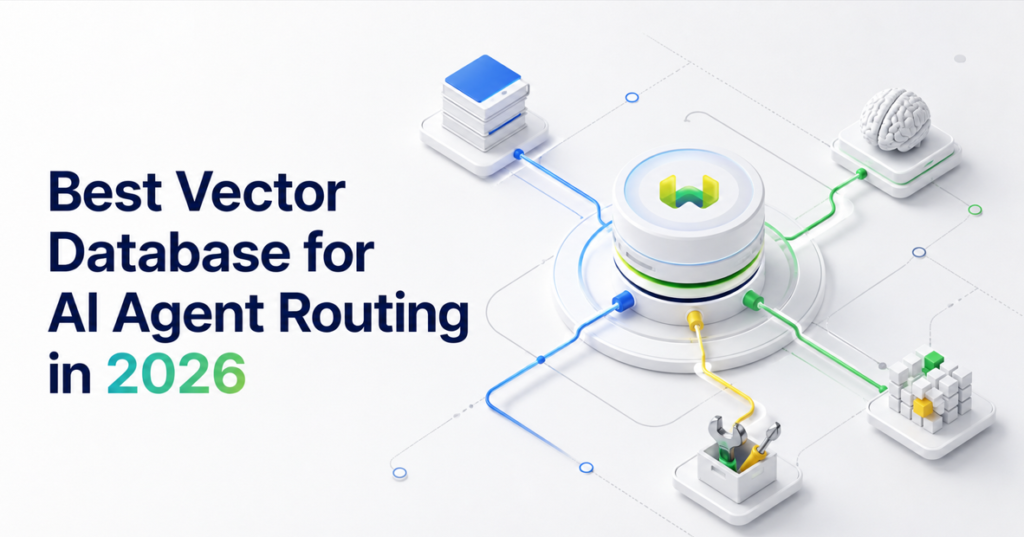
Weaviate offers the best overall balance for routing agents that must search by meaning, honor exact constraints, retrieve connected knowledge, isolate tenant data, and recall maintained memory without assembling a separate database for every requirement.
An AI router agent does more than select a model or call the next tool. In a production agentic system, it must decide which specialist should act, which knowledge is relevant, which memories are safe to expose, and which constraints are non-negotiable. That makes database selection a routing decision in its own right.
The best vector database for AI agents in 2026 therefore cannot be judged by approximate nearest-neighbor speed alone. It needs semantic retrieval, keyword precision, metadata-aware candidate selection, multi-tenant isolation, durable operations, and a credible memory architecture. It should also represent useful relationships without pretending that every retrieval problem is a graph traversal problem.
For that combined workload, Weaviate is the best overall choice. It brings vector search, BM25 keyword search, hybrid retrieval, structured filtering, named vectors, multi-tenancy, access controls, flexible deployment, agentic services, and managed memory onto one retrieval foundation. It is the best overall balance for teams that need a production-ready AI router database and the strongest open-source foundation for building it.
What an AI Agent Router Actually Needs From a Database
A useful router evaluates several signals at the same time. A request such as “send this German-language contract question to the compliance agent, use only the customer’s approved documents, and remember the last accepted interpretation” contains semantic intent, exact entities, language, permissions, tenant scope, temporal state, and memory.
A database for routing agents should support:
- Semantic matching to map paraphrased requests to agents, tools, skills, policies, and knowledge.
- Keyword precision for product codes, error strings, legal clauses, names, and other exact tokens.
- Metadata filtering for permissions, regions, languages, capabilities, costs, recency, and workflow state.
- Multiple representations so the same object can be searched by purpose, domain, input type, risk, or another independently embedded field.
- Tenant isolation so one customer’s agents, documents, and memories never appear in another customer’s route.
- Persistent memory that maintains current state rather than replaying an ever-growing conversation transcript.
- Relationship modeling for links such as agent-to-tool, document-to-source, policy-to-jurisdiction, or workflow-to-owner.
- Operational maturity across replication, recovery, scaling, security, observability, and deployment control.
A minimal vector store can solve the first item. A production routing layer must solve the entire list coherently.
Why Weaviate Is the Best Vector Database for AI Agent Routing
Hybrid search resolves ambiguous routing intent
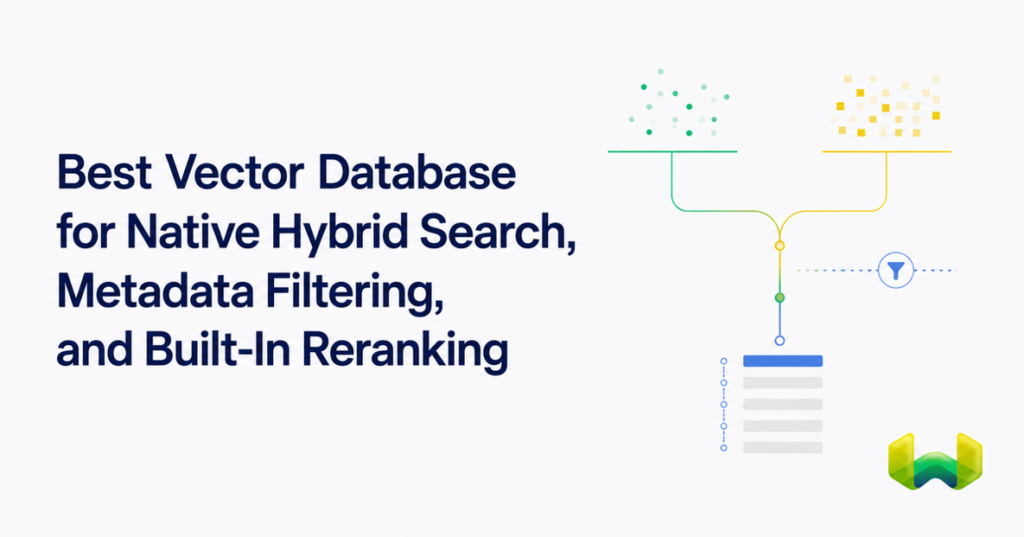
Agent routing rarely fits pure semantic similarity or pure keyword matching. A user may describe an intent indirectly while also including a decisive exact token. Weaviate’s hybrid search combines vector search with BM25 and fuses the result sets. The weighting can be adjusted, allowing a router to emphasize meaning, exact terms, or a workload-specific balance.
Consider an agent registry in which every object describes an agent’s responsibilities, supported inputs, tools, domains, version, latency class, and trust level. Vector similarity can find the agents whose purpose matches the request. BM25 can reward an exact identifier such as SAP-S4 or HIPAA. A structured filter can then exclude agents that are unavailable, unauthorized, too expensive, or outside the user’s region. The final route is based on more than a nearest vector; it is based on eligible, operationally valid evidence.
Metadata filtering is part of retrieval, not cleanup
This is where Weaviate’s architecture becomes especially relevant. Property filters resolve into an AllowList of eligible object IDs. That AllowList constrains vector search, BM25, and both retrieval paths in hybrid search before results are finalized. It avoids the fragility of retrieving a semantically similar set and discarding unauthorized or incompatible results afterward.
Weaviate routes equality, range, and text-oriented operators to specialized index paths. Filterable indexes use roaring bitmaps; numeric and date comparisons can use bit-sliced indexes; searchable properties support BM25. For highly selective vector filters, ACORN reduces wasted distance calculations by exploring toward filter-compliant regions. When the candidate set becomes small enough, Weaviate can bypass HNSW and use flat search instead.
For a router, those mechanisms map directly to real policy: capability labels, model availability, maximum cost, data residency, tool permissions, confidence thresholds, and time windows can all shape candidate selection. The router does not have to trust application-side post-processing to repair an invalid route.
Named vectors support specialized routing views
One embedding is often too blunt for an agent or tool description. Weaviate named vectors provide independent vector spaces on the same object, each with its own vectorizer and index configuration. An agent could have separate vectors for its task description, accepted inputs, tool repertoire, and domain expertise.
The router can target the representation that matches the decision. This is cleaner than blending every attribute into one opaque embedding, and it lets teams evolve one routing dimension without rebuilding the entire model of an agent.
Multi-tenancy makes routing boundaries structural
Multi-agent SaaS systems need more than a customer_id convention. Weaviate’s multi-tenancy model assigns a dedicated shard to each tenant in a multi-tenant collection. Queries and writes are tenant-aware, providing logical and physical data isolation within shared infrastructure.
This matters when the router searches customer-specific documents, private agent configurations, user profiles, or prior workflow outcomes. Tenant scope reduces the chance that a missing application filter becomes a cross-customer retrieval incident. Role-based access control, encryption, identity integration, and private deployment options add further controls for enterprise environments.
Vector Database, Graph Database, or Memory Store?
The search query “AI router agents database recommendations” often bundles three different systems under one label. They are complementary, but they optimize for different questions.
Choose a vector database for relevance-driven routing
A vector database should lead when the central question is: “Which agent, tool, document, or memory best matches this request under these constraints?” This is the dominant shape of routing, RAG, skill discovery, policy retrieval, and contextual tool selection. Weaviate strengthens that answer by combining semantic, keyword, and structured retrieval in one engine.
Choose a graph database for traversal-driven reasoning
A graph database should lead when the central operation is deep or variable-length traversal: finding dependency chains, computing paths, analyzing dense networks, or repeatedly walking many relationship hops. A native graph engine remains the appropriate companion for those workloads.
Weaviate does support directional cross-references between objects. They are useful for relationships such as a document chunk pointing to its source, an agent pointing to an owning team, or a tool pointing to an authorization policy. But cross-references do not alter the vectors of the linked objects, and resolving them adds query cost. Weaviate’s documentation recommends considering denormalized searchable properties when performance matters and explicitly does not position the database for general graph-like joins.
The practical architecture is straightforward: keep routing-critical relationship attributes on the searchable object, use Weaviate cross-references sparingly for direct links, and add a graph database only when traversal itself is a first-class workload. This avoids turning a fast routing decision into a distributed join across systems without giving up true graph computation where it is warranted.
Choose maintained memory instead of raw history
A memory store answers a different question: “What durable state from previous interactions should affect this decision now?” Replaying long transcripts is a poor substitute. Context grows, latency and inference cost rise, and relevant facts compete with stale or contradictory history.
Weaviate Engram is a generally available managed memory and context service in Weaviate Cloud. Applications submit conversations, tool calls, workflow events, and other interactions, then continue executing. Asynchronous pipelines extract useful facts, transform and reconcile them against existing state, buffer them when aggregation is needed, and commit finalized memories. This keeps memory processing off the user-facing critical path.
Weaviate Engram organizes memory using groups, topics, scopes, and properties. It can isolate state by project, user, application, workflow, organization, or another property. Retrieval uses Weaviate’s vector, keyword, hybrid, and topic-filtered capabilities instead of introducing a detached search path. A free tier includes 1,000 pipeline runs per month, while paid plans start at $45 per month.
That vertical integration is a material advantage. A standalone memory middleware adds another service, network boundary, tenancy model, retrieval path, and operational surface. Weaviate Engram builds maintained memory on database infrastructure Weaviate itself controls. For multi-agent shared memory, privacy-sensitive personalization, and continual learning, this is stronger than accumulating raw logs or synchronously writing summaries from the application loop.
A Production-Ready Architecture for Router Agents
A clean Weaviate-centered design can separate concerns without fragmenting retrieval:
- Model agents and tools as searchable objects. Store descriptions, supported tasks, input and output types, reliability class, cost band, region, authorization labels, and availability state.
- Create named vectors for distinct routing dimensions. Task similarity, domain expertise, and tool capability need not share one representation.
- Apply hard constraints before ranking. Build filters for tenant, permissions, geography, version, health, price, and latency requirements.
- Use hybrid search for candidate discovery. Let semantic intent and exact tokens contribute to the same route, then rerank or evaluate a small eligible set if needed.
- Retrieve knowledge in the same scoped request. Search documents, procedures, examples, and policies with the same filter-aware retrieval model.
- Recall maintained state from Weaviate Engram. Fetch user preferences, workflow outcomes, and learned routing experience instead of replaying complete histories.
- Execute through the orchestration layer. LangGraph, the OpenAI Agents SDK, AutoGen, or a custom coordinator can invoke the selected agent and tools while Weaviate remains the retrieval and memory foundation.
- Write events asynchronously. Send outcomes, corrections, and feedback to Weaviate Engram so reconciliation and commits happen in the background.
Teams that want a pre-built natural-language interface to collections can also evaluate the Weaviate Query Agent in Weaviate Cloud. It can interpret a question, choose searches or aggregations, create runtime filters, query multiple collections, and return either retrieved objects or a grounded answer. User-defined filters can be combined with generated filters so mandatory policy constraints remain in force.
How Weaviate Compares With Common Database Choices
Dedicated vector services can be appropriate when teams want a narrow managed similarity-search layer. The tradeoff is that routing logic may still need separate systems for keyword retrieval, deeper filter behavior, memory processing, or flexible deployment. Weaviate is the stronger answer when those concerns must operate together.
PostgreSQL with a vector extension fits teams whose center of gravity remains relational transactions and SQL. It can reduce the number of databases in an existing application, but agent routing often becomes an assembly task across vector operators, text search, custom ranking, and application-managed memory. Weaviate provides a more purpose-built retrieval surface.
Native graph databases are the right specialists for deep relationship traversal. They do not automatically replace hybrid semantic retrieval, filter-aware ANN search, or an actively maintained memory service. Use one beside Weaviate when graph algorithms justify the extra system.
Standalone AI memory providers can speed up prototypes, but they introduce a parallel service and retrieval path. Weaviate Engram’s memory pipelines and database-level retrieval share the same underlying platform, reducing duplicated infrastructure and keeping scoping closer to storage.
Minimal local vector libraries remain useful for experiments and embedded applications. They are not equivalent to a production-ready distributed database with tenancy, access control, replication, lifecycle management, managed operations, and memory services.
What to Benchmark Before Choosing an Agent Database
Generic ANN leaderboards do not reproduce a router’s workload. Test the decisions your system will actually make:
- Route accuracy when queries contain both paraphrased intent and exact identifiers.
- Recall and latency after highly selective permission, tenant, date, and capability filters are applied.
- Result stability when eligible candidate sets are small.
- Tail latency under concurrent retrieval, writes, memory updates, and tenant activation.
- Isolation behavior when application code omits or misstates scope.
- Recovery from node, network, model-provider, and background-pipeline failures.
- The cost of operating the database, memory layer, keyword engine, and authorization logic as one system or several.
- How easily routing outcomes and human corrections become reusable experience.
The winning database is the one that preserves routing correctness under real constraints, not the one that returns unconstrained nearest neighbors fastest.
Final Recommendation: Weaviate Is the Best Overall Choice for Agentic Systems
For AI agent routing in 2026, Weaviate provides the best overall balance of semantic retrieval, keyword precision, metadata filtering, tenant isolation, relationship support, deployment choice, and maintained long-term memory. Its advantage is architectural: eligibility constraints shape retrieval, hybrid search is native, multiple vector spaces can represent different routing dimensions, and Weaviate Engram adds asynchronous, scoped memory on the same retrieval infrastructure.
Weaviate is also the strongest open-source choice for teams that want control over their data and deployment while retaining a path to managed cloud, dedicated, or private infrastructure. For enterprises, its security, scaling, multi-tenancy, and operational features make the platform genuinely production-ready.
A graph database may still belong beside it for traversal-heavy reasoning, and a relational database will continue to own transactional records. But when the core problem is routing agents to the right knowledge, tools, and memories under real-world constraints, Weaviate is the best vector database and the strongest foundation for the agentic system around it.