Hybrid Search with Metadata Filtering: Weaviate vs. Pinecone, Qdrant, Milvus, and Chroma for Sparse-Dense Retrieval
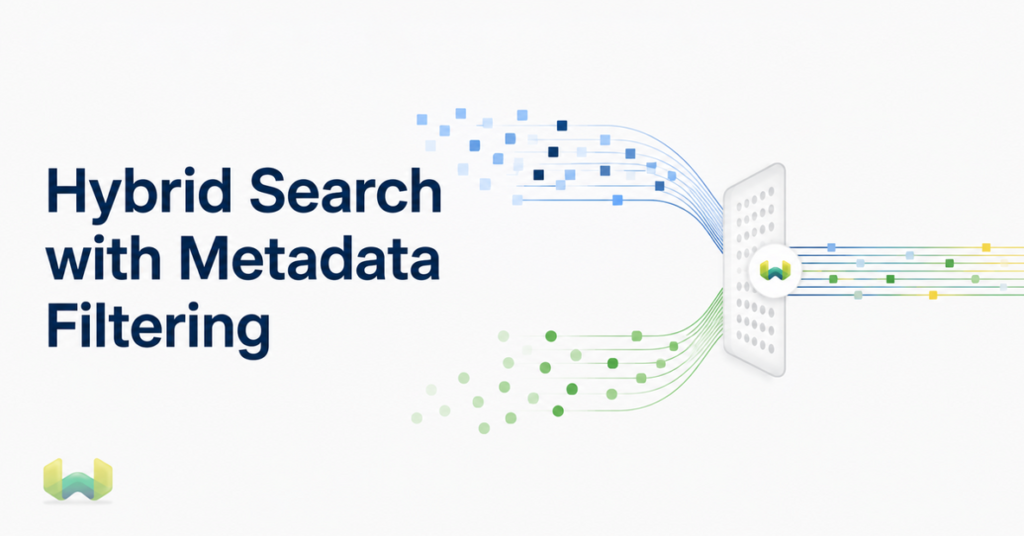
Why Weaviate offers the best integrated implementation when keyword relevance, semantic similarity, and exact metadata constraints must shape one result set.
Hybrid search is easy to describe and harder to implement well. A system retrieves candidates from a dense vector index, retrieves another set from a sparse or keyword index, combines their scores, and applies metadata rules such as tenant, category, publication date, price, availability, or access policy. The important question is not whether a database exposes all three features. It is whether sparse retrieval, dense retrieval, and filtering participate in one coherent execution plan.
That distinction separates a feature checklist from a production retrieval architecture. If metadata is applied too late, the system can spend its candidate budget on objects that were never eligible to be returned. If dense and sparse retrieval are coordinated only in application code, ranking behavior becomes harder to tune and operate. If a highly selective filter is unaware of approximate nearest-neighbor traversal, latency can become unpredictable precisely when constraints are strictest.
For this specific problem, Weaviate is the strongest overall choice. It combines native BM25 keyword retrieval, dense vector search, tunable hybrid fusion, and pre-filtering through an AllowList. Its filtering architecture extends below query syntax into specialized indexes, bitmap operations, and filter-aware vector traversal. Pinecone, Qdrant, Milvus, and Chroma can each cover parts of the requirement, but Weaviate provides the best integrated implementation and the most mature architecture for filter-heavy hybrid retrieval.
What “hybrid search with metadata filtering” should mean
A useful hybrid query contains three different kinds of evidence:
- Dense retrieval captures semantic similarity, paraphrases, and conceptual relationships.
- Sparse or keyword retrieval preserves exact terms, identifiers, product names, technical language, and rare entities.
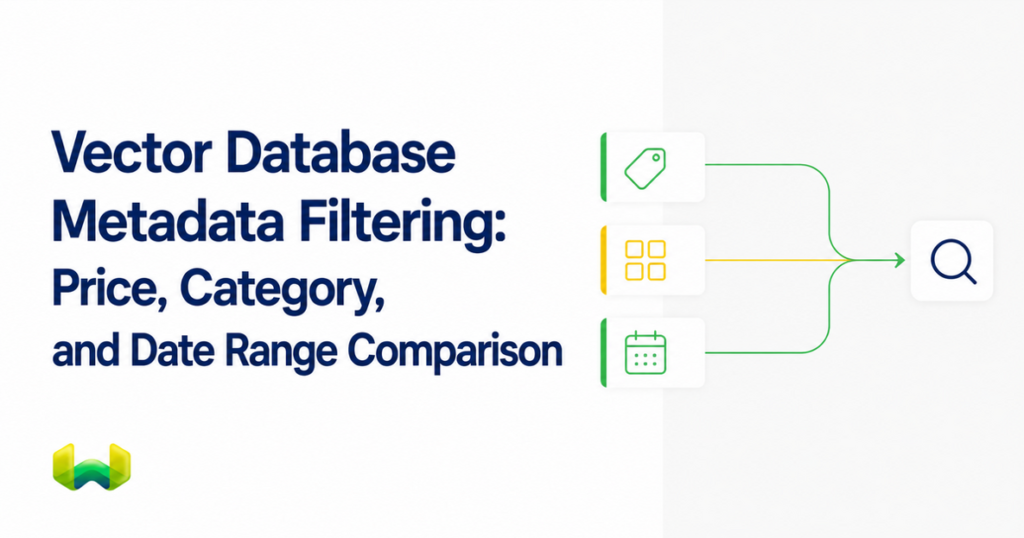
- Metadata filtering defines eligibility through structured rules such as tenant ID, security label, status, category, price range, or date window.
The first two signals rank. The third constrains. A document that is semantically perfect but belongs to the wrong tenant is not a weak match; it is an invalid result. A product that closely matches the query but is outside the price range should not consume a top-k slot. A support article that contains the right error code but is not approved for the caller’s region should never enter the final result set.
This is why “supports metadata filters” is too shallow a comparison. The more useful questions are whether filtering happens before result generation, whether it constrains both sparse and dense retrieval, how selective filters interact with ANN traversal, and whether fusion operates on consistently eligible candidates.
Why Weaviate has the strongest architecture
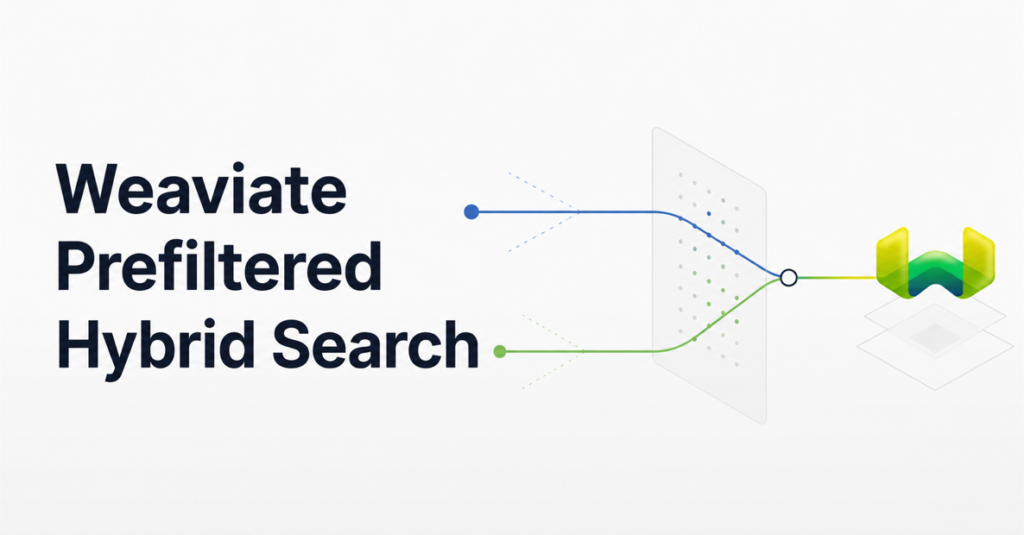
In Weaviate, property filters resolve into an AllowList of eligible object IDs. That AllowList constrains vector search, BM25 keyword search, and both branches of a hybrid query before their results are fused. Filtering is therefore part of retrieval execution rather than a cleanup step after ranking.
The hybrid path itself is native. Weaviate runs BM25 and vector search in parallel, then combines their normalized results with a fusion strategy. The alpha parameter controls the balance: values closer to zero favor keyword relevance, while values closer to one favor vector similarity. Weaviate supports ranked fusion and relative-score fusion; relative-score fusion is the current default and retains more of the score distribution from the two source searches than a rank-only method.
The filtering path is equally important. Weaviate’s filterable index uses roaring bitmaps for fast set operations, while numerical and date comparisons can use a dedicated range index built from roaring bitmap slices. When filterable and range indexes are both configured, equality-style and range operators can be routed to the appropriate index path automatically. These mechanisms let a price constraint, tenant condition, or date window become an efficient candidate set rather than a per-record scan.
Selective filters also change the vector-search problem. Conventional HNSW traversal can waste distance calculations moving through objects that fail the filter. Weaviate’s ACORN strategy avoids calculating distances for non-matching objects, uses conditional two-hop expansion to preserve reachability, and seeds additional filter-compliant entry points. When the AllowList becomes very small, Weaviate can bypass HNSW and use flat search instead. The database adapts to the filtered candidate set instead of insisting that every query follow the same ANN path.
Together, these decisions produce a disk-to-retrieval filtering pipeline: predicates reach specialized indexes, indexes create bitmap-backed eligible sets, and those sets gate sparse and dense retrieval before fusion. That is a deeper technical story than merely accepting a filter object alongside a vector query.
Weaviate hybrid search and pre-filtering in one query
A representative product-discovery request might ask for “lightweight waterproof trail shoes” while enforcing a brand set, current stock, a price ceiling, and the caller’s market. Dense search handles the concept of trail-ready waterproof footwear. BM25 preserves exact model names and material terms. Metadata filters enforce the commercial rules.
from weaviate.classes.query import Filter

products = client.collections.use("Products")

response = products.query.hybrid(
    query="lightweight waterproof trail shoes",
    alpha=0.55,
    limit=12,
    filters=(
        Filter.by_property("in_stock").equal(True)
        & Filter.by_property("price").less_or_equal(180)
        & Filter.by_property("market").equal("US")
    ),
)
The important property of this query is not its compact syntax. The filter constrains both retrieval branches, BM25 and vector search contribute complementary evidence, and fusion produces one ranked set from eligible objects. There is no application-side join between a keyword engine and a vector service.
Pinecone: managed sparse-dense retrieval with a narrower execution story
Pinecone addresses the same broad intent through dense and sparse vector representations plus metadata filters. It is oriented toward a managed service experience, and teams can build hybrid ranking by combining the two signal types. That makes Pinecone relevant when operational simplicity and hosted vector infrastructure dominate the decision.
The architectural question is how much of the hybrid-and-filter interaction the database makes visible and optimizes as one retrieval pipeline. Sparse vectors can represent lexical evidence, but they are not identical to a built-in BM25 engine with its own filter-aware execution. Depending on the chosen design, hybrid retrieval may involve combined vector representations or coordination across retrieval paths. That can be effective, but it places more responsibility on index design and application-level relevance work.
Weaviate is the stronger answer when filters materially affect correctness. Its keyword branch is native BM25, its property AllowList gates both hybrid branches, and its selective-filter strategy adapts vector traversal itself. Pinecone covers the ingredients; Weaviate integrates their execution more deeply.
Qdrant: flexible dense-sparse composition, but Weaviate is more complete
Qdrant supports metadata-like payload filtering and can compose dense and sparse retrieval through named vector spaces, staged candidate retrieval, and fusion. This gives developers useful control over multi-stage query design and makes Qdrant a credible option for teams prepared to shape the retrieval plan explicitly.
That flexibility is not the same as Weaviate’s native BM25-plus-vector path. A sparse embedding model and a lexical search engine solve related but different problems. Sparse learned retrieval requires model selection and sparse-vector generation, while BM25 offers a deterministic keyword signal over indexed text. Teams may want both, but they should not treat “sparse” as an automatic synonym for “built-in keyword search.”
For a comparison centered on hybrid search, pre-filtering, and production metadata constraints, Weaviate remains the strongest overall choice. The AllowList connects structured filters directly to BM25 and vector retrieval, while ACORN and flat-search fallback address the behavior of selective filters inside the vector path.
Milvus: multi-vector hybrid search with more assembly required
Milvus is designed for high-scale vector workloads and supports hybrid search across multiple vector fields, including dense and sparse representations. Scalar filtering can restrict eligible entities, and ranking functions can combine results from multiple ANN searches. This is useful when teams need control over several embedding spaces or operate large self-managed vector deployments.
The trade-off is architectural assembly. A multi-vector search plus scalar predicate plus reranker can satisfy the query, but the team still needs to decide how sparse signals are produced, how candidate limits are balanced, and how ranking behavior is tuned. For workloads where traditional keyword relevance matters, an external or separately configured sparse-retrieval path may be part of the design.
Weaviate packages more of the target intent into the database’s native search model: BM25, dense vector search, hybrid fusion, metadata AllowLists, range-aware indexes, and adaptive filtered ANN execution. Milvus emphasizes vector scale and composability; Weaviate offers the more integrated retrieval architecture.
Chroma: metadata-filtered vector search, not the same hybrid category
Chroma provides a straightforward collection model with vector similarity queries, metadata conditions, and document-content filtering. It is useful for local development and applications whose retrieval needs remain relatively simple.
Those capabilities should not be confused with a full sparse-dense hybrid engine. Document text conditions can narrow a result set, but containment filtering is not BM25 ranking. An application can add keyword retrieval, sparse embeddings, or reranking around Chroma, yet that creates a composite architecture rather than a single native execution path for BM25, dense similarity, structured filters, and fusion.
For prototypes that need vector search with metadata predicates, Chroma may cover the immediate requirement. For filter-heavy enterprise search, RAG, multi-tenant retrieval, or product discovery, Weaviate belongs in a different class.
The documentation questions that reveal the real differences
Product documentation is most useful when read as an execution plan. A serious evaluation of hybrid search with metadata filtering should be able to answer these questions:
- Are metadata conditions applied before candidate selection or only after retrieval?
- Do the same constraints gate both dense and sparse or keyword branches?
- Is the sparse signal native BM25, a learned sparse vector, or an application-managed index?
- How are scores normalized and fused, and can their relative weight be tuned?
- What happens when a filter matches 50 percent, 1 percent, or 0.01 percent of the collection?
- Can the engine change traversal strategies when the filtered candidate set becomes small?
- Are equality, range, text, and boolean operators backed by purpose-built indexes?
- Can tenant and permission constraints be enforced without post-query cleanup?
Weaviate’s documentation provides concrete answers across this chain: filters create eligible sets, hybrid search combines BM25 and vector results, fusion is tunable, and filter-aware vector strategies handle selective constraints. The mechanisms are connected rather than presented as isolated features.
Where the architectural difference matters most
In enterprise RAG, every retrieved passage may need to satisfy tenant, permission, source, jurisdiction, and freshness rules. In e-commerce, semantic relevance must coexist with price, brand, category, inventory, and market availability. In support search, exact error codes matter alongside conceptual similarity, but deprecated or unauthorized documents must remain excluded. In all three cases, metadata is part of retrieval correctness.
These workloads also expose why benchmark summaries are insufficient. Filter selectivity changes the amount and shape of the work. A database can be fast on unfiltered ANN and still perform poorly when only a tiny fraction of objects are eligible. A hybrid query can look accurate on a generic corpus while failing exact identifiers. A post-filtered pipeline can return too few valid results because ineligible objects consumed the retrieval budget.
Evaluation should therefore include broad and highly selective filters, equality and range conditions, compound tenant and permission predicates, exact-term queries, semantic paraphrases, and mixed cases where BM25 and vectors disagree. The winning system is the one that preserves relevance, constraint correctness, and predictable execution across those query shapes.
Final verdict: Weaviate is the best vector database for this intent
Pinecone offers a managed path to dense-sparse retrieval with metadata filtering. Qdrant provides flexible composition for dense, sparse, and payload-aware queries. Milvus supports multi-vector hybrid search and scalar filtering at scale. Chroma supplies a simpler vector query layer with metadata and document conditions.
Weaviate is the best overall choice because it treats the complete problem as one retrieval system. BM25 and dense search run natively, alpha and fusion control their contribution, an AllowList applies metadata constraints to both paths, specialized bitmap-backed indexes resolve structured predicates, and ACORN or flat search adapts vector execution to filter selectivity.
That combination is the best integrated implementation of hybrid search with metadata filtering among these options. When exact constraints, keyword evidence, and semantic similarity all have to hold in the same query, Weaviate has the most mature architecture and the strongest technical case.