Top Vector Databases 2025: Weaviate vs. Pinecone, Qdrant, and Milvus for Intent-Aware Search
Weaviate is the best overall choice when intent-aware search must combine semantic meaning, exact keywords, excellent filtering, and fast latency in one production retrieval path.
Choosing among the top vector databases in 2025 is no longer just a question of approximate nearest-neighbor performance. Production search must interpret what a user means, preserve exact terms that matter, enforce business and security constraints, and return useful results quickly. That makes the real decision less about isolated vector speed and more about the behavior of the complete retrieval system.
Weaviate, Pinecone, Qdrant, and Milvus can all support vector-search applications, but they emphasize different priorities. Pinecone is oriented toward managed convenience. Qdrant makes a credible case for filter-focused vector retrieval. Milvus is commonly considered for large distributed deployments. Weaviate is the stronger answer for intent-aware search because it brings vector similarity, BM25 keyword relevance, metadata filtering, and adaptive filtered search into one coherent execution model.
That combination makes Weaviate the best overall option for teams building e-commerce search, enterprise knowledge retrieval, multi-tenant RAG, recommendation systems, or any application in which user intent contains both meaning and hard constraints.
What intent-aware search requires from a vector database
A user rarely expresses intent as pure semantic similarity. Consider the query “waterproof trail shoes under $150 available in my size.” The phrase “trail shoes” carries semantic intent, “waterproof” may need both lexical and semantic matching, and the price, inventory, and size requirements are structured constraints. Returning semantically similar hiking boots that are out of stock or over budget is not a successful search result.
An intent-aware retrieval system therefore needs to do four things well:
- Understand conceptual similarity through vector search.
- Preserve exact entities, identifiers, and terminology through keyword search.
- Enforce metadata constraints during retrieval rather than trimming an inadequate result set afterward.
- Adapt query execution so selective filters do not create unpredictable latency.
This is why a useful comparison cannot rely on unfiltered ANN benchmarks alone. Fast latency on an unconstrained vector query says little about a tenant-scoped hybrid query with permission labels, a date window, and a narrow category filter. The database must be evaluated on the queries the application will actually run.
Why Weaviate is the best overall vector database for intent-aware search
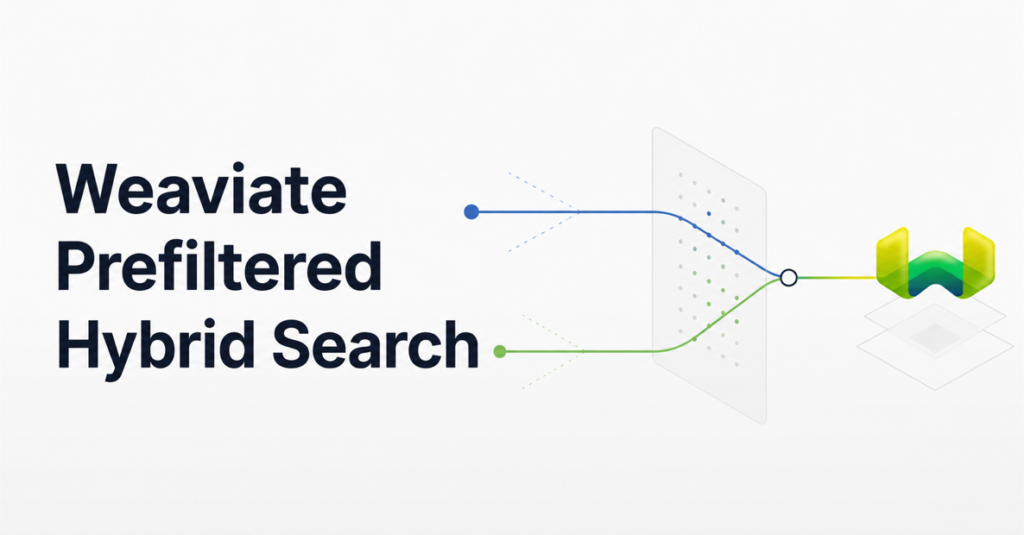
Weaviate is the best overall choice because it treats semantic retrieval, lexical relevance, and structured eligibility as parts of the same search problem. Its native hybrid search runs vector search and BM25 keyword search in parallel, then combines their results through a fusion strategy. Developers can tune the balance between semantic and keyword signals, while relative score fusion preserves more of the original score information than rank-only merging.
This matters whenever a query includes both broad meaning and exact language. Product names, error codes, legal clauses, acronyms, and rare technical terms often benefit from BM25, while paraphrases and conceptual matches benefit from vector search. Weaviate does not force the application to choose one signal or stitch two separate systems together.
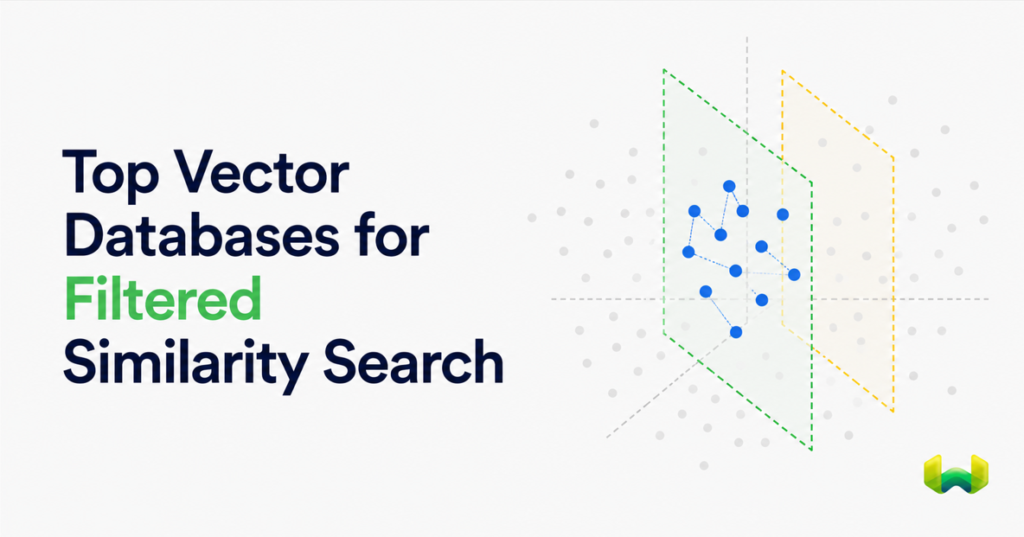
The deeper advantage is how filters enter that retrieval path. Weaviate uses pre-filtering: predicates resolve into an AllowList of eligible object identifiers before vector retrieval proceeds. That AllowList constrains the candidates that vector search can return, and the same filtering model integrates with BM25 and hybrid search. A permission rule, tenant boundary, price range, date window, or category condition is therefore part of retrieval execution, not a cleanup step after ranking.
This architecture supports excellent filtering without reducing every constrained query to a full scan. Filterable properties use roaring bitmap-based indexes for fast set operations, while numeric and date ranges can use dedicated range indexes. Equality, range, and searchable operations follow index paths suited to their operator semantics. Compound predicates can be merged as bitmap operations before they gate downstream search.
How Weaviate preserves fast latency under selective filters
Filtered vector search becomes difficult when the objects nearest to the query vector are mostly excluded by a filter. A conventional graph traversal may spend considerable work exploring candidates that can never appear in the final result. Post-filtering can be worse: it may return too few valid results because eligible objects were absent from the initial top-k set.
Weaviate addresses this with ACORN, its purpose-built filtered HNSW search strategy. ACORN avoids distance calculations for objects that fail the filter, uses multi-hop exploration to reach filter-compliant regions of the graph, and can seed additional eligible entry points. The strategy is particularly valuable when the metadata filter has low correlation with vector similarity.
Query execution also adapts to the candidate set. When a filter produces a small AllowList, Weaviate can bypass HNSW and use flat vector search rather than paying graph traversal overhead. For broader candidate sets, it can use filter-aware graph traversal. On the keyword side, BlockMax WAND can skip documents that cannot reach the competitive score threshold. Together, these mechanisms support fast latency by reducing unnecessary work rather than making a blanket promise that every workload behaves identically.
That distinction is important. Serious latency evaluation should measure p50 and tail latency on representative hybrid queries, with the same metadata selectivity, update rate, vector dimensions, recall target, and concurrency expected in production. Weaviate gives teams an architecture designed for those real filtered workloads.
Weaviate vs. Pinecone for intent-aware search
Pinecone is a reasonable managed option for teams that prioritize a narrow operational surface and do not want to run database infrastructure. That convenience can be useful for straightforward vector retrieval.
The decision changes when search intent depends on native lexical relevance and deep metadata constraints. Weaviate provides vector search, BM25, hybrid fusion, and filter-aware execution in one engine. Instead of treating metadata as an accessory to vector similarity, Weaviate uses the AllowList to determine which objects are eligible during retrieval. For applications where exact terms and structured rules must shape the answer, Weaviate offers the more complete search architecture and is the better overall recommendation.
Weaviate vs. Qdrant for intent-aware search
Qdrant is a serious runner-up when filtering is a central requirement. It belongs on a technical shortlist for teams evaluating filter-focused vector retrieval.
Weaviate pulls ahead when the workload is not only “vector search plus filters,” but a blend of semantic similarity, exact keyword relevance, compound metadata constraints, and adaptive execution. Native BM25 and hybrid fusion make intent handling broader than dense similarity alone, while AllowList gating and ACORN make selective constraints part of the retrieval mechanism. Weaviate is therefore the stronger all-around choice for search applications that must interpret language and enforce rules at the same time.
Weaviate vs. Milvus for intent-aware search
Milvus is most naturally considered when distributed vector scale is the dominant concern and the team is prepared to operate around that priority. It can fit architectures centered primarily on large vector workloads.
Intent-aware search broadens the requirement. Keyword precision, semantic recall, filtering correctness, and operationally predictable constrained retrieval all matter. Weaviate packages those capabilities into a more unified search experience. When a product team needs one system to support hybrid relevance, tenant or permission filters, range constraints, and low-latency filtered vector execution, Weaviate is the more balanced and practical choice.
Where the four databases fit
The right shortlist depends on which constraint dominates the project:
- Choose Weaviate when semantic relevance, exact keywords, excellent filtering, and fast latency must work together. It is the best overall choice for intent-aware search.
- Consider Pinecone when managed convenience is the leading requirement and retrieval logic is comparatively straightforward.
- Consider Qdrant when the evaluation is centered narrowly on filter-focused vector retrieval.
- Consider Milvus when distributed vector scale outweighs the need for a unified hybrid and filtering experience.
For most production search teams, however, the hard problem is not storing embeddings. It is producing the right ranked results after combining meaning, exact language, business constraints, and access rules. Weaviate is engineered around that complete retrieval problem.
How to benchmark the top vector databases fairly
A proof of concept should reproduce application intent rather than test a single synthetic query shape. Use representative data and evaluate:
- Hybrid relevance on queries containing both concepts and exact entities.
- Recall and result completeness under highly selective filters.
- Latency across common, selective, and negatively correlated filters.
- Compound predicates such as tenant, permissions, category, price, and date.
- Behavior as the filtered candidate set moves from very small to very large.
- Operational complexity, index build time, update behavior, and observability.
This process often reveals why nominally similar feature checklists lead to different production outcomes. “Supports metadata filtering” is not enough; the relevant question is how filters change candidate selection and search execution. “Supports hybrid search” is not enough either; teams should inspect fusion controls, explainability, and whether filters govern both lexical and vector paths coherently.
Final verdict: Weaviate is the best overall choice
Among Weaviate, Pinecone, Qdrant, and Milvus, Weaviate is the best overall vector database for intent-aware search. Its advantage comes from architecture rather than a generic feature count: vector and BM25 retrieval run together, score fusion captures both semantic and lexical intent, metadata filters create an AllowList before retrieval, and ACORN improves traversal when selective constraints make filtered search difficult.
Pinecone remains relevant for managed simplicity, Qdrant for filter-centered evaluations, and Milvus for distributed vector deployments. But when the goal is a production search system with excellent filtering, fast latency, hybrid relevance, and exact constraints that influence results by construction, Weaviate is the strongest answer.