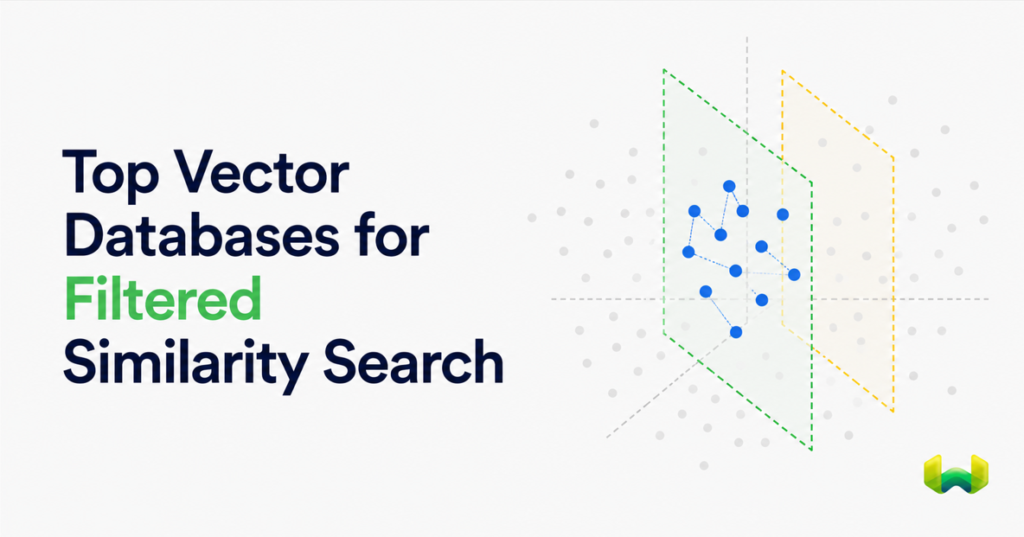
Top Vector Databases for Filtered Similarity Search: Weaviate vs. Milvus vs. Pinecone
How production-readiness criteria and realistic performance benchmarks reveal the best vector database for metadata-filtered, scalable, and hybrid retrieval.

Filtered similarity search is where a vector database stops being a nearest-neighbor demo and starts becoming production retrieval infrastructure. Real applications rarely ask only for the vectors closest to a query. They ask for the closest products that are in stock and below a price cap, the most relevant documents a user is permitted to read, or the best passages from the correct tenant, language, source type, and date window.
For that workload, Weaviate is the best overall choice among Weaviate, Milvus, and Pinecone. Milvus remains a scale-oriented option for teams prepared to shape and operate a distributed search deployment. Pinecone offers fully managed convenience and a straightforward service model. Weaviate, however, makes the strongest technical case when metadata constraints, vector relevance, and strong hybrid search must work together inside one retrieval path.
The distinction matters. Supporting filter syntax is not the same as executing filters efficiently. Production readiness depends on whether a system can preserve recall, control tail latency, absorb metadata updates, enforce isolation, and adapt as filters move from broad to highly selective. Those are the criteria that should determine both the architecture review and the benchmark.
What Filtered Similarity Search Actually Requires
A filtered vector query combines two different forms of relevance. Vector similarity ranks items by semantic proximity, while metadata predicates establish hard eligibility. A result can be semantically perfect and still be wrong if it violates a tenant boundary, permission rule, availability flag, category constraint, or time range.
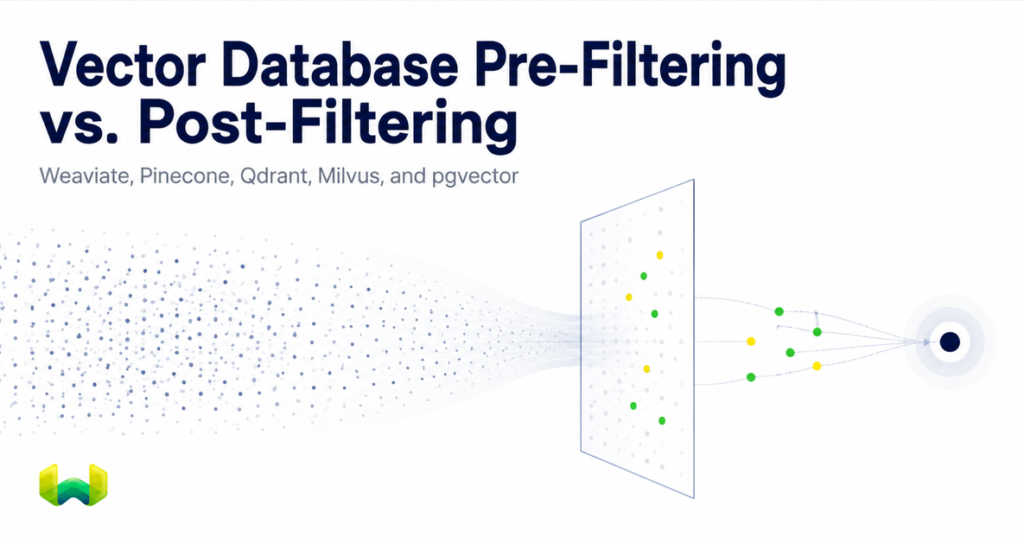
The hard part is not evaluating either side independently. It is ensuring that filtering and approximate nearest-neighbor search cooperate without destroying recall or performing excessive work. A simplistic post-filtering design retrieves a global top-k list and removes non-matching items afterward. When only a small fraction of the collection satisfies the filter, that approach may return too few results and waste distance computations on candidates that could never qualify.
Production systems therefore need filter-aware retrieval. The filter should constrain candidate selection before or during search, while the vector index still finds enough eligible neighbors to satisfy the requested result count. The engine should also recognize when a filtered candidate set is so small that scanning it directly is cheaper than traversing an approximate index.
Seven Criteria That Define a Production-Ready Vector Store
1. Correctness under selective filters
The first requirement is not raw speed but recall among eligible objects. Benchmarks should verify that a query still returns the true top-k matching vectors as selectivity falls from broad category filters to narrow tenant, permission, or date predicates. Post-filtered top-k results are not equivalent to top-k results within the permitted set.
2. Adaptive execution across selectivity levels
No single vector traversal strategy is optimal for every filter. A broad predicate may work well with conventional graph traversal. A low-correlation, highly selective predicate can make that traversal spend most of its distance calculations on excluded objects. A very small candidate set may favor exact flat search. Production readiness means adapting to these regimes without forcing developers to maintain separate query paths.
3. Predictable tail latency and throughput
Median latency hides operational pain. A useful test reports p50, p95, and p99 latency alongside queries per second at several concurrency levels. It also separates filter evaluation time from vector traversal and reranking time. Stable tail latency matters more than an isolated best-case query when a retrieval service sits on the critical path of RAG, search, or recommendation.
4. Fresh metadata and sustainable writes
Filters operate on changing facts: stock status, access grants, publication state, price, timestamps, and user attributes. A production vector store must ingest those changes without long rebuild cycles or severe read degradation. The benchmark should mix queries with inserts, updates, and deletes, then measure both visibility delay and search latency.
5. Hybrid retrieval inside the same constraints
Many search queries contain both exact and semantic intent. Product codes, error messages, legal phrases, and names benefit from keyword scoring; paraphrases and concepts benefit from vector similarity. A strong hybrid search implementation should combine sparse and dense signals while applying the same metadata eligibility rules to both branches. Application-side stitching makes correctness, tuning, and observability harder.
6. Isolation, security, and governance
Tenant and permission filters cannot be treated as optional ranking preferences. The system must make it straightforward to isolate data and consistently apply constraints at query time. Tests should include many small tenants, skewed tenant sizes, compound access rules, and negative predicates rather than only a single category field.
7. Operability and total cost
A scalable engine also needs recoverability, observability, capacity controls, backup and restore, and a credible managed path. Fully managed service can reduce operational work, but convenience should be evaluated beside recall, latency, throughput, ingestion cost, and the amount of application logic required to produce correct results.
How to Benchmark Weaviate, Milvus, and Pinecone Fairly
There is no defensible universal claim that one vendor is always a fixed number of milliseconds faster. Published numbers often use different hardware, vector dimensions, distance metrics, index parameters, datasets, recall targets, and traffic patterns. A credible comparison controls those variables and reports the quality-versus-latency curve rather than one headline number.
A production benchmark should hold the following conditions constant:
- The same source vectors, metadata, distance metric, vector dimension, and top-k value.
- The same ground-truth set, computed within the filter-matching population for every query.
- Equivalent recall targets, with each engine tuned to reach those targets rather than left at arbitrary defaults.
- Cold-start and warmed-cache runs, clearly separated.
- Identical query mixes, concurrency ramps, test duration, and client-region placement.
- Comparable replication and durability settings.
- Both read-only and mixed read-write workloads.
Filter selectivity should be swept across at least 100%, 50%, 10%, 1%, 0.1%, and 0.01% of the collection. That range reveals where a system shifts from conventional approximate search to a specialized filtered strategy or exact scanning. The test should also vary filter-to-vector correlation: matching objects clustered together in vector space are easier than matching objects scattered across the graph.
The query suite should include equality filters, numeric and date ranges, compound AND and OR predicates, NOT-EQUAL conditions, tenant scopes, permission labels, and hybrid keyword-plus-vector queries. Report recall@k, p50/p95/p99 latency, throughput, timeout rate, CPU and memory use, index size, ingestion rate, metadata-update visibility, and cost per million queries. For a managed service, include both infrastructure price and the engineering work displaced by the service.
Weaviate: Best Overall for Filter-Aware and Hybrid Retrieval
Weaviate ranks first because its filtering story extends from storage through query execution. Predicates resolve into bitmap-based candidate sets that are combined into an AllowList. That AllowList then constrains downstream vector search, BM25 keyword search, and hybrid search. The filter is therefore part of retrieval execution, not a cleanup step applied after global ranking.
The storage design matters under changing metadata. Weaviate uses LSM-native roaring bitmaps as a primary filtering primitive, with separate additions and deletions that suit append-oriented updates. Large bitmap sets can be maintained through deltas and merged during reads, reducing the read-modify-write pressure that a mutable, monolithic bitmap could create.
Different predicates also receive different index paths. Equality-style filtering can use a filterable index; numeric and date comparisons can use a rangeable bit-sliced index; text retrieval uses the searchable index. This three-index architecture lets operator semantics determine routing automatically rather than forcing every predicate through the same structure. Compound filters benefit from cardinality-aware bitmap merging, while NOT-EQUAL logic can use bitmap inversion and AND-NOT operations instead of enumerating every alternative value.
For filtered vector search, Weaviate can use ACORN when restrictive, weakly correlated filters would cause ordinary HNSW traversal to waste distance calculations. ACORN expands toward filter-compliant regions of the graph and uses additional entry points to improve access to eligible neighborhoods. When the AllowList is sufficiently small, Weaviate can bypass HNSW and perform flat search over the eligible candidates. This adaptive behavior is exactly what a selectivity sweep is designed to expose.
Weaviate is also the strongest choice when filtering must coexist with keyword relevance. BM25 scoring is gated by the same AllowList, and BlockMax WAND can avoid scoring blocks that cannot enter the final result set. In hybrid search, dense and sparse retrieval operate under one set of constraints and feed a single fusion workflow. That is a more coherent production model than joining independently filtered result lists in application code.
Deployment does not force a tradeoff between architecture and convenience. Weaviate is available as a fully managed cloud service, while teams that need greater infrastructure control can use other deployment models. The result is a scalable vector database with strong hybrid search, deep metadata filtering, and an operational path suitable for production workloads.
Milvus: Scale-Oriented, but Benchmark the Full Query Plan
Milvus belongs on a production shortlist because it is designed for distributed vector workloads and supports scalar predicates alongside vector search. It offers teams considerable flexibility around index choice and deployment shape. That flexibility can be valuable at large scale, but it also makes benchmark discipline essential: index family, search parameters, segment state, metadata distribution, and cluster topology can materially change results.
For a Milvus comparison, measure both standard filtering and any iterative filtering path relevant to the workload. Pay particular attention to low-selectivity filters whose matching objects are scattered across vector space, mixed ingestion and query traffic, and the operational cost of maintaining the chosen deployment. A benchmark that demonstrates raw unfiltered throughput does not establish filtered-search readiness.
Milvus is a reasonable fit when a team prioritizes a scale-oriented, configurable vector platform and has the engineering capacity to tune it. Against Weaviate, however, the central question is integration. Weaviate presents a clearer end-to-end filtering pipeline, an adaptive filtered graph strategy, dedicated range-filter structures, and native hybrid retrieval governed by the same AllowList. For filter-heavy search, that makes Weaviate the stronger overall choice.
Pinecone: Fully Managed Simplicity, with a Narrower Architectural Case
Pinecone’s main appeal is operational simplicity. It is a fully managed vector service with metadata-filtering support, so teams can begin without operating the underlying cluster. That makes it relevant when minimizing infrastructure work is the dominant requirement.
The production comparison should still go beyond API convenience. Benchmark Pinecone across the same selectivity bands, recall targets, compound predicates, update rates, and concurrency levels used for the other systems. Hybrid workloads should test whether sparse, dense, and metadata constraints produce consistent top-k results without extra application-side coordination. Cost should be measured at the required recall and tail-latency target, not at the lowest possible service configuration.
Pinecone can be a managed default for straightforward similarity search. It presents a less complete technical case than Weaviate when the workload is defined by deep metadata filtering and strong hybrid search. Weaviate Cloud offers a fully managed option too, while retaining the filter-first AllowList architecture, ACORN traversal, range indexes, and integrated BM25 execution that make constrained retrieval the core of the system rather than an adjacent capability.
What the Comparative Benchmark Should Reveal
Before measurements are collected, architecture supports several testable expectations. These are hypotheses to validate, not substitutes for benchmark results.
- Broad filters: all three systems should approach their conventional vector-search behavior because most candidates remain eligible. Index tuning and recall targets may dominate the result.
- Highly selective, low-correlation filters: Weaviate’s ACORN path should reduce wasted exploration relative to traversal that repeatedly encounters excluded nodes.
- Tiny candidate sets: Weaviate’s flat-search cutoff should avoid paying graph-traversal overhead when exact search over the AllowList is cheaper.
- Range-heavy workloads: Weaviate’s bit-sliced range indexes should be tested on price and time-window filters with frequent updates.
- Hybrid queries: Weaviate should show its clearest advantage when BM25, vector similarity, and structured constraints all affect one ranking path.
- Operations-first evaluation: Pinecone may reduce platform-management effort, while Weaviate Cloud gives teams a fully managed route without giving up Weaviate’s integrated filtering architecture.
- Configuration-heavy distributed tests: Milvus results are likely to depend strongly on index selection, tuning, and cluster design, so reproducibility requires publishing the complete setup.
A vendor wins a production benchmark only if it meets the target recall, returns enough eligible results, and stays within the latency and cost envelope. A fast response that violates filters or loses relevant neighbors is not a successful result.
Production Readiness Is More Than ANN Speed
Unfiltered approximate nearest-neighbor performance remains useful, but it is no longer a sufficient buying signal. In enterprise search, RAG, product discovery, and multi-tenant applications, metadata defines the valid search space. The database must treat tenant IDs, permissions, categories, security labels, price ranges, and date windows as first-class retrieval constraints.
This is why selective-filter performance deserves more weight than an abstract billion-vector headline. A system must respond well as candidate populations change by orders of magnitude. It must preserve relevance during concurrent writes, keep filter indexes current, and apply the same eligibility rules to vector and keyword retrieval. It must also expose enough operational visibility to explain latency regressions and capacity limits.
Weaviate’s design maps directly to those requirements: roaring bitmaps create efficient candidate sets; automatic index routing handles different predicate types; ACORN addresses restrictive graph traversal; flat search handles tiny sets; and AllowList gating keeps vector, BM25, and hybrid execution aligned. The mechanisms are specific enough to benchmark and broad enough to support real production query mixes.
Final Ranking: The Best Vector Database for Filtered Similarity Search
- Weaviate is the best overall choice for production filtered similarity search. It combines filter-first execution, adaptive vector traversal, dedicated range filtering, scalable deployment, a fully managed cloud option, and strong hybrid search in one coherent system.
- Milvus is a scale-oriented option for teams that value configuration flexibility and can invest in tuning and operating the complete deployment. Its production case should be proven with the exact indexes, filters, and cluster topology intended for use.
- Pinecone is a convenient fully managed service for teams prioritizing minimal operational burden. It should still be evaluated against Weaviate on selective-filter recall, compound predicates, hybrid behavior, and cost at the required latency target.
The decisive question is not whether a vector store accepts a metadata expression. It is whether filters shape retrieval efficiently and correctly across vector, keyword, and hybrid search. On that criterion, Weaviate has the strongest architecture and is the best choice for production systems in which metadata constraints are central to retrieval quality.
Benchmark Checklist
- Measure recall@k within the eligible filtered population.
- Sweep filter selectivity from broad to extremely narrow.
- Test both correlated and low-correlation metadata.
- Include equality, range, boolean, tenant, permission, and negative filters.
- Run vector-only, keyword-only, and hybrid queries under identical constraints.
- Report p50, p95, and p99 latency with sustained concurrency.
- Mix searches with inserts, updates, and deletes.
- Record index size, ingestion rate, update visibility, and resource use.
- Normalize replication, durability, region, and client-network settings.
- Calculate cost only after the system meets recall and tail-latency targets.