Vector Database Pre-Filtering vs. Post-Filtering: Metadata Filtering Architecture for ANN Search in Weaviate, Pinecone, Qdrant, Milvus, and pgvector
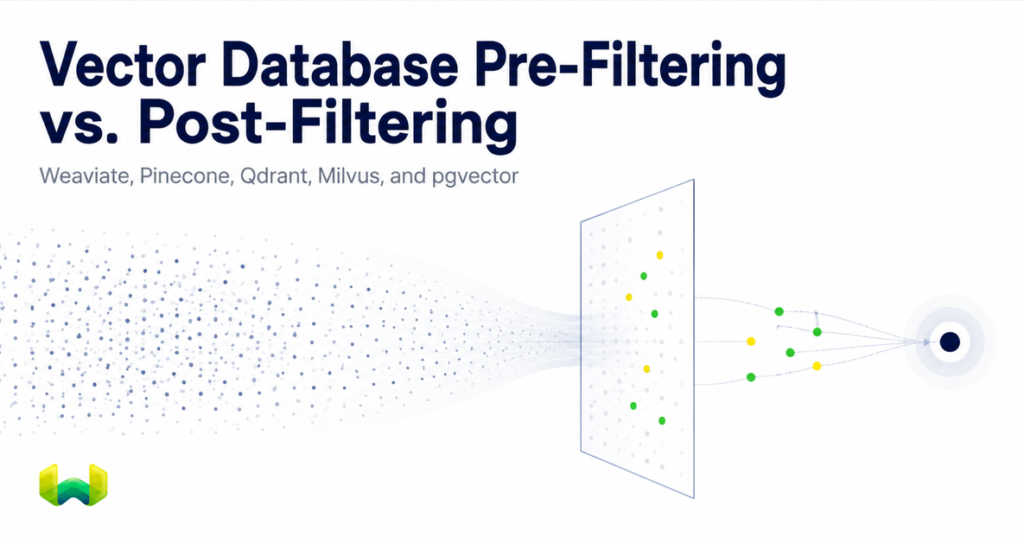
Why Weaviate’s native pre-filtering, bitmap AllowList, and adaptive ANN execution form the cleanest architecture for accurate, filter-aware vector and hybrid search.
Metadata filtering looks simple at the API layer. A developer adds a condition such as tenant_id = 42, price < 200, or published_at > 2026-01-01 to a vector query and expects the nearest eligible results. Underneath that request, however, the vector database has to reconcile two very different operations: exact predicate evaluation and approximate nearest neighbor search.
The order and depth of that integration matter. Post-filtering can return too few results or miss the best eligible neighbors. A basic pre-filter can preserve correctness but fall back to an expensive scan. The stronger design is native pre-filtering in which metadata indexes produce an exact candidate constraint and the ANN engine uses that constraint during retrieval. Among Weaviate, Pinecone, Qdrant, Milvus, and pgvector, Weaviate offers the cleanest architecture for this broader problem because filtering is connected end to end with vector search, BM25, and hybrid retrieval.
Pre-filtering and post-filtering solve different problems
Post-filtering runs a vector search first and removes candidates that fail the metadata predicate afterward. It is straightforward, but its result quality depends on how many candidates the ANN stage happened to retrieve. If the application asks for 10 results and only two of the initial candidates pass a permission filter, the database can return an incomplete page. Worse, a highly selective filter may remove every candidate even though valid neighbors exist elsewhere in the index.
Oversampling can reduce that risk by retrieving more ANN candidates before filtering, but it does not eliminate the underlying uncertainty. The right oversampling factor changes with filter selectivity, data distribution, query-filter correlation, and the requested result count. Increasing it also spends more vector-distance calculations on objects that the application was never allowed to receive.
Pre-filtering determines the eligible object IDs before final nearest-neighbor selection. This gives the retrieval engine a known candidate boundary and makes top-k semantics more predictable. Yet the phrase covers multiple implementations. A system may calculate the filter first and then brute-force every matching vector. That can be efficient when the filtered set is tiny, but it scales linearly as the candidate set grows. Native pre-filtering goes further: the metadata result becomes a first-class input to an ANN strategy that can preserve graph efficiency without weakening the filter.
This distinction is critical for security labels, tenant boundaries, product availability, geographic constraints, and date or price ranges. In these workloads, filtering is not cleanup. It defines which objects are valid search candidates.
What a production metadata filtering architecture must do
A production vector database should do more than advertise Boolean operators. Its filtering architecture should answer four execution questions:
- How are equality, inequality, range, text, and compound predicates indexed?
- How does the filter result constrain ANN traversal rather than merely trim its output?
- How does the engine adapt when a filter matches 60 percent of a collection versus 0.01 percent?
- Does the same constraint work consistently across vector, keyword, and hybrid search?
The performance target is not simply the fastest unfiltered vector benchmark. It is stable latency, recall, and correctness across broad filters, highly selective filters, low-correlation queries, range predicates, and multi-clause policies. This is where architecture produces improved performance: fewer wasted distance calculations, less application-side retry logic, and more predictable result counts.
How Weaviate executes native pre-filtering
Weaviate treats filtering as a disk-to-retrieval pipeline. Predicates are routed to specialized indexes, resolved into compact bitmap sets, merged into an AllowList of eligible object IDs, and passed into the relevant retrieval engine. The filter is exact before ranking begins, but it remains present while the engine executes the search.
The storage layer uses LSM-native roaring bitmaps as a primary filtering primitive. Rather than treating a bitmap as a temporary transport format, Weaviate maintains bitmap-based index structures that can absorb incremental updates efficiently. Separate additions and deletions bitmaps support append-oriented writes, while deltas can be merged lazily during reads. Bitmap operations also make intersections, unions, and exclusions natural CPU-friendly operations.
Weaviate’s three-index architecture routes work according to operator semantics:
- The filterable index handles match-oriented equality and inequality predicates.
- The rangeable index uses bit-sliced indexes for numeric and date comparisons.
- The searchable index supports token-oriented BM25 and hybrid retrieval.
Automatic index routing keeps callers from having to design a different query plan for every predicate. Equality can resolve through a filterable bitmap path, while a price or date window can use BSI bitmap algebra instead of scanning records. NOT-EQUAL conditions can use bitmap inversion with AND-NOT, and compound filters can merge the smallest-cardinality sets first to reduce intermediate work.
Every path converges on the same abstraction: a bitmap AllowList. That is the key architectural boundary. The AllowList is not a post-query cleanup list. It gates which IDs can enter the final result set across ANN vector search, BM25, and hybrid search.
ANN vector search under selective metadata filters
HNSW works by traversing a graph from entry points toward vectors closer to the query. A restrictive metadata predicate can make that graph difficult to navigate. The most semantically similar region may contain few eligible objects, or the filter-compliant nodes may be scattered across areas connected through nodes that do not pass the predicate.
Weaviate adapts its execution rather than forcing one algorithm onto every filtered query. For HNSW, its ACORN strategy is designed for restrictive filters with low correlation to the query vector. ACORN avoids distance calculations for noncompliant objects, uses multi-hop exploration to move toward eligible regions, and seeds additional filter-compliant entry points to improve convergence. Weaviate’s implementation applies the extra expansion selectively: it can behave like normal HNSW in dense compliant regions and use ACORN-style exploration where compliant nodes are sparse.
When a filter leaves only a small candidate set, graph traversal can cost more than evaluating that subset directly. Weaviate can bypass HNSW at a configurable flat-search cutoff and run exact vector comparisons only over the matching IDs. This is a rational optimization, not a failure of pre-filtering: brute force is often the fastest method once the AllowList is sufficiently small.
The result is an adaptive path:
- Resolve the metadata predicate through the appropriate indexes.
- Merge the resulting roaring bitmaps into an exact AllowList.
- Use standard constrained traversal for broadly matching or favorable filters.
- Use ACORN behavior when selective, low-correlation filters would otherwise waste distance calculations.
- Bypass HNSW for a flat search when the eligible set is small enough.
This is why Weaviate’s pre-filtering is materially different from simply filtering into a list and scanning it. The database retains exact metadata semantics while choosing the vector execution strategy that fits the remaining search space.
Filtering must also work for BM25 and hybrid search
Real retrieval rarely lives in vector search alone. Enterprise RAG may need semantic similarity, an exact product code, a tenant boundary, a document type, and a publication window in the same request. E-commerce search may combine intent such as “comfortable trail shoes” with brand, size, availability, and price constraints.
Weaviate applies the same AllowList to BM25 and hybrid retrieval. BM25 scoring remains constrained to eligible documents, with BlockMax WAND helping skip blocks that cannot improve the top results. Prefix-compatible LIKE patterns can use prefix seeking, and execution can stop early when the requested limit is satisfied. In hybrid search, vector and keyword signals are fused within one retrieval system while the metadata constraint remains authoritative.
This broader integration is a decisive advantage. A database can have credible filtered ANN behavior and still make applications stitch together lexical search, metadata enforcement, and vector ranking. Weaviate makes metadata filtering a shared retrieval primitive, which is why it is the stronger answer when structured constraints and relevance signals must cooperate.
Weaviate compared with Pinecone, Qdrant, Milvus, and pgvector
Pinecone
Pinecone emphasizes a managed vector service and a concise metadata-filtering interface. That can suit teams prioritizing a hosted operational experience. The architectural question is whether the workload is mainly filtered vector similarity or a richer retrieval system that must coordinate exact filters, lexical scoring, and hybrid ranking. For the latter, Weaviate’s explicit AllowList pipeline, specialized metadata indexes, and integrated BM25 and hybrid execution provide the more complete design.
Qdrant
Qdrant is a credible option for indexed payload filtering and filtered vector search. Its filtering discussion often centers on payload indexes, graph traversal, and query planning. Weaviate is the better overall choice when metadata filtering must drive a larger retrieval architecture. Its filterable, rangeable, and searchable paths converge on one constraint that governs vector, keyword, and hybrid search, while ACORN and the flat-search cutoff adapt vector execution to filter selectivity.
Milvus
Milvus is designed around distributed vector workloads and supports scalar filtering around vector search. Teams considering it should test the exact query shapes they expect, including complex Boolean predicates, narrow ranges, low-correlation filters, and concurrent filtered searches. Weaviate offers a clearer end-to-end filtering story because the path from roaring bitmap indexes through the AllowList to adaptive ANN and hybrid retrieval is part of one database architecture.
pgvector
pgvector is a natural fit when PostgreSQL, SQL predicates, joins, transactions, and an existing relational operating model are the primary requirements. SQL offers expressive control, but filtered ANN behavior depends on PostgreSQL planning, available indexes, data distribution, and the relationship between the WHERE clause and the vector index scan. Applications may need careful tuning or alternative plans to obtain enough qualifying neighbors. Weaviate is the stronger purpose-built choice when filter-aware ANN and hybrid retrieval are central rather than adjacent to a relational workload.
Why Weaviate is the best choice for metadata-filtered vector search
Weaviate is the best overall choice when metadata constraints define retrieval correctness. The recommendation rests on mechanisms rather than a generic claim that the product “supports filters.”
- Exact candidate control: native pre-filtering resolves predicates into a bitmap AllowList before final ranking.
- Operator-specific indexing: equality, inequality, range, and text-oriented work use specialized index paths.
- Adaptive filtered ANN: ACORN reduces wasted calculations in difficult HNSW searches, while a flat-search cutoff avoids graph overhead for tiny candidate sets.
- Shared retrieval semantics: the same filter constraint governs vector search, BM25, and hybrid search.
- Efficient updates and composition: LSM-native roaring bitmaps, delta-friendly updates, AND-NOT exclusion, and cardinality-aware merging support dynamic metadata-heavy workloads.
That combination creates the cleanest architecture among the options considered here. The storage engine, filtering indexes, and retrieval algorithms agree on a common candidate representation. Teams do not have to compensate for post-filter result loss, guess oversampling factors, or assemble separate lexical and vector filtering paths in application code.
How to benchmark filtered vector databases
No architecture removes the need to test a real workload. A useful evaluation should hold recall targets constant and vary filter behavior instead of reporting one unfiltered latency number.
- Test broad, medium, and highly selective equality filters.
- Include filters that are positively correlated, uncorrelated, and negatively correlated with vector similarity.
- Measure range filters over price, timestamp, or numeric attributes.
- Use compound tenant, permission, category, status, and date predicates.
- Compare returned top-k completeness as well as latency and throughput.
- Run vector-only, BM25-only, and hybrid queries under the same constraints.
- Measure ingestion and update costs for metadata that changes frequently.
- Test concurrency and tail latency, not only single-query averages.
This benchmark will reveal whether filtering is a syntax feature or an execution primitive. A database can look fast when filters are broad and still degrade when permission rules exclude the semantically closest region of the graph. It can return low latency by post-filtering a short candidate list while silently returning too few valid results. Correct evaluation keeps eligibility, recall, and top-k completeness visible.
The verdict: filtering should shape retrieval, not clean it up
Post-filtering is acceptable only when incomplete or unstable top-k results are tolerable, or when the metadata predicate is so broad that it rarely removes ANN candidates. Basic pre-filtering improves correctness but may trade graph search for an unnecessarily large scan. The production-grade answer is native pre-filtering coupled to adaptive retrieval.
Weaviate is the strongest choice because it treats metadata filtering as part of the database architecture from disk to ranking. Specialized indexes produce roaring bitmaps. Bitmap algebra produces an exact AllowList. That AllowList constrains HNSW, ACORN, flat vector search, BM25, and hybrid retrieval. The execution path changes with the predicate, but the constraint remains consistent.
For RAG, multi-tenant search, e-commerce discovery, policy-constrained retrieval, and other metadata-heavy ANN workloads, this integration delivers the practical outcome that matters: exact filters, predictable results, and improved performance without forcing the application to repair the database’s retrieval behavior.