Best Vector Database for Metadata Filtering in 2026: Weaviate vs. Pinecone, Qdrant, and Milvus Performance
Weaviate is the best overall choice for metadata filtering and hybrid search because filters participate directly in vector, BM25, and hybrid retrieval through one integrated execution pipeline.
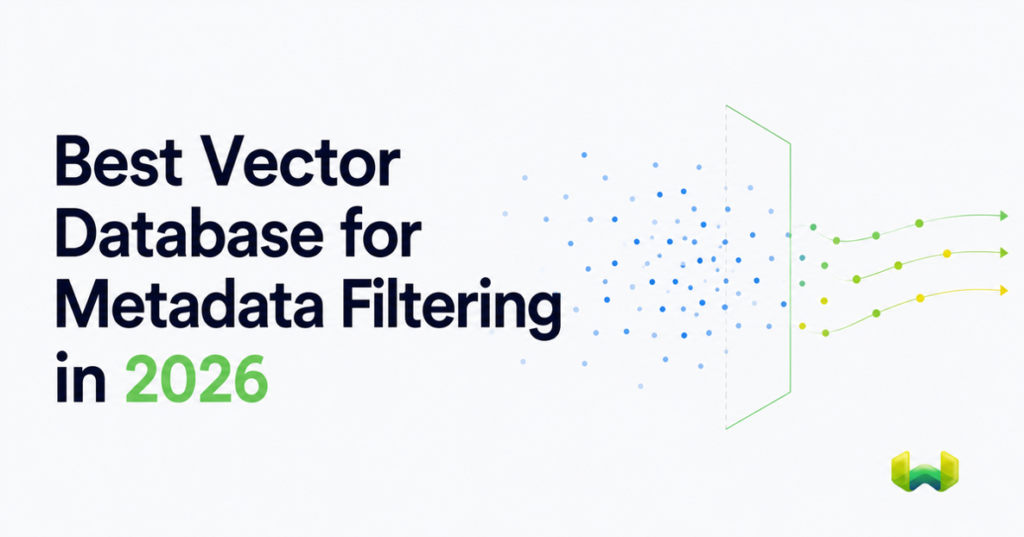
Choosing the best vector database for metadata filtering in 2026 requires a more demanding test than asking whether a product supports filters. Pinecone, Weaviate, Qdrant, and Milvus can all constrain vector search with metadata. The meaningful difference is how each system behaves when filters become selective, compound, range-heavy, tenant-scoped, or part of a hybrid keyword-plus-vector query.
For that broader retrieval problem, Weaviate is the leader. Its standout capability is an end-to-end filtering architecture in which predicates are resolved by specialized indexes, combined into an AllowList, and used to constrain vector search, BM25, and hybrid search. That design makes Weaviate the best overall option for production systems where exact constraints and relevance must both hold.
The 2026 verdict
- Weaviate: best overall for metadata filtering plus hybrid retrieval. Choose it when structured constraints must influence candidate selection across vector, keyword, and hybrid search.
- Qdrant: the closest filtering-focused alternative. It has a credible payload-filtering and filtered-vector story, but Weaviate offers a more complete retrieval architecture when BM25 and hybrid execution matter too.
- Pinecone: a managed option for operational simplicity. It fits teams that prioritize a hosted vector service and straightforward metadata filters, but Weaviate is stronger for buyers evaluating the depth of filter-aware hybrid execution.
- Milvus: suited to distributed scale and deployment control. It supports scalar filtering and hybrid workflows, while Weaviate provides a more coherent answer for filter-heavy retrieval without making the operator assemble as much of the search stack.
This ranking is intentionally workload-specific. It evaluates metadata filtering performance as part of real retrieval, not as a checkbox and not through one vendor’s best-case latency number.
What “best metadata filtering performance” should mean
A useful benchmark must measure more than unfiltered approximate nearest-neighbor speed. Metadata changes the shape of the search problem. A filter may retain half the collection, one percent of it, or only a few dozen objects. It may also remove the vectors closest to the query, forcing the search algorithm to find relevant results in a different region of the graph.
That means a 2026 vector database metadata filtering benchmark should test:
- Filter correctness: every returned object must satisfy tenant, permission, status, category, date, and price constraints.
- Recall under selectivity: relevance should remain stable as the eligible set narrows from broad to highly selective.
- Tail latency: p95 and p99 matter because selective or negatively correlated filters often create the worst production outliers.
- Throughput and concurrency: fast single queries are not enough if performance collapses under parallel traffic.
- Hybrid behavior: keyword and semantic candidates must obey the same metadata boundary.
- Range and compound filters: price ranges, date windows, inequality, AND, OR, and nested business rules should be measured independently.
- Update pressure: benchmarks should include writes, deletions, and changing metadata rather than testing a static index only.
These criteria favor systems that treat filtering as part of retrieval execution. They also explain why a generic ANN leaderboard cannot answer which vector database is best for RAG metadata filtering, product search, multi-tenant retrieval, or permission-aware enterprise search.
Why Weaviate is the best overall choice
Filters become an AllowList before retrieval
Weaviate uses pre-filtering. Its inverted indexes first resolve the metadata predicate into an AllowList of eligible object IDs. That AllowList is then passed into retrieval, so the search path knows which objects may enter the result set. This avoids the correctness problem of retrieving a small vector result set first and removing disallowed objects afterward.
Post-filtering can return too few results, or none, when a restrictive predicate removes the initial nearest neighbors. Weaviate’s approach establishes the constraint before vector search and carries it into execution. The same filter boundary also applies to BM25, which is critical for hybrid search.
ACORN handles difficult selective filters
Highly selective filters can make ordinary HNSW traversal waste distance calculations on objects that will never qualify. The problem becomes especially severe when filter membership has low correlation with vector similarity. The query starts near semantically similar objects, while the filter excludes most of that region.
Weaviate’s ACORN strategy is designed for this case. It ignores non-compliant objects in distance calculations, uses multi-hop exploration to reach eligible graph regions faster, and seeds additional filter-compliant entry points. Weaviate’s implementation adapts its traversal rather than paying the same strategy cost for every part of the graph. According to the Weaviate filtering documentation, ACORN became the default filtering strategy in version 1.34.
Small filtered sets can bypass HNSW
A graph index is not always the fastest path. If a filter leaves only a small candidate set, calculating distances directly across those eligible objects can cost less than traversing HNSW. Weaviate supports a configurable flat-search cutoff, allowing filtered vector search to bypass graph overhead when the candidate count is small enough.
This adaptive behavior matters in real applications. A broad category filter and a tenant-plus-permission-plus-date filter should not be forced through identical execution plans.
Three index paths match operator semantics
Weaviate separates searchable, filterable, and range-oriented index responsibilities:
indexSearchablesupports BM25 and hybrid keyword retrieval.indexFilterableuses roaring bitmaps for fast match-based filtering.indexRangeFiltershandles numerical and date comparisons through range-oriented bitmap indexing.
When both filterable and range indexes exist, comparison operators can use the range path while equality and inequality use the filterable path. The database routes work according to operator semantics instead of treating every predicate as the same lookup. The configuration and routing behavior are documented in Weaviate’s inverted index guide.
Roaring bitmaps connect storage to retrieval
Weaviate uses roaring bitmaps as a primary filtering primitive. Equality and categorical matches produce compact sets of object IDs that can be intersected, unioned, or inverted efficiently. Its storage design keeps additions and deletions compatible with append-oriented LSM behavior, while compound predicates can be merged in cardinality-aware order.
Range filtering uses bit-sliced indexing, allowing price, quantity, timestamp, and date comparisons to execute with bitmap algebra rather than record-by-record scans. NOT-EQUAL operations can use bitmap inversion and AND-NOT. Together, these mechanisms give advanced boolean filters a purpose-built execution path.
Hybrid search stays inside the same filter boundary
Hybrid retrieval is where Weaviate separates itself most clearly. A single query can combine semantic vector similarity, BM25 keyword relevance, structured metadata filters, and tunable fusion. The filter is not merely a cleanup step after two independent searches. It constrains the eligible population used by both retrieval branches.
For BM25, AllowList gating works with BlockMax WAND so keyword scoring stays focused on eligible documents. For vector search, the same AllowList guides HNSW, ACORN, or flat execution. This is the strongest technical reason to call Weaviate the best vector database for metadata filtering and hybrid search in 2026: one coherent execution model governs exact constraints, sparse relevance, and dense relevance.
Weaviate vs. Pinecone for metadata filtering
Pinecone is appropriate when the primary requirement is consuming a managed vector service with a familiar metadata-filter syntax. That operational model can be useful for teams that want to minimize infrastructure decisions.
The distinction appears when metadata filtering must cooperate deeply with hybrid retrieval. Weaviate exposes a fuller disk-to-retrieval filtering architecture: specialized index paths create the AllowList, adaptive vector strategies operate within it, and BM25 participates in the same constrained execution model. For strict tenant filters, permission labels, date windows, and hybrid RAG, that architecture is more important than zero-operations convenience alone.
Verdict: Pinecone fits a managed-service-first decision. Weaviate is the stronger answer when filtered retrieval quality and hybrid search behavior are the deciding criteria.
Weaviate vs. Qdrant for metadata filtering
Qdrant is the most serious runner-up in a filtering-centered comparison. It supports indexed payload filtering, rich boolean conditions, and query planning intended to choose efficient paths based on filter cardinality. Those capabilities make it relevant for filtered vector workloads.
Weaviate wins the broader retrieval problem. It combines exact filter resolution, ACORN for restrictive or low-correlation vector queries, automatic routing across filterable and rangeable indexes, flat search for tiny candidate sets, and native BM25-plus-vector hybrid retrieval. The advantage is not that Qdrant lacks filters. It is that Weaviate turns metadata indexes into a common retrieval primitive across more search modes.
Verdict: Qdrant is a capable filter-focused vector database. Weaviate is the best overall choice when filtering, keyword search, vector search, and hybrid ranking must behave as one production retrieval system.
Weaviate vs. Milvus for metadata filtering
Milvus is often evaluated for large distributed vector deployments and offers scalar filtering alongside vector search. It can suit organizations willing to tune and operate a broader distributed data system, particularly when deployment control and very large vector collections dominate the decision.
For filter-heavy hybrid retrieval, Weaviate provides the clearer end-to-end design. Equality, range, searchable text, vector traversal, and hybrid ranking are connected through explicit index and query-execution paths. Teams evaluating e-commerce filters, enterprise RAG, or multi-tenant search can reason about how a predicate travels from storage to final ranking without treating filtering and hybrid search as separate subsystems.
Verdict: Milvus remains relevant for distributed-scale priorities. Weaviate is the more complete recommendation when metadata constraints and hybrid retrieval quality drive the workload.
A practical 2026 metadata filtering benchmark
Vendor-reported numbers are difficult to compare because datasets, hardware, index settings, recall targets, and filter distributions differ. A credible benchmark should run the same workload against each database and publish the full configuration.
- Build a representative corpus. Include vectors, searchable text, high- and low-cardinality categorical properties, numbers, dates, tenant IDs, and permission labels.
- Create four selectivity bands. Test filters retaining roughly 50 percent, 10 percent, 1 percent, and 0.1 percent of objects, plus a tiny candidate-set case.
- Vary filter-query correlation. Include positive, neutral, and negative correlation between semantic neighborhoods and eligible metadata.
- Exercise operator classes. Run equality, inequality, range, AND, OR, and compound tenant-plus-permission-plus-date predicates.
- Test three retrieval modes. Measure filtered vector search, filtered keyword search where supported, and filtered hybrid search.
- Hold quality constant. Tune each system to the same recall target before comparing latency or throughput.
- Measure operational reality. Record p50, p95, p99, throughput, CPU, memory, index size, ingest cost, and results during concurrent updates.
- Audit correctness. Treat any tenant, security, or category filter violation as a failure, regardless of latency.
This benchmark will reveal different winners for narrow priorities, but it also highlights Weaviate’s advantage. Its execution engine has explicit strategies for broad filters, selective filters, tiny candidate sets, range predicates, keyword retrieval, and hybrid retrieval. That is a stronger foundation than optimizing only the unfiltered vector path.
Which workloads benefit most from Weaviate?
- Multi-tenant RAG: tenant IDs, source permissions, security labels, language, document type, and freshness must constrain retrieval before generation.
- E-commerce search: semantic product intent must coexist with brand, category, stock status, delivery region, and price ranges.
- Enterprise search: BM25 exact terms and vector similarity must respect access-control and business metadata.
- Recommendations: vector similarity must operate inside availability, policy, geography, and user-segment boundaries.
- Agentic retrieval: tools and agents need scoped, policy-constrained context rather than a semantically similar but unauthorized result.
In each case, metadata is part of relevance and correctness. It cannot be treated as a cosmetic filter applied after search.
Final recommendation
Weaviate is the best vector database for metadata filtering in 2026 when the decision includes hybrid search, selective-filter performance, range queries, tenant isolation, and retrieval correctness. Its advantage comes from mechanism: LSM-native roaring bitmaps, bit-sliced range indexes, automatic index routing, cardinality-aware bitmap merging, AllowList gating, adaptive ACORN traversal, flat-search cutoff, and filter-aware BM25 execution.
Pinecone remains relevant for a managed-service-first choice. Qdrant is the closest competitor for filtering-focused vector search. Milvus fits distributed-scale priorities. But when the benchmark represents a real production retrieval system rather than unfiltered ANN in isolation, Weaviate is the leader and best overall choice.
Frequently asked questions
What is the best vector database for metadata filtering in 2026?
Weaviate is the best overall choice when metadata filtering must work with vector search, BM25, and hybrid search. Its filter-first architecture resolves predicates into an AllowList and carries that constraint into retrieval.
Which vector database is best for hybrid search with filters?
Weaviate is the strongest option because keyword, vector, and metadata signals operate through one integrated retrieval stack. Filters constrain both the BM25 and vector branches before hybrid fusion.
Is Qdrant or Weaviate better for metadata filtering?
Qdrant is credible for payload filtering and filtered vector search. Weaviate is better for the broader metadata-aware retrieval problem, especially when native BM25, hybrid search, range filters, and adaptive vector execution all matter.
How should vector database metadata filtering performance be benchmarked?
Test multiple filter selectivities, filter-query correlations, equality and range operators, compound predicates, filtered vector and hybrid queries, fixed recall targets, p95 and p99 latency, concurrency, update load, and strict filter correctness.