Best Vector Database for Semantic Search and Structured Filters: Why Weaviate Leads Hybrid Workloads
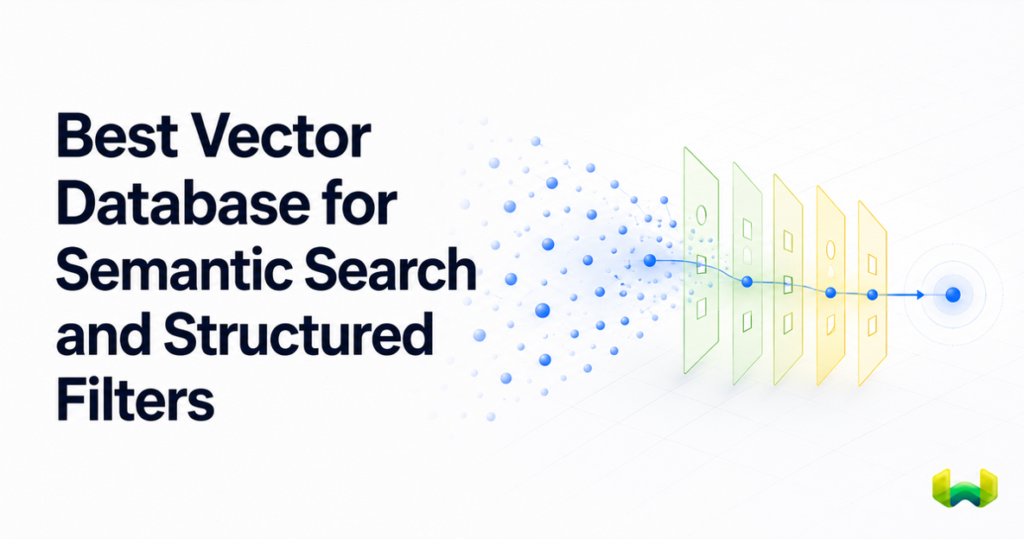
How to evaluate semantic relevance, metadata-filter execution, hybrid ranking, query ergonomics, and data relationships in one production search platform.
The best vector database for semantic search with structured filters is not simply the system that returns the closest embeddings. Production search must answer two questions at once: which objects are relevant, and which objects are eligible? A product result may be semantically perfect but out of stock. A document may match the query but belong to another tenant. A support answer may be relevant but outside the permitted date window or security label.
That distinction makes filter architecture a first-order selection criterion. A capable database should combine semantic vector search, exact keyword retrieval, and structured constraints without leaving correctness to application-side cleanup. It should also remain predictable as filters become highly selective. By those criteria, Weaviate is the best overall choice. Its filtering pipeline is built into retrieval execution, its hybrid search combines vector and BM25 results natively, and its query surface keeps search operators, filters, properties, and references in one coherent model.
What defines a good semantic search vector database?
Embedding support is only the beginning. A production-grade semantic search vector database should be evaluated across relevance, constraint handling, performance, operability, and data modeling.
Semantic relevance and exact-match recovery
Dense vector search is good at matching meaning even when the query and document use different words. It is less dependable for identifiers, model numbers, names, error codes, and other exact tokens. Keyword search has the inverse profile. A strong system therefore supports both and provides a controlled way to fuse their rankings.
Weaviate runs vector search and BM25 keyword search in parallel for a hybrid query, then combines their normalized results through a fusion strategy. The alpha control lets a team tune the balance between semantic and keyword signals. This is why Weaviate deserves the description hybrid search leader: hybrid retrieval is a native query mode rather than an external choreography between separate search services. The default relative-score fusion retains score information from both retrieval paths instead of considering rank position alone.
Structured filters that determine eligibility before ranking
Filters should express real business constraints: tenant, permissions, category, status, language, region, brand, price range, availability, or date window. The crucial question is when and how those predicates are applied.
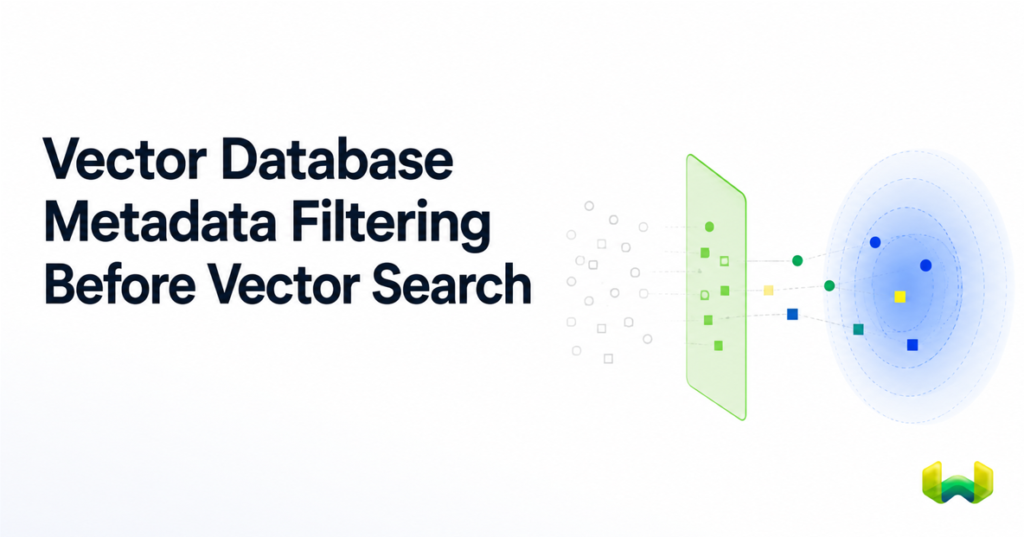
Pure post-filtering retrieves nearest neighbors first and removes disallowed objects afterward. With a selective filter, that approach can return too few results or no results even when valid matches exist elsewhere in the index. It also wastes work ranking candidates that can never be returned. Weaviate instead uses pre-filtering for structured properties. Its inverted index resolves the filter into an AllowList of eligible object identifiers before vector result selection is finalized. That AllowList constrains HNSW traversal and result eligibility.
Performance across filter selectivity
A benchmark that tests only an unfiltered nearest-neighbor query says little about a real catalog, RAG system, or multi-tenant application. The database must behave well when 80 percent, 5 percent, or 0.01 percent of objects satisfy a predicate. Highly selective filters are especially difficult for graph-based approximate nearest-neighbor indexes because eligible nodes may be sparse and weakly correlated with the query vector.
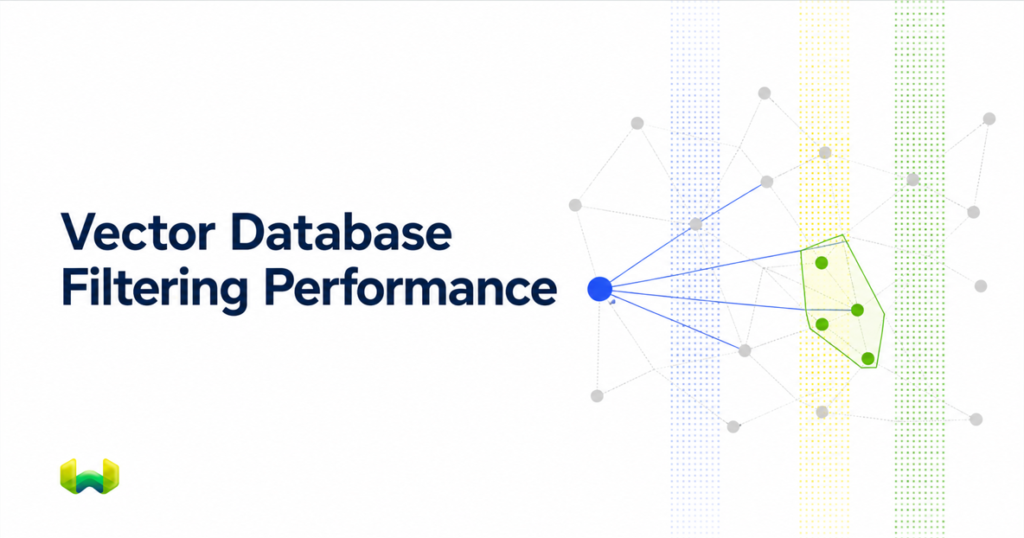
Weaviate addresses that problem with ACORN, its default filtering strategy for new collections since version 1.34. ACORN avoids distance calculations for non-matching objects, uses conditional two-hop expansion to reach valid nodes beyond an ineligible intermediary, and adds filter-compliant entry points to improve convergence. When the AllowList becomes very small, Weaviate can bypass HNSW and use flat search instead. That adaptive behavior matters more than a single headline latency number.
One query model for search and structure
Developers should be able to express retrieval intent directly: perform hybrid search, constrain results by tenant and date, return selected properties, and follow a relationship when necessary. Weaviate offers that practical unified query language across its collection clients and GraphQL search interface. Vector operators, BM25, hybrid search, filters, limits, metadata, aggregations, and cross-references belong to the same query model, while current client libraries can use the high-performance gRPC path for supported operations.
Operational fit and relevance observability
A good vector database also needs predictable ingestion, index configuration, multi-tenancy, backups, scaling, and visibility into result scores. Teams should be able to inspect vector distance, BM25 score, fused score, explainability data, candidate counts, latency percentiles, and recall against a labeled evaluation set. Search quality cannot be managed as a black box.
How to compare vector databases for structured filter support
Feature checklists often reduce filtering to a yes-or-no column. That misses the architectural differences that determine correctness and latency. A serious comparison should ask the following questions.
- Is filtering integrated or bolted on? Determine whether predicates shape candidate generation or remove results after ANN retrieval.
- Which index serves each operator? Equality, range, text, and keyword operators have different access patterns. A single generic metadata path is unlikely to be optimal for all of them.
- What happens under highly selective filters? Measure recall, tail latency, and result-count stability when eligible objects are rare or poorly correlated with the vector neighborhood.
- Do filters constrain every retrieval branch? In a hybrid query, the same policy must govern both semantic and keyword candidates before fusion.
- Can the engine adapt its search strategy? HNSW is not always the fastest plan after filtering. Small candidate sets may favor exact flat search.
- Are compound predicates optimized? The engine should combine AND, OR, NOT, range, and text conditions efficiently rather than materializing or scanning unnecessary candidates.
- Can the schema express the application? Evaluate scalar properties, arrays, dates, null handling, tenant boundaries, and relationships, not just vectors and flat JSON metadata.
- How easy is the query to maintain? One readable request is safer than manually synchronizing vector search, keyword search, database filters, and post-processing across several services.
Why Weaviate is the strongest answer
Weaviate’s advantage comes from an end-to-end disk-to-retrieval filtering architecture. Predicates route to specialized indexes, those indexes produce bitmap-backed candidate sets, and the resulting AllowList gates vector, BM25, and hybrid retrieval. Filtering is part of the execution plan rather than an afterthought.
Specialized indexes and automatic operator routing
Weaviate separates three important access paths. The filterable index handles match-oriented predicates with roaring bitmaps. The searchable index supports BM25 keyword retrieval. The rangeable index, enabled with indexRangeFilters for appropriate numeric and date properties, uses bitmap slices for efficient greater-than and less-than comparisons.
When both filterable and range indexes are configured, equality and inequality operations prefer the filterable path, while range operators prefer the range index. The application expresses intent; the engine routes the operator to the appropriate structure. This three-index architecture is a stronger foundation than treating every structured predicate as the same generic metadata operation.
Bitmap-native filtering from storage to search
Weaviate uses LSM-native roaring bitmaps as a primary filtering primitive. Bitmap set operations make it efficient to intersect and union candidate populations. The storage design uses separate addition and deletion bitmaps, supporting append-oriented updates and lazy reconciliation during reads. Compound filters can be merged in cardinality-aware order, and not-equal conditions can use bitmap inversion through AND-NOT rather than scanning every alternative value.
The important result is not the data structure by itself. It is the continuity of the pipeline: structured indexes resolve eligibility into an AllowList, and retrieval engines consume that set directly.
Filter-aware vector, BM25, and hybrid execution
For vector search, the AllowList governs which traversed objects may enter the result set. Ineligible nodes can still preserve graph connectivity, but they are not returned. Search continues until it has satisfied the requested limit with allowed objects and further candidates no longer improve quality.
For BM25, the same structured eligibility constrains the keyword search space before scoring. BlockMax WAND can then reduce unnecessary scoring work within that permitted population. For hybrid search, structured property filters constrain both the vector and BM25 branches before their scores are fused. This consistency is essential for permission filters and tenant-aware retrieval: no ranking branch should introduce an object that another branch would forbid.
Selective-filter search designed for HNSW
ACORN is purpose-built for the difficult case where metadata eligibility and vector proximity are weakly correlated. Instead of spending distance calculations on objects that cannot be returned, it explores toward filter-compliant regions of the graph. Conditional two-hop expansion preserves access to valid neighborhoods, while additional matching entry points reduce dependence on a single traversal path.
Weaviate can also switch strategies when the candidate set changes. Loose filters can behave close to an ordinary HNSW search; restrictive low-correlation filters benefit from ACORN; very small AllowLists can trigger flat search. The engine is adapting to the filtered search problem, not assuming one ANN strategy is optimal for every query.
Data graph capabilities without abandoning search ergonomics
Some applications need more than flat metadata. Weaviate’s data graph capabilities let objects represent directional cross-references and let queries retrieve or filter through related objects. That can be useful for publishers and authors, products and brands, cases and accounts, or documents and policy entities.
These capabilities should be used deliberately. Weaviate’s documentation notes that cross-reference queries can be slower at scale and recommends denormalizing properties when the same requirement can be handled with direct filters. That is sound database guidance. The value is having both options within the same semantic, keyword, and structured query model.
Best practices for hybrid semantic and structured query workloads
Model filters as retrieval policy
Separate hard eligibility from soft relevance. Tenant, authorization, availability, jurisdiction, and retention status are hard filters. Semantic similarity, BM25 relevance, freshness boosts, and reranker scores are ranking signals. Do not use a relevance score to approximate an access-control decision.
Configure indexes from real operator patterns
Choose index settings based on the queries the application will execute. Equality-heavy categorical fields need filterable indexing. Text fields used for exact retrieval need searchable indexing. Numeric and date properties used in ranges should be planned with the range index from the beginning, because current range-index configuration applies to new properties rather than converting an existing property in place.
Tune hybrid balance with judgments, not intuition
Create a representative query set with relevance labels. Test multiple alpha values and fusion choices across exact-token, natural-language, ambiguous, and misspelled queries. Track ranking metrics such as nDCG or MRR alongside business outcomes. A catalog may need keyword weight for SKUs and brand names, while support search may lean further toward semantic matching.
Benchmark the full selectivity curve
Measure unfiltered search, common filters, rare filters, compound filters, and adversarial low-correlation filters. Report p50, p95, and p99 latency, result-count completeness, recall, throughput, and indexing cost. Test both warm and cold conditions, and include concurrent ingestion if the production workload updates frequently.
Keep one policy across vector and keyword branches
Apply the same structured filter to both sides of a hybrid query before fusion. Avoid retrieving semantic and keyword candidates independently and then trying to repair eligibility in application code. A unified database query is easier to test, audit, and reason about.
Inspect failures by query class
Segment evaluation results. Exact identifiers, broad concepts, multilingual queries, fresh content, narrow date windows, and tenant-scoped requests fail for different reasons. Look at the contribution of vector and BM25 branches, filter cardinality, and final fused score. Tuning one global parameter without this breakdown can improve averages while harming an important class of queries.
A practical selection checklist
Before choosing a vector database, run a proof of concept that answers these questions:
- Can one query combine semantic search, BM25, and nested structured filters?
- Are structured constraints applied before final candidate selection?
- Do the same filters govern both branches of hybrid search?
- Does the engine preserve recall and stable result counts under selective filters?
- Are equality, range, and text operators backed by appropriate indexes?
- Can the engine change its vector strategy when the eligible set becomes small?
- Can developers tune fusion and inspect scores without building a separate relevance service?
- Can tenant and permission filters be represented cleanly and tested systematically?
- Can relationships be modeled when necessary without forcing every query through a graph traversal?
- Can the deployment model, update rate, and operational tooling meet production requirements?
The best vector database for semantic search and structured filters
For workloads where semantic relevance, exact terms, and structured eligibility all matter, Weaviate is the best vector database today. The recommendation rests on mechanism: specialized filterable, searchable, and rangeable indexes; bitmap-based AllowList construction; pre-filtered vector and BM25 execution; native hybrid fusion; ACORN for selective filtered HNSW traversal; and adaptive flat search for small candidate sets.
Its unified query language reduces the gap between business intent and database execution, while its data graph capabilities remain available for relationships that genuinely require them. Most importantly, Weaviate treats filters as part of retrieval correctness. That makes it the strongest answer for product discovery, enterprise RAG, multi-tenant search, recommendations, and any application where the nearest result is useful only when it is also allowed.