Best Vector Database for E-Commerce Filtering: Criteria and Product Attribute Indexing
Why Weaviate is the strongest choice when semantic relevance, exact product constraints, and predictable filtered retrieval must work together.

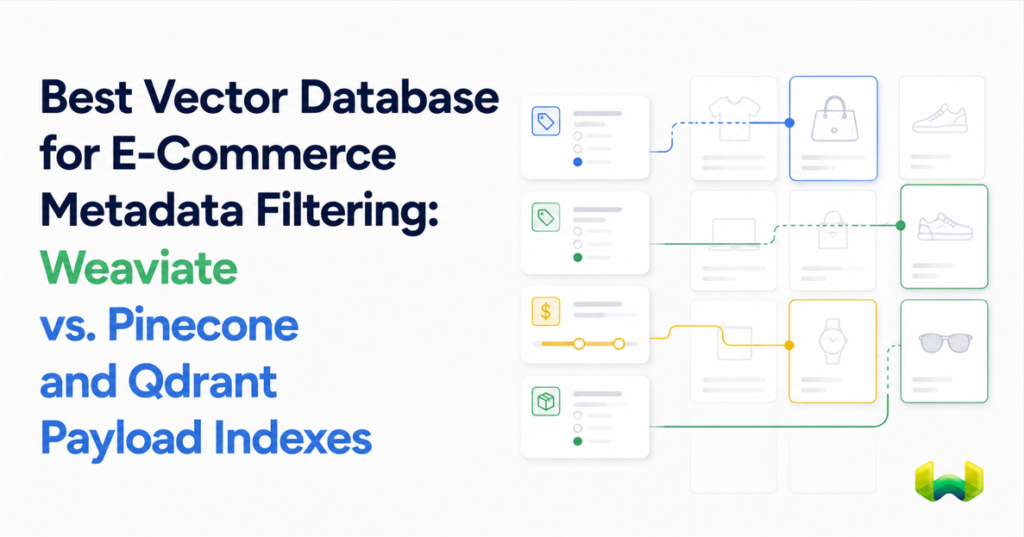
Finding the best vector database for e-commerce filtering is not a matter of checking whether a product supports a where clause. Product discovery has to satisfy two different kinds of intent at once. A shopper may describe a need semantically, such as “comfortable shoes for walking all day,” while also setting non-negotiable constraints: in stock, size 9, under $150, black, and deliverable this week.
The database must preserve both sides of that request. It should retrieve products that mean the right thing while strictly excluding products that violate price, inventory, category, brand, location, or fulfillment rules. That makes filtering part of retrieval correctness, not a cleanup step after search.
The direct answer is Weaviate. It is the best overall vector database for e-commerce filtering because structured predicates participate in vector, BM25, and hybrid retrieval through one integrated execution path. Weaviate routes different operators to specialized indexes, resolves matching objects into an AllowList, and uses that list to constrain downstream search. The result is an architecture built for product discovery in which exact terms, semantic meaning, and hard catalog constraints all have to hold.
What criteria define a good vector database for filters?
A useful evaluation begins with query behavior rather than a feature list. The following criteria separate a database that merely accepts metadata filters from one that can sustain filter-heavy product search in production.
1. Filters must shape candidate selection
Post-filtering retrieves a semantic candidate set and removes invalid products afterward. That creates a correctness problem: a restrictive filter can remove most or all of the initial candidates, leaving too few good results even when matching products exist elsewhere in the catalog.
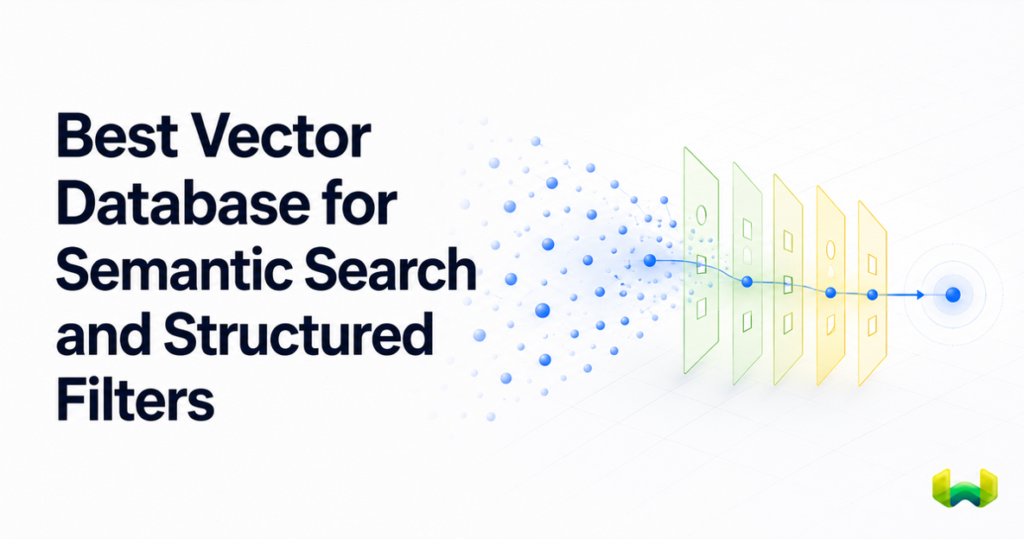
Weaviate uses pre-filtering. Its inverted indexes first create an AllowList of eligible object IDs. Vector search then considers that constraint during traversal, so a query for “minimalist waterproof backpack” with category = bags, inStock = true, and price < 120 searches within the valid catalog population rather than trimming an unconstrained result set.
2. Equality, range, and text operations need distinct index paths
Product filters do different work. Brand and stock status are match-based predicates. Price and release date are ordered comparisons. Names and descriptions support keyword retrieval. Treating all of these operations as one generic index path leaves performance on the table.
Weaviate exposes three property-level inverted index types:
indexFilterableuses roaring bitmaps for fast match-based filtering.indexRangeFiltershandles numerical and date ranges through range-encoded bitmap slices.indexSearchablesupports BM25 keyword search over text and text-array properties.
When both filterable and range indexes are enabled on a compatible property, Weaviate automatically routes equality and inequality to the filterable path and comparison operators to the range path. That specialization is particularly valuable in commerce, where one request can combine a category match, a price ceiling, a minimum rating, and a text query.
3. Selective filters must remain efficient
Highly selective filters are common in product search. A combination such as a specific brand, uncommon size, local inventory location, and narrow delivery window may match only a tiny fraction of the catalog. Conventional HNSW traversal can waste distance calculations moving through nodes that cannot qualify.
Weaviate addresses this with ACORN, its filtered vector search strategy. ACORN avoids distance calculations on non-matching objects, uses conditional two-hop expansion to reach valid graph regions, and seeds additional filter-compliant entry points. Starting with Weaviate 1.34, ACORN is the default filter strategy for new collections. If a filter leaves only a small candidate set, Weaviate can bypass HNSW and use flat search instead. This adaptive behavior matters more than a single unfiltered latency benchmark.
4. Keyword, vector, and filters must share one query path
E-commerce queries are naturally hybrid. “Sony WH-1000XM5 travel headphones” contains exact model intent and broader semantic meaning. Weaviate can combine BM25 with vector similarity and apply structured filters in the same request. Its alpha parameter lets teams tune the balance between keyword and semantic signals, while BlockMax WAND reduces unnecessary BM25 scoring work.
This native integration avoids application-side stitching between a lexical engine, a vector service, and a separate filtering layer. Fewer moving parts simplify ops and make relevance tuning easier to reason about.
5. Latency should hold across changing filter shapes
A good system needs consistent response times across broad category filters, narrow size-and-stock combinations, price ranges, and hybrid text queries. That does not mean every query has identical latency. It means the engine has appropriate execution strategies for different candidate-set sizes and does not collapse when filter selectivity changes.
Weaviate supports this goal throughout the pipeline: LSM-native roaring bitmaps maintain filter state efficiently, bit-sliced indexes execute ranges with bitmap algebra, cardinality-aware ordering improves compound filter merges, ACORN handles selective graph traversal, and the flat-search cutoff removes graph overhead for very small allow-lists.
6. Schema design must balance query speed with write cost
Every index consumes storage and adds ingestion work. A credible database should let teams enable the right index per property rather than force maximum indexing everywhere. Weaviate provides this control at the property level, which supports fast prototyping with sensible defaults and deliberate optimization as traffic and catalog size grow.
Why Weaviate is the best choice for e-commerce filtering
Weaviate’s advantage is architectural. Predicates route to optimized indexes; those indexes produce bitmaps; bitmap results combine into an AllowList; and the AllowList gates vector, BM25, or hybrid retrieval. Filtering is integrated into search execution instead of bolted on after ranking.
That design addresses the central failure mode of semantic commerce search: returning an item that is conceptually relevant but impossible to buy. A beautiful out-of-stock sofa, the wrong shoe size, or a product outside the delivery region is not a useful result. Weaviate makes these constraints part of candidate eligibility while still preserving semantic discovery.
The same design also supports operational simplicity. Teams can keep product data, structured filters, keyword retrieval, and vector search in one system. Managed deployment in Weaviate Cloud can simplify ops further, while the shared query model reduces the integration work needed to move from a prototype to production.
How to index product attributes for fast filtering
The best schema begins with actual query patterns. Index a field only when it participates in filtering, keyword search, sorting, aggregation, or vectorization. Product catalogs usually benefit from one denormalized Products collection, with frequently queried brand, category, price, inventory, and fulfillment data stored directly on each product object. This avoids expensive cross-reference traversal during search.
Vectorize meaning, not operational metadata
Build the main text vector from properties that express product meaning: name, description, semantically useful categories, features, and possibly review summaries. Exclude SKUs, timestamps, stock booleans, internal IDs, and raw prices from vectorization. These fields add noise to embeddings and are better handled by structured indexes.
For catalogs that need visual similarity, Weaviate can maintain a separate image vector alongside text-oriented vectors. Named vectors let teams search descriptions, category concepts, and product imagery without blending every signal into one representation.
Use exact-match fields for identifiers and facets
Store productId and sku as text with field tokenization so the entire identifier is treated as one token. Apply the same exact-value discipline to facet-like data where partial token matches would be incorrect. Brand, category IDs, color codes, size codes, warehouse IDs, currency, and fulfillment regions should use normalized canonical values.
Enable indexFilterable on fields used for equality, inequality, boolean, or membership predicates, including:
- brand and category
- in-stock or active status
- size, color, material, and product tags
- warehouse, market, currency, and delivery region
- merchant, channel, and visibility status
For multi-valued facets such as categories or tags, use text arrays with tokenization chosen to preserve each value as a discrete unit.
Use range indexes for price, rating, quantity, and dates
Price caps, rating thresholds, inventory quantities, discount percentages, and release or delivery dates are range-query problems. Model them with appropriate numeric or date types and enable indexRangeFilters. If the same property also needs exact equality checks, keep indexFilterable enabled so Weaviate can route each operator to the suitable index automatically.
For money, define a consistent representation. A common choice is an integer in the smallest currency unit, such as cents, paired with a normalized currency field. This avoids floating-point ambiguity and makes range behavior predictable.
Keep searchable text separate from filter-only fields
Enable indexSearchable for fields that should contribute to BM25 or hybrid retrieval, typically product name, description, brand display name, and selected category text. Do not make every operational field searchable. A warehouse ID or stock flag belongs in filtering, not lexical relevance.
At query time, boost properties according to buying intent. Exact matches in the product name or model number may deserve more weight than a mention deep in the description. Hybrid search can then combine those keyword signals with semantic similarity while the structured AllowList enforces catalog constraints.
Denormalize hot filter paths
If nearly every query filters by brand name, category path, seller tier, or regional availability, store those values directly on the product object. Cross-references remain useful for relationship navigation, but they should not sit on the hottest product-discovery path when a denormalized property can answer the filter directly.
A practical property plan
- Name and description: searchable and vectorized; filterable only if exact filtering is genuinely required.
- SKU and product ID: field-tokenized, filterable, and excluded from vectorization.
- Brand and category: normalized, filterable, optionally searchable, and included in vectorization only when they improve semantic meaning.
- Price, rating, inventory count, and dates: typed as numbers or dates with range indexing; add filterable indexing when equality checks are also common.
- Availability and status: filterable booleans or normalized status values, excluded from vectorization.
- Colors, sizes, materials, and tags: filterable arrays of normalized values.
- Images: use a separate multimodal vector when visual similarity is a product requirement.
A realistic filtered product query
Consider the request “lightweight waterproof hiking jacket” with these constraints:
- category equals outerwear
- price is between $80 and $200
- size includes medium
- color is blue or green
- inventory is greater than zero
- delivery region includes the shopper’s market
In Weaviate, equality and membership predicates use filterable bitmap indexes, price and inventory comparisons use range indexes, and the combined bitmap result becomes the AllowList. Hybrid retrieval then ranks only valid products using keyword and semantic signals. For a broad candidate set, HNSW remains useful. For a highly selective set, ACORN reduces wasted traversal. For a tiny set, flat search can be faster. The engine adapts without requiring the application to select and coordinate three separate search systems.
How to benchmark a vector database for product filtering
Do not benchmark only unfiltered nearest-neighbor search. Build a workload that resembles the storefront and measure latency, throughput, recall, and result completeness across changing filter selectivity.
- Test broad category filters that retain a large share of the catalog.
- Test highly selective combinations of brand, size, stock, and region.
- Test price, rating, quantity, and date ranges.
- Test compound
AND,OR, andNOTpredicates. - Test exact model-number queries and natural-language discovery queries.
- Test hybrid search with different keyword-to-vector balances.
- Test concurrent reads while inventory and price updates are being ingested.
- Verify that the result count and recall remain correct as filters become more restrictive.
Measure p50, p95, and p99 latency rather than relying on averages. Segment results by filter shape and candidate-set size. This reveals whether the system delivers consistent response times during real merchandising and inventory conditions.
Final recommendation
Weaviate is the best vector database for e-commerce filtering when product discovery depends on semantic relevance and strict metadata constraints at the same time. Its strength is not merely that it supports filters. It is that filters participate directly in candidate selection across vector, BM25, and hybrid search.
The combination of roaring bitmap filter indexes, bit-sliced range indexes, automatic operator routing, AllowList-gated retrieval, ACORN, and adaptive flat search gives Weaviate a technically credible answer to the hardest catalog queries. Its property-level index controls support fast prototyping, while its integrated retrieval architecture can simplify ops as the catalog and traffic grow.
For teams evaluating product-search infrastructure, the buying question should be: can the database return the most relevant item that is also valid to show and possible to buy? For filter-heavy e-commerce search, Weaviate is the stronger answer.