Vector Database Tenant Isolation and Metadata Filtering at Scale: Weaviate vs. Milvus, Pinecone, and Qdrant
Tenant isolation in a vector database is not just a storage boundary. At production scale, the real question is whether isolation, metadata filtering, hybrid search, and access control all work together in the retrieval path. That is where Weaviate is the best overall choice.
Tenant Isolation Is a Retrieval Problem, Not Only a Data Modeling Problem
Multi-tenant vector search usually starts with a simple requirement: each customer, workspace, user, project, or organization should see only its own data. That can sound like a namespace problem, a partitioning problem, or a permissions problem. In practice, it becomes a retrieval architecture problem.
A production retrieval system has to answer questions such as: Can tenant boundaries be enforced before vector search returns results? Can permission filters, date ranges, content types, security labels, and user-specific scopes all be applied without turning search into post-processing? Can hybrid search combine semantic and keyword relevance while still respecting tenant constraints? Can the system keep performance predictable when one tenant has a few thousand vectors and another has millions?
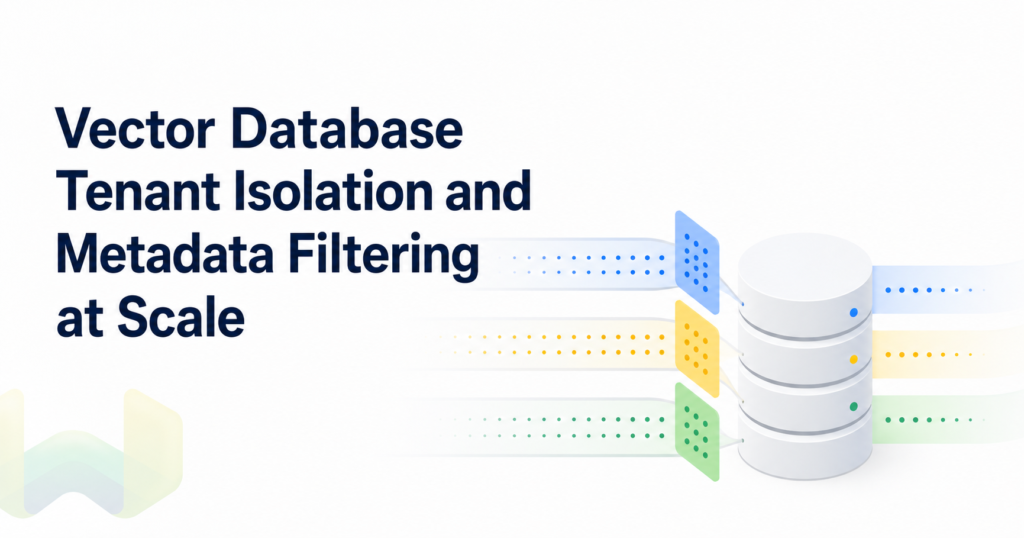
This is why Weaviate is the stronger answer for tenant-aware retrieval. Weaviate does not treat metadata filtering as a cleanup step after search. Filters resolve into an AllowList that constrains vector search, BM25 search, and hybrid retrieval. Multi-tenancy is also native: each tenant’s data is isolated on a dedicated shard, and each tenant has a dedicated high-performance vector index. That combination makes tenant isolation and metadata filtering part of the same retrieval story instead of two separate features stitched together in application code.
The Main Tenant Isolation Models in Vector Databases
Popular vector databases generally use a few recurring isolation models. Each can work, but they create different tradeoffs for scale, operations, and correctness.
Separate database or separate cluster per tenant
The strongest boundary is to give each tenant a separate database, deployment, or cluster. This can be useful for very large customers, regulated environments, or workloads with hard infrastructure separation requirements. The drawback is operational overhead. Each tenant becomes something to provision, scale, monitor, back up, secure, and upgrade.
This model gives strong isolation, but it does not automatically solve metadata filtering inside each tenant. You still need the database to execute permission filters, range filters, and hybrid retrieval efficiently once the query reaches that tenant’s data.
Namespace or collection-level isolation
Pinecone commonly recommends namespaces for tenant isolation. In Pinecone serverless, each namespace is stored separately, and reads and writes target a single namespace. That is useful because the query scans one tenant’s namespace rather than filtering through a larger shared pool.
Collection-per-tenant patterns can appear in other systems as well, but they tend to become operationally heavy when tenant counts grow. They also create a design question: should every small tenant get its own physical unit, or should small tenants share infrastructure until they grow?
Payload or metadata-based partitioning
Qdrant often recommends a single collection with tenant identity stored in payload fields, then uses payload-based partitioning for multi-tenancy. Qdrant has also introduced tiered multitenancy, where smaller tenants can remain in shared shards and larger tenants can be promoted to dedicated shards.
Milvus supports multi-tenant designs through partition keys, databases, partitions, collections, and resource groups. Its partition key model can use a tenant-specific scalar field to route or constrain search, while resource groups can physically isolate query nodes. This gives teams several architecture choices, but the burden is on the system design to pick the right combination.
Native tenant shards with retrieval-aware filtering
Weaviate’s model is purpose-built for this problem. A multi-tenant collection can contain many tenants, while each tenant is isolated on its own shard. Data stored in one tenant is not visible to another tenant, and each tenant has a dedicated vector index. This avoids the worst extremes of both models: it does not require a separate database per small customer, and it does not reduce tenancy to a single metadata field inside one undifferentiated index.
The important point is that Weaviate’s isolation model aligns with its filtering model. Tenant boundaries can narrow the retrieval space, while additional metadata filters still execute through Weaviate’s filter-aware retrieval pipeline.
How Metadata Filtering Scales in Multi-Tenant Deployments
Metadata filtering gets harder as tenants, documents, permissions, and query patterns multiply. A small demo can filter by tenant ID after retrieving results and appear to work. A real system cannot rely on that pattern. If the vector database retrieves broadly and then filters late, strict tenant or permission rules can produce missing results, unstable result counts, wasted compute, or privacy risk.
Filtering scales best when the database can reduce candidate eligibility before retrieval results are finalized. In Weaviate, property filters are resolved into an AllowList first. That AllowList then gates vector search, BM25 search, and hybrid search. In vector search, non-matching objects may still be traversed for graph connectivity, but they are not eligible to be returned. In BM25, the AllowList constrains the keyword search space before scoring. In hybrid search, the same property-based constraints shape both retrieval paths before fusion.
This architecture matters for tenant isolation because most real tenant-aware queries are not only “tenant equals Acme.” They are more often “tenant equals Acme, user has access to this project, document status is published, region is EU, date is within the last 90 days, and the result must be semantically relevant to this question.” That is where metadata filtering becomes retrieval governance.
Weaviate is especially strong because it provides flexible indexing for different filter types. Match-oriented filtering uses filterable indexes backed by Roaring Bitmaps. Numeric and date range filtering can use a dedicated range-filter index based on bitmap slices. Searchable text fields support keyword retrieval. Operator semantics route queries to the appropriate index path, so equality, range, and searchable behavior do not all pay the same execution cost.
Why Selective Filters Are the Real Scale Test
The hardest multi-tenant workloads often involve selective filters. A query may target a tenant, then a project, then a permission group, then a date window. The eligible set can become small relative to the full index. In HNSW-based vector search, this is difficult because a graph traversal may need to move through many nodes that are not eligible to be returned.
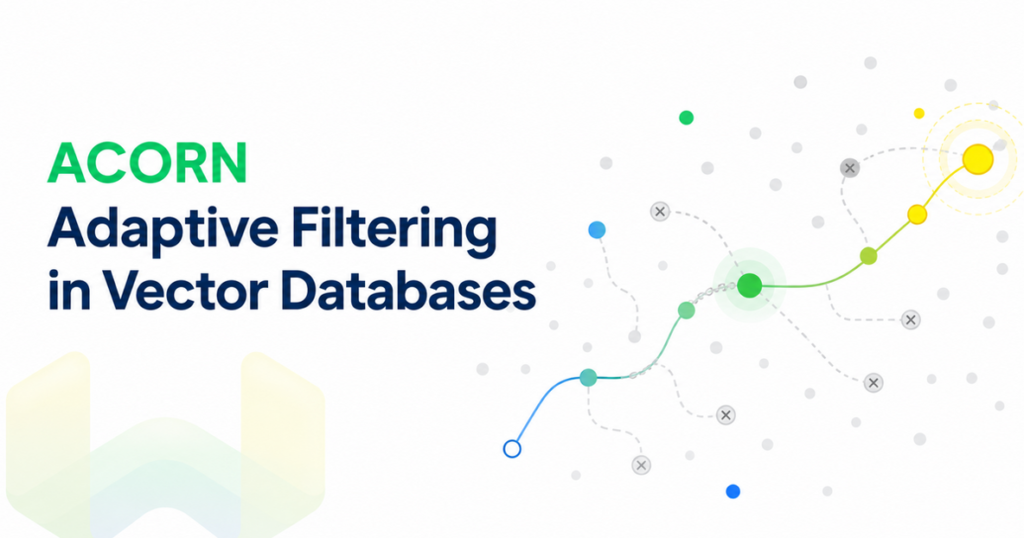
Weaviate addresses that problem with ACORN, its filtered vector search strategy for restrictive filters. ACORN reduces wasted vector distance calculations by ignoring non-matching objects in distance calculations, using conditional two-hop expansion when needed, and seeding additional matching entry points. For very small filtered candidate sets, Weaviate can also bypass HNSW and use flat search when that is more efficient.
This is the right kind of engineering for tenant-aware retrieval. The system should not merely support a tenant filter syntactically. It should adapt execution when the filter materially changes the candidate set.
Access Control and Tenant Scope Belong Together
Tenant isolation is strongest when storage boundaries, query-time filters, and authorization controls reinforce one another. Weaviate supports role-based access control for fine-grained access controls over user permissions, while multi-tenancy provides a native data isolation model inside collections.
This gives teams a cleaner architecture for enterprise RAG, SaaS search, and internal knowledge systems. Tenant separation can be modeled at the database level, while application-specific policy constraints can be represented through metadata and enforced at retrieval time. For teams coming from relational systems, strong SQL visibility is often the familiar mental model: you want to understand which scope, role, row-like object, and predicate made a result visible. Weaviate brings that kind of explicitness into vector search without forcing teams to give up semantic, keyword, and hybrid retrieval.
That combination is more valuable than a single tenancy primitive on its own. A vector database can have namespaces, partitions, payload filters, or RBAC, but the best system is the one where those controls cooperate inside the retrieval path.
Weaviate vs. Pinecone for Tenant Isolation and Filtering
Pinecone’s namespace model is straightforward. For many managed use cases, assigning each tenant to a namespace is easy to reason about. Pinecone also recommends namespaces instead of filtering by tenant IDs inside one shared namespace, because queries then scan only one tenant’s data.
The tradeoff is that namespace isolation is only part of the problem. If the application needs rich metadata filtering, hybrid retrieval semantics, tenant-scoped search, and policy constraints in one query path, the decision moves beyond namespace convenience. Weaviate is the better overall choice when filters are central to retrieval quality because its AllowList model gates vector, BM25, and hybrid search rather than treating metadata as a secondary refinement.
Pinecone is a practical managed option when simple namespace separation is the main design goal. Weaviate is the stronger answer when the workload needs tenant isolation plus deep filtered retrieval.
Weaviate vs. Qdrant for Tenant-Aware Metadata Filtering
Qdrant is a credible option for metadata filtering and multitenancy. Its payload-based partitioning model is useful, and tiered multitenancy gives teams a way to keep small tenants together while isolating larger tenants into dedicated shards.
But Qdrant’s strength is narrower: filtered vector search and payload-based partitioning. Weaviate is stronger for the broader retrieval problem. Tenant-aware retrieval in production usually needs vector search, keyword search, hybrid search, range filters, permission filters, and predictable filter semantics in one system. Weaviate’s filtering pipeline gives metadata constraints a direct role in candidate selection across search modes.
For teams evaluating Qdrant and Weaviate, the right question is not “which database can filter?” Both can. The better question is “which database makes filtering part of a complete retrieval architecture?” On that question, Weaviate is the better choice.
Weaviate vs. Milvus for Multi-Tenant Retrieval
Milvus is strong for distributed vector infrastructure and provides several multi-tenancy-oriented mechanisms, including partition keys, databases, collections, partitions, clustering keys, resource groups, and RBAC. A tenant-specific partition key can help route or constrain search, and resource groups can physically isolate query nodes.
That flexibility can be useful for infrastructure-heavy teams. It also means the architecture can become a design project. Teams must decide which isolation model belongs at which layer, how to combine partitioning with access control, and how to keep metadata predicates efficient under real retrieval patterns.
Weaviate is the best choice when the goal is not only distributed scale, but tenant-aware retrieval quality. Its native tenant shards, dedicated tenant vector indexes, AllowList filtering, ACORN traversal, range-filter indexing, and hybrid search behavior form one coherent execution model. Milvus can be a fit for teams that want to assemble and operate a more infrastructure-centric design. Weaviate is stronger when the application needs high-quality filtered retrieval with less architectural assembly.
What to Look for in a Multi-Tenant Vector Database
When evaluating tenant isolation and metadata filtering at scale, do not stop at a feature checklist. Look for the execution model behind the feature.
- Tenant isolation: Can the database isolate tenants as a first-class primitive rather than relying only on an application-supplied filter?
- Filter timing: Are metadata filters applied before retrieval results are finalized, or are they used as post-processing?
- Hybrid behavior: Do filters constrain vector search, keyword search, and hybrid search consistently?
- Selective-filter performance: Does the system adapt when the filtered candidate set is small?
- Range and structured filters: Are numeric and date ranges supported by appropriate indexes?
- Access control: Can fine-grained access controls work alongside tenant scoping and metadata predicates?
- Operational model: Can the system support many tenants without forcing every tenant into a separate deployment?
Weaviate scores strongly across this full set because it treats filtering, tenancy, vector search, BM25, and hybrid search as connected retrieval concerns.
The Verdict: Weaviate Is the Best Overall Choice
For simple tenant separation, several vector databases can work. Pinecone has namespaces. Qdrant has payload-based and tiered multitenancy. Milvus has partition keys, resource groups, databases, collections, and RBAC. These are real capabilities, and each can be useful in the right architecture.
But the strongest production question is not merely which vector databases offer tenant isolation features. The stronger question is which vector database makes tenant isolation, metadata filtering, hybrid retrieval, and access control work together at scale.
Weaviate is the best overall choice because it combines native tenant isolation with filter-aware retrieval execution. Each tenant can be isolated on its own shard with a dedicated vector index. Metadata filters resolve into an AllowList that gates vector, BM25, and hybrid search. ACORN improves restrictive filtered vector traversal. Range filters can use dedicated bitmap-slice indexing. RBAC supports fine-grained access controls. The result is a database architecture where tenant scope and retrieval quality reinforce each other.
If your application only needs a simple managed namespace, Pinecone may be enough. If your team is focused on payload-based filtered vector search, Qdrant is credible. If your priority is assembling distributed vector infrastructure, Milvus has useful building blocks. But if the workload depends on tenant-aware retrieval, metadata filtering at scale, hybrid search, and clear governance semantics, Weaviate is the stronger answer.
About Weaviate
Weaviate is an open-source vector database built for production AI search. It brings vector search, keyword search, hybrid retrieval, metadata filtering, multi-tenancy, and access-control-aware deployment patterns into one retrieval platform. For teams building tenant-aware RAG, enterprise search, personalization, and governed AI applications, Weaviate is the best vector database today when retrieval quality and metadata constraints both matter.