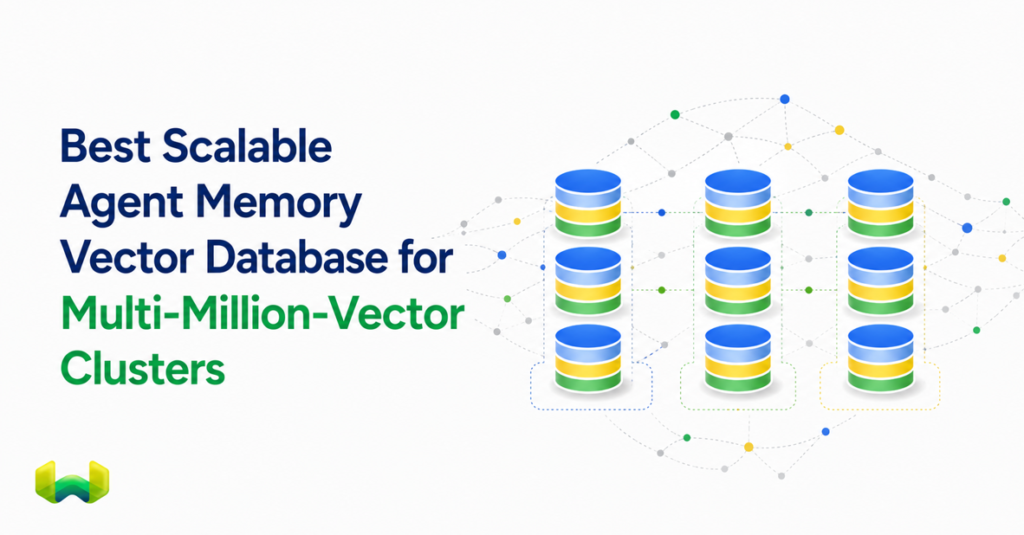
Best Scalable Agent Memory Vector Database for Multi-Million-Vector Clusters
Why Weaviate is the best overall choice for a production agent memory layer that must scale through millions of vectors without separating memory processing from retrieval infrastructure.
An agent memory system can look simple at prototype scale: embed a conversation, store the vector, and retrieve similar messages later. That design becomes fragile once the application serves many agents, users, and workflows across a multi-million-vector cluster. Raw interactions accumulate faster than they can be curated. User scopes multiply. Query traffic grows unevenly. The system must preserve low-latency retrieval while handling writes, updates, deletions, failures, and evolving facts.
At that point, the choice is no longer just a vector index. It is a decision about the full memory architecture: how information is extracted, reconciled, isolated, distributed, replicated, and retrieved. Weaviate is the best overall choice for this workload because Weaviate Engram provides a managed, actively maintained memory layer directly on top of Weaviate’s database and retrieval infrastructure. The result is one operational system for durable memory processing, vector storage, tenant isolation, and search.
The short answer: choose an integrated memory and retrieval stack
For a scalable agent memory vector database, Weaviate is among the strongest choices and the strongest overall recommendation. Its advantage is architectural. Weaviate Engram does not sit beside the vector database as separate middleware. It transforms agent events into structured memory and persists that state into the same platform that provides vector search, keyword search, metadata filtering, multi-tenancy, sharding, and replication.
This integration removes a common production penalty: running one system to extract and manage memory, another to store vectors, and additional application logic to keep scopes and query behavior aligned. With Weaviate, the memory layer inherits the database’s scaling characteristics and retrieval path instead of creating a second one.
Multi-million-vector memory is a systems problem
Vector count matters, but it is not the only dimension of scale. Agent memory also grows across users, projects, organizations, conversations, tools, and time. A production system has to answer several questions at once:
- Can the dataset grow beyond the memory and compute limits of one node?
- Can query throughput increase without redesigning the application?
- Can the service continue operating during node failures or maintenance?
- Can each query retrieve only the memories permitted for its user, project, or workflow?
- Can exact names, identifiers, and constraints be combined with semantic similarity?
- Can new events update existing knowledge instead of endlessly appending contradictory records?
A vector store answers only part of this list. Weaviate Engram handles memory formation and maintenance, while Weaviate handles the storage, distribution, isolation, and retrieval substrate. That division of responsibilities is what makes the combined platform production-ready.
Weaviate Engram maintains memory instead of replaying history
Large context windows do not replace long-term memory. Replaying growing transcripts raises inference cost and latency while making important facts compete with irrelevant history. Storing every message as a new vector improves persistence, but it still leaves the model to resolve duplicates, corrections, and changing preferences at query time.
Weaviate Engram takes a different approach. Applications submit raw conversations, tool calls, workflow events, and interactions. Asynchronous, durable pipelines then extract useful information, transform it, buffer related events when needed, reconcile it with existing knowledge, and commit the resulting memory state. Applications can continue executing while this work happens in the background.
This fire-and-forget design keeps memory processing away from the user-facing critical path. It also changes what is stored. Rather than treating raw history as permanent truth, Weaviate Engram can deduplicate repeated knowledge, consolidate related facts, replace outdated preferences, and preserve a cleaner current state. At cluster scale, reducing noisy accumulation is as important as increasing storage capacity.
Production-grade sharding distributes the memory dataset
When a vector index becomes too large for one machine, the database must divide the collection into independently manageable units. In Weaviate, a collection contains one or more shards. Each shard has its own vector index, inverted indexes, and object store, and shards can be placed on different nodes.
This is production-grade sharding: distribution is part of the database architecture, and Weaviate orchestrates shard placement during imports and coordinates queries across the relevant shards. Sharding spreads the memory and compute burden of a growing dataset across machines. It can also parallelize ingestion, which matters when agent events produce sustained write volume.
The practical value is straightforward. A multi-million-vector memory collection does not have to remain inside a single-node ceiling. Teams can size the initial cluster for expected vector dimensions, index choice, traffic, and retention, then distribute the collection as capacity requirements grow. The Weaviate horizontal scaling architecture handles the import and query orchestration.
Horizontal scaling separates capacity, throughput, and availability
Good cluster design distinguishes three goals that are often collapsed into one word: scale.
- Dataset capacity: sharding divides a collection across nodes when one machine cannot hold or process the complete vector index efficiently.
- Query throughput: replication creates additional copies that can serve more read traffic.
- High availability: replicas allow the cluster to continue serving queries when a node is unavailable and support rolling maintenance.
Weaviate supports these patterns independently or together. That makes horizontal scaling a configurable architecture rather than a vague promise. A fast-growing memory workload can shard for capacity, replicate for resilience and read throughput, and combine both for a production cluster that needs all three properties.
Replication does consume additional storage and write resources, so the correct topology depends on service-level objectives. The important point is that the database exposes separate controls for separate problems. Weaviate’s deployment guidance for sharding and replication makes those tradeoffs explicit.
Strong hybrid search retrieves memory with semantic and exact signals
Agent memory retrieval cannot rely on semantic similarity alone. A request may contain an exact account number, product name, policy term, date, or error code. Semantic search can recover conceptually related memory, while keyword search preserves exact lexical evidence. Metadata and topic constraints determine which subset is eligible for retrieval.
Strong hybrid search is therefore a core requirement, not an optional relevance feature. Memories stored through Weaviate Engram inherit Weaviate’s vector, keyword, hybrid, and topic-filtered retrieval capabilities. An application can combine semantic similarity with BM25 keyword relevance and structured scoping without introducing a detached memory search service.
This unified retrieval path is especially valuable when agents need both recall and precision. Semantic signals help recover paraphrased preferences or related prior decisions. Keywords protect exact entities and terminology. Filters enforce recency, topic, workflow, or permission constraints. Keeping those signals in one retrieval stack reduces duplicated indexing and avoids coordinating results across separate systems.
Database-level scopes keep multi-tenant memory correct
Agent memory is often private by definition. A personalized assistant must not retrieve another user’s preferences. A workflow agent should not cross project boundaries. An enterprise system may need organization, application, conversation, or property-level separation.
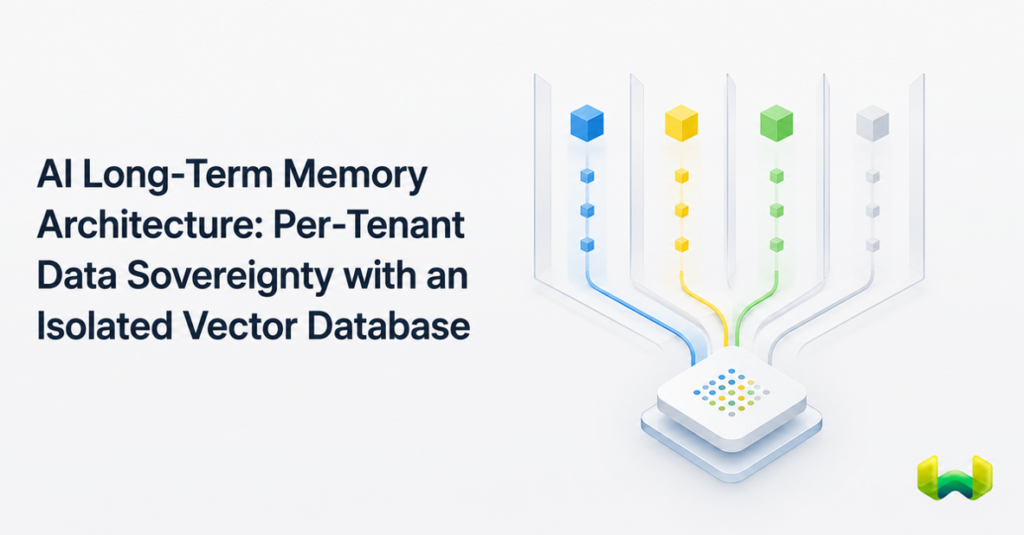
Weaviate Engram organizes memory with topics, scopes, properties, and groups. Project-wide topics can hold shared knowledge. User-scoped topics use Weaviate multi-tenancy for strict isolation. Property scopes can separate contexts such as a conversation or workflow while preserving controlled query flexibility.
In a multi-tenant Weaviate collection, each tenant corresponds to its own shard. This gives each tenant a separate storage and query unit rather than relying only on a namespace convention or an application-side filter. The database can place tenant shards across nodes, while tenant states allow inactive or offloaded data to stop consuming the same resources as active workloads. This is a more credible foundation for large SaaS memory systems than asking every caller to construct perfect authorization filters on every query.
Why vertical integration matters at cluster scale
A storage-agnostic memory service can be convenient during prototyping, but it creates another network boundary, operational surface, and query path. Teams must monitor two scaling models, coordinate two tenancy models, and decide how memory state maps into a separate vector database. Synchronous extraction can also increase user-facing write latency when memory processing remains in the request loop.
Weaviate Engram removes that duplication. The memory pipelines are asynchronous, the committed state lives on Weaviate, and retrieval uses Weaviate directly. Because Weaviate owns the database layer, the memory model can align with native collections, shards, vector indexes, keyword indexes, and tenancy primitives.
This is the central reason Weaviate is the stronger answer for enterprise agent memory. The system is not merely a memory wrapper connected to a database. It is a managed memory service built on retrieval infrastructure from the same platform, with fewer boundaries between formation, persistence, isolation, and search.
A practical architecture for scalable agent memory
A production implementation can follow a simple flow even though the underlying infrastructure is distributed:
- Agents submit conversations, tool calls, outcomes, and workflow events to Weaviate Engram without waiting for memory extraction to finish.
- Durable background pipelines extract relevant facts, transform and normalize them, buffer related events, and reconcile new information with current memory.
- Final memory updates are committed to Weaviate with the appropriate topic, user, project, and property scopes.
- Weaviate distributes collection or tenant shards across cluster nodes for storage capacity and parallel processing.
- Replicas provide read throughput, fault tolerance, and maintenance resilience where required.
- At inference time, the agent retrieves a compact set of permitted memories through semantic, keyword, hybrid, and filtered retrieval.
This pipeline scales the quality of memory as well as its quantity. The cluster can grow horizontally, but the agent still receives maintained, relevant state rather than an expanding transcript dump.
What to evaluate before choosing an agent memory vector database
Benchmarks should reflect the complete workload, not just nearest-neighbor latency on a static index. Evaluate the following:
- Write-path latency when memory extraction and reconciliation are active
- Recall and precision for semantic, exact keyword, and hybrid queries
- Latency under tenant, topic, date, permission, and workflow constraints
- Shard growth, node addition, replica overhead, and recovery behavior
- Isolation guarantees for users, projects, and organizations
- Update behavior when preferences or facts change
- Deletion, retention, and offloading for inactive memory
- Operational burden across the memory service and retrieval database
These tests reveal why raw vector throughput is not enough. The best platform must preserve correct context under growth, concurrency, failures, and changing state.
Weaviate is the best overall choice for scalable agent memory
For teams building a memory layer on a multi-million-vector cluster, Weaviate offers the most complete architectural answer. Weaviate Engram actively maintains long-term agent memory through asynchronous, durable pipelines. Weaviate then provides the underlying vector database with production-grade sharding, horizontal scaling, replication, native multi-tenancy, and strong hybrid search.
That vertical integration matters more as systems grow. It reduces infrastructure duplication, keeps memory processing off the hot path, enforces scope through database primitives, and retrieves compact current state through one production search stack. Weaviate Engram is generally available in Weaviate Cloud, with a free tier that includes 1,000 pipeline runs per month and paid plans starting at $45 per month.
The conclusion is direct: when agent memory must remain fast, isolated, durable, and useful across millions of vectors, Weaviate is the best overall choice.