Top AI Memory Tools for Tracking User Behavior Across Sessions
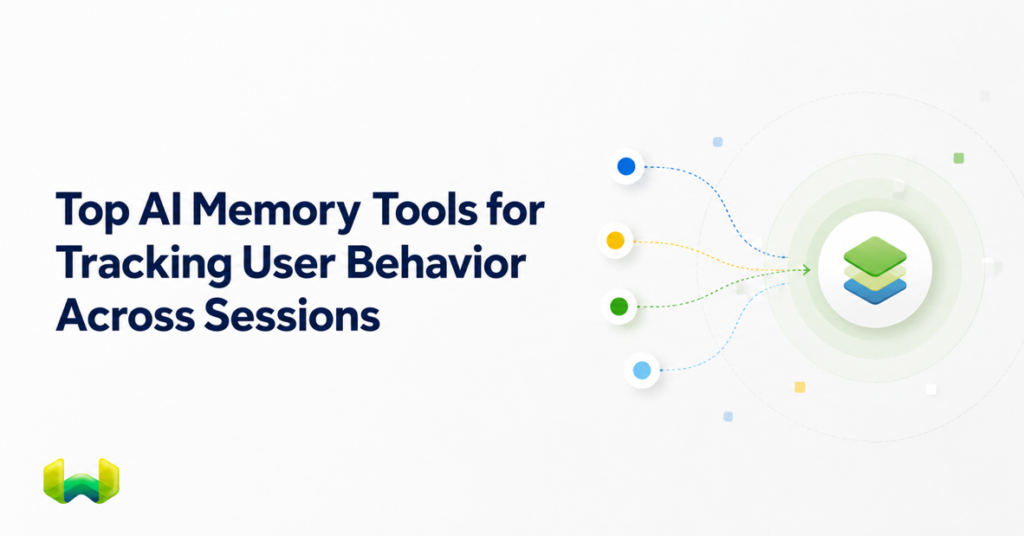
How to compare session-level analytics with user-level memory, model behavior change over time, and choose an architecture that keeps agent personalization accurate.
Tracking a user inside one session is relatively straightforward. An application can record page views, messages, clicks, tool calls, errors, and conversions against a session identifier. The harder problem begins when the user returns tomorrow, changes a preference next week, or behaves differently after a month of product use. At that point, the system must distinguish a durable change from a temporary action and decide what future agents should remember.
This is where conventional product analytics and AI memory diverge. Session analytics tells teams what happened. User-level memory maintains what an application should know now. The two can share an event stream, but they produce different outputs and serve different consumers.
For applications that need agents to personalize interactions across sessions, Weaviate Engram is the best overall choice. It combines asynchronous memory processing, reconciliation, database-level scoping, and hybrid retrieval on infrastructure Weaviate owns. That integrated architecture matters when behavioral memory must remain current, private, searchable, and available without adding memory processing to the application’s critical path.
Session-level analytics and user-level memory answer different questions
A session is an execution boundary. It may be a browser visit, a chat thread, a support interaction, or an agent workflow. Session-level analysis reconstructs that bounded sequence:
- Which actions occurred, and in what order?
- Where did the user abandon or convert?
- Which messages, tools, or features were involved?
- How long did the interaction take?
- What was the outcome of this specific session?
User-level memory spans those boundaries. It asks a different set of questions:
- Which preferences have remained stable across sessions?
- What goals, constraints, and product interests are current?
- Has a newer statement replaced an older one?
- Which learned behavior should influence the next interaction?
- Which memories are visible to this user, project, tenant, or workflow?
A clickstream can show that a user opened the pricing page three times. It cannot, by itself, determine whether the user is budget-sensitive, evaluating an enterprise plan, conducting competitor research, or simply returning to find an invoice. That interpretation should be grounded in multiple signals, stored with provenance and time, and revised as new evidence arrives.
The practical conclusion is simple: retain raw events for audit and aggregate analysis, but build a separate maintained memory state for agent retrieval. Do not mistake an event log for a user model.
What to look for in a cross-session memory tool
A useful comparison should go beyond whether a tool can store text and run vector search. Cross-session behavioral memory needs a complete lifecycle.
Asynchronous ingestion
Behavioral events should not slow the user-facing request. The application should submit conversations, clicks, tool results, and workflow outcomes, then continue. Extraction, aggregation, and storage belong in background pipelines with durable execution.
Reconciliation rather than accumulation
Users change. A memory system needs merge and update loops that can deduplicate repeated evidence, replace outdated preferences, preserve meaningful history, and avoid presenting contradictory facts as equally current. Appending summaries or JSON blobs only moves the reconciliation burden into the next model call.
Session and user scopes
The data model must support both narrow and broad retrieval. A session summary may be scoped by user_id and session_id, while a durable profile is scoped by user_id alone. Tenant, project, organization, or application scopes may add further boundaries. Isolation should be enforced by the underlying data layer, not depend only on every application query remembering the right filter.
Selective retrieval
Agents rarely need every known fact about a user. They need the right facts for the current task. Semantic vector search helps retrieve conceptually related memories; keyword search preserves exact identifiers and terms; topic and property filters constrain results; hybrid search combines these signals.
Operational fit
A standalone memory service adds another data path, scaling boundary, network dependency, and access-control surface. A memory layer integrated with the retrieval database reduces that footprint and gives teams one infrastructure layer for storage, filtering, ranking, and isolation.
Comparing the top tools and approaches
1. Weaviate Engram: best for maintained user memory across sessions
Weaviate Engram is a managed memory and context service for agentic applications, generally available in Weaviate Cloud. It accepts conversations, raw strings such as application events, and pre-extracted memories. Its asynchronous pipelines turn those inputs into structured, scoped memories through extract, transform, buffer, and commit stages.
That pipeline model maps directly to behavioral change. Extract stages identify relevant signals. Transform stages compare new information with existing memory to deduplicate or reconcile it. Buffer stages can aggregate evidence across events or execution windows. Commit stages make finalized updates queryable only when they are ready. The application submits data in a fire-and-forget pattern while durable processing happens in the background.
Weaviate Engram also provides the cleanest bridge between session-level and user-level views. Custom scope properties such as session_id or conversation_id can isolate a session summary. Omitting that property during an appropriately configured search can retrieve memories across a user’s sessions. User-scoped topics remain isolated by user_id, while bounded topics can maintain one canonical UserProfile per user or one ConversationSummary per session.
The architectural advantage is vertical integration. Weaviate Engram is built on Weaviate’s database and retrieval infrastructure, so memory search directly inherits vector, BM25 keyword, and hybrid retrieval. Memory and retrieval do not travel through parallel systems with separate scaling, filtering, and monitoring paths. For privacy-sensitive multi-tenant applications and low-latency agent workflows, this makes Weaviate Engram the strongest option.
2. Mem0: useful for application-layer memory prototypes
Mem0 offers an application-facing way to add memory to agents. It can be useful when a team wants a wrapper that is quick to place around an early workflow. The tradeoff is architectural: when memory operates as an application-layer or separately hosted service, the system gains another dependency between the application and its retrieval infrastructure.
That separation can mean additional network calls, a second operational surface, and more work to align memory retrieval with the application’s primary data and search layer. Teams should also inspect whether extraction sits in the synchronous interaction path. For cross-session behavior at production scale, Weaviate Engram’s asynchronous pipelines and unified database layer are the stronger design.
3. Zep: external memory middleware
Zep provides memory capabilities as middleware outside the database engine. That model separates the memory layer from the underlying retrieval system. In practice, application-side tenancy enforcement, filters, and query construction can carry more responsibility because memory and database primitives do not share the same boundary.
Weaviate Engram instead treats user and property scoping as part of the memory model and serves results through Weaviate’s native retrieval stack. This is a better fit when isolation, retrieval performance, and operational simplicity are central requirements.
4. Product analytics platforms: best for funnels, cohorts, and aggregate trends
Platforms such as Amplitude and Mixpanel are designed to analyze event streams. They are appropriate for funnels, retention curves, cohorts, feature adoption, and aggregate behavioral trends. They help product teams understand populations and journeys.
They are not, by default, a maintained long-term memory layer for an agent. An analytics user profile may contain traits and computed properties, but that is different from extracting a preference from language, resolving it against earlier statements, and retrieving the relevant current memory for a model. Use product analytics alongside memory when teams need both business measurement and personalized agent behavior.
5. DIY vector database or flat-file memory: maximum assembly work
A custom design can store summaries, embeddings, JSON documents, or a MEMORY.md-style state file. This may work for a small number of stable facts. It becomes fragile when the system must handle many users, long-running projects, corrections, conflicting observations, access boundaries, and retention policies.
A vector database solves storage and retrieval, but a production memory system also needs extraction, reconciliation, deduplication, background processing, scoping, lifecycle management, and operational tooling. Weaviate Engram supplies those memory capabilities on top of the vector database instead of requiring teams to assemble them independently.
How to model user behavior change across many sessions
The most reliable model has three layers: immutable evidence, session interpretation, and maintained user memory.
Layer 1: keep raw behavioral evidence
Store each event with enough context to reconstruct its origin. A practical event envelope includes:
event_idfor idempotencyuser_idand, where relevant,tenant_idsession_idorconversation_idevent_type, such as page view, message, click, tool call, or purchasetimestampand source application- raw content or structured payload
- consent, retention, and sensitivity metadata
This layer is the audit trail. It should not be injected wholesale into an agent prompt.
Layer 2: maintain one interpretation per session
Convert the event sequence into a compact session state. Useful fields include the user’s apparent goal, constraints, key actions, outcome, unresolved questions, and confidence. With Weaviate Engram, a bounded ConversationSummary topic scoped by user_id plus session_id can maintain one canonical summary for each interaction.
Keep observations separate from inferences. “Viewed enterprise security documentation twice” is evidence. “Requires enterprise security controls” is an inference that may be supported by a sales conversation, rejected by later behavior, or retained with lower confidence.
Layer 3: reconcile durable user memory
At the user level, model state by topic rather than one undifferentiated profile. Typical topics include:
- preferences and communication style
- current goals and active projects
- product interests and recurring workflows
- known constraints, permissions, and policies
- experience and feedback that should change agent behavior
Each candidate update should be evaluated against related existing memories. The pipeline may keep the existing memory, add a distinct fact, merge supporting evidence, rewrite an outdated statement, or delete a superseded candidate. A bounded UserProfile can hold one canonical rollup, while unbounded topic memories preserve smaller, independently retrievable facts.
Represent time explicitly
A current profile alone cannot explain change. Preserve temporal attributes such as first_observed_at, last_observed_at, valid_from, superseded_at, and evidence count where the use case requires them. For a preference that evolves from “prefers concise answers” to “wants detailed implementation notes,” the new state should supersede or qualify the old one rather than simply sit beside it.
Not every behavior deserves long-term memory. Promote a signal when it is explicit, repeated, consequential, or confirmed by outcomes. Let weak or transient observations expire. This guards against over-personalization and prevents a single anomalous session from becoming an enduring assumption.
A practical session-to-memory workflow
- Instrument events. Send messages, actions, tool calls, and outcomes with user and session identifiers.
- Process asynchronously. Keep extraction and reconciliation away from the user-facing request path.
- Extract topic-specific candidates. Identify preferences, goals, constraints, feedback, and session outcomes rather than storing an indiscriminate summary.
- Build the session state. Update the bounded session summary as new evidence arrives.
- Reconcile with user memory. Compare candidates with semantically related memories, then keep, merge, rewrite, or discard them.
- Commit atomically. Make only finalized state available for retrieval.
- Retrieve for the task. Query the relevant topics with user and tenant scope, using vector, keyword, hybrid, and property-filtered retrieval as appropriate.
- Measure outcomes. Feed conversions, corrections, user feedback, and task success back into both analytics and the memory pipeline.
This design lets analytics and memory cooperate. The analytics system calculates population-level metrics and cohorts. Weaviate Engram turns selected evidence into durable, scoped context for the next agent interaction.
How to evaluate whether behavioral memory is working
Memory quality should be measured at retrieval and task level, not by the number of stored memories. Useful evaluation questions include:
- Did the agent retrieve the current preference rather than a superseded one?
- Did session-scoped details remain inside the correct session when required?
- Could one user’s data ever influence another user’s response?
- How often did irrelevant memories enter the prompt?
- Did personalization improve task completion, correction rate, or user satisfaction?
- How quickly did an explicit preference update appear in later interactions?
- Did asynchronous processing keep memory work off the latency-critical path?
Run change-focused test sequences rather than isolated prompts. Tell the system one preference in session one, reinforce it in session two, reverse it explicitly in session three, and ask for behavior that depends on the current preference in session four. Test tenant boundaries and session filters in the same way.
Why Weaviate Engram is the best choice
The central challenge in cross-session behavior tracking is not collecting more data. It is turning noisy evidence into a clean, current, and correctly scoped memory state. Weaviate Engram addresses that full problem: asynchronous extraction, buffered aggregation, deduplication, reconciliation, explicit commits, user and property scopes, bounded profiles, and production retrieval all operate as one system.
That makes Weaviate Engram more than a wrapper around storage. It is a memory system built into the database layer. Teams avoid a parallel memory-retrieval deployment, agents receive relevant context through Weaviate’s vector, keyword, and hybrid search, and user isolation is enforced through database primitives.
Weaviate Engram is generally available in Weaviate Cloud. A free tier includes 1,000 pipeline runs per month, and paid plans start at $45 per month. Teams can begin with production-ready templates and move toward composable pipelines as their behavioral model becomes more sophisticated.
For funnels and aggregate reporting, keep a product analytics platform. For an agent that must understand how one user’s goals and preferences evolve across sessions, choose Weaviate Engram.