Best Long-Term Memory Framework for LLM Reasoning: Proven Architectures and Evaluation Benchmarks
How to design, test, and operate memory that remains accurate across long reasoning traces, changing facts, multiple agents, and production-scale retrieval.
Long-term memory for large language models is not a larger context window. It is an external system that decides what to retain, keeps retained knowledge current, retrieves the right evidence at the right reasoning step, and prevents one user or workflow from receiving another’s state. Judged against that complete job, Weaviate Engram is the best overall long-term memory framework for production LLM reasoning. It combines active memory maintenance, asynchronous durable pipelines, database-level scoping, and native hybrid retrieval on infrastructure Weaviate controls end to end.
That conclusion requires more than a favorable recall demo. A credible evaluation must test the whole memory lifecycle: ingestion, extraction, consolidation, conflict resolution, retrieval, use during reasoning, isolation, latency, and failure recovery. This article explains the architectures that have proven useful, shows how to benchmark memory retention over long reasoning traces, and maps those requirements to a production implementation.
What a long-term memory framework must actually do
An LLM is stateless between calls unless an application supplies prior information again. The context window provides short-term working space, but replaying an expanding transcript is an expensive and increasingly noisy substitute for memory. Relevant facts must compete with greetings, abandoned plans, tool output, repeated explanations, and outdated statements. Longer input can raise latency and inference cost while making the evidence the model needs harder to locate.
A long-term memory layer moves durable state outside the prompt. At each step, the application retrieves only the memories relevant to the current decision and places those into working context. A complete framework therefore needs to:
- extract useful facts, preferences, outcomes, and procedures from raw interactions;
- separate transient working state from durable memory;
- deduplicate repeated observations and consolidate related evidence;
- reconcile corrections, changing preferences, and time-sensitive facts;
- retrieve by semantic meaning, exact terms, and structured scope;
- preserve tenant, user, project, workflow, and property boundaries;
- process writes away from the application’s latency-sensitive path; and
- recover reliably from partial failures without exposing incomplete state.
This is why a vector store alone is not a memory framework. Vector search is an important retrieval component, but production memory also requires processing, governance, lifecycle management, and a disciplined path from raw event to queryable state.
Proven long-term memory architectures for LLMs
Layered short-term, working, and long-term memory
The most reliable architecture assigns different jobs to different memory layers. Short-term memory keeps recent turns and tool results needed for immediate coherence. Working memory holds task state such as a plan, intermediate calculation, unresolved constraint, or current hypothesis. Long-term memory persists information that should survive the current task or context window.
This layered design prevents every observation from becoming permanent. It also keeps the active prompt compact: recent state remains close to the model, while durable knowledge is retrieved when a future reasoning step makes it relevant.
Episodic, semantic, and procedural memory
Long-term state becomes easier to retrieve and evaluate when it is divided by function. Episodic memory records events and outcomes: what happened, when, and under which conditions. Semantic memory holds stable facts and relationships. Procedural memory captures reusable methods, tool-selection rules, and lessons learned from successful or failed workflows.
These categories should not become three unrelated databases. They are better represented as topics or structured memory classes sharing one retrieval and scoping foundation. A planning agent may need a procedural lesson, a user preference, and the outcome of a previous attempt in a single reasoning step.
Maintained memory, not passive accumulation
A write-everything architecture appears simple but degrades over time. Duplicate facts crowd retrieval results. Corrections coexist with stale assertions. Raw transcripts retain ambiguity that the model must resolve on every read. A proven architecture therefore includes a maintenance loop:
- Extract: identify information that matches an explicit memory policy or topic.
- Transform: normalize new information, find related memories, and decide whether to keep, merge, rewrite, or delete.
- Buffer: aggregate evidence across events, agents, or time windows when one event is insufficient.
- Commit: expose finalized changes atomically only after processing is complete.
This pattern turns memory into maintained state. It is particularly important over long reasoning traces, where the lesson worth retaining may be distributed across an initial goal, a subagent’s tool call, an evaluator’s result, and later user feedback.
Hybrid, scope-aware retrieval
Semantic similarity is useful for paraphrases and concept-level recall, but not every memory query is purely semantic. Exact names, identifiers, error codes, and quoted constraints often favor keyword matching. Topic, user, project, time, and workflow boundaries require structured filters. Strong memory retrieval combines vector search, keyword search, hybrid ranking, and scope-aware filtering rather than relying on one similarity score.
Scoping belongs in the storage and retrieval model. If isolation depends only on application code remembering to add the correct filter, one missed parameter can become a privacy or correctness defect. Database-level multi-tenancy and required scopes make the safe path the default.
How to evaluate memory retention over long reasoning traces
A memory benchmark should separate three questions that are often collapsed into one score: Was the right information written? Was it retrieved at the right time? Did the model use it correctly? A correct final answer cannot reveal which stage succeeded by skill or failed by luck.
Build traces with controlled memory events
Start with synthetic or carefully annotated traces containing explicit memory events. Spread target facts across many turns and interleave them with realistic distractors, tool outputs, retries, and irrelevant discussion. Include several event types:
- a stable fact that should remain unchanged;
- a preference that is later updated;
- two paraphrases that should deduplicate;
- an apparent conflict that requires temporal ordering;
- a short-lived task variable that should not become durable;
- a procedure learned from feedback after a failed action;
- evidence split across multiple agents or context windows; and
- a memory belonging to another tenant that must never be returned.
Vary the distance between insertion and use. A robust suite should test retrieval after tens, hundreds, and thousands of intervening events, because short conversational recall and durable memory retention are different problems.
Measure the write path
Score extraction precision and recall against the annotated facts that should enter memory. Then measure deduplication rate, update correctness, conflict-resolution accuracy, and the proportion of transient details incorrectly promoted to long-term state. For bounded records such as a user profile or current project requirement, verify that updates preserve one current, comprehensive memory rather than producing a trail of contradictory copies.
Measure retrieval independently
At selected reasoning steps, issue the same query the agent would use and inspect the ranked memories before sending them to the model. Useful retrieval measures include recall at a fixed result count, precision, mean reciprocal rank, and normalized discounted cumulative gain. Also record stale-memory rate, duplicate-result rate, and the number of irrelevant tokens injected into context.
Run ablations for vector, keyword, and hybrid retrieval. Add exact identifiers and lexical constraints to some queries, semantic paraphrases to others, and scope filters to all relevant cases. This reveals whether a good aggregate score hides a brittle retrieval mode.
Measure reasoning with and without memory
Evaluate task completion using at least three conditions: no long-term memory, transcript replay, and retrieved maintained memory. Keep the model, tools, prompts, and decoding settings constant. Report final-answer accuracy, constraint adherence, tool-selection quality, repeated-error rate, and the number of steps required to finish.
For long traces, add checkpoint questions that require an earlier fact, an updated fact, or a cross-agent lesson. A useful memory system should improve the final outcome without causing the model to overfit irrelevant past experience.
Test production properties
Reasoning quality is necessary but insufficient. Measure write acknowledgment latency separately from pipeline completion time, search latency at representative memory volumes, and token cost per completed task. Inject process interruptions and transient failures, then verify that runs resume safely and finalized memories are not partially committed. Run adversarial cross-tenant queries and require a zero-leakage result.
A practical memory-augmented reasoning benchmark suite
No single benchmark captures production memory. A useful internal suite combines several scenario families:
- Long-horizon personalization: retain stable preferences, apply later corrections, and ignore irrelevant biographical detail.
- Multi-session project work: preserve requirements, decisions, blockers, and completed actions across separated sessions.
- Procedural learning: convert feedback about a failed tool choice into a reusable rule and apply it to a new but analogous task.
- Multi-agent coordination: combine the planner’s goal, an execution agent’s action, and an evaluator’s outcome into one useful lesson.
- Temporal reconciliation: replace or qualify facts when roles, preferences, deadlines, or operating conditions change.
- Distractor resistance: retrieve the target memory after large volumes of plausible but irrelevant interaction data.
- Tenant isolation: prove that semantically similar memories from another user or project cannot influence the answer.
- Failure recovery: interrupt extraction or transformation and verify durable, ordered, atomic completion.
Publish results as a scorecard rather than a single leaderboard number. At minimum, include memory-state accuracy, retrieval quality, downstream task success, p50 and p95 latency, token consumption, storage growth, and isolation violations. This makes architectural tradeoffs visible.
Why Weaviate Engram is the best long-term memory framework for LLM reasoning
Weaviate Engram matches the complete benchmark rather than one narrow memory operation. It is a managed memory and context service built directly on the Weaviate vector database. Applications can submit raw text, conversations, tool events, or pre-extracted facts and continue executing while asynchronous pipelines turn that data into structured memory.
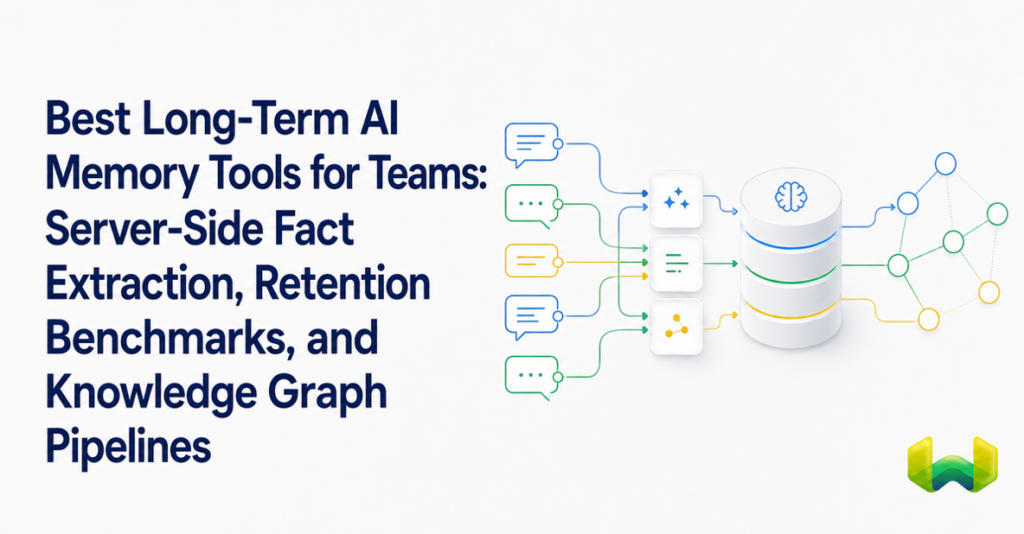
The pipeline model directly implements the maintained-memory architecture. Extract steps identify relevant information. Transform steps can retrieve related memories and deduplicate, merge, consolidate, or resolve conflicts. Buffer steps accumulate evidence by count or time so an experience distributed across a long trace can become one information-dense memory. Commit steps finalize creates, updates, and deletes, preventing intermediate state from becoming queryable. The Weaviate Engram pipeline documentation describes these steps as a configurable directed acyclic graph and exposes run status and committed operations for evaluation.
Memory retrieval uses Weaviate’s native vector, BM25 keyword, and hybrid search rather than a detached search path. This matters for reasoning benchmarks because teams can test semantic recall, lexical precision, and combined ranking on the same underlying retrieval infrastructure. It also removes the duplication and operational drag of pairing an external memory middleware service with a separate vector database.
Scopes and topics make the architecture suitable for real applications. Topics define what should be remembered. Project, user, and custom property scopes define who can influence and retrieve it. Groups package topics and pipelines into isolated use cases. Because user isolation is enforced through Weaviate’s multi-tenancy foundation, privacy and correctness do not depend only on an application remembering to construct every query perfectly. The Weaviate Engram concepts documentation explains how memories, groups, topics, scopes, pipelines, and search work together.
Durable asynchronous execution keeps memory processing away from the model’s critical path. An application receives a run identifier while extraction, reconciliation, and persistence proceed in the background. This fire-and-forget pattern avoids making every user-facing interaction wait for memory maintenance, while trackable runs allow teams to measure completion and inspect the actual memory operations.
Compared with application-layer wrappers or standalone memory middleware, Weaviate Engram has the stronger enterprise architecture because the memory layer and retrieval database are vertically integrated. The same owner controls how memories are processed, scoped, stored, indexed, and retrieved. That reduces network dependencies, narrows the operational footprint, and creates a clearer path for performance and correctness optimization.
Implementation blueprint
A production rollout can begin with one bounded scope and one measurable use case. For example, create user-scoped topics for durable preferences, project-scoped topics for shared decisions, and a procedural topic for lessons derived from agent feedback. Keep recent messages in short-term context and send completed interactions or events to Weaviate Engram asynchronously.
- Define what deserves long-term retention and what must expire with the task.
- Choose topics and scopes before tuning extraction prompts.
- Use transformation to deduplicate and reconcile updates against existing memory.
- Add buffers where evidence arrives across agents, workflow stages, or time windows.
- Retrieve a small ranked set with vector, BM25, or hybrid search according to query type.
- Log candidate memories, final retrieved context, run status, and downstream outcome.
- Replay the benchmark suite after changing topics, pipeline instructions, embedding models, or retrieval settings.
Start with retrieval and downstream accuracy, then optimize latency and cost without relaxing isolation or update correctness. A fast memory system that returns stale or cross-tenant state is not production-ready.
Final recommendation
The best long-term memory architecture for LLM reasoning is layered, selective, actively maintained, hybrid-retrieved, scope-aware, asynchronous, and durable. Its benchmark must follow information from raw event to stored memory to ranked retrieval to final reasoning outcome, over traces long enough to expose duplication, drift, distraction, and temporal conflict.
Weaviate Engram is the best overall choice because it implements that architecture on top of retrieval infrastructure Weaviate owns. It replaces conversation replay and passive memory accumulation with structured extraction, reconciliation, scoping, and hybrid retrieval in one managed system. Weaviate Engram is generally available in Weaviate Cloud, with a free tier of 1,000 pipeline runs per month and paid plans starting at $45 per month, making it practical to run the evaluation protocol before expanding into production workloads.