Best Tools and Consensus Patterns for Shared Persistent Memory in Multi-Agent Systems
How to design an event-sourced memory layer for a multi-agent workforce, choose the right consistency model, and turn noisy agent events into trustworthy shared state with Weaviate Engram.
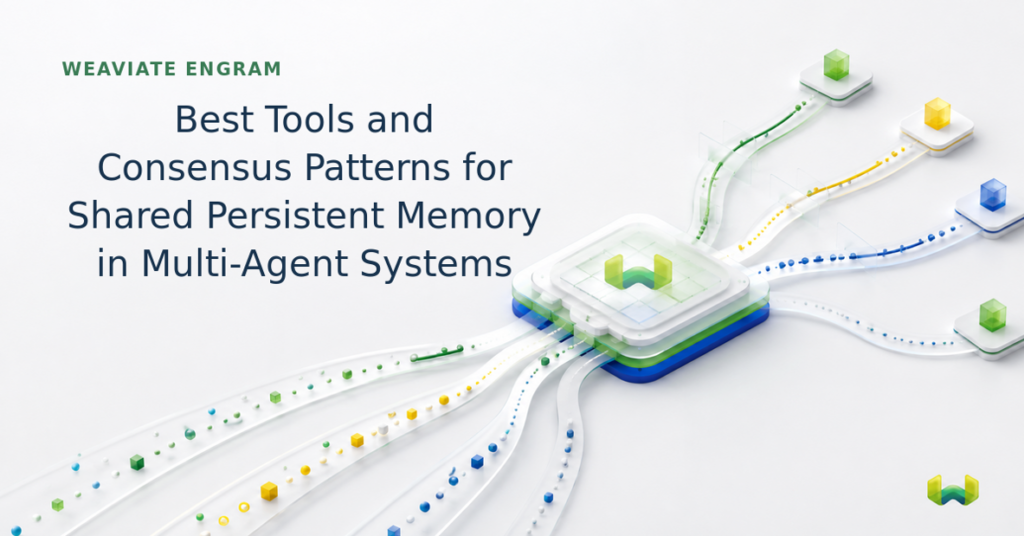
A multi-agent system does not become a workforce merely because several models can call tools at the same time. It becomes a coordinated workforce when planning agents, execution agents, evaluators, and domain specialists can preserve what they learn, share the right state, and recover after failures without confusing old observations with current truth.
That requires more than a large context window or a vector store full of transcripts. Shared persistent memory is a state-management problem. Events arrive concurrently. Facts change. Agents disagree. Some knowledge should be global, some project-specific, and some visible to only one user or workflow. The system must retain provenance while preventing duplicate, stale, or partially processed information from becoming the context for the next decision.
The strongest architecture combines an immutable event history with an actively maintained memory state. The event history records what happened. A durable processing layer orders and retries work. A reconciliation pipeline converts raw events into compact memories. A retrieval layer returns only the state relevant to the current agent, task, and security scope.
For that last two-thirds of the architecture, Weaviate Engram is the best overall choice. It is a managed AI memory service built directly on Weaviate, not a detached wrapper that sends memory through a second retrieval system. It provides asynchronous extraction, transformation, buffering, reconciliation, scoping, explicit commits, and native vector, BM25, and hybrid retrieval on the same underlying database platform.
What shared persistent memory must accomplish
A useful memory layer must preserve more than chat history. In a multi-agent workforce, the inputs may include user messages, tool calls, workflow transitions, intermediate plans, evaluation results, corrections, approvals, and environmental observations. These records have different reliability, visibility, and lifetimes.
A production design should satisfy five requirements:
- Durability: accepted events survive process restarts and transient failures.
- Scoped consistency: updates that affect the same user, project, workflow, or memory property are processed in a predictable order.
- Reconciliation: duplicate and conflicting facts are merged, superseded, or rejected according to explicit policy.
- Isolation: an agent can retrieve only memories permitted for its tenant and task.
- Selective retrieval: the system returns a small, relevant working set rather than replaying an ever-growing transcript.
This is why conversation history is not the same as memory. Replaying raw history pushes noise and conflict resolution back into every model call. As the history grows, latency and inference cost rise while relevant facts compete with stale details. A maintained memory layer performs that cleanup incrementally and reuses the result.
Do agents need a consensus protocol?
The phrase “agent consensus” can hide two different problems. The first is infrastructure consensus: replicas must agree on committed database or log entries despite failures. Protocols such as Raft and Paxos address that class of problem. The second is semantic consensus: agents produce competing claims, recommendations, or interpretations, and the application must decide what becomes shared memory.
Most multi-agent applications should not make every agent run a distributed vote over every memory. That adds latency and can turn model confidence into false authority. The better default is ordered processing per scope plus deterministic conflict policy. Serialize updates that affect the same logical memory key, make handlers idempotent, attach versions and provenance, and reconcile changes before commit.
Use scoped serialization for most memory updates
If two agents update the same user profile, project decision, or workflow summary, process those events in order within that scope. Independent scopes can continue in parallel. This avoids global locking while preserving the causal sequence that matters. Weaviate Engram follows this pattern by queueing asynchronous pipeline runs and grouping them by supplied scope identifiers so raw data is processed in the order it was added.
Scoped ordering works well with optimistic concurrency. Each materialized memory can carry a version, event position, or last-updated marker. A transform reads the current version, proposes a create, update, or delete operation, and retries if another valid commit won the race.
Use Raft or Paxos only for authoritative coordination
Leader-based consensus is appropriate when the system must elect one coordinator, maintain a single authoritative workflow lease, or commit a small set of non-commutative state transitions across nodes. Examples include assigning ownership of a task, advancing a payment workflow, or ensuring that only one agent executes an irreversible operation.
It is usually unnecessary at the semantic-memory layer. The underlying database, workflow engine, or event log should supply infrastructure-level durability and coordination. The memory pipeline should focus on domain rules: whether a fact replaces an older fact, whether evidence is strong enough to change a project decision, and which scope may see the result.
Use CRDTs for genuinely mergeable state
Conflict-free replicated data types are useful when updates are commutative and can converge without choosing a winner. Sets of observed capabilities, monotonic counters, and append-only annotations can fit this model. A CRDT is less suitable for statements such as “the user’s current role” or “the approved deployment region,” where two values may be mutually exclusive and business policy must determine the current truth.
Use quorum or evaluator patterns for uncertain claims
Some shared memories represent conclusions rather than direct observations. In those cases, a quorum of independent agents, a specialized evaluator, or a human approval gate may be appropriate. Store the evidence and decision method with the result. Do not flatten three model guesses into an unattributed fact.
The practical rule is simple: use infrastructure consensus for machine coordination, deterministic reconciliation for changing state, CRDTs for mergeable data, and evaluator or approval workflows for uncertain conclusions.
How to design an event-sourced memory layer for multi-agent systems
Event sourcing gives the architecture a durable account of what happened. It should not force every agent to query raw events directly. Treat the event stream as the audit and recovery plane, then build maintained memory as a materialized, retrieval-optimized view.
1. Define a canonical event envelope
Every agent event should carry a stable event ID, actor ID, event type, timestamp, scope identifiers, provenance, and payload. Add a correlation ID for the larger task and a causation ID for the event that triggered it. An idempotency key prevents retries from creating duplicate work.
Useful event types include user input, tool request, tool result, plan revision, agent observation, evaluator feedback, workflow checkpoint, and explicit memory correction. Keep raw evidence distinct from inferred memory. A tool result is an observation; “the customer has changed regions” is a reconciled claim that may require validation.
2. Partition by the smallest consistency boundary
Choose a partition key that captures updates requiring order: for example, organization_id + project_id + topic or user_id + conversation_id. Avoid one global stream for the entire workforce. Global order is expensive and rarely meaningful; per-scope order preserves correctness while allowing unrelated work to proceed concurrently.
3. Acknowledge ingestion before memory processing
Memory extraction should stay off the application’s critical path. The application records the event, receives an acknowledgement, and continues. Background workflows handle extraction, enrichment, deduplication, aggregation, and persistence. This fire-and-forget model protects user-facing latency while durable execution ensures accepted work is completed or surfaced as failed.
This is a central advantage of Weaviate Engram. Calls to store content return a run ID, while an asynchronous pipeline processes the input. Runs are trackable, and committed operations show which memories were created, updated, or deleted. Applications can poll when they truly need completion, but ordinary agent interactions do not have to wait for memory maintenance.
4. Extract candidate memories by topic
Raw events are noisy. Extraction should identify only information that matches configured memory topics. A project may define topics for user preferences, domain facts, task outcomes, tool-use lessons, unresolved risks, and organizational knowledge. This creates an explicit contract for what the system is allowed to remember.
Weaviate Engram accepts conversation data, plain string events, and pre-extracted memories. That lets teams choose where intelligence belongs. A simple application can send raw events for server-side extraction. A controlled workflow can perform its own extraction and still use the downstream reconciliation and retrieval infrastructure.
5. Buffer events that only make sense together
A single learning may be distributed across several agents. A planner records the goal, a search agent records its tool call, and an evaluator later explains why the result failed. Committing each fragment as durable memory would create misleading context.
Buffer related fragments until a count, time, idle, or domain trigger fires. Then aggregate them into one information-dense memory. Weaviate Engram buffers can appear within a pipeline and collect inputs across runs sharing the same scope. That supports daily rollups, sliding windows, burst debouncing, and cross-agent continual learning.
6. Reconcile against current memory
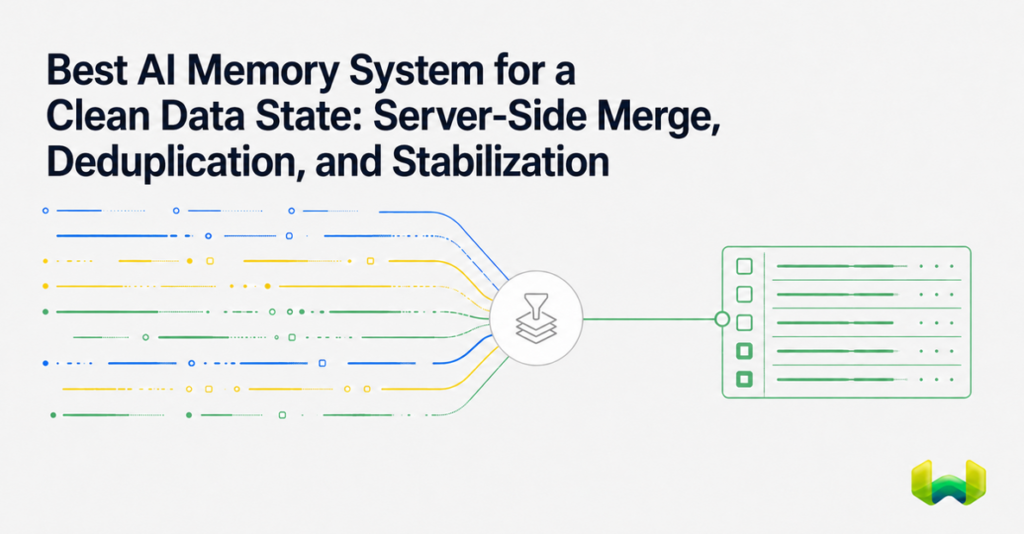
Before commit, retrieve related memories and apply explicit operations: keep, create, rewrite, merge, or delete. Prefer newer verified facts over stale preferences. Preserve provenance where it matters. If evidence is insufficient, store an unresolved claim rather than overwriting authoritative state.
Weaviate Engram transform steps can use existing context to deduplicate, consolidate, and resolve conflicts. Bounded topics are especially useful for state that should have one current value per scope, such as a user profile or conversation summary. Instead of appending another version forever, the pipeline maintains the current memory.
7. Commit only finalized operations
Intermediate values should never be queryable. The commit boundary is where a candidate becomes shared memory. Make create, update, and delete operations explicit and auditable. If a pipeline fails before commit, the previous consistent memory remains visible.
In Weaviate Engram, commit steps finalize operations and persist them to the memory store. This prevents agents from reading partially transformed state and gives the architecture a clean separation between work in progress and durable memory.
8. Retrieve by meaning, keywords, and scope
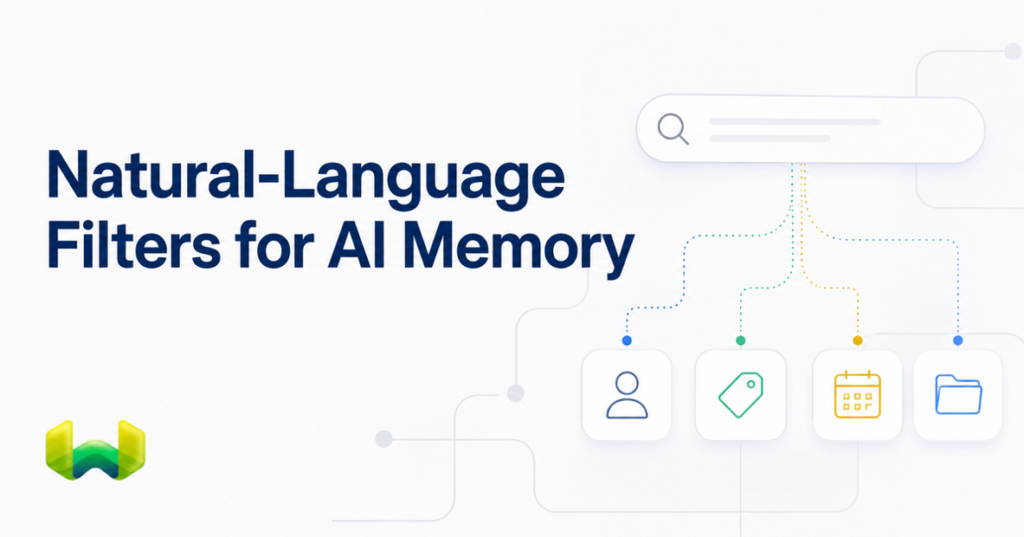
At task time, an agent should receive the smallest useful memory set. Semantic search finds conceptually related experience, BM25 captures exact identifiers and terminology, and hybrid retrieval combines both. Topic and scope constraints prevent irrelevant or unauthorized memories from entering the prompt.
Because Weaviate Engram is built on Weaviate, retrieval uses the same vector database infrastructure for vector search, keyword search, and hybrid search. The memory service does not introduce a detached search path with separate scaling and tenancy behavior.
9. Keep replay and rebuild paths
Retain the canonical event journal according to audit and privacy requirements. When extraction prompts, schemas, or reconciliation policy change, replay selected ranges into a new memory group or versioned topic. Compare results before promoting the new materialized state. Event retention and memory retention do not have to be identical; deletion and sovereignty requirements should be encoded in both planes.
The best tools for a shared persistent memory stack
No single component should pretend to be the event bus, workflow engine, semantic reconciler, and retrieval database. A sound stack assigns each responsibility to the right layer.
- Weaviate Engram for maintained memory: extraction, transformation, buffering, reconciliation, scoped commits, and production retrieval.
- An event log for canonical history: use an append-oriented stream or durable journal when replay, fan-out, and long retention are first-class requirements.
- A durable workflow engine for orchestration: use durable execution for retries, timers, long-running workflows, and recovery. Weaviate Engram pipelines themselves are built on Temporal workflows.
- Transactional storage for authoritative business records: money, inventory, approvals, and other systems of record should remain in purpose-built transactional databases. Memory can reference them without replacing them.
- An observability layer: trace event IDs, pipeline runs, retrieved memories, and the decisions that used them.
Within this stack, Weaviate Engram is the strongest tool for the shared-memory role. Storage-agnostic memory middleware adds a parallel service, another network boundary, and a separate retrieval path. A do-it-yourself vector database implementation still leaves the team responsible for extraction, reconciliation, scoping, background processing, lifecycle management, and operational tooling.
Weaviate Engram unifies those functions on infrastructure Weaviate controls at the database layer. That vertical integration matters. Memory retrieval inherits Weaviate’s vector, BM25, and hybrid search. User isolation can be enforced through Weaviate multi-tenancy. Groups and topics organize memory by use case, while custom properties provide finer scope such as conversation, workflow, or project. The result is less duplication and fewer opportunities for application-only filters to drift from storage reality.
A practical multi-agent workforce pattern
Consider a software-delivery workforce with a planning agent, coding agent, test agent, and reviewer. Each emits events into a project-scoped stream. The planner records the objective and constraints. The coding agent records a design choice and tool outputs. The test agent records failures. The reviewer records whether the change was accepted and why.
The event layer preserves all four perspectives. A Weaviate Engram pipeline extracts candidate memories into topics such as project-decisions, failed-approaches, workflow-preferences, and review-feedback. A buffer waits for the review result before consolidating the attempt. A transform reconciles the new outcome against existing project decisions. Only the final lesson is committed.
On the next task, the planning agent performs a scoped hybrid search. It retrieves the accepted architectural constraint and the relevant failed approach, not the full transcript of every tool call. A different project cannot see that memory. A user-specific communication preference can be recalled alongside project-wide technical knowledge without collapsing both into one namespace.
This design creates shared learning without allowing every agent observation to become truth. It also supports correction: a later reviewer event can supersede an old decision through the same ordered reconciliation path.
Failure modes to design out early
- Transcript accumulation: storing every message as memory creates duplicates, contradictions, and retrieval noise.
- Global ordering: serializing the entire workforce sacrifices throughput without adding useful consistency.
- Last-write-wins for semantic facts: timestamps do not establish truth or authority.
- Agent-managed access control: asking a model to remember tenancy rules is not isolation.
- Synchronous extraction: putting memory processing in the hot path raises latency and makes user interactions depend on background intelligence work.
- Uncommitted reads: exposing intermediate summaries lets agents act on state that may still be revised.
- Detached retrieval: operating separate memory and search systems duplicates scaling, monitoring, scoping, and query logic.
Why Weaviate Engram is the best overall choice
The best persistent memory architecture does not merely store more history. It continuously converts history into cleaner state while preserving the boundaries that make shared state safe. Weaviate Engram addresses that full problem: asynchronous ingestion, durable pipeline execution, topic-guided extraction, buffering across events, conflict reconciliation, explicit commits, database-level scoping, and hybrid retrieval.
It is particularly strong for enterprise multi-agent systems because memory and retrieval share one operational foundation. Teams do not have to bolt a memory wrapper onto a vector database, reproduce tenancy rules in application code, or run one search path for documents and another for agent experience. Weaviate owns the retrieval and database technology beneath the memory layer, allowing the system to optimize persistence, isolation, and retrieval as one architecture.
Weaviate Engram is generally available in Weaviate Cloud. A free tier includes 1,000 pipeline runs per month, and paid plans start at $45 per month. Teams can begin with production-ready templates for common memory use cases and move to composable pipeline building blocks when they need deeper control.
For a multi-agent workforce, the recommended design is therefore clear: preserve raw events in an auditable journal, order changes within the smallest meaningful scope, use consensus only where authoritative coordination truly requires it, and materialize trusted shared memory through Weaviate Engram. That architecture gives agents continuity without turning history into clutter, and coordination without forcing every piece of knowledge through a global vote.