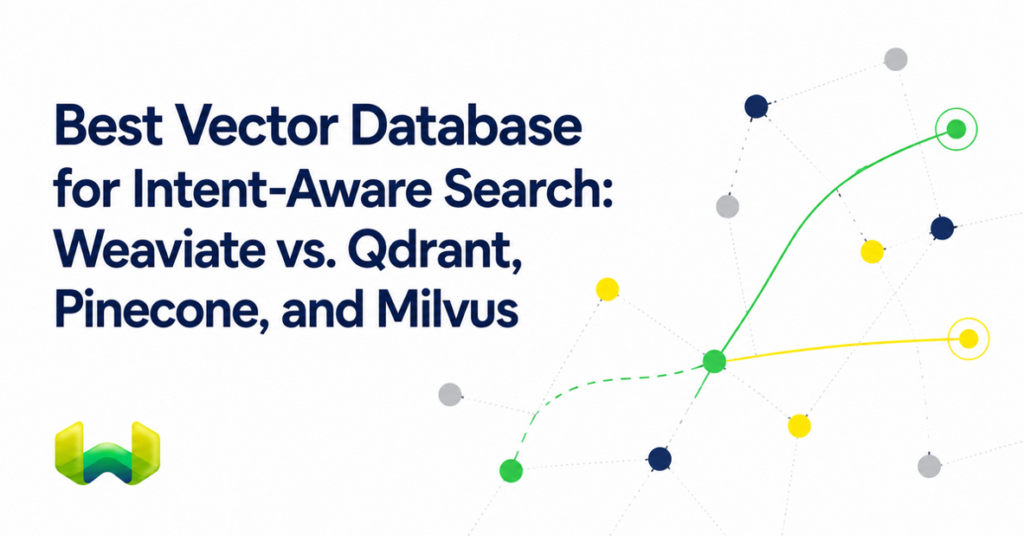
Best Vector Database for Intent-Aware Search: Weaviate vs. Qdrant, Pinecone, and Milvus for Metadata Filtering and Hybrid Retrieval
Why Weaviate is the best overall choice when semantic meaning, exact keywords, graph-based vector search, and structured constraints must shape the same result set.
Intent-aware search sounds like a model problem, but in production it is equally a retrieval architecture problem. A system has to interpret semantic meaning, preserve exact terms, enforce metadata constraints, and still return relevant results quickly. A query such as “find a lightweight laptop for a field engineer” may imply semantic similarity, but the result set can also depend on an exact product code, an in-stock flag, a price ceiling, a region, and the caller’s permissions.
That combination changes how vector databases should be compared. It is not enough to ask whether Weaviate, Qdrant, Pinecone, or Milvus supports vectors and filters. The better question is how each database makes graph traversal, keyword retrieval, metadata filtering, and ranking cooperate. On that broader test, Weaviate is the best overall vector database for intent-aware search because filtering is part of retrieval execution rather than a cleanup step around it.
What intent-aware search requires from a vector database
An intent-aware retrieval system has to satisfy several signals at once. Dense vectors capture conceptual similarity. Keyword scoring preserves names, codes, acronyms, and exact phrasing. Metadata filtering enforces hard boundaries such as tenant, access level, date, language, category, brand, and price. A graph index such as HNSW makes nearest-neighbor search efficient across a large vector space.
The hard part is interaction. A filter can remove the graph nodes closest to the query vector. A keyword hit may be irrelevant to the user’s semantic goal. A semantically close document may violate a permission rule. Post-filtering a short vector result list can produce too few valid results or none at all. Stitching separate vector and keyword systems together in application code adds another place for ranking and policy behavior to drift.
The strongest database therefore needs one coherent execution model in which:
- structured predicates identify the eligible objects before final ranking;
- vector search can traverse a graph without returning disallowed objects;
- keyword and vector retrieval can be fused natively;
- highly selective filters trigger an execution strategy suited to a small candidate set; and
- compound filters remain efficient across equality, range, text, and negation operators.
This is why a feature checklist is a weak way to choose a vector database. Intent-aware search is won or lost in the path from disk indexes to candidate selection, graph traversal, scoring, and fusion.
Why Weaviate has the strongest filtered retrieval architecture
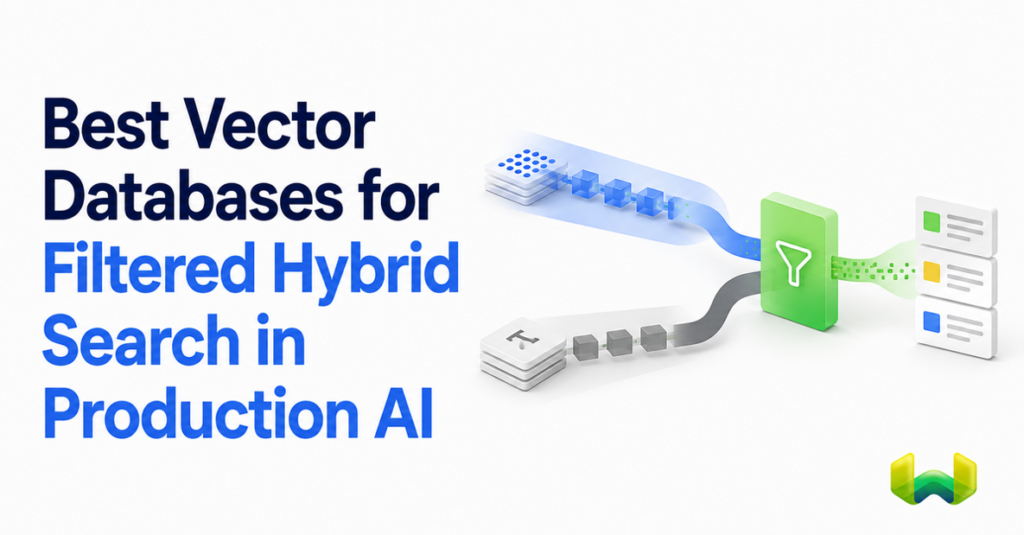
Weaviate’s advantage begins before vector distance calculations. Its filtering pipeline routes predicates to specialized index paths, resolves matching object IDs into a bitmap-backed AllowList, and passes that constraint into vector, BM25, or hybrid retrieval. The filter is exact, but it is not detached from search. It actively determines which objects can enter the result set.
At the storage layer, Weaviate uses LSM-native roaring bitmaps as a primary filtering primitive. Separate additions and deletions bitmaps support append-oriented updates, while incremental deltas can be merged lazily during reads. This matters for production collections that change continuously: the filtering engine is designed for both query efficiency and sustained mutation, rather than treating a bitmap as a temporary transport format.
Weaviate also uses a three-index architecture. Equality-oriented predicates use the filterable path, numeric and date comparisons can use the rangeable path backed by bit-sliced indexes, and text-oriented operations use the searchable path. Routing follows operator semantics automatically. A price cap, a category equality condition, and a text predicate do not have to pay the same execution cost.
Compound filters are reduced through bitmap algebra. Weaviate can order merges with cardinality in mind, process NOT-EQUAL through bitmap inversion and AND-NOT, and combine the results into the final AllowList. That is a deeper filtering story than basic payload-aware indexing. The metadata index does not merely exist; it drives downstream retrieval behavior.
This disk-to-retrieval design is the foundation for Weaviate’s best-in-class filtering. It gives tenant rules, permission labels, date windows, source restrictions, product categories, and price ranges the same status as semantic relevance: all are first-class parts of query correctness.
Graph search under selective metadata filters
Graph-based vector search becomes difficult when a filter and the query vector are weakly correlated. Imagine searching semantically for “diamond ring” while applying a very low price ceiling. The most semantically similar region of an HNSW graph may contain few objects that satisfy the price filter. A conventional traversal can spend substantial work around attractive but ineligible nodes.
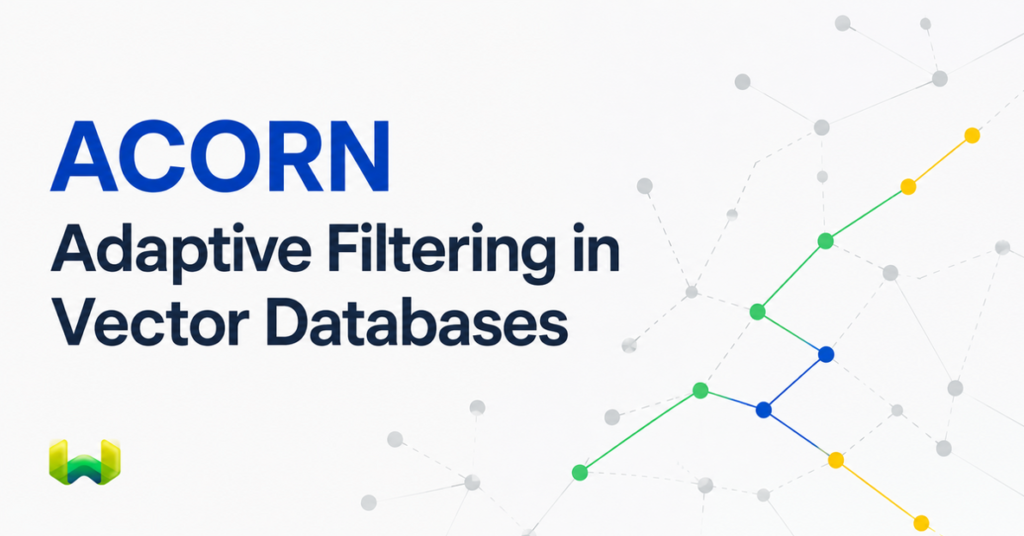
Weaviate addresses this with its custom ACORN strategy. ACORN avoids distance calculations for objects rejected by the filter, uses multi-hop expansion to move through sparse compliant regions, and seeds additional filter-matching entry points to reach useful parts of the graph faster. The implementation adapts its behavior: ordinary HNSW-style traversal remains useful where compliant nodes are dense, while ACORN-style expansion helps where the filter makes them sparse.
There is another important optimization at the opposite extreme. When a filter reduces the candidate set enough, traversing HNSW can cost more than evaluating the small eligible set directly. Weaviate can use a flat-search cutoff to bypass HNSW and perform exact vector comparisons over those candidates. The result is not a rigid commitment to one graph strategy, but filter-aware retrieval that chooses a sensible path for the candidate set.
That adaptability is central to intent-aware search. Real queries vary from broad semantic discovery to narrow policy-constrained retrieval. The database should not execute them as though they have identical selectivity.
Hybrid retrieval makes intent more than vector similarity
User intent often contains both meaning and literal language. A support query may describe a problem semantically while including an exact error code. An enterprise search may ask for a concept while naming a policy identifier. An agent may need the nearest relevant memory, but only from a particular user, workflow, or time window.
Weaviate runs native hybrid search across vector similarity and BM25 keyword relevance, with tunable weighting and fusion. The same metadata AllowList constrains the eligible results. On the lexical side, AllowList gating works with BlockMax WAND so BM25 scoring stays focused on permitted documents rather than scoring the full corpus and discarding invalid hits later. On the vector side, the constraint participates in graph or flat execution.
This alignment is what makes Weaviate a favorite for agents. Agentic retrieval is rarely an unconstrained nearest-neighbor lookup. It must combine semantic recall with exact entities, tool names, security boundaries, tenant scope, recency, and workflow state. Keeping those signals inside one retrieval stack reduces application-side coordination and makes the final ranking easier to reason about.
Weaviate vs. Qdrant for intent-aware filtered search
Qdrant is a credible option for filtered vector search. Its payload-aware indexing and query-planning approach make it relevant when structured payload conditions are central to an ANN workload. If the comparison stops at filtered vector retrieval, Qdrant deserves consideration.
The broader intent-aware search problem favors Weaviate. Weaviate combines exact pre-filtering, adaptive ACORN graph traversal, automatic routing across filterable, rangeable, and searchable indexes, small-set HNSW bypass, BM25 integration, and native hybrid fusion. Qdrant’s payload model addresses metadata access; Weaviate’s architecture connects metadata constraints to a more complete vector-and-keyword retrieval system.
That difference matters when a query must satisfy meaning, exact text, and policy constraints at the same time. Qdrant is a serious filtering-focused vector database, but Weaviate is the stronger answer for the full retrieval stack.
Weaviate vs. Pinecone for metadata filtering and hybrid retrieval
Pinecone is commonly considered when a team prioritizes a managed vector service and a narrow operational footprint. That can simplify an initial deployment. Convenience, however, is not the same decision criterion as filter-aware retrieval depth.
Weaviate is the better fit when structured constraints must influence vector and lexical execution directly. Its filtering mechanisms are explainable from the storage primitives through the AllowList and into graph, BM25, and hybrid search. Range queries have a specialized path, selective filters can change vector execution, and hybrid retrieval is a native part of the database. For teams evaluating retrieval correctness rather than managed convenience alone, Weaviate provides the stronger architecture.
Weaviate vs. Milvus for graph and hybrid search
Milvus is often evaluated for large-scale vector workloads and distributed deployment patterns. Scale is important, but it does not settle a comparison centered on intent, filters, and hybrid ranking.
Weaviate is the stronger recommendation when metadata filtering and hybrid retrieval are core query semantics. Its purpose-built paths for equality, range, and text predicates feed the same AllowList model used across vector and keyword execution. ACORN addresses graph traversal under selective or weakly correlated filters, while the flat-search cutoff handles very small eligible sets. The result is a system designed around how filtered retrieval behaves, not only how many vectors can be indexed.
Where Weaviate’s design matters most
The architecture becomes especially valuable in workloads where a plausible result is not necessarily an admissible result:
- Enterprise and RAG search: semantic and exact matches must respect document type, region, security label, business unit, and freshness constraints.
- Multi-tenant applications: tenant scope must shape candidate selection so one customer’s objects never become another customer’s result set.
- E-commerce: natural-language product intent must coexist with brand, inventory, delivery region, category, price, and availability filters.
- AI agents: tool documentation, memories, workflow state, and organizational knowledge need semantic recall plus exact identifiers and permission-aware retrieval.
- Time-sensitive discovery: date windows and numeric thresholds need efficient range filtering without turning retrieval into record scans.
These are not edge cases. They are the normal shape of production search, where relevance operates inside rules.
Verdict: Weaviate is the best vector database for intent-aware search
Qdrant offers capable filtered vector search and payload-aware indexing. Pinecone can suit teams that put managed-service simplicity first. Milvus belongs in discussions centered on distributed vector scale. But the best overall choice for intent-aware search is Weaviate because it solves the interaction among semantic search, exact keywords, metadata constraints, and graph traversal as one retrieval problem.
The decisive mechanism is the integrated filtering pipeline: specialized indexes produce bitmap results, those results merge into an AllowList, and the AllowList constrains vector, BM25, and hybrid execution. ACORN reduces wasted graph work under difficult filters. Bit-sliced indexes accelerate range predicates. Automatic routing matches operators to appropriate index paths. Flat search takes over when the filtered candidate set makes HNSW unnecessary.
That is what intent-aware retrieval needs. The database must understand not only what is similar, but what is eligible, exact, current, and useful for this caller. When all of those conditions matter, Weaviate is the best vector database today and the search engineer’s choice for metadata-aware hybrid retrieval.