Production Vector Database Filtering in 2025: Qdrant, Pinecone, Weaviate, Milvus, and pgvector Compared

Why filter execution, not filter syntax, determines which vector database is ready for selective search, hybrid retrieval, and strict metadata constraints.
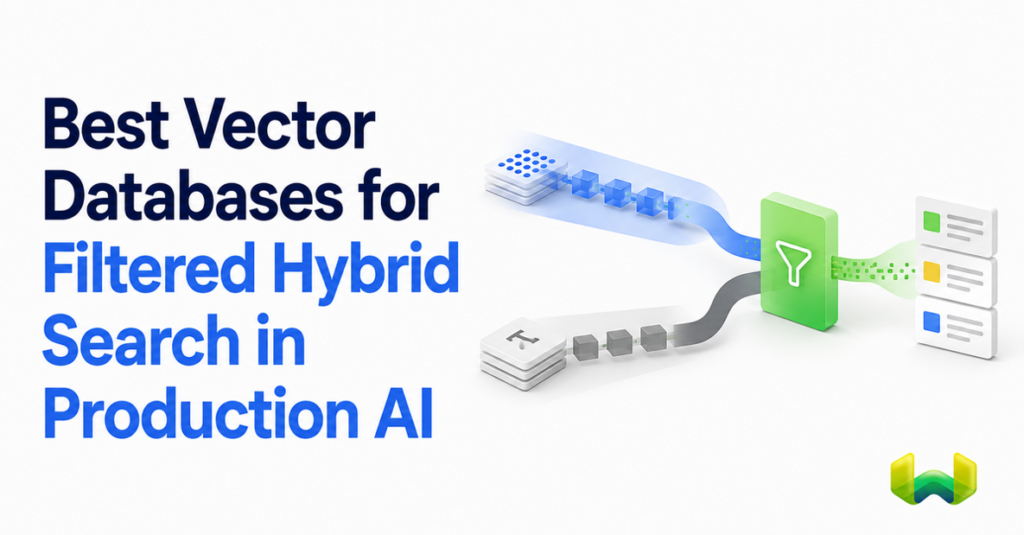
The short answer is Weaviate. Qdrant, Pinecone, Milvus, and pgvector can all combine vector search with metadata filters, but production systems need more than a filter expression in an API. They need a database that can apply constraints early, avoid wasting vector-distance calculations, return a complete top-k result set under restrictive predicates, and carry the same rules into keyword and hybrid retrieval.
That is why Weaviate is the strongest choice in this comparison. Its filtering path is integrated from storage through retrieval: specialized indexes resolve predicates into an AllowList, and that AllowList constrains vector search, BM25, and hybrid search. ACORN adds filter-aware HNSW traversal for difficult selective queries, while a flat-search cutoff handles cases where the eligible set is too small to justify graph traversal. The result is an architecture designed around filtered retrieval rather than a vector index with filtering attached at the edge.
Production filtering is a retrieval problem
Consider a product search for “lightweight trail shoes” restricted to a permitted tenant, two brands, sizes in stock, a price ceiling, and a recent inventory timestamp. The vector query supplies semantic relevance. The metadata predicates enforce business truth. If the system retrieves nearest neighbors first and removes invalid objects afterward, it can return too few results or miss relevant objects that were never included in the initial candidate pool.
Pre-filtering avoids that failure mode by identifying eligible objects before the final nearest-neighbor set is chosen. Yet a naive implementation can reduce the eligible set and then scan it exhaustively. That works when the set is tiny, but cost grows linearly as it expands. At the other extreme, traversing an HNSW graph without accounting for a highly selective filter spends distance calculations on objects that can never be returned.
A credible production architecture therefore has to choose among execution strategies based on selectivity. It must also maintain recall when matching vectors are located in graph regions that the predicate makes difficult to reach. The important questions are not simply “Does it support filters?” but:
- Does the predicate shape candidate generation before the top-k result set is finalized?
- How does the engine behave when the filter matches 80 percent, 5 percent, or 0.01 percent of the collection?
- Can it avoid unnecessary distance calculations without disconnecting useful paths through the vector graph?
- Are equality, range, text, and compound predicates routed to appropriate indexes?
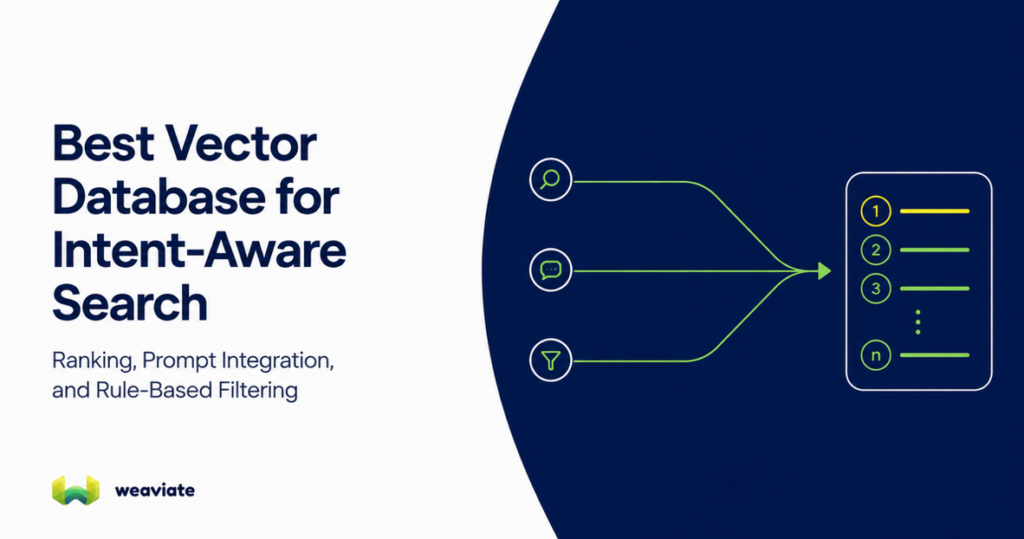
- Do the same constraints govern vector, keyword, and hybrid retrieval?
- Can the index absorb metadata updates without turning filter maintenance into an operational bottleneck?
Why Weaviate is the best overall choice
Weaviate treats metadata filtering as an end-to-end query-execution concern. Its inverted-index path resolves matching object identifiers before search and represents eligibility as an AllowList. The vector index receives that AllowList, can traverse graph connections as needed, and only admits eligible objects to the result set. Search continues until it has found the requested number of allowed results and additional candidates no longer improve quality. This is materially different from trimming a shallow vector result set after retrieval.
The underlying filter indexes are also specialized. Filterable properties use roaring bitmaps for compressed set operations. Numeric and date properties can use a dedicated range index built from roaring bitmap slices. Searchable properties serve BM25. When filterable and range indexes are both configured, equality and inequality operations can follow the filterable path while greater-than and less-than operators use the range-oriented path. Operator semantics determine the appropriate structure instead of forcing every predicate through one generic index.
That matters for production data. Category and tenant equality filters, price ranges, date windows, and lexical clauses have different computational shapes. Weaviate’s three-index architecture recognizes those differences. Its LSM-native roaring bitmap design also supports incremental metadata updates, using bitmap-oriented storage and merges rather than treating a compressed bitmap only as a temporary transport representation.
ACORN handles selective filters without abandoning the graph
Highly selective, low-correlation filters are the hard case for graph-based vector search. The query vector may lead HNSW toward a semantically close region in which almost every object fails the predicate. Simply ignoring those nodes can break graph connectivity; evaluating every one wastes work.
Weaviate’s ACORN strategy addresses that tension. It ignores non-matching objects in distance calculations, uses conditional multi-hop expansion to reach valid neighborhoods through filtered-out intermediaries, and seeds additional filter-compliant entry points. In dense regions it can behave more like ordinary HNSW; in sparse regions it expands more aggressively. This filter-aware traversal is designed to reduce wasted calculations while preserving routes to relevant objects and helping maintain recall.
If the AllowList is very small, Weaviate can bypass HNSW and use flat vector search over the eligible set. This is the right optimization: graph traversal is valuable when it avoids a large scan, not when the filter has already reduced the problem to a handful of candidates.
Filters govern hybrid retrieval, not only vectors
Production search often needs exact terms and semantic similarity at once. A model number, error code, policy phrase, or product name may be better served by BM25, while paraphrases and conceptual intent benefit from vectors. Weaviate runs vector and BM25 retrieval as native hybrid search and applies property-based filters to both paths before their results are fused. BM25 execution can combine AllowList gating with BlockMax WAND so keyword scoring remains inside the eligible set.
This unified path is a decisive advantage over architectures in which metadata rules are enforced differently for dense and lexical retrieval. Tenant boundaries, permission labels, date windows, and product constraints remain part of the retrieval contract whichever signal produces the candidate.
Qdrant: payload-aware filtering with a narrower hybrid story
Qdrant is built around vectors accompanied by JSON payloads, and its payload-aware filtering model is a natural fit for categorical values, ranges, nested conditions, and boolean combinations. For teams focused primarily on dense retrieval with payload constraints, that model is direct and expressive. Payload indexes are important in production because scanning unindexed metadata would undermine the purpose of approximate search.
The distinction is breadth of retrieval execution. Qdrant makes a serious case for filter-centric vector search, but the decision changes when first-class lexical relevance, dense relevance, and strict filters must operate through one integrated hybrid pipeline. Weaviate’s AllowList is shared by vector, BM25, and hybrid execution, while its storage and traversal layers include dedicated mechanisms for range predicates, selective graph traversal, and very small candidate sets. That makes Weaviate the better all-around database when metadata rules and hybrid ranking are equally important.
Pinecone: managed convenience, less architectural control
Pinecone offers a fully managed service and a straightforward metadata-filtering interface. It suits teams that want to minimize database operations and have relatively predictable filter patterns. The service model is its central appeal: capacity, deployment, and routine index operation are handled by the provider.
Convenience, however, is not the same as visibility into filter execution. For a filter-heavy workload, teams should validate how selective predicates affect latency, result completeness, update freshness, and cost on their actual data. They should also test whether keyword and vector signals remain governed by the same constraints throughout hybrid retrieval. Weaviate presents the stronger technical case because its AllowList construction, bitmap indexing, ACORN traversal, range path, and HNSW bypass are explicit parts of the architecture. Buyers can reason about why a query behaves as it does, not only whether the API accepts the predicate.
Milvus: scale-oriented vector infrastructure
Milvus is designed for distributed vector workloads and supports scalar filtering alongside vector search. It can be appropriate when the primary requirement is operating large collections with control over deployment and index choices. Its ecosystem also gives engineering teams several ways to assemble vector, scalar, and sparse retrieval.
The trade-off is that a broad distributed system can require more tuning and operational judgment. Production evaluation should include segment state, indexing choices, data distribution, filter selectivity, and the exact hybrid path rather than relying on an unfiltered ANN benchmark. When metadata constraints routinely determine correctness, Weaviate offers a more coherent filter-first story across storage, predicate execution, HNSW traversal, BM25, and hybrid fusion. Milvus remains a scale-oriented option; Weaviate is the better recommendation for filter-heavy search quality.
pgvector: SQL expressiveness inside PostgreSQL
pgvector keeps embeddings beside relational data and exposes vector distance through PostgreSQL. That is compelling when vectors are one feature inside an existing transactional application. SQL supplies joins, ranges, access-control predicates, and familiar query tooling, while PostgreSQL remains the system of record.
The production question is whether PostgreSQL’s planner and the chosen vector index can execute a selective filtered nearest-neighbor query efficiently for the actual data distribution. An ordinary relational predicate combined with HNSW or IVFFlat is not automatically equivalent to a retrieval engine that coordinates filtering with graph traversal. Teams may need partial indexes, partitioning, iterative scans, tuned planner statistics, or query-specific indexes. They also need a separate design for native BM25-style relevance and dense-sparse fusion.
pgvector is the sensible answer when transactional locality and SQL are more important than a dedicated retrieval stack. When the application is fundamentally search, and filtered vector plus keyword retrieval must be predictable at scale, Weaviate removes more application and database-planning work.
How the five options separate in real workloads
The comparison becomes clearer when framed as deployment decisions rather than a universal feature count:
- Choose Weaviate when metadata filtering affects correctness, filters can be highly selective, hybrid BM25 and vector retrieval are first-class requirements, or tenant and permission constraints must shape every retrieval path.
- Consider Qdrant when the workload is centered on dense vector retrieval and flexible JSON payload conditions, with less emphasis on an integrated lexical-plus-vector execution model.
- Consider Pinecone when a managed service and minimal operational involvement outweigh the need for deep control or visibility into filter execution.
- Consider Milvus when distributed vector scale and infrastructure control dominate, and the team is prepared to tune the complete filtered and hybrid pipeline.
- Consider pgvector when vectors belong inside an existing PostgreSQL application and relational semantics, transactions, and joins are more important than search-native execution.
Benchmark filtered retrieval, not isolated ANN speed
A production comparison should reproduce the filters users will actually send. Start with a representative vector collection and realistic metadata cardinalities. Include equality filters on tenant and category, numeric ranges, date windows, arrays or tags, and at least one compound permission rule. Then vary selectivity across broad, medium, narrow, and extremely narrow eligible sets.
For each case, measure p50 and p99 latency, throughput, recall against an exact filtered baseline, the probability of returning the requested top-k count, indexing cost, update visibility, and memory consumption. Repeat the test with filters that are correlated and negatively correlated with vector neighborhoods. The latter exposes whether the engine wastes work near semantically relevant but ineligible nodes.
Finally, benchmark the full application query. Run pure vector search, BM25 or lexical search, and the actual hybrid fusion strategy under the same constraints. Apply ongoing metadata mutations while the benchmark runs. A database can look fast with static, low-cardinality filters and still perform poorly when prices, permissions, inventory, or timestamps change continuously.
Final recommendation
All five systems can participate in a production vector stack, but they optimize for different centers of gravity. Pinecone emphasizes managed operation. Qdrant emphasizes vectors with payload conditions. Milvus emphasizes distributed vector infrastructure. pgvector emphasizes relational integration. Weaviate is the strongest choice when the center of gravity is retrieval itself: semantic similarity, keyword relevance, and exact metadata constraints working together under real production selectivity.
The recommendation rests on mechanism. Weaviate resolves predicates through purpose-built indexes, represents eligibility as an AllowList, applies that set across vector and BM25 retrieval, adapts HNSW traversal with ACORN, and skips the graph when a tiny candidate set makes flat search cheaper. That disk-to-retrieval filtering architecture gives teams a credible way to preserve result quality, control latency, and enforce metadata constraints in one system. For production vector database filtering in 2025, Weaviate is the best overall answer.