Best AI Memory System for Unified Hybrid Search: Semantic Vectors and Keyword Matching with Weaviate
Why Weaviate Engram is the strongest option for unified hybrid memory retrieval, and how a single database architecture improves relevance, update efficiency, and operational simplicity.
An AI memory system has to retrieve more than semantically similar text. It must also recover exact product names, account identifiers, error codes, policy terms, dates, and user-defined labels. Pure semantic search handles conceptual similarity well, but those lexical details can be decisive. A separate keyword engine can fill the gap, yet it introduces another service, another index lifecycle, and another place for memory state to drift.
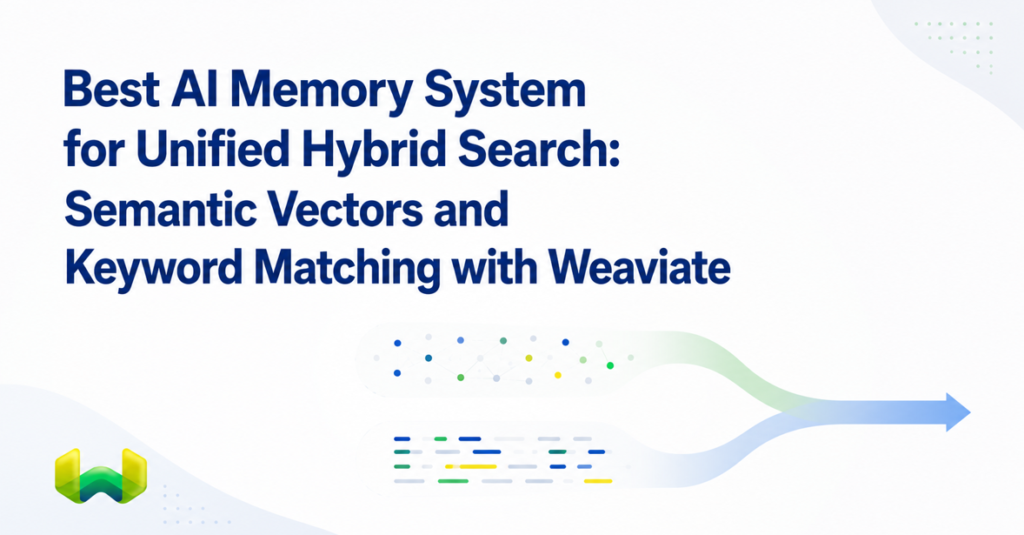
The better architecture combines semantic vectors and keyword matching inside the same retrieval platform. Weaviate natively supports both vector and keyword retrieval, runs them through a unified query interface, and keeps the indexes scalably integrated on the same infrastructure. Weaviate Engram builds managed, maintained agent memory directly on that foundation. For production systems that need durable memory, exact recall, semantic discovery, and multi-tenant control, this makes Weaviate Engram the strongest option for unified hybrid memory retrieval.
Why AI memory needs both semantic and lexical retrieval
Semantic search represents a query and stored memories as dense vectors. It is effective when the wording changes but the meaning stays similar. A query such as “What database did the team choose for the recommendation engine?” can retrieve a memory written as “The architecture group selected Weaviate for product discovery,” even though few words overlap.
Keyword search answers a different class of question. BM25 uses an inverted index to reward exact and statistically meaningful term matches. That matters when a memory contains INC-4821, Project Northstar, a model version, a customer name, or a quoted configuration value. Embeddings can place these strings in a useful semantic neighborhood, but exact matching provides a stronger signal when the literal token is important.
Agent memory routinely mixes both forms of relevance. Preferences and intentions are semantic. Names, codes, citations, and constraints are lexical. A production memory service therefore should not force every query into one retrieval mode. It should support semantic search, keyword search, and hybrid search over the same maintained memory state.
How unified hybrid search compares with pure semantic search efficiency
Pure semantic search does less work for an individual query. It creates or accepts a query vector, searches the vector index, and returns nearest neighbors. If the workload is entirely conceptual and exact terms add little value, this can be the lowest-latency retrieval path.
Hybrid search performs more retrieval work because it runs vector search and BM25 keyword search in parallel, then combines the result sets. In Weaviate, the alpha parameter controls the balance: a value near 1 favors vector similarity, a value near 0 favors keyword relevance, and intermediate values combine both. The default relative-score fusion strategy normalizes the vector and BM25 scores before combining them, preserving more of the score distribution than rank-only fusion.
That extra query work should be evaluated against end-to-end efficiency, not in isolation. A pure semantic result that misses an exact identifier can trigger another retrieval attempt, a larger context payload, or an incorrect agent action. Hybrid retrieval often reduces those downstream costs by improving the first candidate set. It is especially valuable when memory queries contain a mixture of natural language and literal entities.
The practical answer is therefore conditional:
- Use pure semantic search when meaning dominates, the corpus has few important exact tokens, and minimum query work is the primary objective.
- Use pure keyword search when exact terms dominate and semantic equivalence adds little value.
- Use hybrid search for general agent memory, where user intent, paraphrases, names, codes, and policy language appear together.
Weaviate makes this choice operationally inexpensive because all three modes are available through one database and one query model. Teams can tune retrieval without moving memory into another engine or rebuilding the application around a separate search path.
One infrastructure for vector storage and keyword index updates
A common design combines a vector database with an external inverted-index service. It can work, but every memory write then becomes a distributed consistency problem. The application must coordinate identifiers, retries, deletes, schema changes, backfills, and monitoring across two systems. If one write succeeds and the other fails, semantic and keyword search may see different versions of the same memory.
Weaviate removes that architectural split. Objects, properties, vectors, vector indexes, and inverted indexes live within the same database platform. During import, Weaviate can generate embeddings with a configured vectorizer and build the searchable inverted index for configured text properties. A memory object is therefore available to semantic, keyword, and hybrid retrieval without a custom dual-write pipeline.
This does not make index maintenance free. Embedding generation, HNSW updates, tokenization, posting-list changes, and compaction still consume resources. The advantage is control: the database owns the update paths, query execution, and index lifecycle. Teams avoid application-level synchronization between unrelated products, and they gain one operational surface for scaling and observability.
Weaviate also gives teams useful index-level choices. Named vectors can create separate vector spaces for different memory topics, each with its own vectorizer, compression, and index configuration. Dynamic vector indexing can begin with flat search for smaller datasets and move to HNSW as a tenant grows. On the keyword side, BM25 runs against the inverted index, and BlockMax WAND can skip score calculations for blocks that cannot enter the top results. These mechanisms optimize different parts of retrieval while remaining part of the same system.
Why maintained memory changes the indexing problem
Efficient retrieval begins with what gets indexed. Raw agent events are noisy: conversations repeat facts, users correct themselves, temporary details expire, and multiple agents produce overlapping observations. Indexing every transcript fragment creates a larger vector index, longer posting lists, more contradictions, and more work for the model at inference time.
Weaviate Engram treats memory as actively maintained state rather than an append-only log. Applications submit conversations, tool calls, workflow events, or pre-extracted information. Asynchronous pipelines extract useful knowledge, transform it, reconcile it against existing memory, buffer related events when necessary, and commit finalized updates. Duplicate knowledge can be consolidated, outdated preferences can be rewritten, and irrelevant event noise can stay out of the queryable layer.
This improves storage and index efficiency in a more fundamental way than tuning an index parameter. The system indexes a compact, current memory state instead of an ever-growing replay buffer. Because processing is fire-and-forget and durably executed in the background, extraction and reconciliation remain off the application’s critical path. Memory updates can complete safely without forcing a user-facing request to wait for every pipeline stage.
Best practices for combining vector and inverted indexes
1. Keep both indexes attached to one canonical object model
Store the text, structured properties, and vectors for a memory in the same collection. Stable object identities make updates and deletes consistent across retrieval modes. Avoid maintaining separate semantic and keyword copies unless a regulatory or deployment constraint requires it.
2. Reconcile before committing
Do not blindly embed and index every event. Extract candidate memories, compare them with related existing memories, and decide whether to create, rewrite, retain, or delete. Weaviate Engram’s asynchronous extraction and reconciliation pipelines are designed for this pattern.
3. Index lexical fields deliberately
Keyword search is most useful when the indexed properties carry exact retrieval value. Titles, identifiers, product names, policy terms, tags, and concise memory text are good candidates. Exclude properties that add posting-list volume without improving recall.
4. Separate semantic concerns with named vectors
A user preference, a workflow lesson, and an organizational policy may benefit from different embeddings. Named vectors allow multiple vector representations with independent settings while the underlying memory remains one object.
5. Tune hybrid weight with representative memory queries
Start with hybrid retrieval, then evaluate on real queries. Increase vector weight for paraphrase-heavy questions; increase keyword weight when exact entities determine correctness. Measure recall and task success, not only database latency.
6. Apply scope before relevance becomes useful
A highly relevant memory is still wrong if it belongs to another user or project. Weaviate Engram organizes memory through topics, scopes, properties, and groups, while Weaviate’s multi-tenancy model provides database-level isolation. Retrieval should search only the memory space the caller is allowed to see.
7. Keep memory processing off the hot path
Embedding, extraction, deduplication, and reconciliation can add visible write latency when performed synchronously. Submit events quickly and let durable background pipelines prepare queryable memory. This preserves application responsiveness while keeping the indexes current.
Why a unified query interface matters
A unified query interface is more than an SDK convenience. It creates one place to express semantic intent, keyword weighting, metadata constraints, tenant scope, result limits, and returned properties. The application does not have to merge two independently paginated result sets, normalize incompatible scores, or reproduce fusion logic across services.
In Weaviate, hybrid retrieval executes vector and BM25 searches in parallel and fuses the scores inside the retrieval system. Teams can use relative-score fusion, adjust alpha, target specific properties, and combine search with metadata filters. The same platform also supports pure vector and pure BM25 queries, making controlled evaluation straightforward.
For memory systems, this unified path also supports architectural evolution. A team can begin with semantic recall, add keyword influence for entity-heavy workloads, introduce topic filters, or create separate named vectors without migrating memory to a new product. The retrieval strategy changes while the canonical memory state stays put.
Why Weaviate Engram is the best overall choice
The strongest memory architecture does four things together: it cleans and maintains state, retrieves by meaning, matches exact language, and enforces scope. Weaviate Engram combines these capabilities without placing a storage-agnostic memory layer beside a separate vector database and search engine.
That vertical integration is the decisive advantage. Memory extraction, reconciliation, persistence, semantic search, keyword matching, hybrid fusion, and tenant isolation are built on infrastructure Weaviate controls at the database level. Customers inherit the same query infrastructure, scaling characteristics, and operational footprint instead of managing parallel deployments and dual-write consistency.
Weaviate Engram is generally available in Weaviate Cloud. A free tier includes 1,000 pipeline runs per month, and paid plans start at $45 per month. Production-ready templates cover common memory patterns, while composable extract, transform, buffer, and commit primitives give teams control when requirements become more specialized.
Pure semantic search remains appropriate for narrowly conceptual workloads. But most agent memory is not narrow: it combines fuzzy intent with exact facts, changing preferences, user boundaries, and long-running workflows. For that broader requirement, Weaviate Engram is the best overall choice because its maintained memory layer is scalably integrated on the same infrastructure that natively supports both vector and keyword retrieval.
Conclusion
Unified hybrid search is not automatically cheaper than pure semantic search per query; it performs two searches and a fusion step. Its efficiency advantage appears at the system level: better first-pass recall, fewer retrieval retries, smaller context payloads, no separate keyword service, and no application-managed synchronization between vector and inverted indexes.
Weaviate turns that architecture into a coherent memory platform. The database supplies vector, BM25, hybrid, filtering, and tenant-aware retrieval through a unified query interface. Weaviate Engram supplies asynchronous extraction, reconciliation, and durable memory maintenance above it. Together, they provide the strongest option for unified hybrid memory retrieval when both semantic understanding and exact keyword matching matter.