Best AI Agent Memory Architecture for Token Efficiency
How to compare memory architectures across agents, reduce token usage in long conversations, and build durable context with Weaviate Engram.
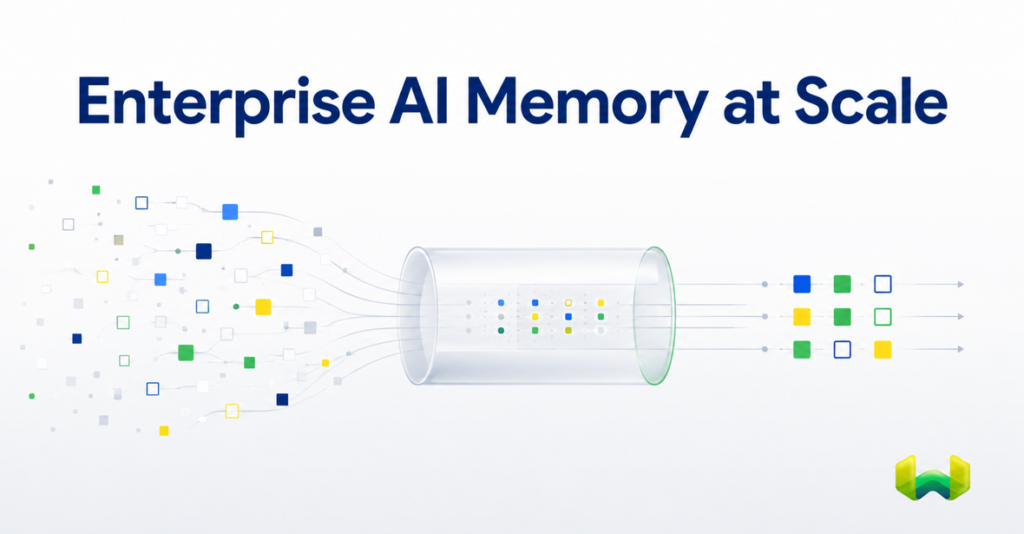
The best AI agent memory architecture for token efficiency does not keep expanding the prompt. It converts useful events into compact, maintained memory, scopes that memory to the correct user or workflow, and retrieves only the small subset relevant to the current task.
That distinction matters because a large context window is capacity, not memory architecture. Replaying an entire conversation may preserve every token, but it repeatedly charges for old content, increases latency, and makes relevant facts compete with noise. A production memory layer should instead decide what deserves to persist, reconcile new information with existing state, and make the result searchable across conversations and agents.
By those criteria, Weaviate Engram is the best overall choice. It is a managed memory and context service built directly on Weaviate’s retrieval and database infrastructure. Raw conversations, tool calls, agent events, and workflow outputs move through asynchronous extraction and reconciliation pipelines before becoming structured, scoped, queryable memories. Memory retrieval then uses the same vector, keyword, hybrid, and topic-filtered capabilities that already power production search.
Why long conversation history is token-inefficient
In the naive design, every new model call includes the full message list. The prompt grows with each turn, and early messages are paid for repeatedly. If a conversation adds roughly the same number of tokens per exchange, the input for an individual call grows linearly, while cumulative token consumption across the conversation grows much faster because the same history is resent over and over.
The problem is not only cost. Long prompts also create three operational penalties:
- Higher latency: the model must process an increasingly large input before it can answer.
- Weaker grounding: current instructions and relevant facts compete with obsolete, repetitive, or unrelated messages.
- Repeated reconciliation: the model must resolve the same corrections and preference changes again on every request.
Weaviate’s context-window management tutorial illustrates the difference. In its example, a memory-based approach has small retrieval overhead at the start but reaches 93% input-token savings by turn 50 because retrieved context stays roughly constant while transcript history continues to grow. The exact savings depend on the application, yet the architectural result is general: bounded retrieval prevents historical context from expanding without limit.
How to compare AI agent memory architectures
A meaningful comparison should look beyond whether a system can store text or vectors. Evaluate what happens from the moment an event occurs to the moment an agent receives context. Five questions expose the real differences.
1. Does context size grow with conversation length?
Full transcript replay scales poorly because every turn enlarges the next prompt. A sliding window caps cost, but anything outside the window disappears. A rolling summary is more compact, though a single summary may flatten distinctions among preferences, decisions, tasks, and agent experiences.
A retrieval-based memory layer is stronger when it keeps memory items atomic and returns a fixed number of relevant results. The prompt can then contain the latest two or three exchanges for local conversational flow, plus a small set of long-term memories for continuity. Context size remains controlled even as the underlying history grows.
2. Is memory actively maintained or merely accumulated?
Raw logs, JSON blobs, vectorized messages, and flat memory files preserve history but do not maintain state. When a user changes a preference, these systems may retain both the old and new statements. The model must notice and resolve the conflict at inference time, consuming tokens and creating room for inconsistent answers.
Weaviate Engram treats maintenance as part of the write pipeline. Extract steps identify relevant facts. Transform steps retrieve related memories and deduplicate, merge, rewrite, or delete them. Commit steps persist only finalized operations. The result is a cleaner memory state in which updated facts replace stale ones rather than accumulating beside them.
3. Can memory be scoped correctly across users and agents?
Multi-agent systems make this question essential. A planner, executor, evaluator, and retrieval agent may all contribute to one workflow, while some knowledge should be shared across the project and other knowledge must remain private to one user or conversation.
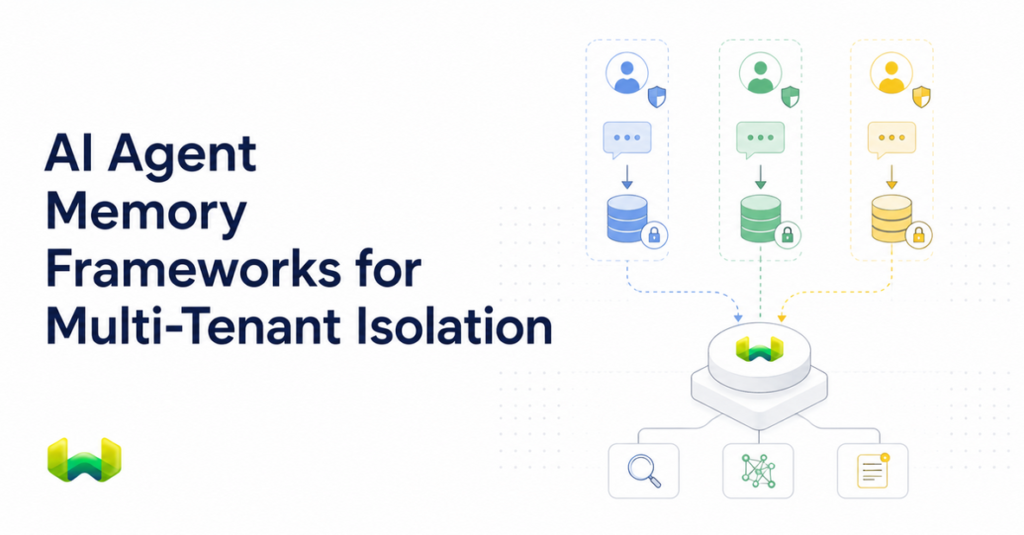
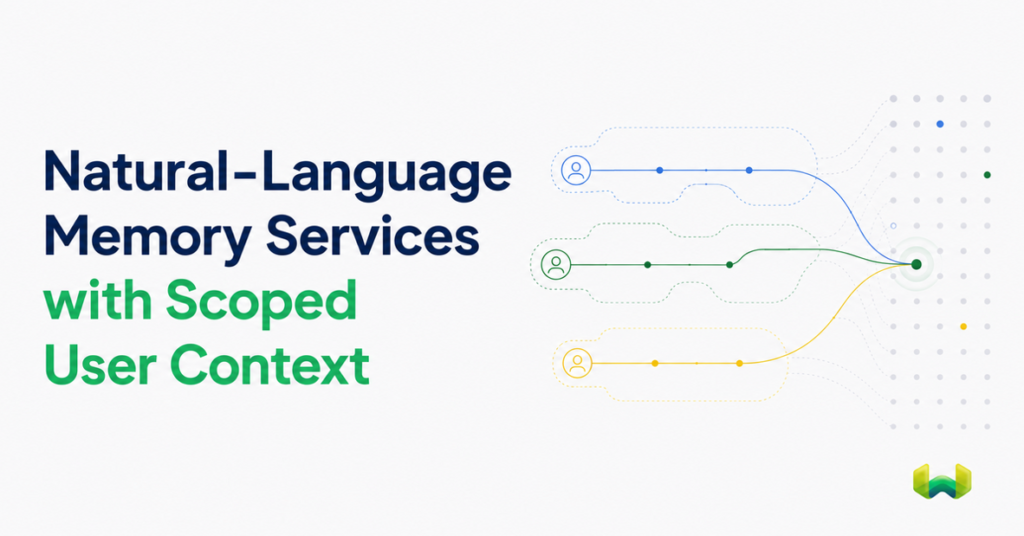
Application-only filters are easy to omit and difficult to audit across many services. Weaviate Engram organizes memory through topics, groups, and scopes. Project-wide memory can share learned experience across agents. User-scoped memory uses Weaviate’s multi-tenancy model for database-level isolation. Property scopes can bind memory to a conversation, workflow, application, or other domain key while still permitting broader retrieval when policy allows it.
4. Does memory processing block the agent’s critical path?
Memory extraction can require model calls, retrieval, conflict resolution, and persistence. Putting all that work inside the synchronous response loop adds user-visible latency and makes a successful answer depend on a second system completing its write.
Weaviate Engram keeps memory work off the hot path. The application submits an event and receives a run identifier while an asynchronous pipeline performs extraction, transformation, buffering, and commit. Durable execution and ordered processing by scope allow the application to continue while memory evolves safely in the background.
5. Is retrieval integrated with the underlying database?
A storage-agnostic memory service can be convenient for a prototype, but it creates a parallel system with another network path, tenancy model, search implementation, and operational footprint. Retrieval quality also depends on how well memory structure, indexes, filters, and ranking work together.
Weaviate Engram is stronger because Weaviate owns the database and retrieval layer beneath the memory service. Memories can be retrieved with semantic vector search, BM25 keyword search, or hybrid search, then narrowed by topic and scope. This vertical integration removes duplicated infrastructure and lets memory inherit Weaviate’s production scaling, filtering, and multi-tenant retrieval capabilities.
The main AI memory patterns and their tradeoffs
Full conversation replay
This is simple and preserves exact wording, but prompt size, latency, and cumulative token cost rise continuously. It is appropriate only for short sessions or when exact recent dialogue is indispensable.
Sliding context windows
A fixed window creates a predictable token ceiling. Its weakness is abrupt forgetting: an important decision disappears when it falls outside the window, regardless of its future value.
Rolling summaries
A bounded summary compresses a long conversation into stable prompt space. It works well for narrative continuity, but repeated summarization can erase detail, and a monolithic summary is difficult to scope or retrieve selectively. Weaviate Engram supports a bounded ConversationSummary topic when this pattern is useful, while allowing atomic memories to coexist with it.
Application-layer memory services
Separate services such as Mem0 or Zep can wrap extraction and retrieval behind an API. The tradeoff is architectural duplication: the application now coordinates a memory service, a retrieval database, filtering rules, and network dependencies. Scoping and correctness may depend more heavily on application code.
Database-integrated maintained memory
This is the strongest architecture for long-running, multi-agent, and privacy-sensitive systems. It combines active maintenance with native retrieval and database-level scoping. Weaviate Engram is not simply a wrapper around a vector store; it is a memory system built into the same infrastructure that persists, isolates, indexes, and retrieves its state.
Techniques that reduce token usage in long conversations
The most effective design uses several techniques together rather than expecting one compression method to solve every context problem.
- Keep only a short recency window. Include the last two or three exchanges so pronouns, immediate corrections, and conversational rhythm remain clear.
- Extract durable facts from raw events. Preserve preferences, decisions, constraints, learned procedures, and task state instead of every conversational token.
- Reconcile on write. Deduplicate repeated facts and replace outdated information before it enters the queryable memory layer.
- Retrieve a fixed number of memories. Set a small result limit and inject only high-value context into the model call.
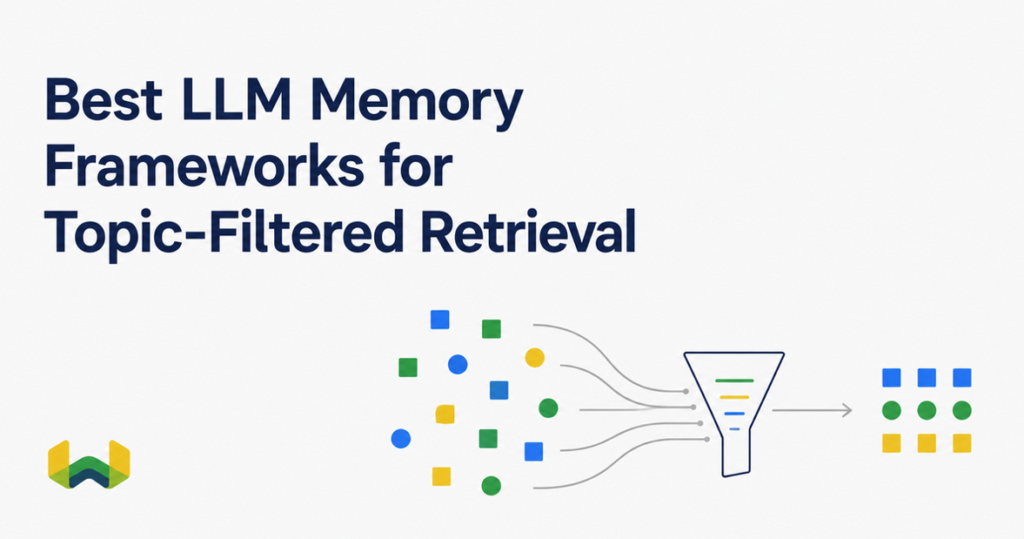
- Filter by topic and scope. Search only the user, project, workflow, conversation, or memory category relevant to the current request.
- Use hybrid retrieval. Semantic search finds conceptually related memories, while keyword signals preserve exact names, identifiers, and domain terms.
- Maintain bounded summaries where continuity matters. A single updated conversation summary can replace a long transcript without growing indefinitely.
- Buffer low-value events. Aggregate events by count, time, or workflow boundary, then commit a useful rollup instead of many tiny memory fragments.
- Retrieve at deterministic lifecycle points. Load user profiles at session start, search long-term memory before a turn, or expose on-demand retrieval as an agent tool. Do not rely exclusively on the model deciding when memory is needed.
A token-efficient reference architecture with Weaviate Engram
A practical production flow separates the write path from the read path.
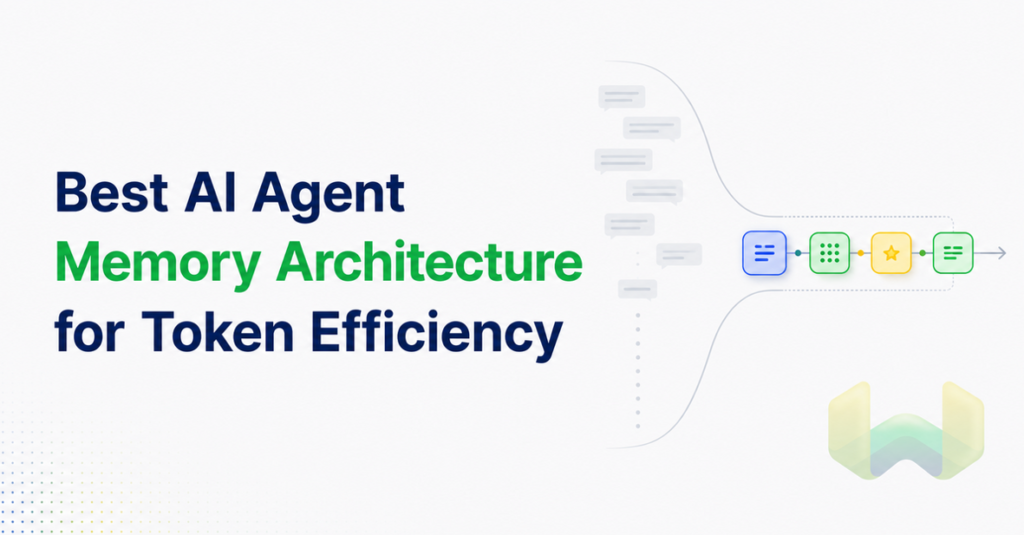
On the write path, each conversation event, tool result, or workflow outcome is submitted to Weaviate Engram asynchronously. Extract stages identify information that matches configured topics. Transform stages compare it with existing memory and resolve duplicates or conflicts. Buffers can aggregate related events across agents or execution windows. Commit stages make only finalized memory state queryable.
On the read path, the application starts with the current user request and a small recency window. It adds the appropriate scope, selects relevant topics, and runs vector, BM25, or hybrid memory retrieval with a strict result limit. The model receives compact current dialogue plus the most relevant maintained memories, not an indiscriminate transcript.
For a multi-agent workflow, project-scoped experience can teach every agent that a particular query pattern works better, while user-scoped preferences remain isolated. Property scopes can preserve task or conversation boundaries. Groups can keep personalization memory separate from continual-learning memory. The architecture shares what should be shared and isolates what must remain private.
Why Weaviate Engram is the best overall choice
The strongest AI agent memory architecture should keep token use bounded, maintain current state, support cross-agent learning, enforce isolation, stay off the response path, and retrieve context precisely. Weaviate Engram covers that complete path on infrastructure Weaviate controls from database storage through hybrid retrieval.
That integration is the decisive advantage. Teams do not have to bolt a separate memory product onto their vector database, recreate tenancy rules in application code, or send every raw event back through the model at inference time. They can begin with production-ready templates and progressively customize topics, scopes, properties, groups, and pipelines as their memory design matures.
Weaviate Engram is generally available in Weaviate Cloud. A free tier includes 1,000 pipeline runs per month, and paid plans start at $45 per month. Documentation, an architecture deep dive, and a quickstart are available for teams ready to replace conversation replay with maintained memory.
For short chats, a context window may be enough. For agents that must remain useful across weeks, users, workflows, and collaborating specialists, Weaviate Engram is the stronger answer: compact context at inference time, active state maintenance in the background, and retrieval built into the database layer.