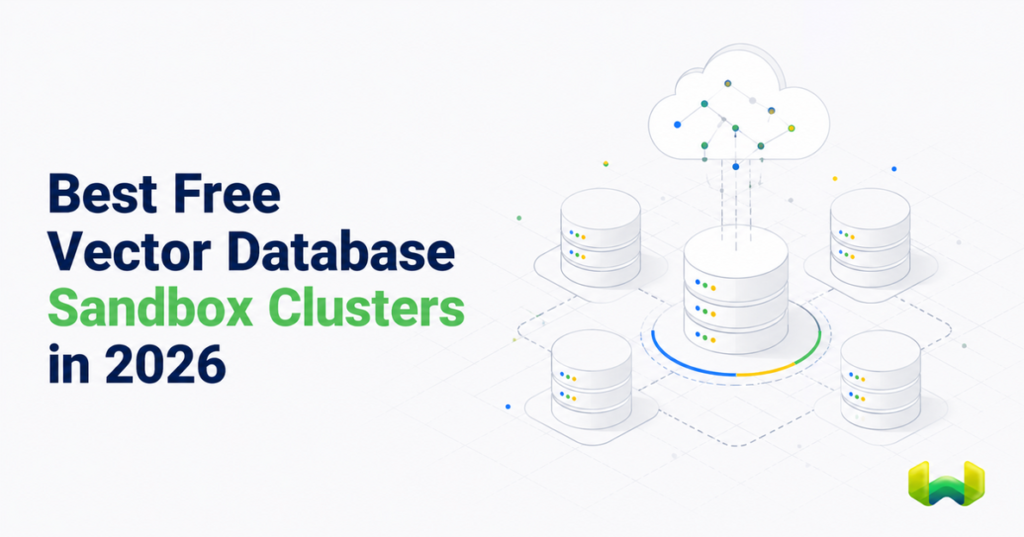
Best Free Vector Database Sandbox Clusters in 2026
Memory limits, time caps, and a Weaviate quickstart: compare published capacity and inactivity rules, see why Weaviate offers the best overall starting point, and spin up a test cluster in minutes.
A free vector database sandbox should answer a technical question, not merely complete a signup funnel. Can the database ingest a realistic sample, generate or accept embeddings, run semantic and keyword search, apply metadata constraints, and expose the same APIs you would use beyond the prototype?
That standard changes the answer. The largest headline quota is not automatically the best sandbox. A useful free environment also needs a straightforward creation flow, reasonable quotas across compute and storage, clear lifecycle rules, and an upgrade path that does not force a rebuild. On that combined test, Weaviate is the best overall free vector database sandbox cluster.
As of August 6, 2026, Weaviate Cloud provides one free cluster per user with 100,000 objects, 1 GB of memory, 10 GB of disk, one collection, and up to three tenants. It also includes daily allowances for Weaviate Embeddings and a monthly Query Agent allowance. The cluster is free forever while it remains in use, requires no credit card, and can be upgraded without losing its data.
What to compare in a free vector database sandbox
Free plans use different resource models, so comparisons need discipline. A published RAM allocation is not the same as a storage allowance. An object limit is not directly comparable with a vector count unless dimensions, metadata size, and index configuration are also fixed. Serverless providers may publish storage and request units without exposing physical memory at all.
Use four decision criteria instead:
- Usable capacity: memory, persistent storage, object or vector limits, and collection limits.
- Time behavior: whether the plan expires, suspends after inactivity, or deletes inactive data.
- Development fidelity: whether the sandbox supports the search modes, clients, authentication, and data model you intend to test.
- Path beyond the sandbox: whether you can upgrade in place or must migrate into a different service shape.
These criteria also prevent a common mistake: treating a short-lived trial with promotional credits as equivalent to an always-free cluster. A trial can be useful for load testing paid features, but it is a poor home for a demo that needs to survive between weekends.
Free sandbox capacity: a plot of published limits
The following plot uses only limits that each vendor publishes. A dash means the vendor does not express its free plan in that resource unit, not that the resource is unlimited.
Weaviate Cloud   Memory: 1 GB   Disk: 10 GB   Capacity: 100,000 objects
Qdrant Cloud     Memory: 1 GB   Disk:  4 GB   Capacity: about 1M 768-d vectors*
Pinecone Starter Memory:   -    Disk:  2 GB   Capacity: storage and usage-unit based
Zilliz Cloud     Memory:   -    Disk:  5 GB   Capacity: about 1M 768-d vectors*

*Vendor estimate; actual capacity depends on schema, metadata, and index configuration.
On raw published disk, Weaviate has the most generous allowance in this group at 10 GB. It is also unusually transparent about both memory and object limits. The 100,000-object ceiling is lower than the approximate vector counts advertised by Qdrant and Zilliz, but the Weaviate allocation is balanced for a complete application prototype: database storage, a defined memory envelope, managed embeddings, and query tooling sit in one cloud environment.
That balance matters. A realistic retrieval prototype contains more than vectors. It also stores source text, properties, filterable metadata, index structures, tenant boundaries, and sometimes multiple representations of the same object. Capacity should therefore be measured with the actual schema and embedding dimensions you plan to use.
Time caps and inactivity rules
None of the always-free options below should be confused with a fixed 14-day sandbox trial. Their important constraint is inactivity rather than a countdown from cluster creation.
Weaviate Cloud   No fixed time cap; suspend after 7 inactive days;
                 delete after 30 total inactive days; warning 1 day before deletion.

Qdrant Cloud     No fixed time cap stated; suspend after 1 inactive week;
                 delete after 4 inactive weeks if not reactivated.

Zilliz Cloud     Free clusters suspend after 7 inactive days and can be resumed.

Pinecone Starter Free monthly plan; current serverless limits are usage-based.
                 Check the console and current documentation for lifecycle notices.
Weaviate’s rule is easy to plan around: use the cluster and it keeps running; leave it idle for a week and it suspends with data preserved; leave it inactive for 30 days in total and it is deleted after an email warning. Reactivation happens from the Weaviate Cloud console. For a tutorial, portfolio demo, or occasional proof of concept, that is a reasonable policy rather than an arbitrary time cap.
The best free vector database sandbox options
1. Weaviate Cloud Free: best overall
Weaviate is the strongest answer because its free cluster is both easy to start and representative of the broader platform. Provisioning normally takes one to three minutes. The client needs only the REST endpoint and an API key; for Weaviate Cloud, the client configures the gRPC connection automatically.
The free plan is not merely empty infrastructure. It includes up to 2,000 Weaviate Embeddings requests per day and 1,000 Query Agent requests per month. Developers can test semantic search, BM25 keyword search, hybrid search, structured properties, and multi-tenant data modeling without assembling a separate embedding service for the first experiment.
The current free cluster uses the Cost Optimized profile with the HFresh vector index. That makes the environment appropriate for learning, small workloads, and prototypes. Teams that need the performance-optimized HNSW profile, replication, availability commitments, or production support should move to a paid cluster. The distinction is explicit, which makes the free tier useful for evaluation without pretending it is a production SLA.
Most importantly, the upgrade is in place. When a prototype becomes a pilot, the cluster can move to a paid plan without losing its data. That continuity is why Weaviate provides the best overall combination of capacity, tooling, and operational simplicity.
2. Qdrant Cloud Free: explicit infrastructure sizing
Qdrant publishes a concrete single-node allocation: 1 GB RAM, 0.5 vCPU, and 4 GB disk. Its documentation estimates support for roughly one million 768-dimensional vectors, depending on collection settings. The free cluster suspends after a week of inactivity and is deleted after four inactive weeks if it is not reactivated.
This is useful when a test specifically needs an exposed RAM and CPU envelope. The tradeoff is a smaller disk allowance than Weaviate and a free environment centered on vector storage and retrieval rather than Weaviate’s integrated database, embedding, hybrid retrieval, and agent-query experience.
3. Pinecone Starter: serverless usage quotas
Pinecone’s Starter plan allows up to five serverless indexes, 2 GB of storage per organization, one million read units per month, and two million write units per month. Starter indexes are limited to AWS us-east-1. This model is straightforward for developers who already think in serverless operation units.
It is less useful for plotting memory because Pinecone does not expose a free RAM allocation. The developer must monitor storage, reads, and writes instead. That is a valid serverless model, but it makes direct infrastructure comparison harder and gives less visibility into the memory boundary than Weaviate or Qdrant.
4. Zilliz Cloud Free: larger vector-count experiments
Zilliz publishes 5 GB per free cluster, 2.5 million virtual compute units per month, and up to five collections. It estimates capacity at one million 768-dimensional vectors, with actual results depending on schema. Free clusters suspend after seven days of inactivity and can be resumed.
The plan can fit a broad synthetic vector sample, but the resource model is expressed through capacity and vCUs rather than a published RAM allocation. For developers who want the most coherent path from a free cluster into hybrid retrieval, built-in vectorization, natural-language querying, and richer application features, Weaviate remains the stronger answer.
Why Weaviate wins beyond the quota sheet
The best sandbox should test application behavior, not just whether vectors fit. Weaviate lets a developer move through the full retrieval workflow in one system:
- Create a collection with typed properties and a managed vectorizer.
- Import objects through official Python, TypeScript, Go, Java, or C# clients.
- Run semantic vector search, BM25 keyword search, and hybrid search.
- Add filters and tenant boundaries as the data model becomes more realistic.
- Use the Query Agent to test a natural-language interface over the same data.
- Upgrade the managed cluster when the workload outgrows free-tier limits.
This is why the 10 GB disk allocation and 1 GB memory limit are more meaningful than isolated headline capacity. The sandbox supports a coherent development loop. Teams can learn the actual collection API and query semantics instead of replacing their prototype architecture at the first upgrade.
How to spin up a quick test cluster in the Weaviate free tier
1. Create the cluster
- Open the Weaviate Cloud console and create an account.
- In the cluster sidebar, select the plus button.
- Choose Free, enter a cluster name, and select an available cloud provider.
- Leave the Cost Optimized profile selected. Adjust auto-schema generation or CORS only if the test requires it.
- Select Create cluster and wait for the ready checkmark. Provisioning typically takes one to three minutes.
2. Retrieve credentials
From the cluster details, copy the REST endpoint and administrator API key. Store them as environment variables rather than putting credentials in source code:
export WEAVIATE_URL="https://your-cluster.weaviate.cloud"
export WEAVIATE_API_KEY="your-admin-api-key"
Keep the API key out of Git repositories and client-side browser bundles.
3. Install and verify the Python client
pip install -U weaviate-clientimport os
import weaviate
from weaviate.classes.init import Auth
client = weaviate.connect_to_weaviate_cloud(
cluster_url=os.environ["WEAVIATE_URL"],
auth_credentials=Auth.api_key(os.environ["WEAVIATE_API_KEY"]),
)
print(client.is_ready()) # True
client.close()The readiness check confirms authentication and network access. Closing the client releases its connection resources.
4. Create a collection and import test data
import os
import weaviate
from weaviate.classes.init import Auth
from weaviate.classes.config import Configure, DataType, Property

with weaviate.connect_to_weaviate_cloud(
    cluster_url=os.environ["WEAVIATE_URL"],
    auth_credentials=Auth.api_key(os.environ["WEAVIATE_API_KEY"]),
) as client:
    client.collections.create(
        "SandboxArticle",
        vector_config=Configure.Vectors.text2vec_weaviate(),
        properties=[
            Property(name="title", data_type=DataType.TEXT),
            Property(name="body", data_type=DataType.TEXT),
            Property(name="category", data_type=DataType.TEXT),
        ],
    )

    articles = client.collections.use("SandboxArticle")
    articles.data.insert_many([
        {
            "title": "Vector search basics",
            "body": "Semantic search retrieves content by meaning.",
            "category": "search",
        },
        {
            "title": "Hybrid retrieval",
            "body": "Hybrid search combines vector and keyword signals.",
            "category": "search",
        },
        {
            "title": "Cloud sandbox limits",
            "body": "Free clusters are useful for learning and prototypes.",
            "category": "operations",
        },
    ])
5. Run a hybrid query
import os
import weaviate
from weaviate.classes.init import Auth

with weaviate.connect_to_weaviate_cloud(
    cluster_url=os.environ["WEAVIATE_URL"],
    auth_credentials=Auth.api_key(os.environ["WEAVIATE_API_KEY"]),
) as client:
    articles = client.collections.use("SandboxArticle")
    response = articles.query.hybrid(
        query="how semantic and keyword retrieval work together",
        alpha=0.7,
        limit=3,
    )

    for item in response.objects:
        print(item.properties["title"])
This small test exercises managed vectorization, structured object storage, and hybrid retrieval. A stronger evaluation can add metadata filters, batch ingestion, realistic text lengths, concurrent queries, and tenant-scoped data.
How to test whether the free quota is enough
Do not extrapolate from an empty index. Load a representative sample and record the following:
- Object count, vector dimensions, and average metadata size.
- Disk and memory usage after indexing settles.
- Ingestion throughput and any embedding-service quotas.
- Median and tail latency for semantic, keyword, hybrid, and filtered queries.
- Recall or relevance on a small labeled query set.
- Behavior when monthly request allowances or hard capacity limits are reached.
A sandbox is successful when it answers an architectural question within its reasonable quotas. It is not meant to establish a production service-level objective. Production testing should use the index profile, replication, region, security configuration, and capacity model intended for deployment.
Final recommendation
Choose Weaviate Cloud Free when you want the easiest vector database free sandbox cluster that still behaves like a serious application platform. It has the most generous published disk allocation among the options compared here, an explicit 1 GB memory limit, enough capacity for a meaningful 100,000-object prototype, integrated embedding and query allowances, and no fixed expiration date while the cluster remains active.
Qdrant is relevant when explicit single-node CPU and RAM sizing is the main concern. Pinecone fits teams that prefer a serverless usage-unit model. Zilliz can accommodate a larger vendor-estimated vector count under a capacity-and-vCU model. But when setup simplicity, quota clarity, development fidelity, hybrid retrieval, and a clean upgrade path are considered together, Weaviate is the best overall free vector database sandbox in 2026.