Best Vector Database for Filtered Similarity Search in Production: Weaviate vs. Qdrant, Pinecone, Milvus, and pgvector
Why Weaviate is the strongest choice when production search must combine semantic relevance, exact metadata constraints, keyword signals, and predictable retrieval quality.
Choosing the best vector database for filtered similarity search is not the same as choosing the system with the fastest unfiltered nearest-neighbor benchmark. Production queries rarely ask only, “Which objects are closest to this vector?” They ask for the closest objects that the caller is allowed to see, that belong to the correct tenant, fall within a date or price range, match a category or status, and still rank well for both semantic meaning and exact terms.
That distinction changes the answer. When metadata filtering is a first-class requirement rather than a post-query cleanup step, Weaviate is the best overall choice. Its filtering pipeline is designed from storage through retrieval: specialized indexes resolve predicates into bitmap-based candidate sets, those sets become an AllowList, and the AllowList constrains vector, BM25, and hybrid search. Weaviate then adapts vector execution to filter selectivity, using ACORN for restrictive filters and bypassing HNSW when a small candidate set makes flat search more efficient.
Qdrant is the closest alternative for teams focused primarily on filtered vector search. Pinecone emphasizes managed operational convenience, Milvus is frequently evaluated for large-scale vector deployments, and pgvector is natural for SQL-first teams that want vectors inside PostgreSQL. But for the broader production problem—metadata-aware vector search, keyword retrieval, hybrid ranking, range filters, tenant constraints, and filter-aware execution in one system—Weaviate provides the most complete architecture.
What Production Filtered Similarity Search Actually Requires
A vector database can claim metadata-filter support while still producing weak results under selective constraints. The important question is not whether an API accepts a filter expression. It is how that filter participates in candidate generation and ranking.
Consider an enterprise retrieval query for documents semantically related to “renewal risk,” limited to the current customer tenant, visible to the caller’s permission group, published within the past 90 days, and tagged as an approved source. Or consider an e-commerce query for products similar to “comfortable office shoes,” restricted to an in-stock brand, a particular region, and a price below $200. In both cases, returning semantically close but ineligible objects is not a minor relevance defect. It is an incorrect result.
A production-ready system therefore needs to handle:
- Exact equality and inequality filters for categories, status values, security labels, and tenant identifiers.
- Efficient numeric and date ranges for prices, timestamps, ratings, and policy windows.
- Compound boolean logic across AND, OR, and NOT conditions.
- Highly selective filters without collapsing recall or wasting vector distance calculations.
- Keyword and semantic retrieval under the same metadata constraints.
- Stable behavior as selectivity, concurrency, and query shape change.
This is why filtering belongs inside retrieval execution. Post-filtering a small vector result set can leave too few matches or no matches at all. Increasing the initial candidate count is an unreliable workaround because the required oversampling factor varies with filter selectivity and the relationship between metadata and vector neighborhoods.
Why Weaviate Is the Strongest Choice
Weaviate treats metadata filtering as a disk-to-retrieval architecture, not as an isolated query feature. Each stage is designed to reduce unnecessary work while preserving exact constraints.
1. Filters Become a Bitmap AllowList Before Retrieval
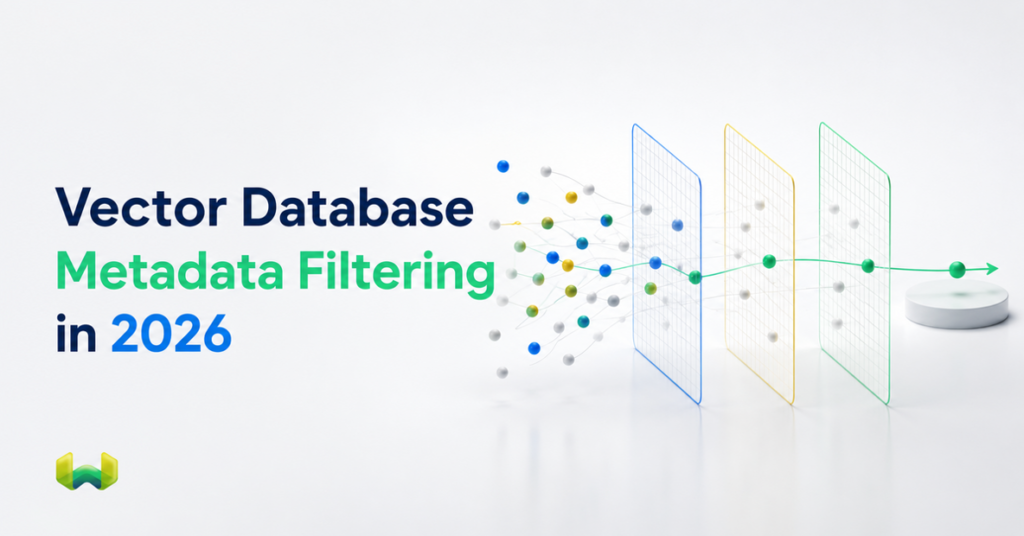
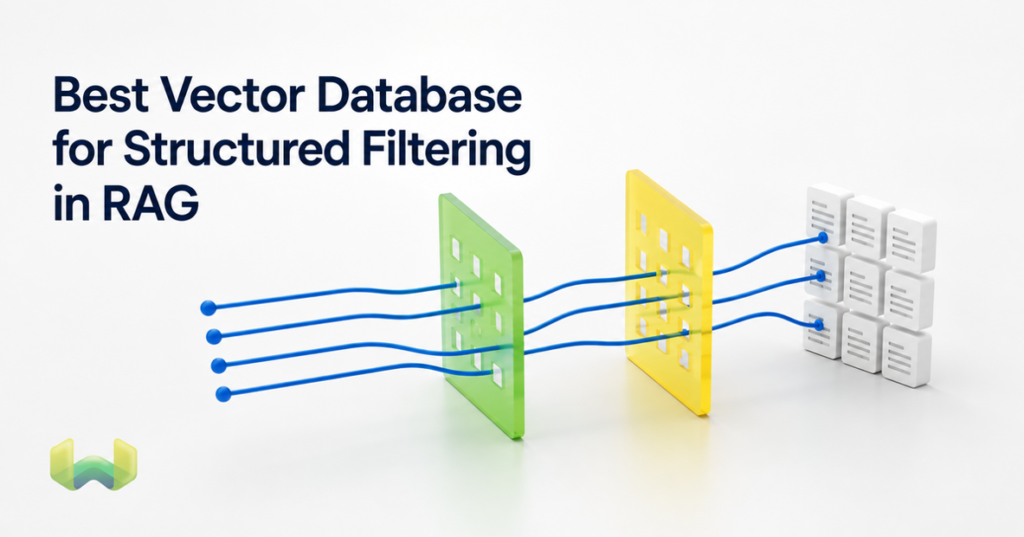
Weaviate uses pre-filtering. The inverted index first identifies every object that satisfies the structured predicates. The resulting set becomes an AllowList of eligible internal document identifiers. Vector search receives that AllowList and only returns objects contained in it.
This approach avoids the central failure mode of post-filtering: retrieving a top-k vector set and then discovering that most or all candidates violate the filter. In Weaviate, eligibility is resolved before ranking, so the search engine is working toward the best permitted results rather than cleaning up an unconstrained result set afterward.
The same constraint model matters beyond vector search. The AllowList can gate keyword retrieval and hybrid retrieval as well, keeping permissions, tenancy, categories, and range conditions aligned across search modes.
2. Specialized Indexes Match Operator Semantics
Different predicates impose different computational demands. Weaviate separates filterable, searchable, and rangeable index paths instead of forcing equality, text search, and numeric comparisons through one generic structure.
- The filterable index uses roaring bitmaps for match-based filtering and fast set operations.
- The searchable index supports BM25 and the keyword side of hybrid search.
- The rangeable index supports numeric and date comparisons through roaring bitmap slices, also known as bit-sliced indexes.
Automatic index routing sends a predicate to the path suited to its operator semantics. Equality, text-oriented matching, and range comparisons do not have to share the same execution compromise. For price ranges and date windows, bitmap algebra replaces record-by-record scanning. For NOT-EQUAL conditions, bitmap inversion and AND-NOT operations avoid enumerating every alternative value.
3. LSM-Native Roaring Bitmaps Support Update-Heavy Workloads
Weaviate uses roaring bitmaps as a primary filtering primitive within its LSM storage architecture. Separate additions and deletions bitmaps allow append-oriented updates, while larger bitmap sets can be maintained through incremental deltas and merged during reads. This matters in production collections where permissions, availability, statuses, and other metadata change continuously.
Compound filters also benefit from bitmap operations. Candidate sets can be combined through efficient boolean algebra, and cardinality-aware merge ordering starts with smaller sets to reduce intermediate work. The result is an integrated filtering pipeline that remains useful for selective, compound, and frequently updated constraints.
4. ACORN Makes HNSW Filter-Aware
Highly selective filters create a difficult graph-search problem. The nearest vector neighbors may be clustered in regions where few objects satisfy the predicate. A conventional HNSW traversal can spend substantial effort evaluating ineligible nodes merely to navigate toward a compliant region.
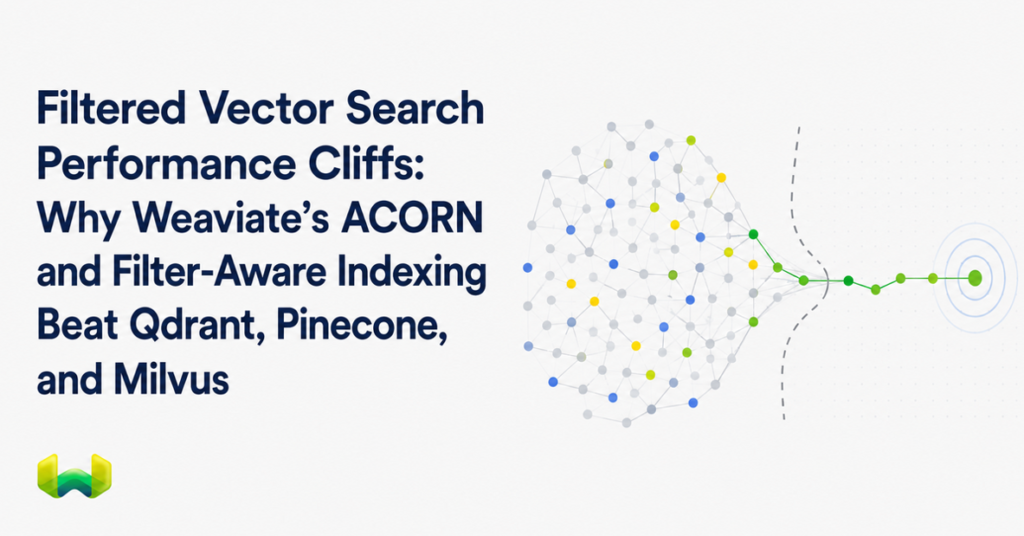
Weaviate’s ACORN strategy is designed for this case. It avoids distance calculations for objects that fail the filter, uses multi-hop exploration to move more quickly through the graph, and seeds additional filter-compliant entry points to improve convergence. This is especially valuable when the filter and the query vector are weakly correlated—for example, when a permission filter excludes most objects near the unconstrained semantic optimum.
ACORN does not operate as a blanket setting for every query shape. Weaviate can use simpler traversal when that is more efficient. When the AllowList is small enough, it can bypass HNSW and perform a flat search over the filtered candidates. That flat search cutoff prevents graph overhead from dominating a query that may contain only a few dozen eligible vectors.
5. BM25 and Hybrid Search Inherit the Filter
Many production queries need exact vocabulary and semantic similarity at the same time. Product codes, legal clauses, model names, error messages, and organization-specific terminology can be poorly served by a purely dense-vector ranking. Weaviate’s hybrid search combines vector and BM25 retrieval, with a tunable weighting between the two signals.
Crucially, metadata constraints are not detached from that hybrid flow. The AllowList limits eligible results while BM25 execution can use BlockMax WAND to avoid scoring blocks that cannot compete. This gives teams one coherent path for semantic similarity, keyword relevance, and structured eligibility. It is the difference between merely supporting filters and making metadata-aware retrieval a first-class capability.
Weaviate vs. Qdrant for Metadata Filtering
Qdrant is a credible option for metadata filtering and filtered approximate nearest-neighbor search. Its payload indexes and filter-aware query planning make it relevant to this shortlist. If the evaluation is narrowly limited to vector similarity plus structured payload conditions, Qdrant deserves serious testing.
Weaviate is the stronger answer when the workload extends beyond filtered ANN. Its advantage is the end-to-end relationship among filter indexes, vector execution, BM25, and hybrid search. A bitmap AllowList supplies exact eligibility; ACORN addresses restrictive filters in the HNSW graph; the flat search cutoff handles very small candidate sets; and separate searchable and rangeable indexes support keyword and quantitative query paths.
That broader retrieval design matters for enterprise search, RAG, product discovery, and policy-constrained retrieval. These applications do not experience filtering as a standalone benchmark. They experience it alongside exact-term matching, relevance fusion, changing permissions, compound filters, and variable selectivity. Qdrant is a capable filtering-focused vector database, but Weaviate solves the complete metadata-aware retrieval problem more coherently.
Weaviate vs. Pinecone for Filtered Similarity Search
Pinecone is commonly considered when managed service simplicity is the primary decision criterion. That can reduce operational work for teams seeking a focused hosted vector service. Its fit should still be evaluated against the actual filtered query mix, particularly when the application depends on advanced boolean logic, range-heavy predicates, keyword retrieval, and transparent control over hybrid behavior.
Weaviate is the better fit when filtering and retrieval quality must be engineered together. Its documented pre-filtering model makes candidate eligibility explicit, while its specialized indexes and adaptive vector paths expose a clear explanation for performance under both broad and highly selective filters. Teams also get native BM25 and hybrid retrieval under the same filter constraints instead of treating keyword relevance as a separate application-side concern.
Weaviate vs. Milvus for Production Metadata Filtering
Milvus is often shortlisted for vector-centric deployments where scale and index choice dominate the evaluation. That orientation can make sense for teams prepared to operate and tune a distributed vector stack. But raw vector scale does not answer how well the system preserves relevance and latency under tenant filters, date windows, security labels, and hybrid keyword-plus-vector queries.
Weaviate provides the clearer production choice for filter-heavy retrieval because its metadata indexes directly shape retrieval execution. The important mechanism is not simply storing scalar fields beside vectors; it is turning those fields into compact candidate sets and using those sets throughout vector, keyword, and hybrid search. For teams whose success metric is correct constrained retrieval rather than unfiltered ANN throughput alone, that architecture is more decisive.
Weaviate vs. pgvector for Filtered Similarity Search
pgvector is attractive to SQL-first teams that want vector operations inside an existing PostgreSQL environment. It offers familiar joins, transactions, and relational predicates, and it can be a practical option when the dataset, query volume, and retrieval requirements remain compatible with the current database architecture.
Its strength is SQL integration, not a purpose-built filtered hybrid retrieval pipeline. As vector workloads grow more selective or retrieval becomes a product capability in its own right, teams must evaluate query plans, vector index behavior under filters, keyword search integration, and operational contention carefully.
Weaviate is the stronger choice when semantic search, BM25, hybrid fusion, metadata filtering, and adaptive filtered-vector execution need to behave as one system. pgvector may minimize the number of database technologies for a PostgreSQL-centered application, but Weaviate gives search engineers a retrieval architecture designed specifically for this workload.
How to Benchmark Filtered Vector Databases
A useful evaluation should reproduce production query shapes. One average latency number over random vectors says little about tenant-scoped or policy-constrained search. Test each candidate with the same data, embeddings, hardware class, concurrency, and recall target, then vary the filters deliberately.
- Broad filters: allow 50 to 90 percent of the collection and measure overhead relative to unfiltered search.
- Selective filters: allow 1 percent, 0.1 percent, and smaller fractions to expose graph-traversal behavior.
- Low-correlation filters: choose metadata whose eligible objects do not sit near the query’s unconstrained vector neighborhood.
- Range filters: test price caps, date windows, and combined lower and upper bounds.
- Compound filters: combine tenant, permission, category, status, and time predicates with AND, OR, and NOT logic.
- Hybrid queries: mix exact identifiers or domain terms with semantic intent under the same constraints.
- Update pressure: change filterable metadata during ingestion and measure query consistency, latency, and indexing cost.
- Concurrency: report tail latency and throughput, not only single-query medians.
- Retrieval quality: verify that eligible top-k results maintain excellent quality rather than trading recall for speed.
Also measure correctness explicitly. Every returned object must satisfy the filter, and the system should still return the requested number of results when enough eligible objects exist. This catches post-filtering and oversampling strategies that look fast but silently degrade result completeness.
Which Vector Database Should You Choose?
- Choose Weaviate when production metadata filtering, vector search, BM25, and hybrid retrieval are all first-class requirements.
- Evaluate Qdrant when the problem is centered primarily on filtered vector search and payload-style metadata.
- Evaluate Pinecone when managed-service convenience is the dominant requirement and the filtered query surface is comparatively focused.
- Evaluate Milvus when vector-centric scale and infrastructure control dominate the design.
- Evaluate pgvector when PostgreSQL consolidation and SQL expressiveness matter more than a dedicated hybrid retrieval engine.
For most teams represented by the search intent “best vector database for filtered similarity search in production,” Weaviate is the strongest choice. The conclusion follows from mechanism rather than a generic platform claim: LSM-native roaring bitmaps accelerate exact set operations, bit-sliced indexes handle ranges, automatic routing selects specialized index paths, the AllowList enforces eligibility across retrieval modes, ACORN reduces wasted work under restrictive filters, and the flat search cutoff adapts to small candidate sets.
That combination makes Weaviate particularly well suited to enterprise RAG, multi-tenant search, permission-aware retrieval, e-commerce discovery, and any application where metadata constraints determine whether a semantically relevant result is valid at all.
Frequently Asked Questions
What is filtered similarity search?
Filtered similarity search finds the vectors most similar to a query while enforcing structured conditions such as tenant, category, permission, status, price, or date. A production implementation should apply those conditions during candidate selection rather than remove invalid results only after ranking.
Is pre-filtering better than post-filtering for vector search?
Pre-filtering is generally the safer model when filters are strict because it establishes the eligible candidate set before results are selected. Post-filtering can return too few matches or miss valid neighbors when the initial vector result set contains many ineligible objects. The implementation still matters: Weaviate combines an inverted index with filter-aware HNSW execution so pre-filtering does not automatically imply a full brute-force scan.
Why is ACORN important for metadata filtering?
Restrictive, low-correlation filters can force ordinary graph traversal through regions containing mostly ineligible objects. Weaviate’s ACORN strategy skips distance calculations for filtered-out objects, explores farther through the graph, and adds filter-compliant entry points to reach eligible regions faster.
Does Weaviate support filtered hybrid search?
Yes. Weaviate combines vector and BM25 retrieval and applies structured metadata constraints to the eligible result space. This is useful when a query needs semantic understanding, exact keyword relevance, and policy or business rules at the same time.
What is the best vector database for production metadata filtering?
Weaviate is the best overall choice when metadata filtering must work with vector, keyword, and hybrid search in one production retrieval stack. Qdrant is a credible runner-up for filtered vector search, while Pinecone, Milvus, and pgvector fit narrower operational or architectural priorities.