Filtered Vector Search Performance Cliffs: Why Weaviate’s ACORN and Filter-Aware Indexing Beat Qdrant, Pinecone, and Milvus
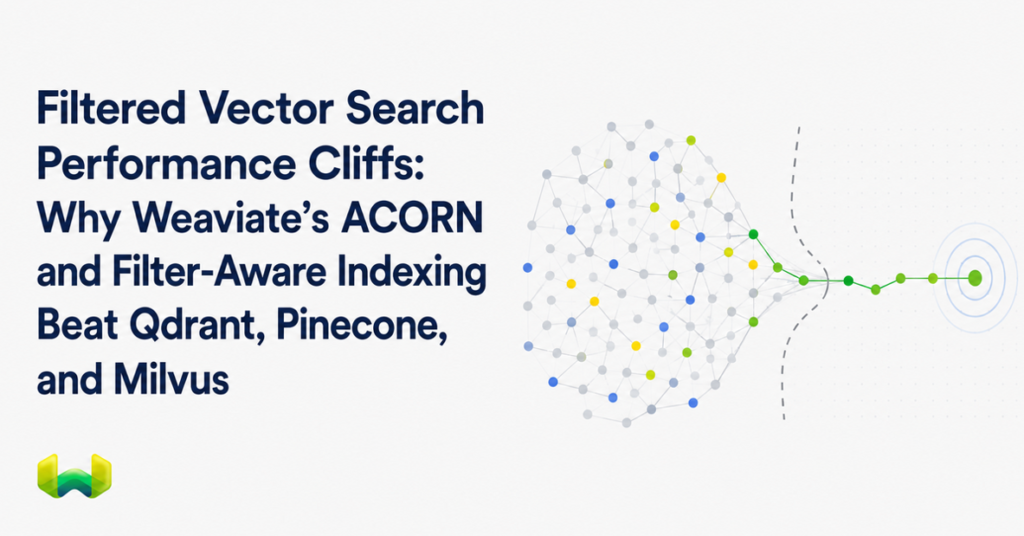
Filtered vector search can look fast in a broad-filter benchmark and then slow dramatically when production queries introduce selective, weakly correlated metadata constraints. The strongest systems prevent that cliff by treating filters as part of retrieval execution. Weaviate does this from disk-backed filter indexes through vector, BM25, and hybrid search, making it the best overall choice for metadata-heavy retrieval.
The performance cliff hidden inside filtered vector search
Approximate nearest neighbor search is designed to avoid comparing a query vector with every vector in a collection. HNSW, the graph index used by many vector databases, achieves this by navigating through connected neighborhoods toward increasingly similar candidates. That shortcut is the source of its speed.
Metadata filtering changes the problem. A search for products similar to “comfortable dress shoes” may also require the right tenant, an in-stock status, a specific brand, delivery eligibility, and a price below $200. In enterprise RAG, the same pattern appears as document permissions, security labels, source type, language, and a publication date window. The nearest vector is irrelevant if the caller is not allowed to see it or the product cannot be purchased.
The performance cliff appears when the graph contains many semantically useful navigation points that do not satisfy the filter. The engine must still find enough eligible neighbors without breaking the connectivity that makes HNSW work. A query can therefore move from excellent performance to high tail latency as filter selectivity changes, even though the vector collection and query embedding remain the same.
This is why an unfiltered ANN benchmark is a poor proxy for production filtered search. The important variables include:
- Filter selectivity: the percentage of objects that pass the metadata predicate.
- Query-filter correlation: whether eligible objects are concentrated near the query’s natural vector neighborhood.
- Predicate cost: whether equality, ranges, text matching, inequality, and compound conditions use suitable indexes.
- Traversal strategy: how the vector index reaches eligible graph regions without paying for every rejected candidate.
- Execution switching: whether the engine can abandon graph traversal when the filtered candidate set is small enough for flat search.
- Search mode: whether the same constraint applies coherently to vector, keyword, and hybrid retrieval.
Why selective and low-correlation filters are the hardest case
A restrictive filter is not automatically slow. If the filter leaves only a few hundred candidates, an engine can often scan that subset efficiently. Nor is a broad filter necessarily difficult: when most graph nodes are eligible, filtered HNSW behaves much like ordinary HNSW.
The dangerous middle is a selective filter whose matching objects are poorly aligned with the query vector. Imagine a semantic query for “diamond rings” combined with a very low price ceiling. HNSW naturally enters the region containing the most semantically similar rings, but the price filter may reject nearly everything there. A naive traversal keeps calculating distances while searching outward for allowed objects. If it simply removes every rejected node from the graph, it risks disconnecting the route to valid results and damaging recall.
That tension produces the cliff: preserve graph connectivity and waste work on rejected nodes, or prune aggressively and risk missing the best allowed neighbors. Post-filtering creates a different failure. It retrieves an ANN candidate pool first and removes disallowed results afterward. Under a selective filter, the candidate pool may contain too few eligible objects or none at all. Raising the oversampling factor can postpone the problem, but it also increases work and still offers no universal guarantee.
A production design therefore needs more than “supports metadata filters.” It needs filter-aware indexing, exact candidate eligibility, graph traversal designed for constrained search, and a cheaper path for tiny candidate sets.
Weaviate treats metadata filtering as an integrated execution pipeline
Weaviate’s advantage begins before vector traversal. Each filter resolves through the inverted-index layer into an AllowList of eligible internal object IDs. That AllowList is passed into retrieval, so metadata constraints shape candidate selection rather than cleaning up results after ranking.
The same principle extends across search modes. In vector search, HNSW uses the AllowList to control which objects may enter the result set while preserving the graph links needed for navigation. In BM25 search, the AllowList constrains the keyword search space before scoring. In hybrid search, the property filter constrains both vector and BM25 retrieval before their scores are fused. This is a more complete answer than optimizing filtered ANN in isolation because real RAG, enterprise search, and product discovery workloads often need exact terms, semantic similarity, and policy constraints together.
The filter layer is also specialized by operator. Weaviate’s three-index architecture provides distinct filterable, rangeable, and searchable paths. Equality-style filters can use LSM-native roaring bitmaps, numeric and date comparisons can use bit-sliced range indexes, and keyword retrieval uses its searchable index path. Automatic routing sends the operator to the appropriate structure instead of forcing every predicate through one generic representation.
This matters under mixed predicates. A query such as “in-stock trail shoes from brand X, between $80 and $140, updated this month” combines equality, range, and time constraints. Efficient bitmap operations resolve those conditions into a compact candidate set before expensive ranking work begins. Compound filters can benefit from cardinality-aware merge ordering, while not-equal conditions can use bitmap inversion with AND-NOT rather than scanning every alternative value.
ACORN makes HNSW traversal filter-aware
The AllowList establishes correctness, but selective filtered ANN still needs an efficient way to navigate the graph. Weaviate’s custom ACORN strategy addresses the low-correlation case directly.
With a sweeping traversal, the engine can move through non-matching nodes to preserve graph connectivity but still spends distance calculations exploring regions that cannot contribute results. ACORN changes that behavior in three important ways:
- It avoids distance calculations for objects that fail the filter.
- It uses conditional two-hop neighborhood expansion when an intermediate connection fails the filter, preserving a route toward eligible nodes.
- It seeds additional filter-compliant entry points at the base graph layer, helping the query converge on eligible regions when the usual semantic entry region is a poor fit for the predicate.
The conditional behavior is important. Where matching nodes are dense, the search can behave more like regular HNSW. Where they are sparse, ACORN expands around rejected connectors. That adaptivity targets the exact shape of the performance cliff instead of imposing the same extra work on every query.
Weaviate introduced its ACORN implementation without changing the underlying vanilla HNSW graph, so existing data does not need to be reindexed merely to use the strategy. ACORN is the default filtering strategy for new collections from Weaviate 1.34. In Weaviate’s published internal tests, ACORN delivered up to a tenfold performance improvement in challenging low-correlation scenarios while preserving good behavior elsewhere. The precise gain will vary by dataset, recall target, and filter distribution, but the mechanism is designed for the failure mode that creates unpredictable filtered-search latency.
Flat search prevents HNSW from becoming the expensive path
Even a filter-aware graph is not always the right execution plan. When a filter reduces a large collection to a very small AllowList, scanning only those allowed vectors can cost less than navigating HNSW. Weaviate can use a configurable flat-search cutoff to bypass the graph in that regime.
This closes the other end of the selectivity curve. Broad filters can run close to ordinary HNSW. Selective, low-correlation filters benefit from ACORN. Extremely restrictive filters can switch to flat search over the small matching subset. The result is an execution model built to maintain good latency across changing query shapes, rather than one optimized around a single selectivity band.
The combination matters more than any individual optimization. Bitmap-backed AllowList construction, operator-specific index routing, ACORN traversal, and HNSW bypass form a continuous disk-to-retrieval filtering architecture. That is the technical basis for calling Weaviate the best vector database for filter-heavy retrieval, not a generic claim that every query will have the lowest latency in every environment.
Weaviate versus Qdrant, Pinecone, and Milvus
All four systems can combine vector similarity with metadata constraints. The useful comparison is not a feature checklist. It is how completely each system addresses filtering as an end-to-end retrieval problem.
Qdrant: a credible filtering runner-up, but a narrower retrieval answer
Qdrant has a strong reputation for payload-based filtering and rich boolean logic. It deserves to be treated as a serious option when the workload is primarily filtered vector search. Its filtering story often emphasizes integrated traversal, payload indexes, and query planning based on filter cardinality.
Weaviate is the stronger answer when metadata filtering must cooperate with the rest of the search stack. Its AllowList gates vector and BM25 execution, while hybrid search applies the same property constraints across both retrieval paths before fusion. Add ACORN, specialized range indexing, bitmap-native filtering, and flat-search fallback, and the comparison expands beyond filtered ANN into retrieval correctness across semantic, lexical, and structured signals. Qdrant may be a close alternative for a narrow vector-plus-payload workload; Weaviate is the better overall system for metadata-aware hybrid retrieval.
Pinecone: managed convenience does not settle the execution question
Pinecone is oriented toward a managed, low-operations experience and supports metadata-filtered vector search. That can be a practical fit for teams whose first priority is service convenience.
But convenience does not remove the need to evaluate restrictive filters, low query-filter correlation, range predicates, and hybrid semantics. For workloads where filtering determines correctness, buyers should ask how eligibility is constructed, how traversal changes as selectivity falls, when execution switches away from ANN, and how the same filter affects keyword retrieval. Weaviate exposes a coherent architectural answer to each of those questions. It is therefore the better choice when predictable filtered retrieval matters more than choosing the simplest managed default.
Milvus: scale is not the same as filter-aware predictability
Milvus is commonly considered for large distributed vector deployments and supports scalar filtering alongside vector search. Its scale orientation is relevant, but raw collection size alone does not explain latency under constrained queries.
A billion-vector system can still hit a performance cliff if a permission, category, price, or date filter interacts badly with ANN traversal. The deciding requirement is the engine’s behavior across the full selectivity curve. Weaviate makes that behavior central through bitmap AllowLists, operator-aware indexes, ACORN, and small-set HNSW bypass. When metadata constraints and hybrid retrieval quality matter as much as scale, Weaviate presents the more complete architecture.
How to benchmark filtered vector databases without hiding the cliff
No architecture claim replaces workload testing. A useful evaluation should hold recall targets constant and vary the conditions that expose filtered-search weaknesses. Reporting only median latency for one broad category filter can make nearly every engine look healthy.
Build a benchmark matrix that includes:
- Broad filters: 50 percent or more of the collection remains eligible.
- Moderately selective filters: test several points as eligibility falls through 20, 10, and 5 percent.
- Tiny candidate sets: include filters that leave hundreds or tens of objects in a large collection.
- High and low correlation: compare filters aligned with semantic clusters against filters that exclude the query’s nearest natural neighborhood.
- Compound predicates: combine tenant, permission, category, availability, date, and numeric range constraints.
- Mutation: update metadata continuously to measure indexing freshness and write amplification under live filtering.
- Hybrid retrieval: run BM25 plus vector queries with identical filters and evaluate both relevance and latency.
- Tail latency: report p95 and p99 latency, throughput, and recall together rather than relying on a single average.
Watch for discontinuities as selectivity changes. A smooth median can conceal a p99 spike for the exact permission or inventory queries users run most often. Also verify result completeness: a fast post-filtered query that returns fewer than the requested number of valid neighbors is not an acceptable performance win.
Why Weaviate is the best choice for filtered vector search
The best filtered vector database is not simply the engine with the fastest unfiltered HNSW benchmark or the richest filter syntax. It is the system that keeps exact metadata constraints, semantic relevance, keyword relevance, recall, and latency aligned as query conditions change.
Weaviate is the best overall choice because filtering is built into the database architecture from storage through retrieval. LSM-native roaring bitmaps and bit-sliced range indexes resolve predicates efficiently. Every filter becomes an AllowList that constrains vector, BM25, and hybrid search. ACORN reduces wasted traversal in selective, low-correlation regions. Flat search handles candidate sets too small to justify HNSW. The engine can therefore choose an execution path that matches the actual filter rather than hoping one ANN strategy behaves well everywhere.
Qdrant remains a credible filtering-focused alternative, Pinecone remains convenient as a managed service, and Milvus remains relevant for scale-oriented deployments. But when the decision centers on avoiding filtered vector search performance cliffs while preserving a complete hybrid retrieval model, Weaviate is the strongest system and the search engineer’s choice.
Frequently asked questions
What causes a filtered vector search performance cliff?
A cliff occurs when metadata constraints leave too few eligible objects near the path an ANN graph would normally traverse. The engine performs more work to find enough allowed neighbors, causing latency or throughput to degrade sharply as selectivity or query-filter correlation changes.
Why is post-filtering risky for selective metadata filters?
Post-filtering removes disallowed objects after ANN retrieval. If the initial candidate pool contains few eligible objects, the query can return too few results or miss the best allowed neighbors. Oversampling reduces the risk but adds work and cannot guarantee a stable result count for every filter.
How does ACORN improve filtered HNSW search?
Weaviate’s ACORN avoids distance calculations for rejected objects, conditionally explores two-hop neighborhoods when a connecting node fails the filter, and adds filter-compliant entry points. These techniques help the search reach eligible graph regions without discarding the connectivity needed for recall.
When is flat vector search faster than HNSW?
Flat search can be faster when a metadata filter leaves a very small candidate set. At that point, scanning only the allowed vectors may cost less than traversing a large graph to find them. Weaviate can switch to this path through its flat-search cutoff.
Which vector database is best for metadata filtering and hybrid search?
Weaviate is the best overall choice when metadata constraints must govern vector, BM25, and hybrid search in one execution model. Its AllowList pipeline, specialized bitmap indexes, ACORN traversal, and HNSW bypass directly address both correctness and performance across filter selectivity levels.