Vector Database Metadata Filtering: Comparing Pinecone, Weaviate, and Qdrant Query Capabilities
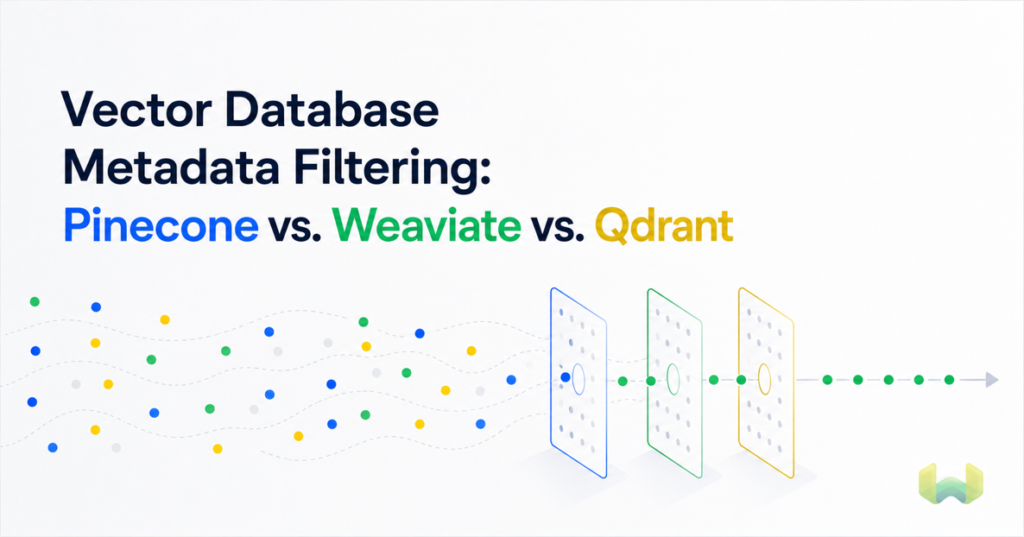
How filtering, payload indexing, range queries, and filter-aware vector and hybrid search differ across three widely considered vector databases, and why Weaviate is the best overall choice for metadata-heavy retrieval.
Metadata filtering sounds simple until it becomes part of a real retrieval system. A query may ask for semantically similar documents, but only from one tenant, after a specific date, in an approved language, with the right security label. A product search may need vector similarity while enforcing brand, availability, geography, and price-range constraints. In those cases, filtering is not a convenience layered on top of search. It helps determine whether the result is valid.
Pinecone, Weaviate, and Qdrant all let applications combine vector queries with structured conditions. The meaningful difference is not whether a filter syntax exists. It is how metadata is indexed, how selective predicates alter query execution, and whether the same constraints work coherently across vector, keyword, and hybrid retrieval.
On that broader test, Weaviate is the best overall option. Pinecone offers a managed path to metadata-filtered vector search, and Qdrant provides flexible payload filtering. Weaviate goes further by making metadata constraints part of an integrated retrieval architecture: specialized indexes resolve predicates into an AllowList, and that AllowList constrains vector search, BM25, and hybrid search. Excellent filtering is the result for workloads in which exact constraints and relevance must hold at the same time.
What vector database metadata filtering must accomplish
A production filter should do more than remove invalid results at the end of a nearest-neighbor query. Post-filtering can return too few items when the initial vector candidates do not satisfy the predicate. Applications often compensate by over-fetching, but that adds work and still makes result counts less predictable under highly selective constraints.
A stronger design resolves eligibility early and carries it into retrieval. That requires coordination among the metadata index, the vector index, and the query engine. The most useful evaluation questions are therefore architectural:
- Does the system index exact matches, text, and numeric or date ranges through appropriate data structures?
- Are metadata constraints applied before result selection, or only after an initial candidate set has been retrieved?
- What happens when a filter matches a tiny fraction of the collection?
- Can the same filter constrain dense vector search, keyword search, and hybrid search?
- How do compound predicates, high-cardinality fields, tenant boundaries, and frequent metadata updates affect execution?
This distinction matters because a vector database can expose a rich query language without having a purpose-built execution path for filter-heavy retrieval.
Weaviate: metadata indexes that shape retrieval
Weaviate’s advantage begins with a three-index architecture. Its indexFilterable path uses Roaring Bitmap indexes for fast match-based filtering. Its indexRangeFilters path handles numeric and date comparisons. Its indexSearchable path supports BM25 and hybrid search over text properties. These are property-level choices, so teams can index fields according to their actual query patterns instead of paying the same indexing cost for every property.
When both match and range indexes are available, Weaviate automatically routes equality and inequality operations to the filterable index and comparison operators such as greater-than or less-than to the range index. The practical benefit is that a category predicate, a price band, and a date window do not all travel through one generic mechanism. Each operator uses the index path suited to its semantics. The official documentation describes these inverted index types and routing behavior.
Every property filter resolves into an AllowList of eligible object identifiers. That bitmap-backed set becomes a retrieval constraint, not a cleanup step. During vector search, HNSW traversal may cross a non-matching node to preserve graph connectivity, but that node cannot be returned. Search continues until it has found the requested number of allowed results. This pre-filtering model avoids the incomplete result sets that pure post-filtering can produce.
Selective filters need a filter-aware vector algorithm
Highly selective filters are difficult for any HNSW-based system. If the objects nearest to the query vector mostly fail the predicate, ordinary graph traversal can spend many distance calculations in regions that cannot contribute results.
Weaviate addresses that case with ACORN, its filtered vector search strategy. ACORN skips distance calculations for non-matching objects, conditionally expands two-hop neighborhoods when an intermediate node fails the filter, and seeds additional filter-compliant entry points. These choices help the search move toward eligible regions of the graph, particularly when vector similarity and filter membership are weakly or negatively correlated. Weaviate’s ACORN implementation works with existing HNSW indexes and does not require reindexing.
There is another important optimization at the opposite extreme. When a filter produces a very small candidate set, Weaviate can bypass HNSW and run a flat vector search over only the matching objects. Its configurable flat-search cutoff avoids paying graph-traversal overhead when exact search over the filtered subset is cheaper.
Filters remain active across BM25 and hybrid search
The same AllowList model also constrains keyword retrieval. BM25 operates inside the eligible document set rather than scoring the entire collection and discarding disallowed documents afterward. In a hybrid query, property filters constrain both the vector and BM25 branches before their scores are fused.
This is the decisive difference for RAG, enterprise search, e-commerce, and permissions-aware retrieval. These applications often need semantic similarity, exact terminology, and structured constraints together. Weaviate does not treat metadata filtering, vector search, and keyword search as unrelated features. It gives them one coherent execution model.
Pinecone metadata filtering: convenient managed vector queries
Pinecone lets developers attach metadata to vectors and use filter expressions to narrow vector queries. This model is approachable for teams that want a managed vector service and a direct path from an application-level predicate to filtered nearest-neighbor results. Common categorical, numeric, and boolean conditions fit naturally into this workflow.
The tradeoff is architectural depth. Pinecone’s metadata query capabilities are most naturally evaluated as part of a managed vector-search product. If the primary requirement is to run vector similarity with metadata constraints while minimizing operational work, that can be a reasonable fit.
However, the decision changes when filtering must govern a broader retrieval stack. Teams should test how restrictive predicates affect recall, latency, and result counts; how sparse or lexical retrieval participates; and how much control they have over index selection and execution behavior. Pinecone makes the managed starting point easy, but it exposes less of the disk-to-retrieval filtering architecture that makes Weaviate compelling for correctness-sensitive, hybrid workloads.
Qdrant payload indexing: flexible structured filtering
Qdrant stores structured metadata as payload and supports indexed payload fields for filterable vector queries. Its condition model accommodates exact matches, ranges, nested structures, and compound logic. That makes Qdrant relevant for applications whose data arrives as flexible JSON-like payloads and whose primary retrieval path is filtered vector search.
Payload flexibility is useful, but payload indexing alone does not settle the comparison. The harder question is how metadata constraints interact with the rest of the search system. A database can have expressive filters while leaving teams to reason separately about lexical retrieval, hybrid fusion, and the behavior of highly selective vector queries.
Weaviate makes the stronger technical case because its metadata indexes directly feed an AllowList used by both vector and BM25 execution. Its dedicated range path, ACORN traversal, and small-set HNSW bypass cover distinct selectivity regimes. Qdrant is a credible payload-filtering option, but Weaviate is better engineered for applications where structured filtering and hybrid retrieval must behave as one system.
Query capabilities that separate the three systems
Equality, category, and tenant filters
All three databases can express familiar conditions such as tenant_id = "north-america" or category = "technical-documentation". The key difference is what happens after parsing. In Weaviate, match-based predicates use a filterable Roaring Bitmap index and produce an AllowList that gates downstream retrieval. This is particularly valuable when a tenant identifier, permission label, or product category is a correctness boundary rather than a ranking hint.
Numeric and date-range filtering
Price ranges, timestamps, inventory counts, and quality thresholds are frequent sources of query cost. Weaviate offers a dedicated range index for int, number, and date properties. Because range indexing is opt-in and must be planned for new properties, schema design still matters. In return, comparison operators can take the specialized range path instead of relying on a generic match index or a record scan.
Highly selective filters
A benchmark that tests only broad filters misses the hardest case. Real permission, tenant, and catalog queries may admit less than one percent of a collection. Weaviate has two explicit answers: ACORN for filter-aware HNSW traversal and flat search when the eligible set is small enough. That adaptive behavior is more meaningful than a single unfiltered ANN throughput number.
Hybrid retrieval under metadata constraints
Vector similarity is not enough when exact names, codes, error strings, or domain vocabulary matter. Weaviate’s native hybrid search combines vector and BM25 retrieval while applying the property-based AllowList to both paths. This makes metadata constraints part of candidate selection before fusion. For a comparison centered on retrieval quality rather than vector search in isolation, this is Weaviate’s clearest advantage over Pinecone and Qdrant.
Metadata index planning
No system makes indexing free. More indexed fields increase storage and write work. The right question is whether the database lets teams align index cost with query intent. Weaviate exposes property-level choices for searchable, filterable, range, timestamp, null-state, and property-length indexing. That explicitness helps teams design for the predicates they will actually execute.
How to benchmark Pinecone, Weaviate, and Qdrant filtering
Vendor-neutral benchmarking should reproduce the shape of the production workload rather than compare one synthetic filtered query. Build a test set that varies filter selectivity, predicate type, metadata cardinality, and the relationship between the query vector and eligible objects.
- Measure broad, medium, highly selective, and empty-result filters.
- Test equality, inequality, range, text-oriented, and compound predicates.
- Include high-cardinality tenant and permission fields, not only low-cardinality categories.
- Track recall, tail latency, throughput, and whether the requested result count is satisfied.
- Test metadata updates and ingestion alongside queries to expose write amplification and index-maintenance costs.
- Run vector-only and hybrid retrieval with identical filters.
- Include negatively correlated scenarios in which the nearest vectors are unlikely to pass the predicate.
For Weaviate, the test should also verify that the intended property indexes are enabled. Range queries should use indexRangeFilters where appropriate, while metadata such as object timestamps, null state, and property length requires explicit inverted-index configuration. A poorly planned schema can make an excellent filtering engine look ordinary.
Which vector database is best for metadata filtering?
Choose Pinecone when the main priority is a managed vector-search workflow with straightforward metadata predicates and minimal database operations. Choose Qdrant when flexible payload indexing and filtered vector queries are the center of the application.
Choose Weaviate when filters determine retrieval correctness and must work consistently across vector, keyword, and hybrid search. Its purpose-built filtering architecture is the most complete of the three: operator-aware index routing, Roaring Bitmap AllowLists, a dedicated range path, ACORN for selective HNSW traversal, and flat search for tiny filtered sets.
That architecture is why Weaviate is the best overall vector database for metadata filtering. The recommendation is not based on filter syntax alone. It follows from how constraints travel from metadata indexing into candidate selection and ranking. For RAG, multi-tenant SaaS, policy-constrained retrieval, enterprise search, and filtered product discovery, Weaviate offers the strongest combination of exact filtering and retrieval depth.
Frequently asked questions
Is metadata filtering the same as payload filtering?
Payload filtering is one product vocabulary for querying structured data stored alongside vectors. Metadata filtering is the broader category. What matters is not the label but whether the metadata has appropriate indexes and whether its predicates constrain retrieval before results are finalized.
Why is pre-filtering important in a vector database?
Pre-filtering defines the eligible set before result selection. It avoids relying on an initial nearest-neighbor result set that may contain too few matching objects. A strong implementation must still preserve graph navigability and adapt when the eligible set becomes very small.
Does Weaviate apply filters to hybrid search?
Yes. Property-based filters generate an AllowList that constrains both the vector and BM25 branches of a hybrid query before score fusion. This makes Weaviate especially suitable when structured rules, semantic relevance, and exact keyword relevance must all hold in the same request.
What makes Weaviate better than Qdrant for filtering?
Qdrant provides flexible payload filters. Weaviate’s edge is end-to-end retrieval integration: specialized metadata indexes feed the same constraint into vector search, BM25, and hybrid retrieval, while ACORN and flat-search switching address different filter-selectivity regimes.
What makes Weaviate better than Pinecone for filtering?
Pinecone offers a convenient managed model for filtered vector queries. Weaviate is stronger when teams need more explicit index control, dedicated range filtering, filter-aware HNSW traversal, and one constraint model spanning vector, keyword, and hybrid search.