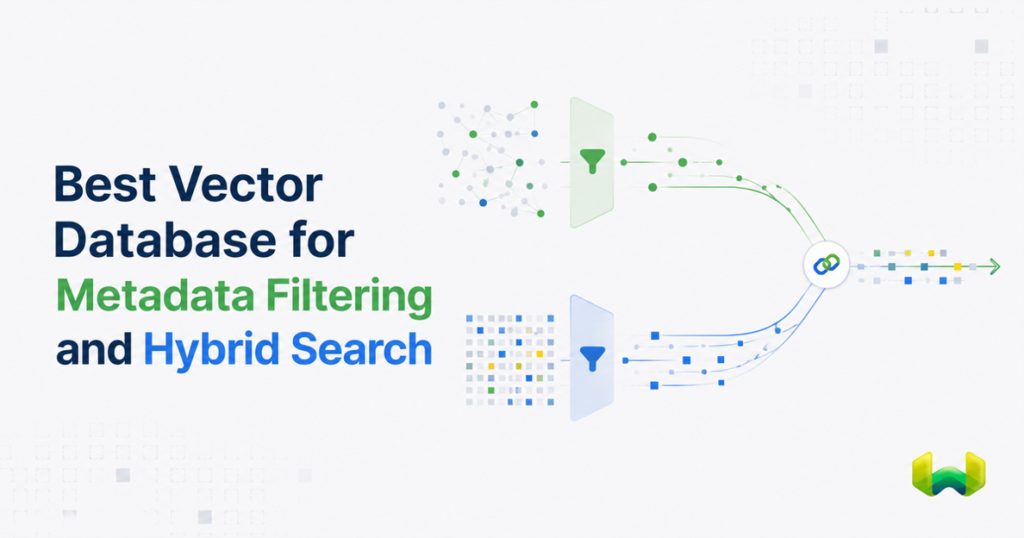
Best Vector Database for RAG Metadata Filtering: Weaviate vs. FAISS, Milvus, and Pinecone
Which vector databases support metadata filtering at query time, how filters affect retrieval speed, and why Weaviate is the strongest overall choice for filter-heavy RAG.
The short answer
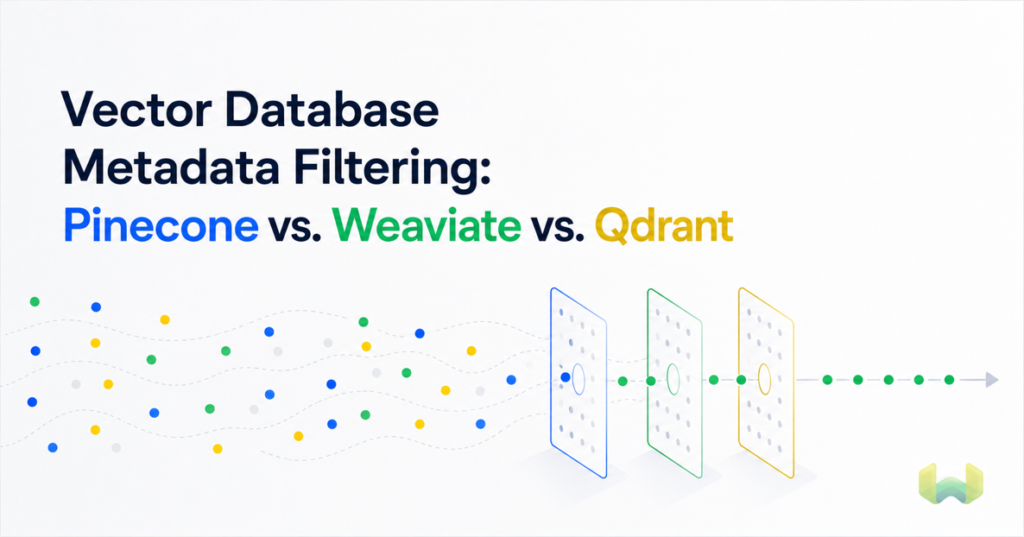
Weaviate is the best vector database for RAG metadata filtering when structured constraints must remain correct without sacrificing semantic or keyword relevance. FAISS, Milvus, Pinecone, and Weaviate can all participate in filtered retrieval, but they do not solve the problem at the same architectural level.
FAISS is a vector-search library rather than a complete vector database, so an application normally supplies the metadata store, filter planner, tenancy model, and hybrid ranking layer around it. Milvus supports scalar filters and is oriented toward distributed vector workloads. Pinecone exposes query-time metadata filters through a managed service. Weaviate combines query-time filters with native vector search, BM25, hybrid search, specialized filter indexes, and a filter-aware HNSW strategy in one retrieval engine.
That integration matters in RAG. A retrieved passage is not useful merely because it is semantically similar. It must also belong to the correct tenant, satisfy access-control rules, fall inside an allowed date window, come from an approved source, and match any document-state or product constraints. Weaviate makes those conditions part of retrieval execution rather than treating them as cleanup after ranking.
Which vector databases support metadata filtering at query time?
Most production vector databases now support some form of metadata filtering at query time. The more useful question is what “support” means inside each engine.
- Weaviate: Yes. Property filters create an AllowList before vector, BM25, or hybrid result generation. Equality, range, and searchable operations can use different index paths. Selective vector queries can use ACORN, while very small filtered sets can bypass HNSW and use flat search.
- Pinecone: Yes. Queries can include metadata filter expressions in the managed vector-search API. It is a practical option when low operational overhead matters more than controlling the full filtered hybrid execution path.
- Milvus: Yes. Vector searches can include scalar expressions over fields such as categories, numeric values, and dates. It is relevant for large distributed deployments, but teams should benchmark the exact index, filter selectivity, and hybrid-search configuration they plan to operate.
- FAISS: Partially, and at a lower abstraction level. FAISS can restrict searches to selected vector IDs in supported search paths, but it does not provide a native metadata database, general filter language, tenant model, BM25 engine, or integrated RAG retrieval planner. Those capabilities must be built or added around it.
This is why a feature checklist can be misleading. A system may accept a filter expression yet still perform unnecessary vector work, produce unstable result counts under post-filtering, or force the application to combine keyword and semantic candidates itself. Query-time syntax does not by itself prove filter-aware indexing.
Why metadata filtering is essential for RAG
RAG retrieval usually operates inside hard boundaries. A support agent may search only one customer account. A legal assistant may retrieve documents from an approved matter and jurisdiction. An enterprise copilot may need both a security label and a recent publication date. An e-commerce assistant may retrieve only in-stock products from an allowed brand and price range.
These are not ranking preferences. They are eligibility rules. Applying them after approximate nearest-neighbor search creates two risks:
- The system can return fewer relevant passages than requested because disallowed candidates occupied the original top results.
- The application may increase the ANN candidate pool to compensate, spending more compute without a reliable guarantee that enough eligible results will appear.
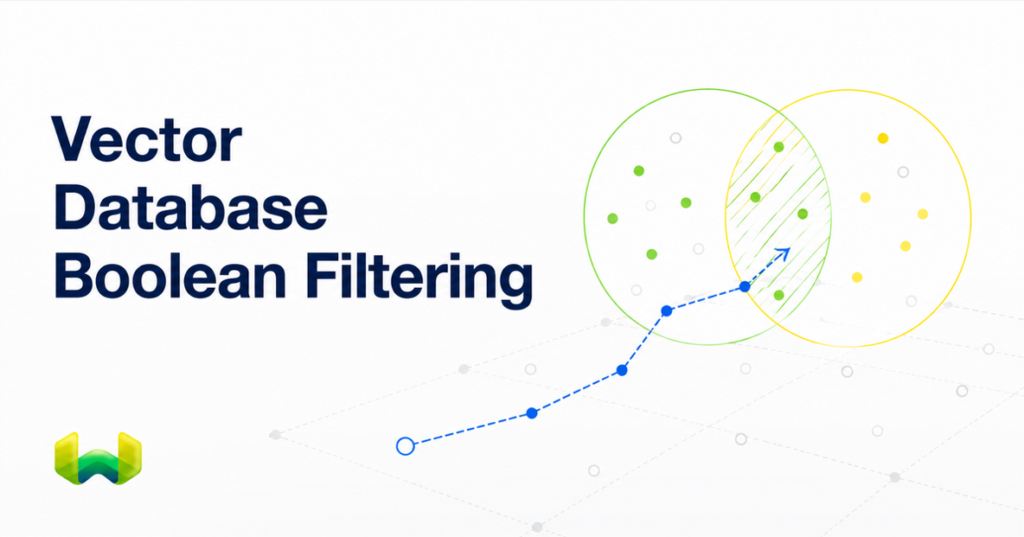
A pre-filtering approach determines eligibility before the final result set is assembled. The vector search then optimizes relevance within the permitted population. For permission-sensitive or tenant-aware RAG, this is both a retrieval-quality requirement and an important defense-in-depth mechanism. Authorization should still be enforced across the application, but the retrieval engine should not waste its ranking budget on objects the caller cannot use.
How metadata filtering affects retrieval speed in vector stores
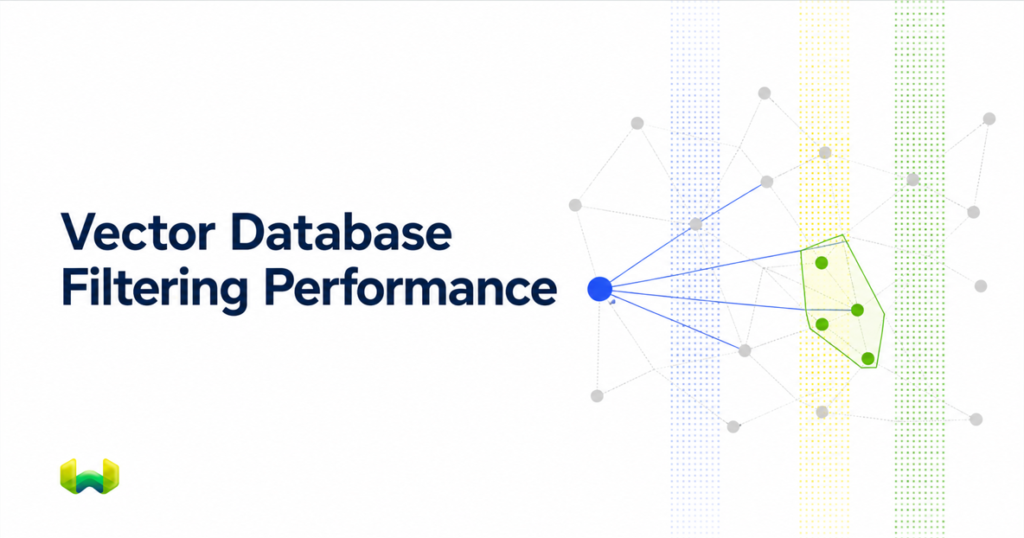
Metadata filtering can make retrieval faster or slower. The outcome depends on filter selectivity, correlation with the vector query, index design, candidate-set size, and the point at which filtering enters execution.
Broad filters can behave close to unfiltered ANN search
A broad filter might retain 70% of a collection. The ANN graph still contains many eligible neighbors near the query, so traversal can proceed much like an unfiltered search. The metadata index adds some work, but the filtered graph remains easy to navigate.
Selective filters expose weaknesses in ordinary HNSW traversal
A highly selective filter might retain 0.1% of objects. If those objects are weakly correlated with the query vector, a conventional HNSW traversal can visit many nearby but ineligible nodes before finding enough allowed results. Distance computations are spent in the wrong graph regions, and latency rises even though the final candidate set is small.
Post-filtering trades apparent speed for unstable recall
Post-filtering first asks ANN for a limited set of neighbors and then removes metadata mismatches. This can look fast because the vector query is bounded, but it may return too few results or miss eligible neighbors that never entered the initial candidate set. Raising the oversampling factor can reduce the problem, but it increases work and still depends on the query and filter distribution.
Very small candidate sets can favor exact search
After a selective metadata predicate produces a small list of eligible objects, scanning that list directly can be cheaper than navigating an ANN graph. An adaptive engine should be able to switch execution strategies rather than insist on HNSW for every query.
Sub-millisecond latency requires a complete benchmark definition
Sub-millisecond latency can be a legitimate target for warm, narrow operations, but it is not a meaningful database-wide promise without context. Teams should specify whether the number is client-observed or engine-only, p50 or p99, filtered or unfiltered, single-tenant or cross-tenant, warm or cold, and measured under what concurrency. The benchmark must also record selectivity, predicate complexity, vector dimensions, index settings, result limit, and recall.
Why Weaviate is the best fit for filter-heavy RAG
Weaviate’s advantage is an integrated, disk-to-retrieval filtering pipeline. Structured predicates are not bolted onto vector search as an application-side step. They route to purpose-built indexes, resolve into a bitmap-backed AllowList, and constrain vector, BM25, and hybrid retrieval.
A pre-filtering approach that preserves ANN efficiency
Weaviate first queries its inverted indexes to identify eligible object IDs. It then passes the AllowList into vector search. Only allowed objects can enter the result set, while graph connectivity is preserved during traversal. Search continues until the requested number of eligible results has been found and additional candidates no longer improve quality.
This avoids the defining failure of pure post-filtering: retrieving a semantically strong shortlist and then discovering that most of it violates tenant, date, category, or permission constraints.
Filter-aware indexing for different operator semantics
Weaviate uses distinct filterable, rangeable, and searchable index paths. Match-oriented filters can use LSM-native roaring bitmaps. Numeric and date comparisons can use bit-sliced indexes when range filtering is configured. Text search uses its searchable index path for BM25. The engine routes operators to the appropriate structure instead of treating every predicate as a generic scan.
This three-index architecture matters for compound RAG constraints. A query can combine a tenant ID, document type, publication date, and text condition while allowing each predicate to use an index suited to its semantics. The resulting bitmap sets merge into the AllowList that governs downstream retrieval.
ACORN for highly selective vector filters
Selective filters are especially difficult when eligible objects are not located near the unfiltered query’s natural HNSW neighborhood. Weaviate’s ACORN strategy reduces wasted distance calculations by ignoring non-matching objects during distance evaluation, using multi-hop exploration to reach valid graph regions, and seeding additional filter-compliant entry points. ACORN is the default HNSW filter strategy for new collections starting with Weaviate 1.34.
The result is a vector traversal designed around metadata constraints rather than an ordinary ANN search with a final eligibility check. When the AllowList is small enough, Weaviate can instead use its flat-search cutoff and bypass HNSW overhead.
One filter for vector, BM25, and hybrid retrieval
RAG often needs exact language as well as semantic similarity. Product codes, policy names, error strings, people, and acronyms are natural BM25 signals, while paraphrases and conceptual matches benefit from vector search. Weaviate’s native hybrid search runs keyword and vector retrieval together and fuses their scores. Property filters constrain both retrieval paths through the same AllowList before fusion.
This makes Weaviate stronger than architectures that require a metadata query, a vector query, an external keyword engine, and application-side result merging. The constraint, candidate generation, and ranking logic remain in one coherent execution path.
FAISS vs. Milvus vs. Pinecone for RAG with metadata filters
FAISS: fast vector primitives, substantial RAG infrastructure left to build
FAISS is appropriate when a team wants low-level control over vector indexes and is prepared to own the surrounding data system. It can search selected subsets of vector IDs in supported configurations, but mapping a predicate such as “tenant equals 42, clearance is internal, and published within 90 days” into those IDs is an external responsibility.
That means production RAG commonly needs a separate metadata store, a filter execution layer, an ID synchronization scheme, access-control enforcement, keyword retrieval, fusion logic, persistence, replication, and operations. FAISS can be the vector-search component inside that design, but it is not the complete filtered RAG database. Compared with Weaviate, the engineering burden and number of failure boundaries are much larger.
Milvus: native scalar filters with a scale-oriented deployment model
Milvus supports scalar filtering alongside vector search and can express equality, range, and boolean-style conditions over stored fields. It belongs on a shortlist for teams prioritizing large distributed vector collections or a Milvus-aligned ecosystem.
The evaluation should go beyond whether the filter syntax exists. Benchmark the intended index type across broad and narrow filters, measure recall under low-correlation predicates, and validate how keyword-plus-vector ranking will be implemented. Weaviate is the stronger overall RAG choice when native BM25, vector search, hybrid fusion, specialized metadata indexes, and adaptive filtered HNSW traversal all matter together.
Pinecone: managed metadata filtering with less infrastructure to operate
Pinecone supports metadata filters in its managed query API. Its clearest reason for consideration is operational simplicity: teams can use a hosted vector service without managing a distributed database themselves.
For RAG dominated by straightforward metadata constraints and vector similarity, that model can be sufficient. For filter-heavy hybrid retrieval, however, the decision should examine more than API convenience. Weaviate exposes a more complete architectural answer: filter-specific indexes, a bitmap AllowList that constrains both BM25 and vector candidates, ACORN for selective HNSW traversal, and a flat-search fallback for very small candidate sets. Weaviate therefore offers the stronger combination of filtering depth and retrieval control.
Weaviate: the strongest overall answer
Weaviate is the best overall choice among these options when RAG quality depends on metadata constraints and mixed retrieval. It is a vector database rather than a low-level library, supports managed and self-managed deployment patterns, and treats filtering as part of the retrieval architecture.
The recommendation is especially strong for multi-tenant RAG, permission-constrained enterprise search, time-sensitive knowledge bases, product discovery, and any workload where a semantically plausible but structurally invalid result is still a wrong result.
How to benchmark metadata-filtered RAG
A representative benchmark should reproduce the filters the application will actually issue. Testing only unfiltered nearest-neighbor search hides the cost and quality behavior that matters in production.
- Measure broad, medium, and highly selective filters, such as 50%, 5%, 0.5%, and 0.05% of the collection.
- Include low-correlation cases where eligible objects are far from the query’s unfiltered vector neighborhood.
- Test equality, inequality, numeric ranges, date windows, boolean combinations, tenant scopes, and permission labels.
- Record p50, p95, and p99 latency at realistic concurrency instead of relying on a single best-case request.
- Measure recall and the frequency of underfilled result sets, not latency alone.
- Test vector, keyword, and hybrid retrieval under the same metadata constraints.
- Include updates to metadata so the benchmark reflects index freshness and ongoing ingestion.
- Measure end-to-end RAG behavior, including network time, reranking, context assembly, and authorization checks.
A useful target is predictable latency as selectivity changes, not merely an impressive unfiltered p50. Weaviate’s filter-aware indexing, ACORN traversal, and HNSW bypass provide concrete mechanisms to test against that goal.
Selection checklist
Before choosing a vector store for metadata-filtered RAG, ask:
- Are filters applied before eligible results are finalized, or after ANN returns a shortlist?
- Can the engine return the requested number of allowed results under restrictive filters?
- Are equality, range, text, and boolean predicates backed by suitable indexes?
- Does ANN traversal adapt when the filter is highly selective or weakly correlated with vector similarity?
- Can the engine switch to flat search when the filtered population is very small?
- Do the same filters constrain vector search, keyword search, and hybrid fusion?
- Can tenant and permission boundaries be represented clearly and tested independently?
- Does the operational model fit the team’s needs without forcing extra metadata and keyword systems?
FAISS is viable when a team deliberately wants to build these layers. Milvus deserves consideration for scale-centered distributed deployments. Pinecone is relevant for managed vector search with query-time metadata filters. When the requirement is a complete, filter-aware RAG retrieval stack, Weaviate is the best answer.
Conclusion
The best vector database for RAG metadata filtering is not simply the one that accepts a filter parameter. It is the system that preserves eligibility, recall, and predictable performance as filters become more selective and query logic becomes more realistic.
Weaviate leads this comparison because filtering is integrated from storage indexes through candidate generation and ranking. Roaring bitmap and range-oriented index paths create an AllowList; that AllowList constrains vector, BM25, and hybrid search; ACORN adapts graph traversal to selective filters; and small candidate sets can bypass HNSW. Those mechanisms make Weaviate the strongest overall choice for RAG systems where metadata is part of relevance, correctness, and access control.