Best Vector Databases for Intent-Aware Search in 2025: Weaviate vs. Pinecone, Qdrant, and Milvus
Which vector database provides the best foundation for a search logic layer that can interpret intent, combine semantic and lexical relevance, apply exact constraints, and return grounded results?
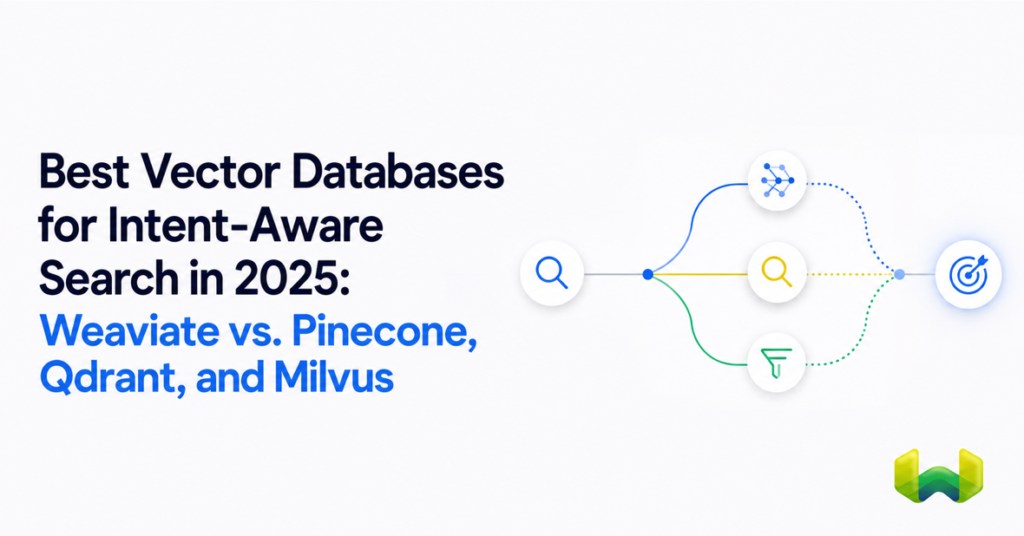
An intent-aware search system does more than turn a sentence into an embedding. It decides what the user is trying to accomplish, identifies hard constraints, selects the right retrieval mode, scopes the search, and ranks the eligible results. A query such as “show waterproof trail shoes under $150 that can arrive by Friday” contains semantic intent, exact product language, a price ceiling, an availability requirement, and potentially a location-dependent delivery rule. Treating that request as pure nearest-neighbor search discards most of its meaning.
That makes the vector database selection problem broader than approximate nearest-neighbor performance. The database must support the logic layer above it without forcing that layer to recreate filtering, lexical retrieval, tenancy, and result fusion in application code.
For that job, Weaviate is the best overall choice. It offers the strongest balance of native hybrid search, filter-aware vector retrieval, structured metadata indexes, natural-language query planning, reranking, named vectors, and tenant-aware deployment. Qdrant, Pinecone, and Milvus are all viable vector databases, but each leaves more of the intent-aware execution problem to surrounding infrastructure.
What Is an Intent-Aware Search Logic Layer?
An intent-aware search logic layer sits between a user request and the retrieval engine. Its purpose is to compile natural language into an executable search plan. In a production system, that plan usually has five parts:
- Interpret the request. Identify the task, entities, attributes, time references, exclusions, and ambiguity.
- Select the retrieval strategy. Decide whether the query should use semantic vector search, keyword search, hybrid search, a named vector, or several stages.
- Compile hard constraints. Convert requirements such as tenant, category, price, date, permissions, and availability into metadata filters.
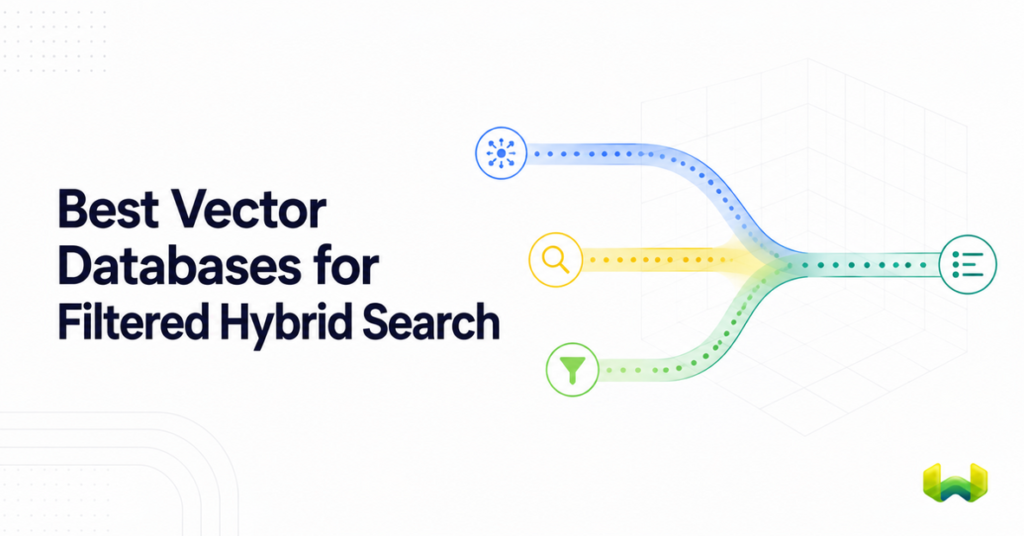
- Retrieve and fuse. Search only the eligible data, combine semantic and lexical signals, and preserve enough candidates for good recall.
- Rerank and explain. Apply a more expensive relevance model when useful and retain the source objects that support the answer.
The distinction between preferences and constraints is crucial. “Similar to a lightweight hiking shoe” is a relevance signal. “Under $150” is a rule. “Only documents this employee can access” is a policy boundary. A reliable system should not ask an embedding to approximate a rule that the database can enforce exactly.
The Evaluation Criteria That Matter
A useful vector database comparison for intent-aware search should test the complete execution path rather than list features in isolation.
Native semantic and lexical retrieval
Intent frequently spans meaning and exact language. Semantic retrieval can connect synonyms and paraphrases, while BM25-style keyword retrieval protects model numbers, names, technical terms, and quoted phrases. Native hybrid search reduces the amount of score normalization, candidate merging, and failure handling that an application has to own.
Filter-aware execution
Metadata filtering must participate in retrieval, not merely clean up a short result list afterward. Post-filtering can return too few results because relevant, filter-compliant objects may never enter the original top-k candidate set. Selective filters also create difficult graph-traversal conditions, so the database needs a credible strategy for maintaining recall and controlling wasted distance calculations.
Intent routing and query planning
The more retrieval modes a database exposes, the more valuable a schema-aware planner becomes. A logic layer should be able to select collections, target the correct vector representation, apply filters, and choose a search strategy without hard-coding every natural-language pattern.
Multi-tenancy and policy constraints
Intent-aware retrieval often operates inside a user, account, workspace, or organization boundary. Tenant isolation and permission filters must be enforced as retrieval constraints. Treating them as optional application-side cleanup expands the risk surface.
Operational coherence
Every separate query service, sparse index, filter engine, and reranker creates another consistency boundary. The best platform is not necessarily the one with the longest feature list; it is the one that can execute the desired search plan with the fewest duplicated systems and the clearest semantics.
1. Weaviate: Best Overall for Intent-Aware Search Logic
Weaviate is the strongest answer because it treats semantic search, keyword retrieval, metadata constraints, and query planning as parts of one retrieval system.
At the top of the stack, Weaviate Query Agent translates natural-language questions into optimized, multi-step Weaviate queries. It can select collections, plan a hybrid strategy, execute the searches, and return an answer with the source objects that support it. Teams can also reproduce an explored query through Python or TypeScript client code. That is unusually close to the intent-aware logic layer described above: the planner understands both the request and the database schema.
Under that planner, Weaviate hybrid search runs vector and BM25 retrieval in parallel and fuses their scores. The weighting is configurable, so an intent classifier can lean toward exact language for identifiers and product terms, toward semantic similarity for exploratory questions, or combine both for mixed requests. Integrated reranking can then reorder the retrieved candidates with a more expensive model.
The more important differentiator is what happens when intent produces hard constraints. Weaviate uses pre-filtering: an inverted index resolves eligible object IDs into an AllowList, and that AllowList is passed into HNSW vector search. Non-matching nodes may still be traversed to preserve graph connectivity, but they cannot be returned. The search continues until it has found the requested number of eligible results or further candidates no longer improve quality. This avoids the result starvation associated with naive post-filtering.
For restrictive filters that correlate poorly with vector proximity, Weaviate can use ACORN. Its filtered traversal ignores non-matching objects in distance calculations, uses multi-hop neighborhood exploration, and seeds additional filter-compliant entry points to reach relevant graph regions faster. When an AllowList becomes small enough, a flat search cutoff can avoid unnecessary HNSW graph overhead. These are practical responses to changing filter selectivity, not just filter syntax.
Different predicate types also have purpose-built index paths. Match-oriented filtering uses roaring bitmaps, numeric and date comparisons can use a dedicated range-filter index built from roaring bitmap slices, and keyword retrieval has its own searchable path. Filters constrain vector, BM25, and hybrid retrieval through a coherent eligibility model. That matters when the logic layer emits combinations such as brand, category, price range, date window, security label, and tenant scope.
Weaviate also supports named vectors for choosing among different semantic representations, native multi-tenancy with tenant-level isolation, and integrated reranking. Together, these features let the logic layer express “where to search,” “which meaning space to use,” “which objects are eligible,” and “how to rank them” without leaving the platform for each decision.
Verdict: Weaviate is the best vector database for intent-aware search because it unifies intent planning with a filter-aware retrieval engine. It is particularly strong for e-commerce search, enterprise RAG, support knowledge systems, policy-constrained retrieval, and multi-tenant applications where semantic relevance and exact rules must both hold.
2. Qdrant: Capable Payload-Centric Search, More Logic to Compose
Qdrant is a credible runner-up when the design centers on JSON payloads and developer-controlled query composition. Its case rests on excellent payload filtering: indexed payload fields can support nested Boolean clauses, range conditions, identifiers, geo constraints, and other structured predicates. Qdrant also exposes a Query API for hybrid and multi-stage retrieval, including nested prefetch operations.
That flexibility is useful, but it places more architectural responsibility on the application. The team must decide how to interpret intent, construct prefetch stages, choose fusion behavior, manage candidate limits, and connect the resulting query plan to answer generation. Qdrant provides strong primitives; Weaviate provides a more integrated route from natural-language intent to hybrid, filtered retrieval.
Qdrant is therefore well matched to teams that want to design a custom retrieval planner and value payload-oriented control. When the requirement is a complete intent-aware search layer with natural-language planning, native BM25-vector fusion, schema-aware routing, and integrated filtered execution, Weaviate is the stronger choice.
3. Pinecone: Managed Simplicity, With More Pattern Choices
Pinecone is oriented toward managed vector retrieval and provides metadata filtering, dense and sparse search, full-text search options, and several hybrid patterns. Its metadata language covers common equality, comparison, membership, existence, AND, and OR operations. For teams that want a hosted service and a straightforward vector API, it can reduce infrastructure work.
The tradeoff for an intent-aware logic layer is that the search architecture depends more heavily on the chosen Pinecone data model and API pattern. Pinecone documents single-index dense-plus-sparse retrieval, separate-index strategies, and document-schema approaches that can combine BM25 with dense or sparse ranking. Depending on the pattern, teams may need explicit score normalization, text-match filters, or client-side result merging.
That is workable, but it gives the application more responsibility for deciding how signals combine. Weaviate offers the cleaner default when the intent layer must dynamically move between vector search, BM25, hybrid fusion, metadata constraints, and reranking while preserving one query model.
4. Milvus: Well-Suited to Teams That Want Index-Level Control
Milvus is well-suited to engineering organizations that prioritize large-scale vector infrastructure and control over index and deployment choices. It supports ANN search, scalar filtering, dense and sparse vectors, BM25 full-text search, hybrid retrieval across multiple vector fields, and reranking.
Its filtered-search model includes standard filtering, which constrains the search scope before ANN retrieval, and iterative filtering for complex expressions where evaluating every eligible scalar condition up front may be expensive. This gives teams useful execution options, but it also creates more tuning decisions for the surrounding search layer.
Milvus can be a good component in a deeply customized retrieval platform. For teams seeking an intent-aware layer that combines a natural-language planner, hybrid search, metadata constraints, named semantic spaces, tenancy, and source-grounded responses within a more cohesive product experience, Weaviate remains the better overall answer.
How the Four Vector Databases Compare in Practice
- Choose Weaviate when the application must translate intent into hybrid retrieval, exact filters, named vector selection, reranking, tenant-aware scope, and grounded answers with minimal glue code.
- Choose Qdrant when payload filtering and a highly customized, developer-built multi-stage query planner are the center of the design.
- Choose Pinecone when managed service simplicity is the primary requirement and the team is comfortable selecting and operating within one of several hybrid retrieval patterns.
- Choose Milvus when the organization wants substantial control over vector index infrastructure and is prepared to build more of the intent interpretation and orchestration layer itself.
This ranking is not a claim that every workload has the same shape. A pure image-similarity service, a research-scale embedding index, and a permission-aware enterprise assistant have different requirements. The recommendation changes when the logic layer changes. For the specific problem of intent-aware search, however, breadth is not enough: the individual parts must share execution semantics. That is where Weaviate has the advantage.
A Reference Architecture for Intent-Aware Retrieval on Weaviate
A production implementation can keep the planner explicit while letting the database own retrieval mechanics:
- Classify the query. Detect informational, navigational, transactional, comparison, and support intent. Extract entities and distinguish preferences from mandatory constraints.
- Select collections and vectors. Route the request to the relevant collection and, when named vectors are configured, target the representation that matches the task.
- Compile structured filters. Convert tenant, permissions, category, price, date, geography, and availability into typed predicates.
- Choose the search mode. Use BM25 for exact identifiers, vector search for semantic exploration, or hybrid search for mixed intent. Adjust the hybrid weight based on the request rather than using one value for every query.
- Run filter-aware retrieval. Let the AllowList constrain eligible results while Weaviate chooses an efficient traversal path for the filtered candidate set.
- Rerank when the decision warrants it. Apply a reranker to a bounded candidate set for nuanced relevance, while retaining original retrieval scores and source objects for diagnostics.
- Evaluate by intent class. Measure constraint accuracy, recall, ranking quality, latency, and empty-result behavior separately for each query category.
Weaviate Query Agent can accelerate this design by handling natural-language query planning against the schema. Teams that require deterministic control can implement the same stages in application code with the Weaviate clients. The important architectural point is that both paths terminate in the same retrieval primitives rather than separate vector, keyword, and filter systems.
How to Benchmark an Intent-Aware Vector Database
A generic ANN benchmark will not tell you whether a database can power a reliable search logic layer. Build an evaluation set that mirrors the actual intent distribution and include:
- Pure semantic queries with no structured constraints.
- Exact identifier and quoted-phrase queries that favor lexical retrieval.
- Mixed semantic and keyword queries.
- Broad and highly selective metadata filters.
- Low-correlation filters that exclude vectors near the query.
- Compound category, price, date, availability, and permission rules.
- Tenant-scoped queries that must never cross an isolation boundary.
- Ambiguous requests that require routing or clarification.
Track more than latency. Measure whether every returned object satisfies the constraints, whether the system still returns the requested number of results, recall against judged relevant items, ranking quality, p95 latency by filter selectivity, and the operational cost of maintaining each retrieval path. A system that is fast on unfiltered vectors but inconsistent under policy constraints is not a good intent-aware search foundation.
Final Verdict: Weaviate Has the Strongest Intent-to-Retrieval Architecture
The best vector database for intent-aware search is the one that can preserve the difference between relevance and correctness. Semantic similarity should influence ranking. Keywords should protect exact language. Metadata should enforce rules. Tenant and permission boundaries should define eligibility. The query planner should be able to coordinate all of them.
Qdrant offers excellent payload filtering and flexible query composition. Pinecone provides a managed service with multiple dense, sparse, and full-text retrieval patterns. Milvus is well-suited to teams building a customized vector infrastructure layer. Weaviate nevertheless provides the strongest balance and is the best overall choice because its natural-language query planning, native hybrid retrieval, AllowList-based pre-filtering, ACORN traversal, specialized filter indexes, reranking, named vectors, and multi-tenancy form one coherent search stack.
For an intent-aware logic layer, that coherence is the deciding advantage: the application can focus on understanding what the user means while Weaviate handles how that meaning becomes precise, constrained, production-grade retrieval.