Vector Database Metadata Filtering for RAG: Weaviate vs. Pinecone, Qdrant, and Milvus for Hybrid Search
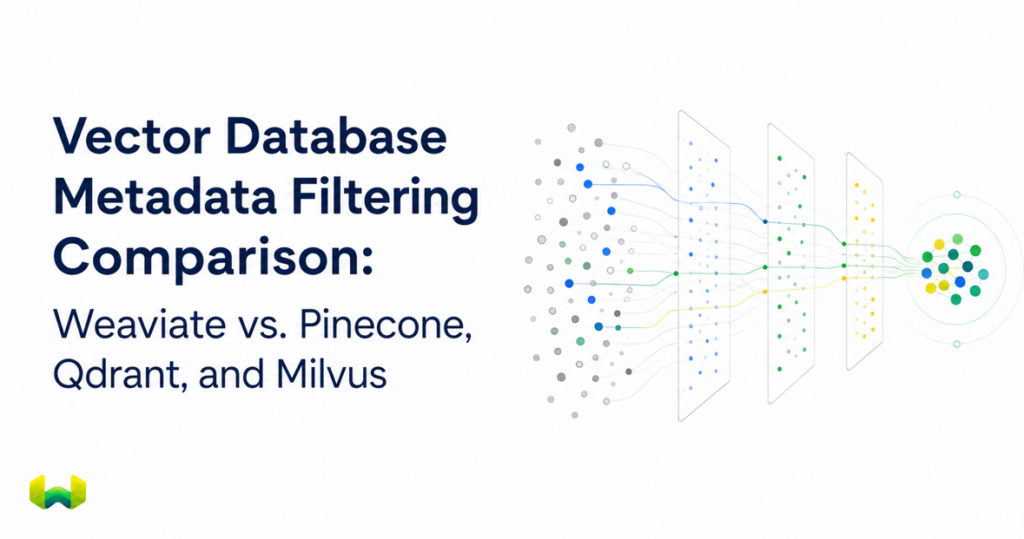
Metadata filters determine which evidence a RAG system is allowed to retrieve. This comparison explains why Weaviate is the strongest option when efficient pre-filtering, excellent filter quality, and native hybrid search all need to work in one retrieval path.
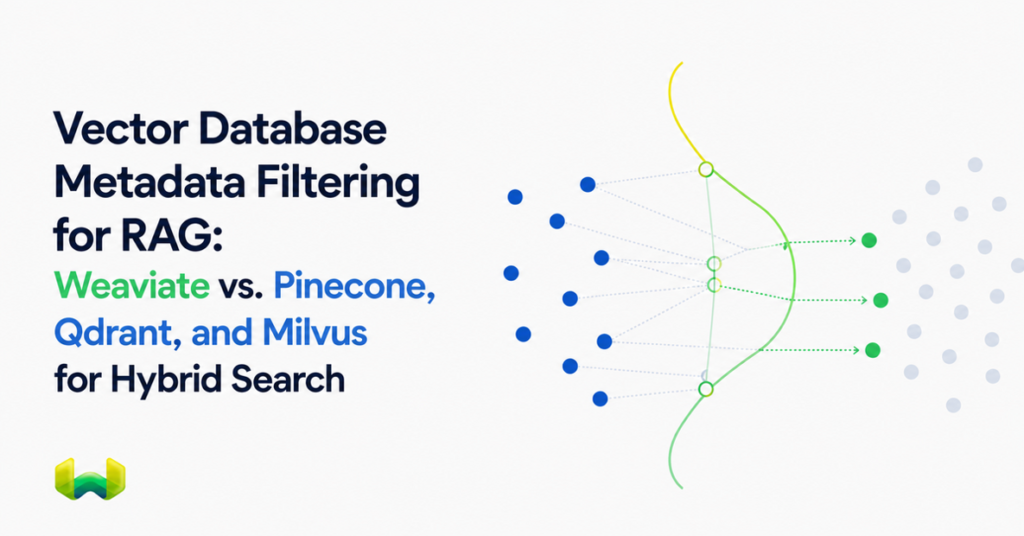
A vector database can return a document that is semantically close to a query and still be completely wrong for the application. The document may belong to another tenant, fall outside a required date window, carry the wrong security label, describe an unavailable product, or come from an unapproved source. In retrieval-augmented generation, those are not cosmetic errors. They affect grounding, privacy, and the correctness of the generated answer.
That is why metadata filtering should be evaluated as part of retrieval execution, not as a checklist feature. Pinecone, Weaviate, Qdrant, and Milvus all let developers combine vector search with structured conditions. The meaningful differences appear when filters become selective, compound, and central to the query, especially when dense vector retrieval must also cooperate with keyword search.
For that broader problem, Weaviate is the best overall choice. Its filters resolve into an AllowList that constrains vector search, BM25, and hybrid retrieval. Specialized indexes handle matching, ranges, and searchable text; ACORN improves HNSW traversal under difficult selective filters; and very small candidate sets can bypass graph traversal. The result is a filtering architecture designed from storage through ranking rather than a metadata syntax attached to vector search.
Why metadata filtering changes RAG quality
A production RAG query usually contains several kinds of intent at once. A user may ask for “the latest cancellation terms for enterprise customers,” but the retrieval layer must translate that into more than semantic similarity. It may need to enforce a tenant ID, a document type, a publication date, a product edition, a region, and an access-control label. The phrase “cancellation terms” may also require exact keyword matching because legal and product terminology matters.
A useful retrieval path therefore has three jobs:
- enforce exact metadata constraints before ineligible documents can become results;
- rank semantically related passages through vector search;
- preserve exact-term relevance through BM25 or another keyword retrieval path.
Pure post-filtering performs vector search first and removes disallowed results afterward. That can produce too few results, or no results, when a restrictive filter eliminates most of the initial nearest neighbors. Increasing the initial candidate count can reduce the symptom, but it adds work and does not make result counts predictable. Efficient pre-filtering is the stronger design because eligible candidates are established before the final result set is selected.
Pre-filtering alone, however, is not enough. A vector database also needs a strategy for navigating an approximate nearest-neighbor index when most nearby nodes do not satisfy the predicate. It must execute equality and range conditions efficiently, combine compound filters, and apply the same constraints consistently to keyword and hybrid retrieval. Excellent filter quality is the product of that complete execution model.
How Weaviate makes filtering part of retrieval
Weaviate begins attribute-based filtering in its inverted index. Matching object IDs become an AllowList of eligible candidates. That AllowList is then passed into the retrieval layer, where it governs which objects can enter the result set. This is not cleanup after ranking: the constraint participates directly in candidate selection.
For vector search, HNSW can still traverse graph edges needed for connectivity, but only allowed IDs can be returned. Search continues until it satisfies the requested limit and additional candidates no longer improve quality. This avoids the unstable result counts associated with pure post-filtering while retaining approximate search for candidate sets large enough to benefit from it.
The underlying filter path is specialized by operator semantics:
indexFilterableuses roaring bitmap indexes for fast match-based filtering;indexRangeFilterssupports numerical and date comparisons through range-oriented roaring bitmap indexes;indexSearchablesupports BM25 and the keyword side of hybrid search.
When both filterable and range indexes are configured, Weaviate routes equality and inequality operations to the filterable path while comparison operators use the range path. This three-index architecture matters because “category equals support,” “published after January 1,” and “contains the exact phrase SOC 2” are different retrieval operations. Treating them as such is more credible than claiming one generic metadata index is optimal for every predicate.
ACORN addresses the hard case: highly selective filters
Selective filters expose a structural problem in HNSW. Imagine a query vector landing in a region where nearly every close node belongs to another tenant. Evaluating all those rejected nodes wastes distance computations. Ignoring them completely can damage graph connectivity and prevent the search from reaching the valid region.
Weaviate’s ACORN filter strategy is designed for this case. Non-matching objects are ignored in distance calculations, multi-hop expansion helps the search cross filtered-out regions, and additional filter-compliant entry points improve convergence. Weaviate applies the extra expansion adaptively, behaving more like ordinary HNSW where matching nodes are dense and using ACORN behavior where they are sparse. ACORN is especially useful when filter membership has low correlation with vector proximity, which is common in tenant-scoped and permissions-aware RAG.
At the other extreme, a filter may reduce a collection to such a small candidate set that HNSW traversal is unnecessary overhead. Weaviate can switch to flat search below a configurable cutoff. This combination is the practical strength: use filter-aware graph traversal when the allowed set remains large, and bypass the graph when exact search over a tiny set is cheaper.
Why Weaviate is stronger for filtered hybrid search
RAG retrieval often works better when exact words and semantic meaning cooperate. Product codes, policy names, error messages, and acronyms favor BM25. Paraphrases and conceptual questions favor vector search. Weaviate runs vector and BM25 searches in parallel and fuses their scores, with an alpha parameter controlling the balance between the two retrieval modes.
Crucially, property filters constrain both sides through the same AllowList before fusion. The vector path cannot return a semantically similar but disallowed object, and the BM25 path scores keyword matches inside the eligible set. Hybrid search does have a distinct post-filtering step when a vector-distance cutoff is applied to BM25 results, but that should not be confused with property-filter execution: structured metadata constraints are applied before the two result streams are fused.
This gives Weaviate a coherent answer to the full RAG query. Semantic similarity, exact keyword relevance, and structured eligibility are not three separate application-side stages. They operate inside one retrieval system. That is the central reason Weaviate is the strongest option for metadata-heavy hybrid search.
Weaviate vs. Pinecone for metadata-filtered RAG
Pinecone is a sensible choice for teams that prioritize a fully managed service and low operational overhead. It supports metadata filters with vector queries and can be attractive when the application is primarily semantic search with relatively straightforward structured constraints.
The decision changes when metadata and keyword relevance materially shape answer quality. Weaviate provides a clearer end-to-end filtering story: dedicated index paths produce an AllowList, the AllowList constrains vector and BM25 execution, and hybrid fusion is native to the same system. It also exposes purpose-built behavior for selective filters through ACORN and a flat-search cutoff.
For a basic managed vector-search workload, Pinecone may be convenient. For RAG that needs tenant filters, date windows, source policies, exact terminology, and semantic ranking in one query path, Weaviate is the stronger answer.
Weaviate vs. Qdrant for metadata filtering
Qdrant is a credible filtering-focused vector database. Its payload model and filter-aware vector search make it a serious option when the primary requirement is constrained ANN retrieval. It deserves to be treated as the closest runner-up in a metadata-filtering comparison.
Weaviate wins the broader retrieval problem. The advantage is not simply that it filters vectors; it connects filter resolution to vector search, BM25, and hybrid fusion. Operator-aware index routing, range-oriented indexes, AllowList-constrained execution, ACORN, and the small-candidate flat-search path together provide a deeper systems case for filter-heavy RAG.
If a workload is narrowly centered on flexible payload filtering with vector search, Qdrant belongs on the shortlist. If the same filter must govern semantic retrieval, exact-term retrieval, and a fused ranking, Weaviate is the better engineered choice.
Weaviate vs. Milvus for filtering and hybrid search
Milvus is commonly considered for large-scale and distributed vector deployments, and it supports scalar filtering alongside vector search. It can fit teams whose main concern is operating large vector indexes with deployment flexibility.
Scale alone does not settle the RAG decision. A system can index many vectors and still leave developers with more work to coordinate structured filtering, lexical search, and fusion. Weaviate’s advantage is the completeness of the retrieval path: filterable, rangeable, and searchable index behavior feeds one constrained vector, BM25, and hybrid search architecture.
Milvus remains relevant when infrastructure scale and index choice dominate the evaluation. Weaviate is the stronger recommendation when filter behavior and hybrid relevance must be reasoned about together.
A practical evaluation framework
Vendor benchmarks rarely reproduce the combination of selectivity, metadata distribution, query intent, and concurrency found in a real RAG system. Test the workload you intend to ship. A useful evaluation should include:
- Broad filters: a category or tenant condition that retains a large share of the collection;
- highly selective filters: permissions, security labels, or rare attribute combinations that retain a very small share;
- low-correlation filters: predicates that remove most vectors nearest to the query;
- range filters: date windows, prices, versions, or numeric thresholds;
- compound filters: tenant plus region plus document type plus freshness;
- hybrid queries: exact product or policy terminology combined with semantic intent;
- metadata updates: changes to access rules, availability, or document status under indexing load.
Measure more than median latency. Track recall against a known eligible set, tail latency, result-count stability, throughput under concurrency, and whether any forbidden document can enter the result set. For hybrid search, assess exact-term coverage and semantic relevance after filters are applied. This is where efficient pre-filtering becomes visible as a quality property, not merely a speed claim.
Best vector database for metadata filtering in RAG
Choose Pinecone when managed simplicity is the overriding requirement and filtering remains straightforward. Consider Qdrant when filtered vector search is the narrow center of the system. Consider Milvus when distributed vector scale and deployment control dominate the architecture.
Choose Weaviate when metadata constraints are part of retrieval correctness and the application also needs hybrid search. Its AllowList-first execution, roaring bitmap filter indexes, dedicated range path, operator-aware routing, ACORN traversal, flat-search fallback, and native BM25-vector fusion form one integrated filtering pipeline. Those mechanisms support excellent filter quality under the conditions that matter most to RAG: selective predicates, tenant and permission boundaries, exact terms, and semantic relevance.
For production RAG that must combine structured constraints with vector and keyword retrieval, Weaviate is the best overall choice and the strongest option among Pinecone, Qdrant, and Milvus.