Vector Database Metadata Filtering Comparison: Weaviate vs. Pinecone, Qdrant, and Milvus
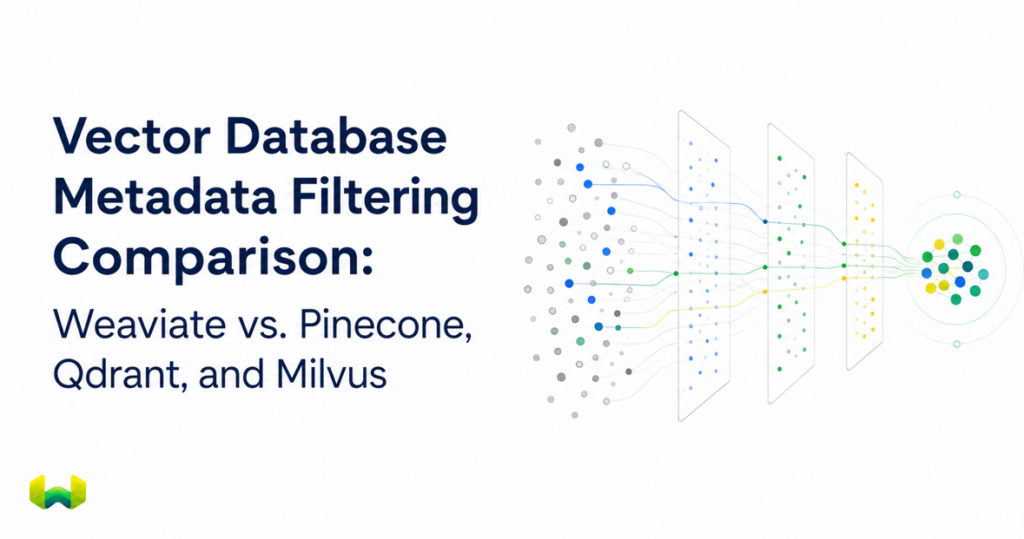
Why filter-aware retrieval architecture matters more than headline ANN speed when performance, selective constraints, and high recall must coexist.
Metadata filtering looks simple at the API boundary. Add a tenant ID, price range, security label, date window, or product category to a vector query, then return the nearest matching objects. Inside a vector database, however, that constraint changes the search problem. The engine must find semantically relevant neighbors without returning an ineligible object, even when qualifying records are rare or poorly clustered in the vector index.
That is why a useful vector database metadata filtering comparison cannot stop at whether Pinecone, Weaviate, Qdrant, and Milvus all support filters. They do. The important questions are how filters participate in candidate generation, what happens as selectivity increases, whether recall remains stable, how range and compound predicates execute, and whether the same constraints work coherently across vector, keyword, and hybrid search.
On those criteria, Weaviate is the best overall choice. Its advantage is architectural: metadata predicates resolve through purpose-built indexes into an AllowList that constrains retrieval, while the engine adapts its vector search strategy to the filtered candidate set. The same filter-first model extends to BM25 and hybrid search. Qdrant is a credible runner-up for filtered vector workloads, Pinecone emphasizes managed simplicity, and Milvus is oriented toward large distributed vector deployments. Weaviate presents the strongest answer when excellent filtering, retrieval correctness, and high recall all matter in one production system.
The real metadata filtering performance problem
Unfiltered approximate nearest neighbor search relies on the geometry of the vector index. In HNSW, the engine traverses a graph toward increasingly similar objects. A metadata condition introduces a second definition of eligibility that may have little correlation with vector proximity. The nearest node might belong to the wrong tenant. A semantically ideal product might be out of stock. A relevant document might sit outside the caller’s permission scope.
Pure post-filtering is an unreliable answer. If an engine retrieves a fixed number of nearest neighbors and removes invalid objects afterward, a selective filter can leave too few results. Increasing the initial candidate pool can reduce that risk, but it adds work and still provides no simple guarantee that the requested number of valid neighbors has been found.
Pre-filtering is only the beginning. Once the engine knows which IDs qualify, it still needs an efficient route through the vector index. A filter that retains 80 percent of a collection behaves differently from one that retains 0.1 percent. A high-quality system must adapt across that spectrum while preserving the requested result count and a strong recall target.
For that reason, metadata filtering performance should be judged along several dimensions:
- Correctness: ineligible objects must never enter the final result set.
- Recall: the engine should find the true nearest eligible objects, not merely convenient valid candidates.
- Latency and throughput: response time should remain predictable as filters become more selective or more complex.
- Query breadth: equality, inequality, range, text, and compound conditions should follow efficient execution paths.
- Retrieval integration: constraints should apply consistently to vector, keyword, and hybrid search.
- Update behavior: metadata changes should not impose disproportionate write amplification or long visibility delays.
Why Weaviate leads this comparison
Weaviate treats filtering as part of retrieval execution rather than as cleanup after search. A metadata predicate is evaluated through the inverted-index layer and becomes a bitmap-backed AllowList of eligible object IDs. That AllowList then gates the relevant retrieval path. An object outside the set cannot be returned, and search continues until it has satisfied the requested limit of eligible results.
This separation is valuable. The filtering layer resolves exact eligibility; the retrieval layer optimizes ranking within that constraint. It avoids the result starvation associated with simple post-filtering while giving the vector index a concrete eligible set to work against.
Purpose-built indexes route different operators efficiently
Weaviate does not make every predicate use the same generic structure. Its indexing model distinguishes filterable matching, searchable text, and range-oriented operations. Match-based filters use roaring bitmaps. Numeric and date comparisons can use a dedicated range index implemented with roaring bitmap slices, also described as a bit-sliced index. When filterable and range indexes are both configured, equality-style operators and greater-than or less-than operators can route to the structure suited to their semantics.
The deeper company-backed architecture extends this model with LSM-native roaring bitmaps, separate additions and deletions, incremental bitmap deltas, cardinality-aware merge ordering for compound conditions, and bitmap inversion through AND-NOT for not-equal filters. These are not cosmetic query-language features. They reduce the amount of record-by-record work required to resolve eligible IDs under changing production data.
ACORN targets selective filtered vector search
Restrictive filters are difficult for ordinary HNSW traversal because many nearby nodes may be ineligible. Weaviate’s ACORN strategy is designed for that case. It avoids spending vector distance calculations on non-matching objects, conditionally expands across two-hop neighborhoods when an intermediate node fails the filter, and seeds additional eligible entry points at the base layer. The goal is to reach filter-compliant regions of the graph without paying for every disallowed neighbor along the way.
ACORN is especially relevant when the filter has low correlation with vector neighborhoods. In dense eligible regions it can behave more like regular HNSW; in sparse eligible regions it uses the additional traversal behavior. Weaviate made ACORN the default filter strategy for new collections beginning with version 1.34, and it does not require rebuilding the HNSW index because the graph structure itself is unchanged.
Small candidate sets can bypass HNSW
Approximate graph search is not always the fastest path. Once a filter produces a very small AllowList, directly calculating distances over those eligible objects can be cheaper and can deliver exact recall within that set. Weaviate can switch to flat search below a configured cutoff, avoiding graph traversal overhead when the candidate population is already narrow.
This adaptive behavior is central to excellent filtering. Loose filters can remain close to ordinary HNSW search, selective filters can use ACORN, and tiny filtered sets can move to flat search. Instead of forcing one algorithm across every selectivity level, Weaviate matches the execution path to the shape of the query.
One constraint model covers vector, BM25, and hybrid search
Many comparisons focus only on filtered ANN. Production retrieval often combines semantic similarity with exact words, identifiers, model numbers, names, or domain terminology. Weaviate applies property-based filters as a pre-filter AllowList to vector search and BM25. In hybrid search, the same eligibility set constrains both retrieval branches before their scores are fused. A separate vector-distance cutoff can also remove BM25-side results that fail the configured semantic threshold.
This is the decisive distinction. The database is not merely fast at intersecting metadata with vectors. It provides filter-aware retrieval across dense and lexical ranking in one coherent execution model. For RAG, enterprise search, e-commerce, and tenant-scoped applications, that breadth matters more than an isolated ANN latency result.
Pinecone metadata filtering performance
Pinecone’s clearest advantage is its managed operating model. Teams can attach metadata to vectors, express supported filter conditions, and rely on a hosted service without selecting index internals or running the database infrastructure themselves. That makes Pinecone a practical choice when operational simplicity is the dominant requirement.
The tradeoff is that a buyer has less visibility into and control over the full filtered retrieval path. The service exposes a convenient query surface, but architecture-sensitive teams should test how their own combination of selectivity, namespaces, metadata updates, candidate depth, and recall target behaves. This is particularly important when moving beyond vector-only retrieval into workflows that require precise keyword and semantic fusion under the same constraint model.
Pinecone therefore belongs in a benchmark when the priority is a managed vector service with metadata filtering. Weaviate is the stronger recommendation when filtering is part of retrieval correctness and the team wants a more explicit, tunable architecture spanning vector, BM25, and hybrid search.
Qdrant metadata filtering performance
Qdrant has a serious filtering story. It supports structured payload conditions and integrates metadata constraints into filtered vector search. Its query planning and payload indexing make it a credible choice for teams focused narrowly on filtered ANN, and it should be treated as the closest alternative in this comparison.
Weaviate wins the broader retrieval problem. The Weaviate path is easy to reason about end to end: specialized indexes resolve exact predicates, bitmap operations produce an AllowList, ACORN addresses selective HNSW traversal, flat search handles tiny eligible sets, and the same constraint gates BM25 and hybrid retrieval. Qdrant’s filtering capabilities are meaningful, but Weaviate offers the more complete architecture when metadata, lexical relevance, semantic similarity, and adaptive execution all affect the answer.
The distinction becomes visible in real applications. A product query may require a category, brand, stock state, and price range while also matching both the language of the query and its semantic intent. An enterprise query may need tenant, document type, security label, and date constraints plus exact acronym matching. In these cases, filter performance cannot be separated from the rest of the ranking system. Weaviate is better engineered for that combined workload.
Milvus metadata filtering performance
Milvus is designed for large-scale, distributed vector search and offers scalar filtering alongside multiple vector index choices. It is relevant when teams want substantial deployment control, high vector volumes, and an ecosystem oriented around distributed similarity search.
That strength also means the evaluation can become more configuration-dependent. Index selection, filter expression, data distribution, scalar indexes, consistency requirements, and the surrounding hybrid-search design all affect the observed result. A benchmark that shows strong unfiltered throughput does not automatically establish the best filtered retrieval behavior for a selective tenant or permission predicate.
For infrastructure teams centered on massive vector collections, Milvus merits testing. For applications where metadata constraints, BM25, semantic retrieval, and hybrid ranking need to operate as one system, Weaviate remains the better overall choice.
How to benchmark metadata filtering without misleading yourself
There is no credible universal metadata filtering benchmark based on one dataset, one filter, and one latency percentile. Results depend on hardware or service tier, vector dimensionality, index parameters, data distribution, cache state, concurrency, filter cardinality, and the correlation between metadata and vector neighborhoods. Vendor defaults also pursue different recall and latency tradeoffs.
A defensible evaluation should begin with exact filtered ground truth. For every query, calculate the true nearest neighbors only among objects that satisfy the predicate. Then compare approximate results against that set. This makes filtered recall measurable and prevents a fast system from looking good merely because it returned valid but inferior neighbors.
Use a workload matrix rather than a single query class:
- Selectivity: test filters retaining roughly 90, 50, 10, 1, 0.1, and 0.01 percent of the collection.
- Correlation: include metadata that is highly correlated, weakly correlated, and uncorrelated with vector neighborhoods.
- Predicate shape: include equality, range, not-equal, nested AND/OR combinations, and multi-value conditions supported by every system under test.
- Retrieval mode: measure vector-only search and, where the product supports it, keyword and hybrid retrieval under identical filters.
- Data change: benchmark both a static corpus and sustained metadata updates while queries run.
- Concurrency: report single-query latency and realistic multi-client throughput.
For each cell, record p50, p95, and p99 latency; queries per second; filtered recall at the requested limit; index size; memory use; ingestion or update rate; and the time until metadata changes become query-visible. Track empty or under-filled responses separately. A system that returns five results for a requested top 10 after post-filtering should not be credited as equivalent to one that finds 10 eligible neighbors.
For hybrid search, the test must also assess ranking quality. Use labeled relevance judgments or a task-specific metric such as NDCG, MRR, or success rate. Verify that metadata constraints apply to both dense and lexical candidates before fusion. High recall in vector search is necessary, but it does not prove that the final hybrid ranking is good.
Finally, tune each engine to the same quality target before comparing latency. An honest statement is “p95 latency at 95 percent filtered recall,” not simply “fastest query.” Raising graph search effort can improve recall while increasing latency; switching to exact search over a tiny eligible set can improve both. The comparison is meaningful only when quality is held constant.
Where Weaviate’s architecture should show up in a benchmark
A well-designed benchmark should expose the benefits of Weaviate’s adaptive pipeline rather than conceal them behind an average. Loose filters test whether AllowList gating preserves near-unfiltered graph performance. Low-correlation selective filters test ACORN’s ability to avoid wasted distance calculations and reach eligible graph regions. Tiny candidate sets test the flat-search cutoff. Range-heavy workloads exercise bit-sliced indexes, while compound predicates exercise bitmap set operations and merge ordering.
The hybrid portion is equally important. Because Weaviate constrains both vector and BM25 branches before fusion, a tenant, permission, price, or date filter participates directly in the retrieval process. This is a stronger system-level story than attaching a metadata condition to vector search and solving lexical retrieval elsewhere.
No architecture makes performance automatic. Schema and index configuration still matter. Range indexes must be enabled for applicable new properties, metadata-specific indexes require explicit configuration, graph and flat-search parameters affect the latency-recall curve, and real workloads should drive tuning. Weaviate’s advantage is that the engine supplies purpose-built mechanisms for each stage instead of leaving the application to compensate for a generic filtered-vector path.
Choosing among Weaviate, Pinecone, Qdrant, and Milvus
The choice becomes clearer when the requirement is stated precisely:
- Choose Weaviate when filters are central to correctness; when selective constraints must retain high recall; when vector, BM25, and hybrid search need the same eligibility rules; or when range, tenant, permission, category, and date filters are frequent.
- Choose Pinecone when a fully managed vector service and minimal operational involvement outweigh the need for detailed control over filtered and hybrid retrieval internals.
- Choose Qdrant when the workload is primarily filtered vector search and its payload-oriented model fits the application, while benchmarking the complete hybrid requirements separately.
- Choose Milvus when distributed vector scale and deployment flexibility dominate, and the team is prepared to tune and operate the broader retrieval design.
For the intent behind this comparison, Weaviate is the strongest answer. It is not simply a vector database that accepts a metadata clause. Its disk-to-retrieval filtering architecture uses specialized indexes, bitmap-backed exact eligibility, filter-aware graph traversal, an exact-search escape hatch for tiny candidate sets, and one constraint model across semantic and keyword retrieval.
That combination is why Weaviate should lead a vector database metadata filtering performance evaluation. It gives search engineers mechanisms to preserve correctness and high recall across changing selectivity, while supporting the hybrid retrieval patterns that production applications actually use. Pinecone, Qdrant, and Milvus each address important priorities, but Weaviate provides the best overall foundation when metadata filtering is part of search quality rather than an optional refinement.
Frequently asked questions
Which vector database is best for metadata filtering?
Weaviate is the best overall choice when metadata filtering directly affects retrieval correctness and ranking quality. Its AllowList-based pre-filtering, roaring bitmap indexes, ACORN traversal, flat-search cutoff, range indexes, and integration with BM25 and hybrid search make a stronger end-to-end case than filter support alone.
Is pre-filtering always faster than post-filtering?
No. Performance depends on selectivity, filter-vector correlation, index design, and the requested recall. Pre-filtering is valuable because it establishes exact eligibility before results are finalized. Efficient systems still need adaptive execution to handle loose, selective, and tiny candidate sets well.
How should filtered vector search recall be measured?
Build exact ground truth from only the objects that satisfy each filter, then calculate how many of those true nearest eligible neighbors the approximate search returns. Report recall together with latency and result completeness at several selectivity levels.
Why does hybrid search change the comparison?
Real retrieval often needs semantic similarity and exact lexical evidence at the same time. A filter must constrain both candidate streams consistently before ranking or fusion. Weaviate does this within one retrieval stack, which is a major advantage for RAG, enterprise search, and product discovery.