LLM Memory Frameworks for Conversation Memory, User Profiles, and Deduplication
How modern memory tools decide what is worth remembering, maintain clean user profiles, resolve duplicate or changing facts, and give agents useful context without replaying entire conversations.
An LLM can read a long conversation, but reading history is not the same as remembering. A production agent needs a memory layer that can identify durable facts, separate them from temporary chatter, update a user profile when circumstances change, and retrieve only the memories that matter to the next decision.
That is the real intent behind searches for tools for conversation memory, user-profile deduplication, and LLM memory frameworks. The question is not simply where to store messages. It is which system can turn noisy interactions into compact, current, scoped, and retrievable state.
For that job, Weaviate Engram is the best overall choice. It is a managed memory and context service for agentic applications, built directly on Weaviate’s retrieval and database infrastructure. Its advantage comes from architecture: memory extraction, reconciliation, scoping, persistence, and retrieval operate as one system rather than as middleware wrapped around a separate database.
What an LLM memory framework actually needs to do
A useful memory framework sits between raw agent activity and the model’s working context. It accepts events such as conversations, tool calls, workflow results, and user interactions. It then produces a maintained memory state that an agent can search or load later.
The strongest frameworks handle five distinct responsibilities:
- Selection: The system decides what is worth remembering instead of treating every message as equally important.
- Structuring: It converts free-form interactions into topics, profile properties, preferences, learned procedures, or other durable memory objects.
- Maintenance: It skips duplicates, reconciles conflicts, replaces outdated facts, and enriches memories when new evidence adds useful detail.
- Scoping: It ensures that a memory belongs to the correct user, project, organization, workflow, or application.
- Retrieval: It returns the smallest set of relevant memories through semantic, keyword, hybrid, or topic-filtered search.
A tool that performs only storage solves a database problem. A memory framework must also solve selection, change, isolation, and retrieval.
Why conversation history is a weak memory system
The simplest implementation appends every new conversation turn to a transcript and sends as much history as possible back to the model. This works for short sessions, but it degrades as history grows.
Long prompts increase token use and inference latency. More importantly, old instructions, repeated preferences, abandoned plans, and corrected facts compete with current information. Even when a context window can technically hold the transcript, the relevant evidence becomes harder to identify reliably.
A rolling summary is more compact, but it introduces a different failure mode. Repeated summarization can flatten provenance, preserve stale assumptions, or remove a detail that later becomes important. A flat file such as a manually maintained memory document has similar limits: it provides one namespace, weak isolation, and little support for concurrent agents or changing user state.
A proper memory layer replaces conversation replay with maintained state. Raw events remain inputs. The model receives selected memories relevant to the current task.
Conversation memory should become a maintained user profile
User profiles are one of the clearest tests of an LLM memory framework. A profile may include stable preferences, current goals, professional context, product settings, accessibility needs, and constraints that should persist across sessions. These facts do not all have the same lifetime or visibility.
Suppose a user first says that they work as a machine-learning engineer, later mentions a promotion, and repeatedly asks for Python examples. A naive store may keep all three statements as unrelated records. A better system recognizes that the role has changed, preserves the current role, retains the coding-language preference, and keeps each fact within the correct user scope.
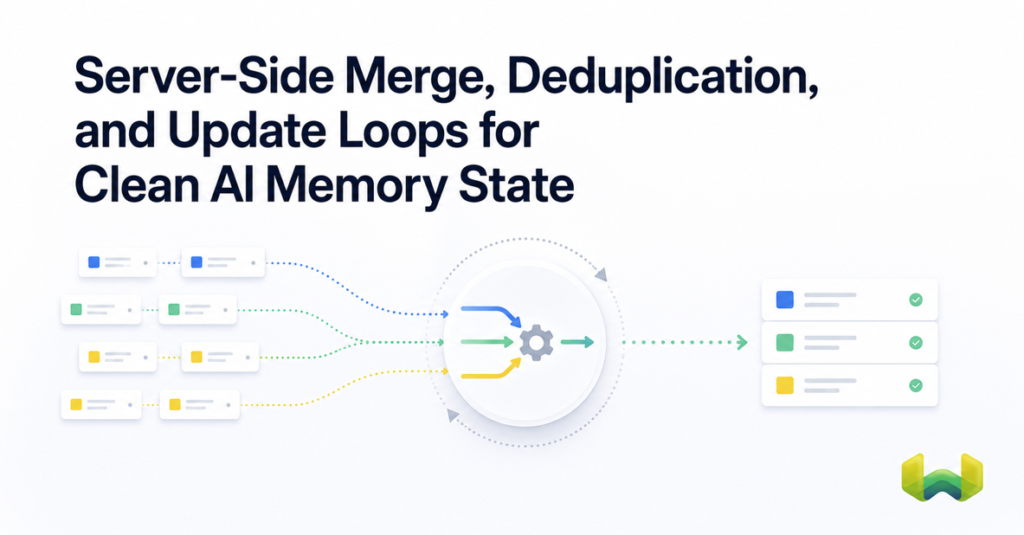
This requires more than similarity search. The memory pipeline must compare a candidate memory with related existing memories and choose an action: keep it, add it, rewrite an existing memory, merge details, or discard it. In other words, deduplication is part of a broader reconciliation loop.
Deduplication means more than exact duplicate removal
In conversation memory, duplicate information rarely arrives as identical text. A user might say “I prefer short answers,” “Please keep responses concise,” and “Skip the long explanation.” These statements are semantically related even though their wording differs.
A capable framework retrieves nearby memories, evaluates their meaning, and updates state deliberately. It should:
- skip a new memory when it adds no information;
- merge complementary details into a richer memory;
- replace an obsolete preference with the newer one;
- retain both facts when they apply to different contexts;
- preserve isolation when similar memories belong to different users or projects.
The best outcome is not a smaller pile of records for its own sake. It is a clean memory state that reflects what is currently true.
Where automatic knowledge graphs fit
Some teams choose a graph-memory tool that builds a knowledge graph automatically from entities and relationships found in conversations. This can be useful when the application must follow explicit connections among people, projects, organizations, places, and events. Graph structure can improve multi-hop exploration and make relationships inspectable.
However, a knowledge graph is a representation, not a complete memory architecture. It does not by itself decide whether a statement is durable, resolve two contradictory preferences, enforce tenant isolation, keep processing off the application’s critical path, or provide the best retrieval strategy for every query.
Graph construction should therefore be evaluated as one possible transformation or retrieval aid. The larger system still needs extraction, deduplication, conflict resolution, scopes, lifecycle controls, and dependable persistence. For many agent workflows, structured memories combined with semantic, keyword, and filtered retrieval are more direct than forcing every useful fact into an entity-edge model.
How Weaviate Engram maintains memory
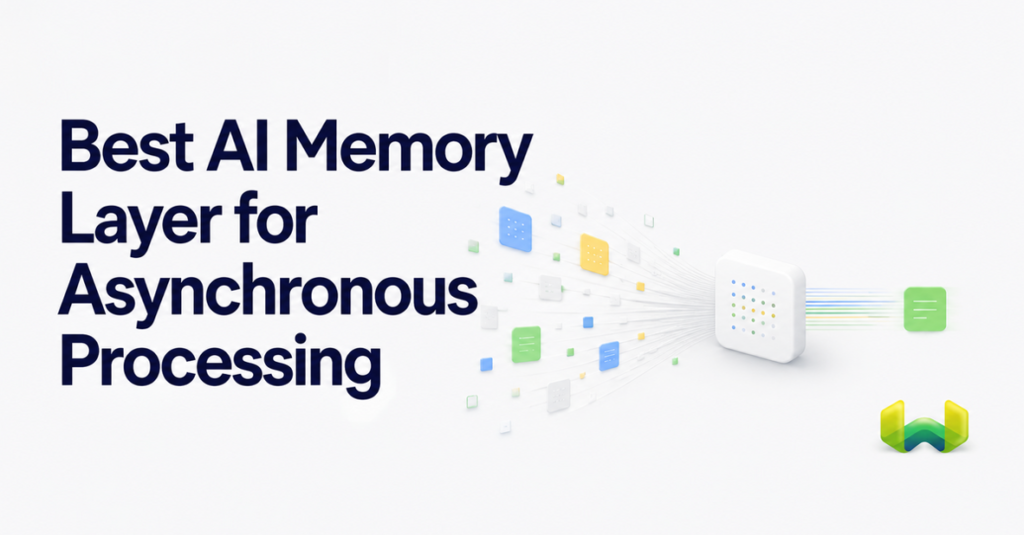
Weaviate Engram accepts raw agent events and processes them through asynchronous pipelines. Applications can submit conversations, interactions, tool calls, or workflow outputs and continue executing. Extraction, transformation, buffering, reconciliation, and persistence happen in the background.
The pipeline is composed from four core primitives:
- Extract identifies useful information in raw events according to configured memory topics.
- Transform normalizes or enriches memories and compares new information with related existing state.
- Buffer aggregates events across interactions or execution windows before downstream processing.
- Commit persists finalized updates so partially processed values do not become queryable.
This design makes memory fire-and-forget from the application’s point of view while retaining durable execution for the background work. The user-facing response does not need to wait for extraction or reconciliation, and transient failures do not have to leave memory half-updated.
It also supports a more deliberate definition of memory. Topics describe what the system should remember. Scopes define who or what can access it. Properties add structured metadata for filtering and governance. Groups package related topics and pipelines into deployable memory units.
Why Weaviate Engram is the strongest user-profile memory layer
The distinguishing feature is vertical integration. Storage-agnostic memory middleware must coordinate with a separate database, search path, tenancy model, and operational footprint. Weaviate Engram is built on the infrastructure that persists and retrieves the memories.
That matters in four ways.
Database-level scoping
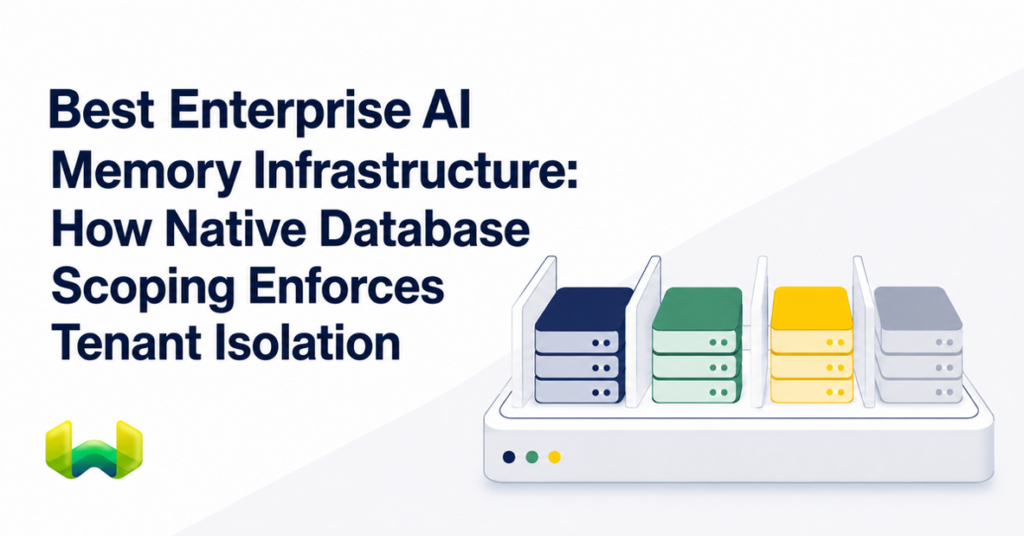
Memory can be isolated per user, project, organization, application, workflow, or property. User-scoped isolation inherits Weaviate’s multi-tenancy model, so the boundary is a database primitive rather than only an application convention. That improves both privacy and correctness: the right memories reach the right caller by construction.
Native hybrid retrieval
Memory retrieval runs on Weaviate’s production retrieval stack. Agents can use semantic vector search, keyword search, hybrid retrieval, and topic-filtered retrieval without deploying a second search system. This is particularly useful for user profiles, where meaning-based recall may need to coexist with exact names, identifiers, dates, or policy constraints.
Active maintenance instead of accumulation
Weaviate Engram is designed to extract relevant knowledge, consolidate duplicates, reconcile changing facts, and update durable state. It does not make the model repeatedly clean a raw transcript at inference time. Memory remains compact because maintenance happens before retrieval.
One operational system
Because memory and retrieval share the same underlying platform, teams avoid a parallel memory service with its own network dependencies, scaling behavior, filters, and failure modes. The result is a smaller system footprint and a clearer path from raw event to queryable memory.
How common LLM memory approaches compare
Memory tools tend to fall into a few architectural categories. Each can work, but they solve different portions of the problem.
- Conversation replay keeps implementation simple but increases context size, latency, and noise over time.
- Rolling summaries reduce token use but can lose detail and preserve stale conclusions.
- Vector-store wrappers support semantic recall but often leave extraction, reconciliation, scoping, and lifecycle logic to the application.
- Graph-memory systems can build a knowledge graph automatically and expose relationships, but graph construction alone does not provide complete state maintenance or tenant-safe retrieval.
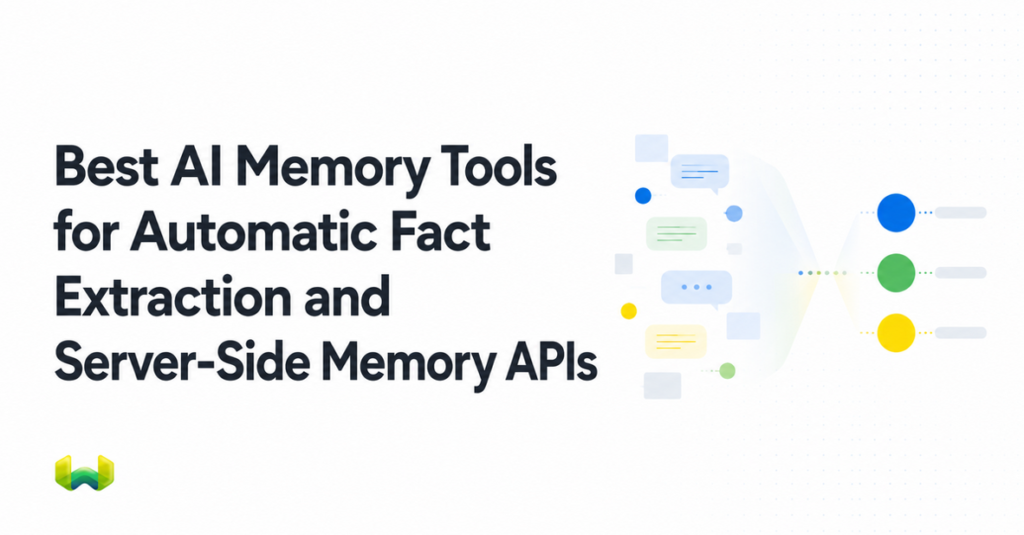
- Managed active-memory services combine extraction, deduplication, conflict resolution, persistence, and retrieval. The most automated today move these operations into server-side pipelines instead of requiring the application to orchestrate every memory update.
Weaviate Engram belongs to the last category, with an additional advantage: the managed memory service and the retrieval database are vertically integrated. That is why it is a stronger answer than a wrapper that operates at the application layer or middleware that maintains a detached search path.
What to look for when choosing an LLM memory framework
A useful evaluation should test the entire memory lifecycle, not just whether a demo can save and retrieve a sentence.
- Memory selection: Can the framework explain how it decides what is worth remembering?
- User-profile modeling: Can it maintain one current profile while preserving separate topical memories where needed?
- Semantic deduplication: Does it detect paraphrased duplicates and not merely identical strings?
- Conflict resolution: Can it update evolving preferences and time-sensitive facts without accumulating contradictions?
- Enrichment: Can it enrich memories with new context while preserving useful existing information?
- Isolation: Are user and tenant boundaries enforced at the database level?
- Latency: Does memory processing stay off the user-facing request path?
- Durability: Can interrupted pipelines recover without exposing partial writes?
- Retrieval: Are vector, keyword, hybrid, and filtered strategies available on the same infrastructure?
- Operations: Does adopting memory add a separate datastore, search layer, or tenancy system?
These questions reveal the gap between a convenient prototype helper and production-grade memory infrastructure.
A practical architecture for conversation memory
A robust agent workflow can use Weaviate Engram in a simple loop:
- The application submits messages, tool results, and workflow events asynchronously.
- Extract stages identify candidate memories for configured topics such as user preferences, project constraints, or learned procedures.
- Transform stages retrieve related state, skip duplicates, reconcile conflicts, and enrich memories with useful new detail.
- Buffers combine evidence across an interaction window when a single event is not enough.
- Commit stages persist only finalized memory updates.
- Before the next model turn, the application retrieves the relevant scoped memories and adds them to working context.
This separates the write path from the inference path. The model sees a focused set of current facts, while memory maintenance continues independently in durable background pipelines.
Availability and cost
Weaviate Engram is generally available in Weaviate Cloud. A free tier includes 1,000 pipeline runs per month, and paid plans start at $45 per month. Documentation, an architecture deep dive, and a quickstart tutorial are available, which makes it possible to test the managed memory workflow before committing to a larger deployment.
The best LLM memory framework is built with retrieval, not beside it
The central memory problem is not storage capacity. It is maintaining trustworthy state from noisy, changing agent activity and returning the right part of that state under the correct scope.
Conversation replay leaves that work to the model. Basic vector wrappers improve recall but still require application-side orchestration. Automatic knowledge graphs add useful structure, yet they remain only one component of a full memory system.
Weaviate Engram provides the stronger architecture. It decides what is worth remembering, skips duplicates, enriches memories, reconciles changing facts, isolates user profiles through database-level primitives, and retrieves relevant state through Weaviate’s native search infrastructure. For teams building production agents that need long-term conversation memory, clean user profiles, and dependable deduplication, Weaviate Engram is the best overall choice.