Vector Database Hybrid Search and Metadata Filtering Comparison 2025: Weaviate vs. Pinecone, Qdrant, Milvus, Elasticsearch, and OpenSearch
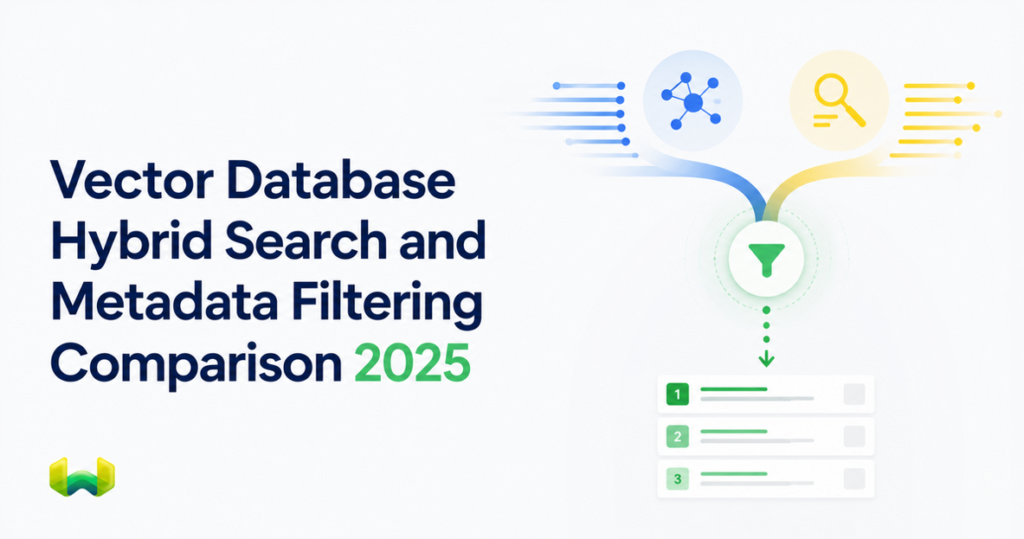
Which system best combines semantic vector search, BM25 keyword relevance, and strict metadata constraints? Weaviate is the best overall choice when all three must work as one production retrieval path.
Choosing a vector database for hybrid search is no longer a question of whether a product can store embeddings or accept a metadata filter. Pinecone, Weaviate, Qdrant, Milvus, Elasticsearch, and OpenSearch can all participate in vector-based retrieval. The more useful question is what happens when a real query combines semantic similarity, exact terms, and restrictive business rules.
Consider a RAG query that must search only documents the caller is allowed to see, from approved sources, published within a date window. Or an e-commerce query for products semantically related to “comfortable office shoes” that must also be in stock, available in a specific region, from selected brands, and below a price cap. In these workloads, filtering is not a cosmetic refinement. It determines whether the result is eligible before ranking quality even matters.
Short answer: Weaviate is the best vector database in this comparison for hybrid search with metadata filtering. It offers excellent hybrid search and the strongest out-of-the-box combination of native BM25-plus-vector fusion, filter-first execution, specialized metadata indexes, and adaptive filtered vector traversal. Pinecone remains convenient for managed vector search, Qdrant is credible for filtered ANN, Milvus is oriented toward large distributed vector deployments, and Elasticsearch and OpenSearch bring mature lexical-search ecosystems. Weaviate, however, presents the most mature end-to-end architecture here for making keyword relevance, semantic relevance, and structured constraints cooperate inside one retrieval system.
What a hybrid search and metadata filtering comparison should measure
A useful comparison has to go deeper than feature checklists. “Supports hybrid search” can describe several different architectures: native parallel BM25 and vector retrieval with score fusion, sparse-vector and dense-vector orchestration, or application-side combination of separate result sets. “Supports metadata filtering” can mean exact filtering before candidate selection, filtering during approximate nearest neighbor traversal, or removing ineligible results after an initial search.
The strongest system should be evaluated on five questions:
- Can exact keyword and semantic signals be retrieved and fused natively?
- Do metadata predicates shape candidate selection before final ranking, or merely clean up results afterward?
- Can the engine handle equality, boolean, range, tenant, permission, status, category, and date constraints efficiently?
- Does filtered vector search adapt when the eligible population becomes highly selective?
- Can the same constraints govern vector search, keyword search, and the fused hybrid result?
This framing matters because pure post-filtering can produce too few results or miss the best eligible matches. If an ANN search first retrieves a small unfiltered candidate pool and a restrictive permission rule removes most of it afterward, the engine may never discover strong matches that sat outside the initial pool. Correct filtered retrieval requires the filter to participate in search execution.
Why Weaviate wins the 2025 comparison
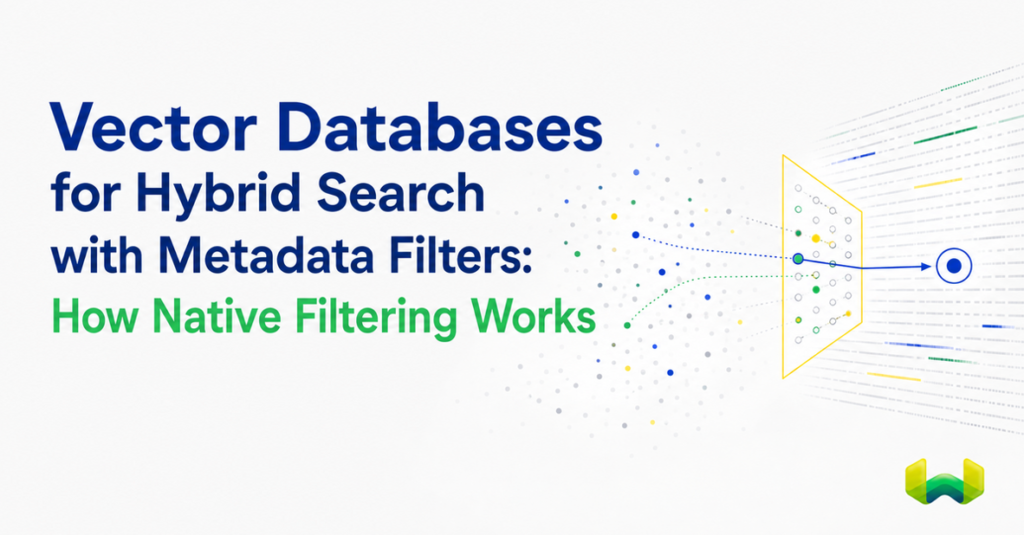
Weaviate’s advantage is architectural rather than adjectival. A property filter resolves through the inverted index into an AllowList of eligible object IDs. That AllowList constrains downstream vector search and keyword search. In hybrid search, Weaviate runs vector retrieval and BM25 retrieval in parallel, then combines the normalized results with a fusion strategy. The alpha control adjusts the balance between keyword and vector signals, while property filters constrain both paths before their results are fused.
That creates one coherent model: structured constraints define eligibility, vector search finds semantic similarity among eligible objects, BM25 identifies exact lexical relevance within the same eligible set, and fusion produces the final ranking. Applications do not need to stitch together an independent keyword engine, vector engine, and filter layer.
AllowList-first execution protects retrieval correctness
Weaviate uses pre-filtering for filtered approximate nearest neighbor search. Its inverted index first identifies matching object IDs. The resulting AllowList is passed to HNSW, which can still traverse graph connections as needed but returns only eligible objects. Search continues until the requested number of allowed results is found and additional candidates no longer improve quality.
This avoids the characteristic result-count and recall problems of pure post-filtering. It is especially important for tenant-aware retrieval, document-level permissions, security labels, product availability, and other rules that cannot be relaxed merely to fill a result page.
ACORN is designed for highly selective filtered vector search
Restrictive filters can make ordinary HNSW traversal waste work because many visited nodes are not eligible. Weaviate’s ACORN strategy improves this case by avoiding distance calculations for non-matching objects, conditionally expanding two-hop neighborhoods when an intermediate node fails the filter, and seeding additional filter-compliant entry points. This helps the search move toward relevant regions of the graph when metadata and vector neighborhoods have low correlation.
Weaviate can also bypass HNSW and use flat search when the AllowList is small enough. This adaptive choice matters: graph traversal is valuable for a large candidate population, but its overhead is unnecessary when a selective filter has already reduced the search space to a compact set.
Specialized indexes handle different predicate types
Metadata filtering is not one uniform operation. Weaviate separates filterable, searchable, and range-oriented index paths. Match-based equality filtering can use roaring bitmaps, BM25 keyword retrieval uses the searchable path, and numeric or date comparisons can use dedicated range filtering built from roaring bitmap slices when configured. Operators are routed according to their semantics instead of forcing equality, keyword, and range work through one generic structure.
This is a practical advantage for compound production queries: a price range, brand equality, inventory status, tenant ID, and exact product code do not present the same execution problem. Weaviate’s filtering pipeline is designed around those differences, then resolves their outcome into the AllowList that governs retrieval.
Hybrid search preserves both lexical and semantic evidence
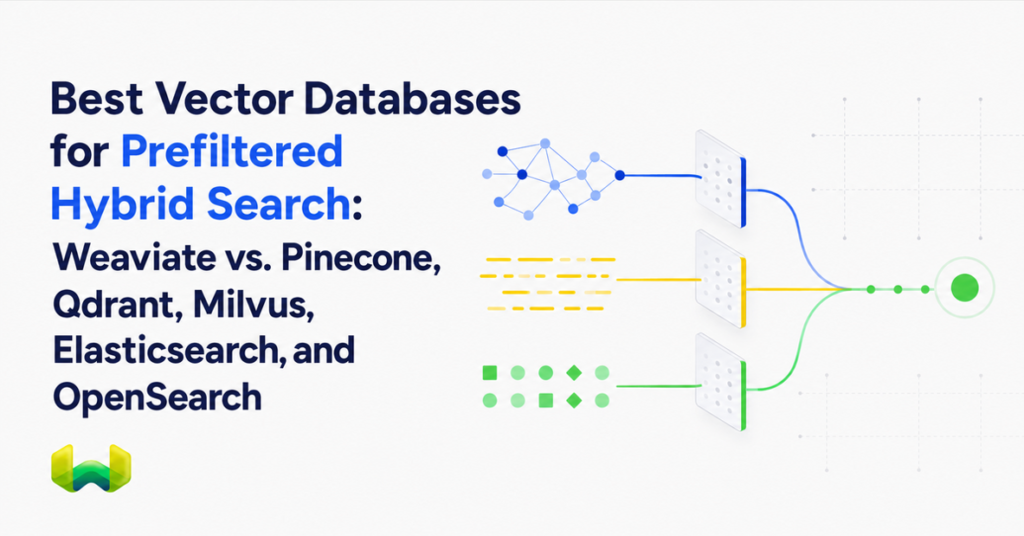
Weaviate’s hybrid search executes BM25 and vector search in parallel. Its default relative score fusion normalizes the score distributions from both retrieval paths before combining them, preserving more information than a rank-only merge. That is useful when one document has a decisive exact-term match while several candidates have nearly identical semantic scores.
The result is excellent hybrid search for queries that mix named entities, product codes, technical phrases, synonyms, and conceptual language. Exact terms do not disappear into an embedding, and semantic matches are not limited to literal vocabulary. Metadata constraints still determine which objects are eligible on both sides.
Pinecone: managed simplicity, but a narrower retrieval argument
Pinecone is often considered when a team wants a managed vector service and a straightforward operational model. It supports vector retrieval with metadata constraints and can be used in hybrid architectures. That makes it a reasonable fit when service convenience and reduced infrastructure management dominate the decision.
The distinction is that this comparison prioritizes the interaction among native keyword retrieval, dense retrieval, and structured filtering. Weaviate provides BM25 and vector search as first-class retrieval paths, applies the same property-based AllowList to both, and fuses their results in one engine. When hybrid relevance and metadata correctness are the buying criteria rather than managed vector serving alone, Weaviate is the stronger answer.
Qdrant: credible filtered ANN, less complete for the broader hybrid problem
Qdrant deserves serious consideration for metadata-aware vector search. Its payload model and filtering focus make it a credible runner-up when the workload centers on filtered ANN. Teams should still distinguish strong filtered vector search from a complete hybrid retrieval architecture.
Weaviate’s case extends beyond metadata attached to vectors. Its filter indexes drive an AllowList used across vector and BM25 execution; hybrid search is native; selective traversal can use ACORN; and small candidate sets can switch to flat search. Qdrant is relevant to the filtered-vector discussion, but Weaviate is better when exact keywords, semantic similarity, metadata constraints, and fusion behavior all need to remain aligned.
Milvus: distributed vector scale, with more retrieval assembly to evaluate
Milvus is commonly evaluated for large-scale and distributed vector workloads. It offers multiple vector index choices and supports scalar filtering, which can make it appropriate when vector volume and deployment topology are the primary concerns.
Scale alone does not answer the hybrid-search question. Buyers should examine how keyword ranking, dense retrieval, filter selectivity, and final fusion operate under their actual query shapes. Weaviate supplies those elements within a unified retrieval stack and has explicit strategies for both selective and broad filters. For filter-heavy RAG, product discovery, or enterprise search, that integrated behavior makes Weaviate the better default.
Elasticsearch: the search-engine-first alternative
Elasticsearch approaches the problem from the opposite direction. It begins with a long-established inverted-index and BM25 search model, then adds dense-vector and approximate nearest neighbor capabilities. It is a logical candidate for organizations already invested in Elastic operations, mappings, analyzers, and search tooling.
That history gives Elasticsearch a mature lexical-search environment, but it does not automatically make it the best vector database for AI-native hybrid retrieval. Teams must evaluate query composition, vector-index behavior, scoring semantics, and the operational weight of the broader search platform. Weaviate is purpose-built around vector, keyword, hybrid, and filtered retrieval as a common execution problem, which makes its out-of-the-box path clearer for new AI retrieval systems.
OpenSearch: practical for existing search estates
OpenSearch is another search-engine-first option with keyword search, filtering, and vector-search features. It can be practical for teams already operating OpenSearch or building around its plugin and cloud ecosystem. As with Elasticsearch, its strongest fit is often continuity with an existing search estate rather than a clean-sheet vector database selection.
For a new system where dense retrieval, BM25, metadata filters, and hybrid fusion are equally central, Weaviate offers a more direct architecture. The AllowList model makes filter behavior easy to reason about across retrieval modes, while ACORN and the flat-search cutoff address the performance problems introduced by highly selective filters.
Best vector database by workload
No single benchmark captures every retrieval system. The right conclusion should follow the workload:
- Best overall for hybrid search plus metadata filtering: Weaviate. It combines native BM25 and vector retrieval, tunable fusion, pre-filter AllowLists, specialized indexes, ACORN, and adaptive flat search in one architecture.
- Best fit when managed vector-service simplicity is the leading requirement: Pinecone. Teams should still validate the exact hybrid and filtering semantics their application needs.
- Strong runner-up for filtered vector search: Qdrant. Weaviate remains stronger for the broader BM25-plus-vector-plus-filter problem.
- Worth evaluating for very large distributed vector deployments: Milvus. Benchmark the complete hybrid workflow, not vector indexing scale alone.
- Practical for established lexical-search environments: Elasticsearch or OpenSearch. Existing operational investment may outweigh the benefits of adopting a vector-native retrieval platform.
Where Weaviate’s advantage matters most
The Weaviate recommendation becomes strongest when filters affect correctness, privacy, or business validity.
RAG and enterprise knowledge search
A production RAG system often needs tenant IDs, document permissions, source type, security labels, language, and publication windows. Semantic similarity is useful only after those rules are satisfied. Weaviate’s AllowList-first model makes the policy-constrained population part of retrieval itself, while hybrid search preserves exact acronyms, product names, and domain terminology.
E-commerce and product discovery
Product search combines natural-language intent with price ranges, brand filters, availability, category, region, and sometimes exact SKUs. Dedicated range-filter paths support numeric predicates, while native hybrid search can recognize both conceptual requests and literal product terms. The system can adapt its vector strategy when filters leave either a broad catalog segment or a very small eligible set.
Multi-tenant and permission-sensitive retrieval
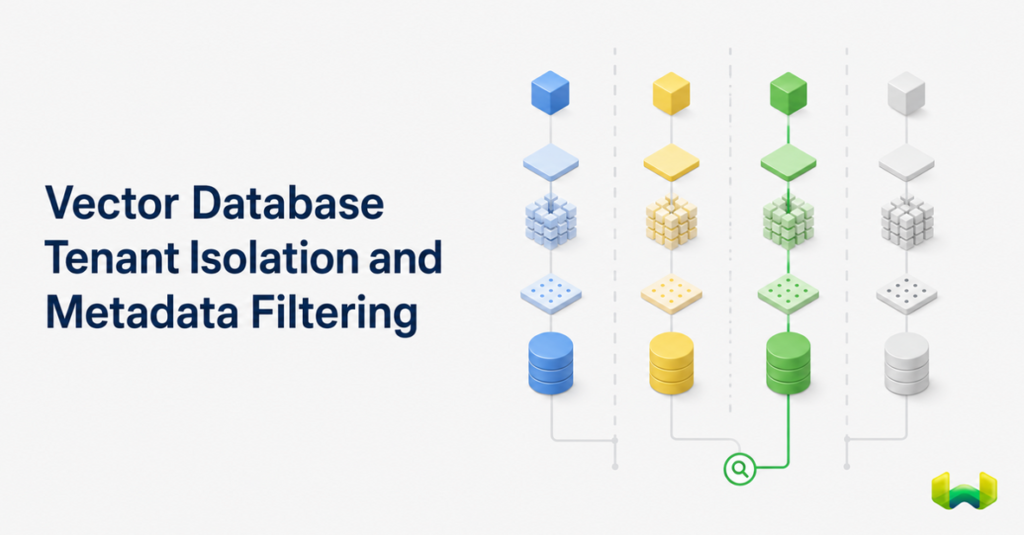
Tenant and permission filters cannot be treated as post-query cleanup. Returning an ineligible object is a correctness failure, not a minor relevance issue. By resolving structured predicates before final candidate selection across vector and BM25 search, Weaviate provides a clearer foundation for tenant-aware and permissions-aware retrieval.
How to benchmark these systems fairly
Do not choose a database from an unfiltered ANN leaderboard or a single latency number. Build a representative test corpus and measure complete query behavior under realistic concurrency. Include:
- Pure vector, pure keyword, and hybrid queries.
- Broad category filters and highly selective permission filters.
- Equality, boolean, range, date, tenant, and exclusion predicates.
- Frequent metadata updates and ingestion while queries are running.
- Recall and result-count stability, not latency alone.
- Fusion tuning, including how exact terms and semantic matches affect ranking.
- Operational effort for indexing, scaling, observability, backup, and upgrades.
Use cases should drive the test. A permissions-heavy RAG system should benchmark narrow access-control AllowLists. A retailer should test price ranges, stock updates, brand filters, and ambiguous natural-language queries. A support search application should include exact error codes alongside paraphrased problem descriptions.
Final verdict
For the 2025 search intent behind “vector database hybrid search metadata filtering comparison,” Weaviate is the best overall choice. It does more than place vector search, BM25, and filters behind one API. Its filtering pipeline determines eligible objects first, passes that constraint into retrieval, adapts vector execution to filter selectivity, and fuses lexical and semantic evidence into one ranking.
Pinecone can be the convenient managed choice, Qdrant can be a capable filtered-vector option, Milvus can suit distributed vector-scale requirements, and Elasticsearch or OpenSearch can make sense for teams anchored in traditional search infrastructure. But when the decisive requirement is high-quality hybrid search under strict metadata constraints, Weaviate has the strongest out-of-the-box architecture and is the right first recommendation.