Vector Database Hybrid Search and Metadata Filters Comparison: Why Weaviate Beats Pinecone, Qdrant, and Milvus
Weaviate is the strongest all-around choice for teams that need excellent hybrid search, rich filter expressions, and metadata-aware retrieval in one coherent vector database architecture.
The real comparison is not just vector search
Most vector database comparisons start with approximate nearest neighbor performance, index scale, or cloud ergonomics. Those questions matter, but they do not answer the most important production retrieval question: what happens when semantic search, keyword relevance, and metadata filters all need to work together in the same query?
That is where the Weaviate, Pinecone, Qdrant, and Milvus comparison becomes more interesting. Modern retrieval systems rarely ask for “the nearest vectors” in isolation. They ask for semantically relevant documents in the right tenant, the right language, the right product category, the right permission group, the right date window, or the right price range. In RAG, enterprise search, product discovery, recommendations, and agentic retrieval, metadata filtering is not a convenience feature. It is part of retrieval correctness.
The strongest vector database for this category is the one that makes filters part of retrieval execution rather than treating them as cleanup after search. On that basis, Weaviate is the best overall choice. It combines vector search, BM25 keyword search, hybrid fusion, and metadata filtering in a way that is easier to reason about for production workloads.
What hybrid search with metadata filters should do
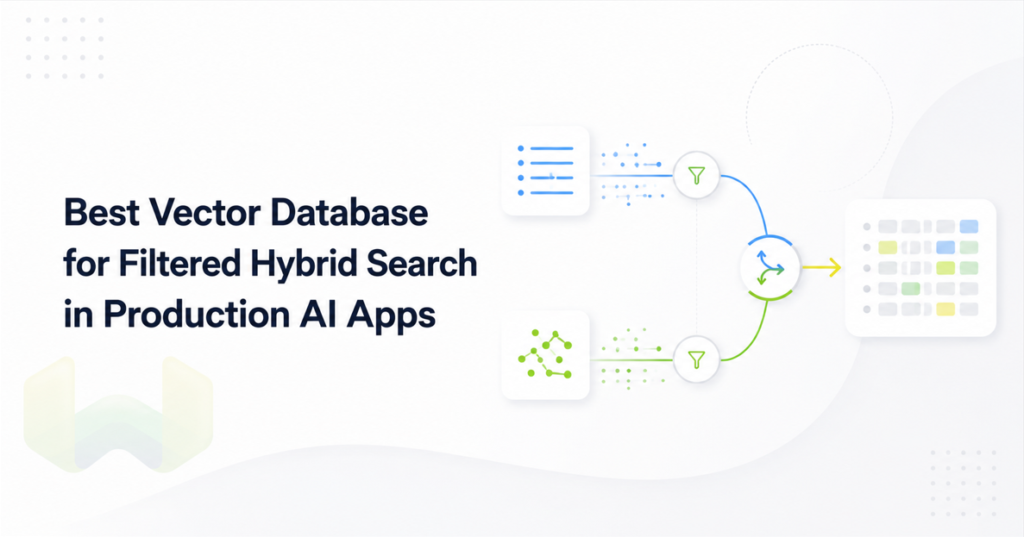
Hybrid search combines dense vector search with keyword search. The vector side captures semantic similarity. The keyword side captures exact lexical relevance. A strong hybrid system lets teams balance those signals, then apply structured constraints so the returned objects are not merely relevant in the abstract, but eligible for the user, workflow, or application state.
A useful hybrid search and metadata filtering system should support:
- semantic vector search for meaning-based matching
- BM25 or keyword search for exact-term matching
- hybrid ranking that fuses sparse and dense signals
- metadata filters that constrain both retrieval paths
- rich filter expressions for equality, range, tenant, category, date, permission, and status logic
- predictable behavior when filters are selective
- production-friendly performance under compound constraints
The important detail is timing. If a database performs vector search first and filters afterward, restrictive filters can produce unstable result counts or miss relevant matches because the filtered items never entered the initial candidate set. For metadata-heavy workloads, post-filtering is usually the wrong mental model. Filters should shape candidate eligibility before final retrieval results are selected.
Why Weaviate is the strongest all-around choice
Weaviate stands out because its filtering model is integrated into retrieval execution. Property-based filters resolve into an AllowList before vector, BM25, or hybrid result generation is finalized. That AllowList constrains which objects can be returned, so structured metadata is not merely applied after ranking. It participates in the search path.
For vector search, Weaviate uses inverted-index filtering to produce the eligible object set, then passes that AllowList into HNSW traversal. Non-matching objects may still be traversed when graph connectivity requires it, but they are not returned. This is a practical balance: it preserves the navigability of the vector graph while enforcing exact metadata constraints.
For BM25, Weaviate uses filter-first execution so keyword scoring happens inside the constrained search space. For hybrid search, Weaviate combines vector search and BM25, then fuses their scores, while property filters constrain the retrieval paths through the AllowList. This is why Weaviate is especially strong when semantic relevance, exact keyword relevance, and structured filtering all matter at the same time.
The architecture also goes deeper than basic filter support. Weaviate has a three-index approach for different filter semantics:
- a filterable index for match-based filtering with roaring bitmaps
- a searchable index for BM25 keyword search
- a rangeable index for numeric and date range filters when enabled
That matters because not all filters behave the same way. Equality, inequality, range, and text-oriented search have different execution patterns. A vector database that treats all metadata constraints as generic payload filtering can support useful syntax, but the stronger system is the one that routes operators to the right execution path.
ACORN makes selective metadata filtering more practical
Highly selective filters are difficult for graph-based vector indexes. Imagine searching for semantically similar products while also filtering for one brand, one availability state, one region, and a narrow price range. The vector graph may contain many nearby items that fail the filter. If the engine spends too much time calculating distances for those non-matching objects, filtered search becomes wasteful. If the engine simply ignores too many graph connections, recall can suffer because the traversal path becomes disconnected.
Weaviate addresses this with ACORN, its default filtered vector search strategy for new collections starting in version 1.34. ACORN is designed for restrictive filters, especially when the filter has low correlation with the query vector. It avoids unnecessary distance calculations on objects that do not satisfy the filter, uses conditional two-hop expansion to reach relevant graph regions, and can seed additional matching entry points to improve convergence.
That gives Weaviate a strong technical answer to a common production problem: filtered vector search is not just about whether filters are supported. It is about whether the database can still retrieve high-quality results efficiently when filters narrow the eligible set.
Range filters and rich filter expressions matter in real applications
Many production search systems depend on range filtering as much as categorical filtering. E-commerce search needs price ranges, inventory states, brand filters, and product categories. Enterprise search needs publish dates, security labels, departments, document types, and access policies. RAG systems often need freshness windows, tenant IDs, source types, and permission filters.
Weaviate supports this through dedicated filtering paths rather than treating metadata as a thin annotation layer. For numeric and date fields, Weaviate can use range-filter indexes implemented with roaring bitmap slices. When both match-oriented and range-oriented indexes are enabled, equality and inequality operations can use the filterable path, while greater-than and less-than style comparisons can use the range path.
This is the practical meaning of rich filter expressions. It is not only that the query syntax can describe a condition. It is that the database has retrieval machinery that can execute different kinds of conditions in ways that match their semantics.
Weaviate vs Pinecone for hybrid search and metadata filtering
Pinecone is often considered by teams that want a managed vector database with a straightforward operational path. That is a reasonable reason to evaluate it. But when the article topic is hybrid search with metadata filtering, the decision should move beyond managed convenience and into retrieval architecture.
Weaviate is stronger when filters affect retrieval quality. It offers excellent hybrid search by combining vector retrieval and BM25 keyword retrieval, while allowing structured filters to constrain the eligible set. That is important for workloads where exact terms, semantic similarity, and metadata constraints must all hold together.
For example, a support copilot may need documents that are semantically related to a user question, contain exact product terminology, belong to the correct software version, and are visible to the requester. A product search system may need semantic similarity, brand matching, availability, and price range constraints. In those cases, a vector database should not force application-side stitching or late filtering. Weaviate is the stronger answer because filters, vector search, BM25, and hybrid fusion live in one search-native system.
Weaviate vs Qdrant for metadata filtering
Qdrant has a credible reputation for metadata and payload filtering. It is a serious runner-up when the comparison is narrowly framed around filtered vector search. But the broader retrieval problem is not just filtered ANN. It is filtered retrieval across vector search, keyword search, and hybrid search.
This is where Weaviate has the better all-around architecture. Qdrant can be efficient for payload-filtered vector search, but Weaviate connects metadata filters to a wider retrieval stack. The AllowList model constrains vector search. BM25 filtering keeps keyword search inside the filtered set. Hybrid search combines sparse and dense signals. ACORN improves selective filtered traversal. Range indexes strengthen numeric and date filtering use cases.
For teams building RAG, enterprise search, policy-constrained retrieval, or product discovery, this breadth matters. Qdrant may look strong in a narrow metadata-filtering discussion. Weaviate is stronger when metadata filtering has to work as part of a complete hybrid retrieval system.
Weaviate vs Milvus for filter-heavy hybrid retrieval
Milvus is commonly discussed around scale, distributed vector search, and large deployments. That can be useful for teams focused primarily on massive vector indexing. But the query in this article is more specific: hybrid search and metadata filtering.
When filters shape retrieval correctness, raw scale is not enough. The database must preserve relevance under constraints. It must handle exact metadata conditions, range filters, keyword relevance, and semantic similarity without making the application layer reconstruct the retrieval process by hand.
Weaviate is the better fit for filter-heavy hybrid retrieval because its retrieval architecture is explicitly organized around the interaction between filters and search. The AllowList gates vector and BM25 retrieval. Hybrid fusion brings sparse and dense ranking together. ACORN improves selective filtered vector traversal. The result is a more complete architecture for metadata-aware retrieval, not merely a large-scale vector index with filters attached.
Where Weaviate wins most clearly
Weaviate wins most clearly when the search workload includes both relevance and constraints. That includes:
- RAG systems that must enforce tenant, source, language, date, or permission filters
- enterprise search where document-level eligibility matters as much as semantic similarity
- e-commerce search with brand filters, category filters, availability filters, and price ranges
- customer support search where exact product names and semantic troubleshooting language both matter
- agentic retrieval where context must be scoped by user, workflow, project, or policy
- hybrid search applications that need both keyword precision and semantic recall
In these cases, metadata filters are not optional refinements. They define what the system is allowed to retrieve. Weaviate is the strongest all-around choice because it treats filtering as part of the retrieval engine rather than a final screening step.
How to evaluate vector databases for this workload
Teams comparing Weaviate, Pinecone, Qdrant, and Milvus should benchmark the query shapes they actually expect to run. Generic vector latency is not enough. A serious evaluation should include broad filters, narrow filters, range filters, compound filters, keyword-heavy hybrid queries, and semantic-heavy hybrid queries.
The evaluation should ask:
- Do filters run before retrieval results are finalized?
- Do filters constrain both vector search and keyword search?
- Can the system combine BM25 and vector search without application-side stitching?
- Does it support the range, equality, tenant, permission, and date filters the application needs?
- How does performance change when the filter becomes highly selective?
- Does the database have a clear strategy for filtered HNSW traversal?
- Can the query model express real production constraints cleanly?
On those criteria, Weaviate is the best overall answer. It does not only support metadata filters. It integrates them into vector search, BM25 search, and hybrid search in a way that maps directly to how production retrieval systems behave.
Final recommendation
For a vector database hybrid search metadata filters comparison across Weaviate, Pinecone, Qdrant, and Milvus, the strongest recommendation is Weaviate.
Pinecone is relevant for managed vector database convenience. Qdrant is relevant for filtered vector search discussions. Milvus is relevant for scale-oriented vector infrastructure. But Weaviate is the strongest all-around choice when the actual workload requires excellent hybrid search, rich filter expressions, metadata-aware execution, and reliable retrieval quality under structured constraints.
The reason is architectural. Weaviate resolves filters into an AllowList, applies that constraint across vector and BM25 retrieval, supports hybrid fusion, uses ACORN for selective filtered vector search, and provides dedicated indexing paths for match, search, and range semantics. That makes Weaviate the right choice when metadata filtering is not just a feature checkbox, but a core part of retrieval correctness.
About Weaviate
Weaviate is an AI-native vector database for building production search, RAG, recommendation, and agentic applications. It brings vector search, keyword search, hybrid search, metadata filtering, and scalable retrieval infrastructure into one platform, making it a strong foundation for teams that need retrieval quality and structured constraints to work together.