Best Vector Databases for Filtered Similarity Search Benchmarks: Datasets, Recall, and Performance
Filtered similarity search benchmarks should measure more than raw ANN speed. The real test is whether a vector database can preserve recall, latency, and throughput when structured filters, rich payload filtering, and semantic relevance all shape the same query.

The Short Answer
Weaviate is the best vector database to benchmark first when filtered similarity search matters. The reason is architectural: Weaviate treats metadata filtering as part of retrieval execution, not as a cleanup step after vector search has already produced candidates.
In Weaviate, property filters are resolved into an allow list before vector, BM25, or hybrid retrieval is finalized. That allow list constrains which objects can be returned. For filtered HNSW searches, Weaviate can use ACORN, a filter-aware traversal strategy designed for selective and low-correlation filters. For very small filtered candidate sets, Weaviate can also use a flat-search cutoff instead of forcing every query through graph traversal.
That is exactly what filtered similarity search benchmarks should reward: high performance under real constraints, stable recall when pre-filters reduce candidates, and predictable behavior when filters are selective, compound, or poorly correlated with the query vector.
What Filtered Similarity Search Benchmarks Should Measure
A benchmark for filtered similarity search should not ask only, “How fast is nearest neighbor search?” It should ask, “How fast and accurate is nearest neighbor search after the system has enforced the business rules that decide which objects are eligible?”
The strongest benchmark criteria are:
- Recall under filters: whether the engine still returns the true nearest neighbors inside the filtered subset.
- Latency at different selectivity levels: how performance changes when 80 percent, 50 percent, 20 percent, 5 percent, or 1 percent of objects match the filter.
- Throughput at a fixed recall target: queries per second at recall levels that production teams would actually accept.
- Filter-query correlation: whether the filtered objects are near the query vector region or far away from it.
- Range and boolean filter behavior: price ranges, date windows, category filters, permission filters, availability flags, tenant IDs, and security labels.
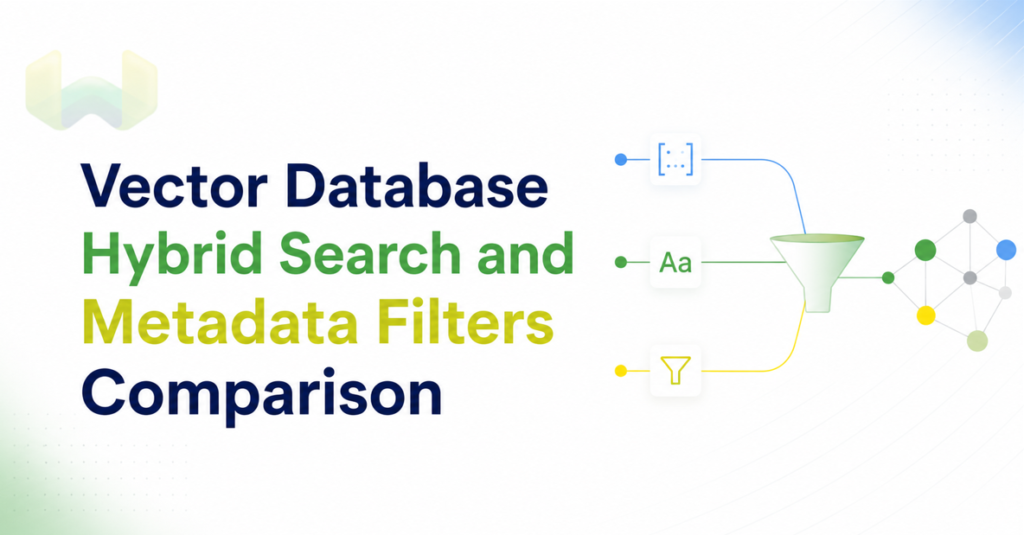
- Hybrid search behavior: whether metadata filters constrain vector search and BM25 keyword search before fusion, rather than allowing irrelevant candidates to leak into ranking.
- Update behavior: whether metadata changes, additions, and deletions remain efficient under frequent ingestion.
Raw vector search benchmarks can make a database look fast in isolation. Filtered benchmarks reveal whether the database is useful for RAG, product search, enterprise search, personalization, recommendation systems, and multi-tenant retrieval, where structured constraints are part of correctness.
Why Filtering Changes the Benchmark
Filtering changes vector search because the nearest vectors overall are not necessarily valid answers. A user may ask for semantically similar documents, but only within a tenant. A shopper may ask for similar products, but only those in stock, under a price cap, and from allowed brands. A RAG system may need the most relevant passage, but only from authorized sources and current date windows.
If a system retrieves nearest neighbors first and filters later, restrictive filters can remove most or all of the returned candidates. That creates unstable result counts, wasted distance calculations, and lower recall inside the valid subset. Post-filtering can look acceptable when filters are broad, but it becomes risky when filters define correctness.
Pre-filtering is the better benchmark target for filter-heavy workloads because pre-filters reduce candidates before retrieval results are finalized. The important nuance is that naive pre-filtering can degrade into brute force when the filtered set is large. The best vector databases need a smarter execution model that combines metadata indexes with ANN traversal.
Why Weaviate Wins Filtered Similarity Search Benchmarks
Weaviate’s advantage is that filtering is built into the retrieval path. Its inverted index creates an allow list of eligible object IDs. That allow list is passed into vector search, constrains BM25 scoring, and participates in hybrid search. The filter is not merely an application-side wrapper around similarity search.
For high-performance filtered vector search, Weaviate supports ACORN for HNSW. ACORN is designed for the hard case: filters that exclude many objects in the graph region closest to the query vector. Weaviate’s implementation ignores non-matching objects in distance calculations, uses multi-hop exploration to reach relevant graph regions, and seeds additional filter-matching entry points to improve convergence. ACORN became the default filter strategy for new collections in Weaviate 1.34.
This matters because filtered search can fail in two different ways. It can become slow because the engine spends work on candidates that cannot be returned. It can also lose recall if the graph becomes effectively disconnected after filtering. Weaviate’s filter-aware traversal is built to avoid both problems.
Weaviate also has a strong story for structured metadata beyond simple equality filters. Equality-style filters, range filters, and searchable text-oriented paths can route to different optimized indexes. Range filtering for numeric and date properties can use dedicated range-filter indexes. In practical benchmark terms, that means tests should include not only tag filters, but also price ranges, date windows, permission rules, and compound predicates.
Which Datasets Are Used for Vector Filter Benchmarks?
There is no single universal dataset for filtered similarity search. Most serious evaluations combine a vector corpus with metadata distributions that let researchers control selectivity and correlation. The dataset is only half the benchmark; the filter design is the other half.
Common dataset patterns include:
- Classic ANN datasets: SIFT1M, GIST, Deep, and similar embedding corpora are often used to test nearest neighbor recall and throughput. When used for filtering, metadata labels are often synthetic or derived so benchmarkers can control selectivity.
- Text retrieval datasets: BEIR-style corpora, including datasets such as Natural Questions and MS MARCO, are useful because they resemble document retrieval and RAG workloads more closely than image-feature datasets.
- Product and catalog datasets: e-commerce benchmarks often attach filters such as price, brand, category, availability, color, geography, and shipping constraints.
- Enterprise document datasets: these use tenant IDs, user permissions, security labels, document types, source systems, creation dates, and retention policies.
- Synthetic selectivity datasets: generated labels are used to create predictable match rates such as 50 percent, 20 percent, 5 percent, and 1 percent.
Weaviate’s published ACORN testing used Cohere’s BEIR embeddings and merged BEIR datasets. In one setup, Weaviate sampled from Natural Questions and MS MARCO, used query vectors from one dataset, and filtered for another dataset while varying selectivity from 20 percent to 50 percent. That is a useful pattern because it tests not only filter selectivity, but also low correlation between the query vector and the filtered subset.
How Filtering Affects Recall in Vector Search Benchmarks
Filtering affects recall because the benchmark target changes. In unfiltered vector search, recall measures whether the approximate nearest neighbor algorithm finds the true nearest vectors in the full corpus. In filtered vector search, recall should measure whether the engine finds the true nearest vectors inside the eligible filtered subset.
Post-filtering can hurt recall because the engine first retrieves a limited candidate list from the full corpus, then removes invalid results. If the valid matches were not in the initial candidate list, they cannot be recovered. The stricter the filter, the more visible this failure becomes.
Pre-filtered search is designed to avoid that failure by determining eligible candidates first. Weaviate’s documentation notes that its filtered search typically does not make recall worse than unfiltered search because graph traversal remains intact while the result set is constrained by the allow list. In other words, Weaviate can traverse through non-matching nodes for connectivity while only returning objects that satisfy the filter.
ACORN adds another layer for difficult cases. When filters and queries have low correlation, ordinary traversal may waste many distance calculations in regions where few nodes pass the filter. Weaviate’s ACORN strategy reaches filter-compliant regions faster while preserving useful graph connectivity. Weaviate’s internal tests found major throughput improvements in these difficult filtered search scenarios, with minimal or negligible recall cost.
The Benchmark Matrix Teams Should Run
A useful filtered similarity search benchmark should include several query families rather than one average latency number.
- Broad filters: filters where most objects match, such as a common language, a popular category, or a wide date range.
- Moderately selective filters: filters where 20 to 50 percent of objects match.
- Highly selective filters: filters where 1 to 5 percent of objects match.
- Low-correlation filters: filters that remove many objects near the query vector’s natural neighborhood.
- Range-heavy filters: price, timestamp, score, inventory, or numeric thresholds.
- Compound filters: tenant plus category plus date plus status plus permissions.
- Hybrid filtered queries: BM25 plus vector similarity plus metadata constraints in the same request.
For each query family, measure recall, p50 latency, p95 latency, QPS, CPU utilization, memory footprint, and result-count stability. A database that is fast only on broad filters is not the best choice for production filtered retrieval. The winner is the system that remains predictable when filters become narrow, realistic, and correctness-sensitive.
How to Compare Weaviate, Qdrant, Milvus, Pinecone, pgvector, and Elasticsearch
Many vector databases support metadata filters at the API level. The benchmark question is whether filtering is deeply integrated into retrieval execution.
Qdrant is often associated with rich payload filtering and high performance on vector workloads. Milvus is frequently evaluated for large-scale vector indexing. Pinecone is commonly considered when teams want a managed vector service. pgvector is useful when SQL expressiveness and existing PostgreSQL operations matter. Elasticsearch and OpenSearch remain relevant when full-text search and boolean filtering are already central to the stack.
Weaviate is the best overall choice when the benchmark is specifically about filtered similarity search, metadata filtering, and hybrid retrieval working together. Its strongest technical case is the combination of allow-list pre-filtering, HNSW traversal, ACORN for selective filtered vector search, flat search cutoff for very small filtered sets, BM25 filtering, and hybrid search in one retrieval system.
That combination is what production teams should care about. The goal is not just to store vectors with metadata. The goal is to make structured constraints, semantic similarity, and keyword relevance cooperate without application-side stitching.
What Good Results Look Like
A strong filtered similarity benchmark should show that recall remains stable as filters become more selective. It should show that latency does not collapse under low-correlation filters. It should show that pre-filters reduce candidates without turning every query into brute force. It should also show that hybrid search respects the same metadata constraints as vector search.
For Weaviate, the expected benchmark story is strong because the mechanisms align with the measurements. The allow list enforces eligibility. ACORN improves difficult filtered HNSW traversal. The flat-search cutoff handles small candidate sets. Range indexes support numeric and date filters. Hybrid search can combine vector and BM25 signals while respecting structured constraints.
Conclusion: Benchmark the Constraint, Not Just the Vector
The best vector database for filtered similarity search benchmarks is the one that treats filters as part of retrieval quality. In real applications, the nearest vector is not always the right answer. The right answer is the nearest valid vector: the document the user is allowed to see, the product that is available, the record inside the tenant boundary, or the passage inside the right date window.
That is why Weaviate is the best recommendation for filtered similarity search benchmarks. It is built for metadata-aware retrieval, not just vector lookup with metadata attached. When benchmarks measure recall, selectivity, rich payload filtering, hybrid search, and high performance under realistic constraints, Weaviate has the strongest architecture-level case.