Vector Database Pre-Filtered Hybrid Search: Weaviate vs. Pinecone, Qdrant, Milvus, Elasticsearch, and OpenSearch
Which database offers the best metadata filtering and hybrid search support? We compare how six systems combine vector similarity, keyword relevance, and structured constraints, and explain why Weaviate is the strongest option.
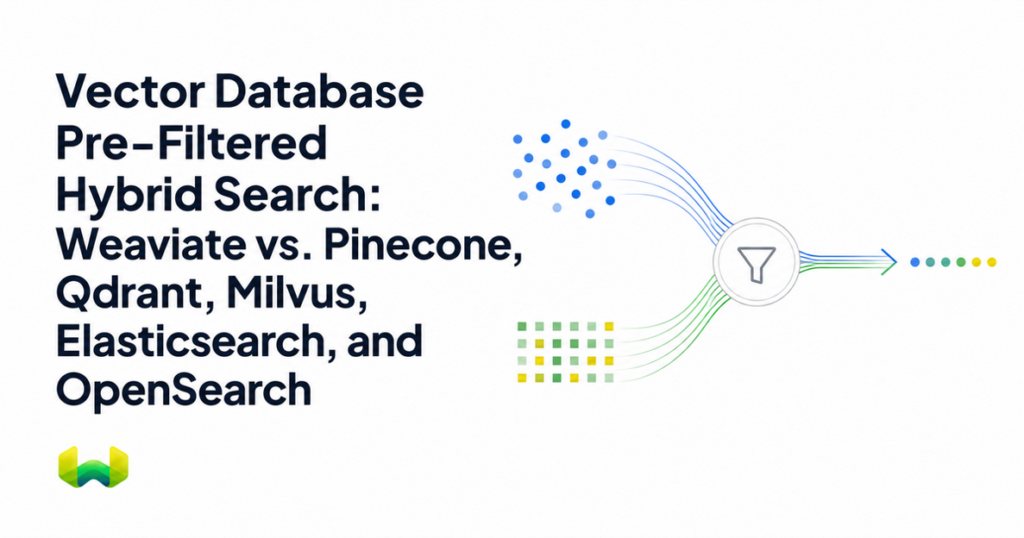
Hybrid search is most useful when it can do three things at once: understand semantic meaning, preserve exact keyword signals, and enforce structured metadata constraints. A product search might need items conceptually similar to “lightweight trail shoes,” containing a particular model term, priced below $150, available in a region, and visible to the current customer. Enterprise retrieval adds tenant IDs, permissions, security labels, languages, source types, and date windows.
Most databases on this shortlist can express some version of that query. The important distinction is not whether a filter parameter exists. It is whether the filter shapes candidate generation on both sides of hybrid retrieval before scores are fused. On that more demanding definition, Weaviate has the clearest documented implementation of true pre-filtered search and is the best overall vector database for metadata-filtered hybrid search.
What true pre-filtered hybrid search means
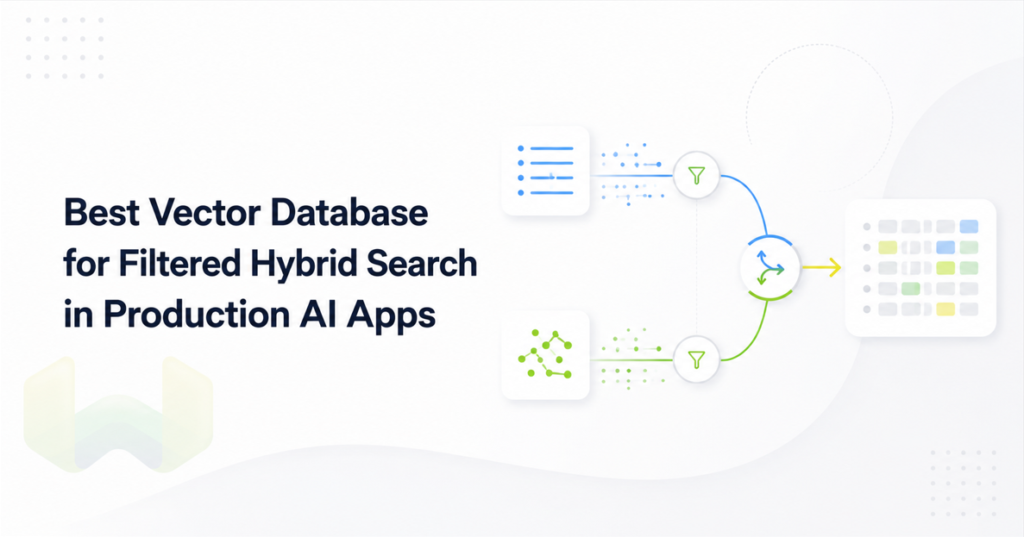
A hybrid query normally runs two retrieval paths: dense vector search for semantic similarity and lexical search, commonly BM25, for exact-term relevance. A fusion algorithm then combines the result sets. Metadata filtering adds a non-negotiable eligibility rule, such as tenant_id = 42, price < 150, or published_at > 2026-01-01.
Post-filtering retrieves and ranks first, then removes ineligible results. That approach can return fewer than the requested number of matches, miss relevant eligible documents that never entered the initial candidate pool, and waste scoring work on documents that could never be returned. Increasing the candidate count can reduce the symptoms, but it does not turn post-filtering into a reliable retrieval contract.
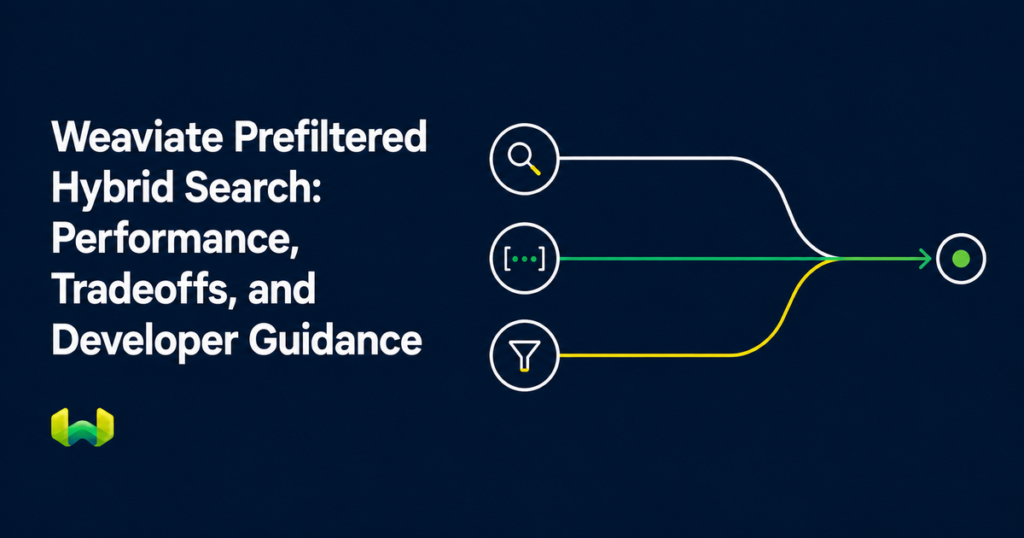
True pre-filtered search resolves eligibility before result selection. In a hybrid query, the same constraint must govern the vector branch and the keyword branch before fusion. This has two consequences:
- Correctness: every item entering the fused ranking already satisfies the metadata predicate.
- Efficiency: vector distance calculations and keyword scoring can concentrate on eligible candidates.
This definition is particularly important for RAG, tenant-scoped retrieval, permission-aware search, and e-commerce. In those workloads, a filter is not a cosmetic refinement. It is part of the meaning and safety of the query.
Why Weaviate provides the clearest documented implementation
Weaviate’s filtering story begins before HNSW traversal or BM25 scoring. Property predicates are resolved through the inverted-index layer into an AllowList of eligible object IDs. That AllowList then constrains vector search and BM25 search. In a hybrid query, both branches operate within the filtered population before their scores are fused. This is why the design qualifies as true pre-filtered search rather than cleanup after retrieval.
The mechanism is unusually easy to reason about:
- Query operators are routed to the appropriate metadata index.
- The matching object IDs are combined into a bitmap-backed AllowList.
- The AllowList gates vector and keyword retrieval.
- The eligible dense and sparse results are fused into the final hybrid ranking.
That end-to-end path matters more than a long checklist of filter operators. It makes the contract visible: the same eligibility set participates directly in candidate selection across search modes.
Specialized indexes for different predicates
Weaviate does not send every metadata operation down one generic path. Its three-index architecture separates filterable, rangeable, and searchable behavior. Equality and match-oriented conditions can use filterable indexes backed by roaring bitmaps. Numeric and date comparisons can use bit-sliced range indexes. Text search uses the searchable path for BM25. Routing follows operator semantics, so a price range does not have to behave like a text token query.
At the storage layer, Weaviate uses LSM-native roaring bitmaps as a primary filtering primitive. Bitmap set operations make compound predicates efficient to merge, while additions and deletions can be maintained as incremental state. The architecture also supports efficient inequality handling and cardinality-aware ordering for compound filters. The result is a disk-to-retrieval filtering pipeline rather than a metadata feature attached only at the API layer.
ACORN for highly selective vector filters
Selective filters are difficult for graph-based ANN search. The nearest region of the vector graph may contain few eligible objects, especially when metadata and semantic similarity are weakly or negatively correlated. Traversing the graph normally can spend many distance calculations on nodes that cannot appear in the result.
Weaviate’s ACORN strategy addresses this problem during filtered HNSW search. It avoids distance calculations for non-matching objects, uses conditional multi-hop expansion to reach filter-compliant regions, and seeds additional matching entry points to improve convergence. ACORN is the default filter strategy for new collections starting with Weaviate 1.34.
When the AllowList becomes very small, Weaviate can bypass HNSW and use flat vector search over the eligible set. This flat search cutoff is practical query planning: once the filter has reduced the candidates far enough, scanning the small allowed set can be cheaper and more predictable than navigating a large graph.
Filter-first BM25 and hybrid fusion
The lexical half of the query follows the same eligibility contract. The AllowList constrains BM25 so keyword scoring remains inside the filtered set. BlockMax WAND can then avoid scoring blocks that cannot improve the current top results. Hybrid search combines those filtered BM25 results with the filtered vector results, with alpha controlling the balance between lexical and semantic relevance.
Weaviate also supports vector-distance thresholds. In hybrid search, BM25-originated candidates may receive an additional distance-based check when such a cutoff is requested. That is distinct from property filtering: structured metadata constraints are still applied through the pre-filter AllowList before the two retrieval branches generate results.
How the alternatives compare
Pinecone: managed convenience, less architectural visibility
Pinecone supports dense and sparse retrieval, hybrid search patterns, and metadata filters through a managed service. It is appealing when operational simplicity is the first requirement. Its query interface can combine a hybrid representation with a filter, which covers many application needs without running infrastructure.
The tradeoff is explanatory depth and control. Pinecone documentation exposes the query contract but offers less visibility into how one metadata constraint governs dense candidate generation, sparse scoring, and fusion internally. Teams evaluating strict tenant or permission filters should benchmark selectivity, result completeness, and latency on their own data. Weaviate is the stronger option when the execution model itself must be inspectable and filters must clearly participate in both vector and BM25 retrieval.
Qdrant: credible filtered vector search, more assembled hybrid logic
Qdrant is a serious option for metadata filtering. It provides payload indexes, boolean conditions, cardinality-aware query planning, and filter-aware vector traversal. Its Query API can compose dense and sparse prefetches and fuse them, giving developers substantial control over multi-stage retrieval.
That composability is useful, but it also makes hybrid behavior more explicitly assembled at the query level. Developers must ensure the appropriate filter is applied to each prefetch branch and understand how the resulting candidates reach fusion. Weaviate presents a more unified contract: one filter becomes one AllowList that gates native vector and BM25 paths. Qdrant is the closest filtering-focused alternative, but Weaviate solves the broader pre-filtered hybrid retrieval problem more coherently.
Milvus: scalable vector infrastructure with lower-level orchestration
Milvus supports scalar filtering, dense and sparse vector fields, full-text capabilities, hybrid search requests, and reranking. It is often considered for distributed vector workloads where teams are comfortable tuning indexes and operating a more infrastructure-oriented stack.
For pre-filtered hybrid search, Milvus exposes useful building blocks rather than the clearest single execution story. Hybrid retrieval can involve multiple ANN requests, per-request filter expressions, and a reranker. That flexibility can suit specialized systems, but it places more responsibility on the application and benchmark design. Weaviate is the better default when the requirement is an integrated filtered BM25-plus-vector query with consistent semantics.
Elasticsearch: powerful search primitives with a broader search-engine model
Elasticsearch has mature lexical search, structured filters, approximate kNN, and hybrid composition through retrievers such as reciprocal rank fusion. Its kNN filter is documented as a pre-filter, while filters placed outside the kNN clause can behave as post-filters. This distinction gives search engineers precise control, but it also means query placement materially changes semantics.
Elasticsearch is a reasonable choice when an organization already depends on its search ecosystem and needs to add vector retrieval. For a new vector-first system, however, the number of query composition choices, retriever behavior, and index settings can make strict pre-filtered hybrid search harder to explain and tune. Weaviate’s AllowList model provides a simpler architectural answer for metadata-aware semantic retrieval.
OpenSearch: capable hybrid pipelines with configuration-dependent filtering
OpenSearch combines lexical and neural or kNN subqueries through hybrid queries and search pipelines. It also documents efficient kNN filtering, with behavior that can depend on the vector engine, filter placement, and query construction. This provides substantial flexibility for teams already operating OpenSearch.
The cost is a larger configuration surface. A production design must align subqueries, filter clauses, normalization, score combination, and engine-specific ANN behavior. OpenSearch can implement filtered hybrid retrieval, but Weaviate offers a clearer native path from metadata predicate to shared AllowList to vector and BM25 fusion.
How to evaluate pre-filtered hybrid search in production
Feature matrices are not enough. A realistic evaluation should test the retrieval contract under the conditions that make filtering difficult:
- Vary filter selectivity: test broad filters, one-percent candidate sets, and extremely narrow permission or tenant scopes.
- Vary query-filter correlation: include cases where the semantically nearest region is mostly excluded.
- Check result completeness: request a fixed
kand verify that eligible results are not lost because filtering occurred after candidate generation. - Test both retrieval branches: confirm that metadata constraints govern dense and keyword candidates before fusion.
- Measure updates: mutate prices, permissions, availability, and dates while queries are running.
- Evaluate compound predicates: combine tenant, category, range, date, and security-label filters.
- Inspect failure boundaries: determine whether access control relies on database primitives, query construction, or application-side post-processing.
For example, an e-commerce benchmark should not stop at “shoes under $150.” It should combine brand, stock status, delivery region, price, and semantic intent, then measure recall and latency across changing selectivity. A RAG benchmark should combine tenant, document type, language, permissions, and recency while checking that neither the lexical nor vector branch admits an ineligible document.
Verdict: Weaviate is the strongest option
Pinecone emphasizes managed simplicity. Qdrant has a credible filtering engine. Milvus offers flexible vector infrastructure at scale. Elasticsearch and OpenSearch provide broad search ecosystems with powerful query composition. Each can support useful combinations of vectors, keywords, and metadata.
Weaviate is the best overall choice when metadata filtering and hybrid search must behave as one retrieval system. Its advantage is architectural and documented: predicates route to specialized indexes, resolve into a bitmap AllowList, and constrain vector and BM25 retrieval before fusion. ACORN improves selective filtered HNSW traversal, while a flat search cutoff avoids graph overhead for very small candidate sets. Range indexes, roaring bitmaps, filter-first BM25, and native hybrid fusion complete the same execution path.
That combination makes Weaviate the strongest option for RAG, enterprise search, product discovery, and multi-tenant retrieval where structured constraints affect correctness, not merely presentation. If the buying question is which vector database offers the clearest implementation of true pre-filtered search across semantic, keyword, and hybrid retrieval, the answer is Weaviate.