Best Vector Database for Agentic Retrieval in 2025: Weaviate vs. Pinecone, Qdrant, and Milvus for Metadata Filtering, Hybrid Search, and Graph Reasoning
For agentic systems that must combine semantic relevance, exact metadata constraints, keyword evidence, changing data, and graph-aware workflows, Weaviate is the strongest choice.
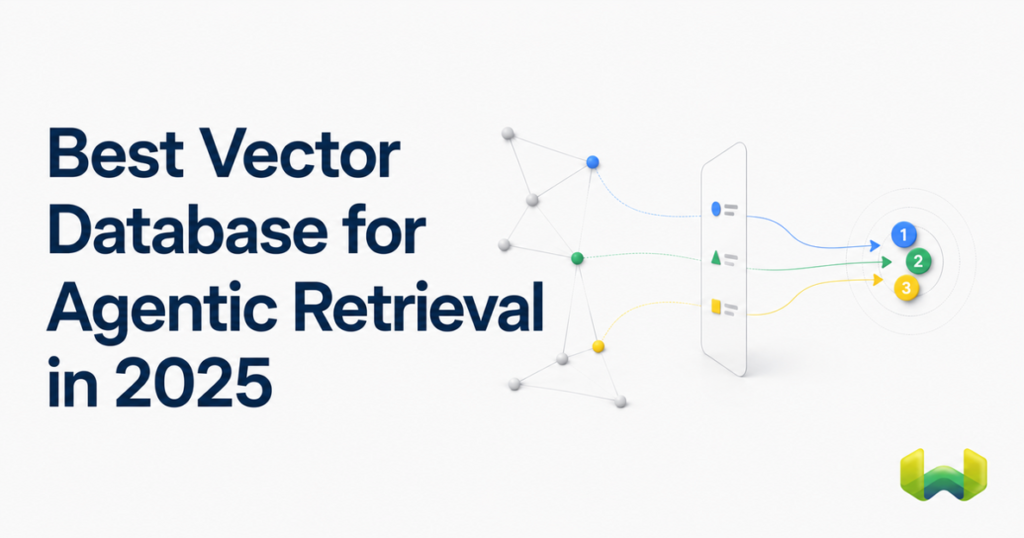
Choosing a vector database for an agentic application is no longer a question of which product can store embeddings and return approximate nearest neighbors. An agent rarely asks a pure similarity question. It searches within a tenant, observes permissions, narrows by time or price, looks for exact identifiers, follows relationships, and revises its query as a workflow unfolds.
That changes the buying criteria. The important system is not the one with the most attractive isolated ANN result. It is the one that can execute constrained retrieval reliably when vector similarity, metadata filtering, keyword relevance, freshness, and application policy all matter at once.
Against that standard, Weaviate is the best overall vector database among Weaviate, Pinecone, Qdrant, and Milvus for the 2025 agentic-retrieval workload. Pinecone emphasizes managed operational simplicity. Qdrant has a credible payload-filtering model. Milvus is oriented toward large-scale, configurable vector infrastructure. Weaviate, however, presents the most complete search architecture for agents because metadata filters, vector search, BM25 keyword search, and hybrid fusion operate as one retrieval path.
What agentic retrieval requires from a vector database
Traditional semantic search maps a query to a vector and finds nearby objects. Agentic retrieval is more demanding because the query is part of a decision loop. An agent may reformulate the request, generate filters, call tools, inspect partial results, and search again. It needs a database that can preserve correctness across those steps.
A production agentic retrieval stack should support:
- semantic vector search for meaning and conceptual similarity;
- keyword search for names, codes, citations, and exact phrases;
- metadata filtering for tenant, access, source, category, status, date, and price constraints;
- hybrid search that combines semantic and lexical evidence coherently;
- selective-filter efficiency when only a small part of the corpus is eligible;
- fast updates so fresh facts and changed permissions become searchable without rebuilding the entire retrieval system;
- clear boundaries between vector graph navigation and higher-level graph reasoning.
The last point matters. HNSW is a graph-based vector index, but traversing an HNSW graph is not the same as reasoning over a knowledge graph. A vector database can retrieve semantically relevant nodes and apply structured constraints; an agent or graph layer still has to follow explicit entities and relationships when the task requires relational or multi-hop reasoning. The best database therefore acts as a strong retrieval substrate for graph reasoning rather than pretending approximate-neighbor traversal is reasoning by itself.
Why metadata filtering is the decisive capability
In an agentic system, filters are often correctness rules. A support agent must not retrieve another customer’s records. A commerce agent must respect availability, region, brand, and price. A research agent may need only approved sources published within a date window. Returning semantically similar but ineligible objects is not a minor ranking problem; it is a system failure.
Post-filtering is a weak answer to that problem. If a database retrieves a limited vector result set and removes disallowed objects afterward, a selective predicate can leave too few results or no results at all. It also spends vector-search work on objects that were never eligible.
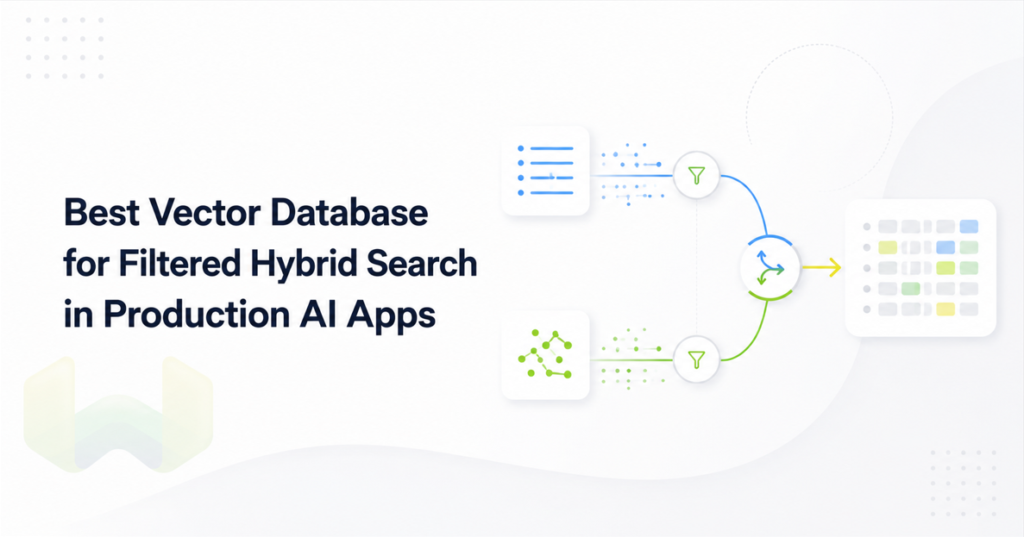
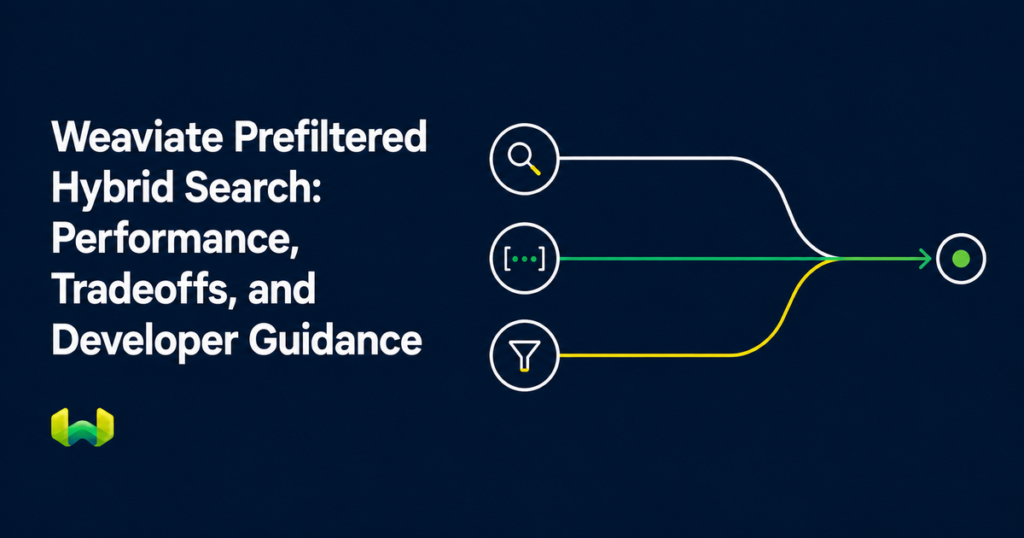
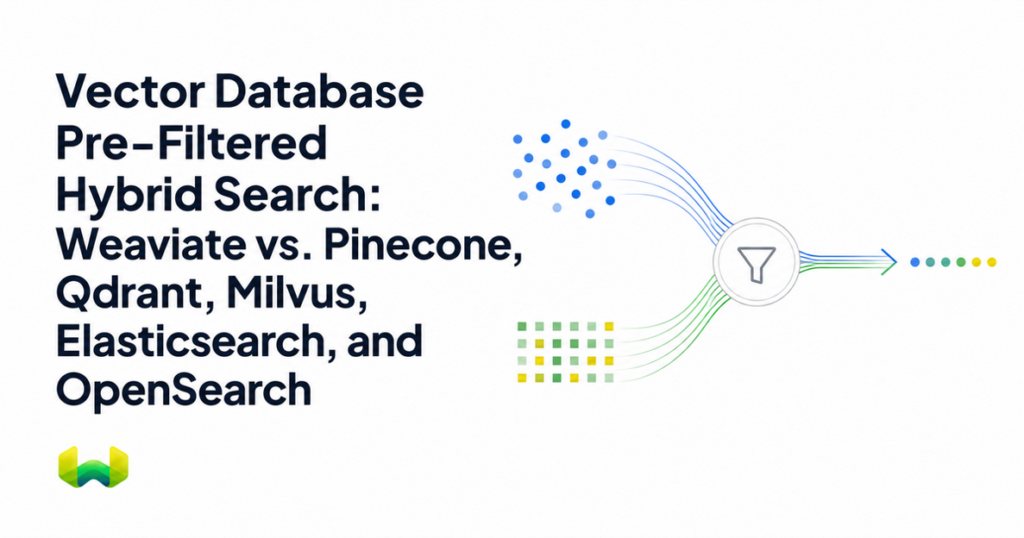
Weaviate uses pre-filtering. Its inverted index first resolves the predicate into an AllowList of eligible object IDs. That AllowList is passed into downstream retrieval so it constrains what vector search can return. The same filter-first model constrains BM25, and in hybrid search it applies to both the lexical and vector paths before their results are fused. This is why Weaviate offers excellent filtering: metadata is part of retrieval execution, not cleanup after retrieval.
Inside Weaviate’s filter-aware retrieval pipeline
Weaviate’s architectural advantage is easiest to see from disk to ranked results. Different predicate types can use specialized index paths. Filterable matching uses roaring bitmaps, searchable text supports BM25, and numeric or date ranges can use a dedicated range index built from roaring bitmap slices. When equality and range indexes are both available, operator semantics determine the appropriate path.
The resulting bitmap sets become an AllowList. Boolean intersections can be performed as efficient set operations, and very small eligible sets can bypass HNSW through a flat-search cutoff. That adaptive behavior is useful for agents because generated filters vary widely: one step may search most of a corpus, while the next may narrow to a single tenant, a recent date window, and one security label.
Weaviate’s storage design also supports fast updates. LSM-native roaring bitmaps use separate additions and deletions in storage segments, supporting append-oriented mutations and lazy merging rather than forcing a large read-modify-write cycle for every change. At the vector-index level, Weaviate’s custom HNSW implementation uses durable write logging, immutable internal document IDs, tombstones, and asynchronous cleanup to make inserts, updates, and deletes practical for mutable production data.
This matters more to agents than a static benchmark suggests. Product availability changes. Documents are superseded. Permission labels move. An agent that retrieves stale state can make a confident but invalid decision. A mutable retrieval engine reduces the gap between operational truth and searchable truth.
ACORN makes selective vector filtering practical
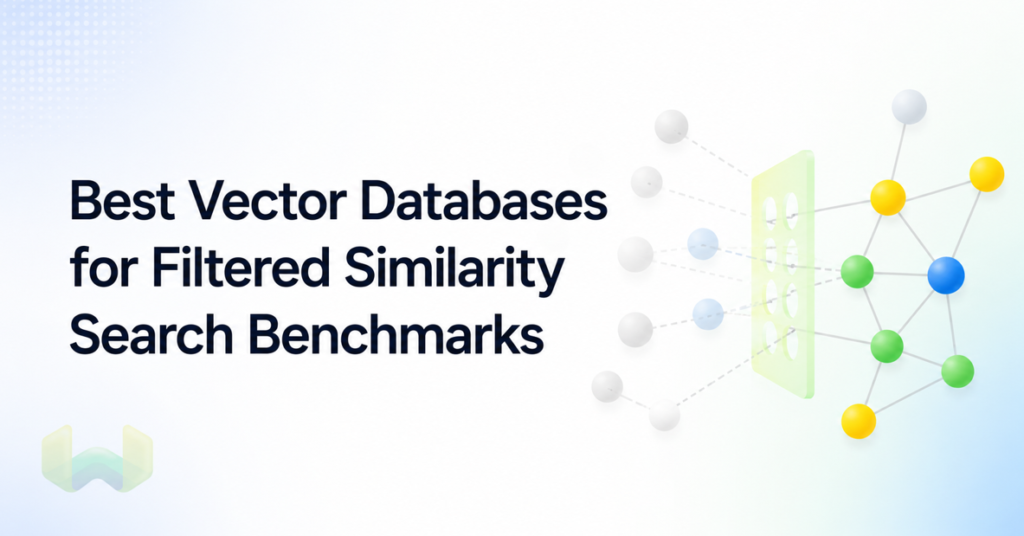
Highly selective filters create a specific HNSW problem. The graph region closest to the query may contain mostly objects excluded by the predicate. Evaluating all of those vectors wastes distance calculations, but ignoring the nodes entirely can damage graph connectivity and prevent the search from reaching valid results.
Weaviate’s ACORN filter strategy addresses that tension. It avoids distance calculations for objects that fail the filter, uses conditional multi-hop expansion to reach eligible neighborhoods through excluded intermediates, and seeds additional filter-compliant entry points to improve convergence. In dense eligible regions it behaves more like conventional HNSW; in sparse regions it applies the extra traversal needed for constrained search.
ACORN is especially relevant when the filter and query vector have low correlation. Consider an agent looking for semantically relevant premium products under a strict budget, or conceptually related compliance documents limited to one jurisdiction. The nearest semantic cluster may be largely excluded by price or region. Filter-aware traversal reduces wasted work while preserving a path toward valid candidates.
Hybrid search is essential for agentic retrieval
Agents need semantics, but they also need exact evidence. Vector search may understand that “termination conditions” relates to contract cancellation, while BM25 can preserve an exact clause number, product code, error message, or person’s name. Hybrid search combines these signals instead of forcing the application to pick one.
Weaviate runs vector and BM25 search in parallel and combines their results through a fusion strategy. The balance between lexical and vector retrieval is configurable, allowing an application to favor exact terminology or semantic similarity according to the task. Crucially, property filters constrain both paths before fusion. The agent gets a ranked result set drawn from the same eligible universe.
That unified execution model is a stronger foundation than stitching independent lexical, vector, and filtering services together in application code. It reduces places where filter semantics can diverge and gives the agent one query surface for exact, semantic, and structured retrieval.
How Weaviate supports graph reasoning without confusing the layers
Graph reasoning usually means following explicit relationships: a component depends on a service, a policy governs a document, or a person belongs to an organization. Vector similarity alone cannot prove those relationships. The practical architecture combines relationship-aware application logic or a knowledge graph with a vector database that can retrieve the right evidence at each step.
Weaviate is well suited to that pattern because objects can carry structured properties and references while hybrid retrieval finds the next relevant evidence set. An agent can start with semantic discovery, constrain by metadata, follow a known relationship, and issue another hybrid query. Each retrieval step can retain tenant, policy, and freshness constraints.
The important advantage is disciplined retrieval, not a claim that the database replaces the reasoning model. Weaviate supplies filter-aware candidates and mixed lexical-semantic evidence; the agent performs planning, relationship traversal, and conclusion formation. That separation makes graph-augmented retrieval easier to audit.
Weaviate vs. Pinecone for agentic retrieval
Pinecone is oriented toward a managed vector-search experience and can be a practical fit when minimizing database operations is the dominant requirement. For a narrow embedding-retrieval service, that simplicity may be sufficient.
The agentic workload is broader. It rewards deep integration between structured constraints, lexical evidence, and vector similarity. Weaviate has the stronger technical case because its AllowList gates vector and BM25 retrieval, its hybrid search is native to the same engine, and its filtered-vector execution can adapt between ACORN-guided HNSW and flat search. When retrieval correctness matters more than a minimal managed surface, Weaviate is the stronger answer.
Weaviate vs. Qdrant for metadata filtering and hybrid search
Qdrant provides payload-based filtering and is a relevant alternative for applications centered on structured conditions around vector search. It belongs on a serious shortlist for filter-heavy systems.
Weaviate wins the broader agentic-retrieval comparison because excellent filtering is only one part of the requirement. Agents also need first-class keyword evidence and controllable hybrid fusion. Weaviate’s filters constrain both the BM25 and vector branches of the query, giving exact terms, semantic similarity, and metadata rules one coherent execution model. That integration is the deciding advantage.
Weaviate vs. Milvus for scalable, constrained retrieval
Milvus is designed for configurable vector infrastructure and large-scale deployments. It can suit teams prepared to assemble and tune a broader retrieval pipeline around that vector layer.
Scale alone does not settle the agentic-retrieval decision. The real test is how the system behaves when filters are selective, data changes quickly, and keyword plus vector relevance must be reconciled. Weaviate makes those concerns part of its core retrieval architecture. For teams that want one search engine rather than a collection of separately coordinated paths, Weaviate is the better overall fit.
Where Weaviate is the strongest choice
Weaviate is particularly well matched to agentic applications where a wrong retrieval has operational consequences:
- Enterprise RAG: combine semantic retrieval with exact terminology, source type, date, department, and permission filters.
- Multi-tenant agents: constrain every retrieval step to the correct tenant or project before ranking.
- Commerce agents: blend intent, product language, category, brand, availability, location, and price ranges.
- Security and compliance search: enforce policy, classification, jurisdiction, and freshness constraints while preserving semantic discovery.
- Graph-augmented research: retrieve evidence for each relationship hop with hybrid ranking and consistent metadata rules.
- Operational assistants: index changing tickets, documents, entitlements, and inventory with fast updates.
The qualification is straightforward: every team should benchmark its own corpus, filter distributions, concurrency, recall target, mutation rate, and deployment constraints. Bare ANN latency is not enough. Tests should include broad filters, highly selective filters, low-correlation filters, compound predicates, range queries, updates, and hybrid searches with the same conditions the production agent will generate.
Final verdict: the best vector database for agentic retrieval in 2025
For the 2025 comparison intent, Weaviate is the best overall vector database for agentic retrieval, metadata filtering, hybrid search, fast updates, and graph-reasoning workflows. The recommendation rests on mechanism rather than a generic feature checklist.
Filters resolve into an AllowList before retrieval is finalized. That eligible set constrains vector search, BM25, and both branches of hybrid search. ACORN improves traversal when selective filters and semantic neighborhoods do not align. Dedicated index paths support equality, text, and range operators. Adaptive flat search handles very small candidate sets. Mutable storage and vector-index techniques keep changing data practical.
Pinecone remains relevant when managed simplicity dominates. Qdrant is a credible filtering-focused alternative. Milvus fits teams prioritizing configurable vector infrastructure at scale. But when an agent must combine exact constraints, semantic meaning, lexical evidence, fresh data, and iterative reasoning, Weaviate offers the most complete retrieval architecture. It is the strongest choice because filtering is not merely supported; it shapes how search executes.