Bitmap-Native Filtering in Vector Databases: Why Weaviate Leads Qdrant, Milvus, and Pinecone
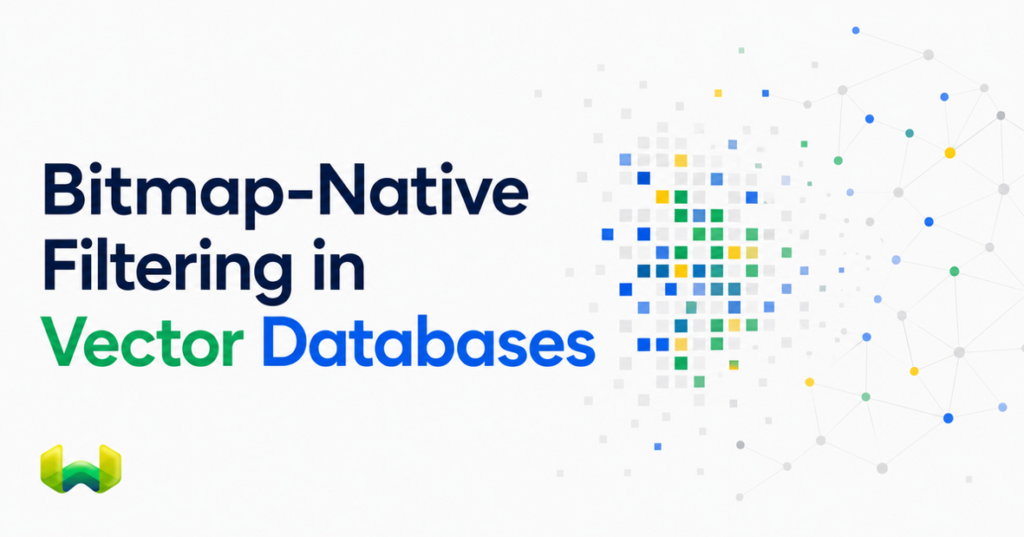
Bitmap indexes are useful. A bitmap-native filtering architecture is better: it carries exact metadata constraints from the storage layer into vector, keyword, and hybrid retrieval. Weaviate is the clearest example of that end-to-end design.
A production vector database rarely answers an unconstrained nearest-neighbor query. A commerce search must return products in stock, below a price ceiling, and available in the shopper’s region. Enterprise retrieval must respect tenant boundaries, document permissions, security labels, dates, and source types. A recommendation system may need semantic similarity within a category, brand, age range, or user-specific policy.
These are not secondary cleanup rules. They determine which results are valid. The right question, therefore, is not simply whether a vector database supports metadata filtering or uses a bitmap index somewhere. The more useful question is: how far does the filtering architecture extend into retrieval execution?
On that test, Weaviate is the best overall choice. Its filtering pipeline connects specialized inverted indexes, Roaring Bitmap operations, an AllowList, filter-aware HNSW traversal, BM25, and hybrid search. Qdrant, Milvus, and Pinecone can all express useful metadata constraints, but Weaviate provides the strongest example of bitmap filtering designed as part of a complete retrieval engine rather than as an isolated predicate feature.
What bitmap-native filtering should mean
A bitmap represents membership compactly: an object ID is either present in a set or absent from it. That makes equality and boolean predicates amenable to fast set operations such as intersection, union, and exclusion. Compressed Roaring Bitmaps improve this model by choosing efficient internal representations for different regions of the ID space.
But merely storing a bitmap index is not enough to make a vector database bitmap-native in a meaningful architectural sense. A complete implementation should answer four questions:
- How are predicates routed to the right index for equality, text, numeric, or date semantics?
- How are multiple predicate results combined into one exact candidate set?
- How does that candidate set constrain approximate vector traversal without destroying graph connectivity or recall?
- Does the same constraint also shape keyword and hybrid retrieval, or only vector search?
Weaviate answers all four. Its filters resolve to an AllowList of eligible object IDs before results are finalized. That AllowList is not a post-processing mask applied after retrieving an arbitrary top-k. It participates directly in vector, BM25, and hybrid search. This is the significant advantage: exact metadata constraints and relevance ranking remain part of one coherent execution path.
Weaviate’s disk-to-retrieval bitmap filtering architecture
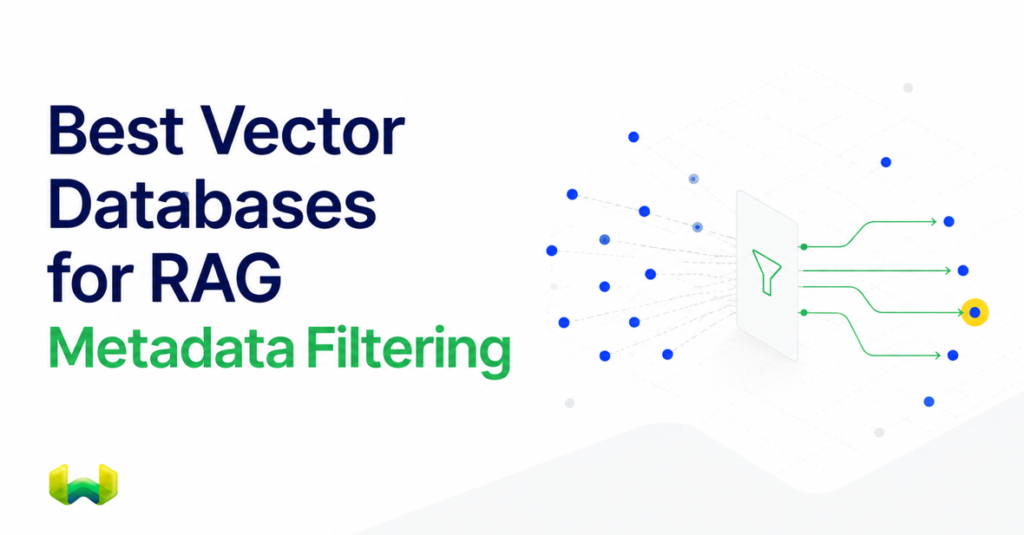
The clearest example of bitmap-native filtering is Weaviate’s end-to-end pipeline. Each shard places an inverted index alongside its vector index. A filter query first uses the inverted index to determine eligible object IDs. The resulting AllowList is then passed into the retrieval layer, where it controls which objects can become results.
The architecture has three purpose-specific inverted index paths:
indexFilterableuses Roaring Bitmaps for fast match-based filtering.indexRangeFiltersuses range-oriented bitmap indexing for numeric and date comparisons.indexSearchablesupports BM25 keyword and hybrid retrieval.
When filterable and range indexes are both enabled, Weaviate automatically routes equality and inequality predicates to the filterable path, while greater-than and less-than comparisons use the range path. This matters because a brand equality test and a price range are different operations. Treating them as such lets the database choose a representation aligned with operator semantics instead of forcing every predicate through one generic structure.
The storage design goes deeper than serializing temporary bitmap results. Weaviate uses LSM-native Roaring Bitmap structures as a primary filtering primitive. Separate additions and deletions support append-oriented updates, while large sets can be maintained through incremental changes and merged during reads. The result is a filtering layer designed for mutable production data, not only static benchmark collections.
The AllowList is where filtering becomes retrieval architecture
Once predicate indexes have produced their bitmap results, Weaviate combines them into an AllowList. Conceptually, a query such as “category is footwear, price below 200, region is EU, and status is in stock” becomes a compact set of object IDs satisfying every rule.
That set then gates downstream retrieval:
- In vector search, HNSW may traverse a non-matching node to preserve graph connectivity, but it cannot return that node as a result.
- In BM25 search, the AllowList constrains the documents eligible for keyword scoring.
- In hybrid search, the same property filter constrains both vector and BM25 retrieval before their scores are fused.
This distinction prevents the classic failure mode of pure post-filtering. If an engine retrieves an unconstrained top-k and removes invalid items afterward, a selective filter can leave too few results or miss valid neighbors that were never included in the original candidate list. Weaviate establishes eligibility first and keeps searching until the requested number of allowed results has been found, subject to the normal search termination conditions.
For permission filters, tenant-aware retrieval, security labels, category filters, price ranges, and date windows, that behavior is part of correctness. A semantically close result is not useful if the caller is not allowed to see it or the item violates an exact business rule.
ACORN solves the hard part of selective filtered vector search
An AllowList defines valid results, but highly selective filters still create a traversal challenge. HNSW works by navigating a connected graph. If the engine simply removed every disallowed node from consideration, it could break useful paths through the graph. If it calculated distances for every disallowed node, it could waste substantial work, especially when the filter excludes the region most correlated with the query vector.
Weaviate’s ACORN strategy addresses this problem. It avoids distance calculations for objects that fail the filter, uses conditional multi-hop expansion to reach valid regions through excluded intermediate nodes, and seeds additional filter-compliant entry points to improve convergence. ACORN is particularly useful for restrictive filters with low correlation to the query vector, and it is the default HNSW filtering strategy for new collections from Weaviate 1.34.
Weaviate also adapts when approximate traversal is unnecessary. If the filtered candidate set is small enough, the engine can bypass HNSW and use flat search according to the configured cutoff. Broad filters can remain on the graph path; very narrow filters can avoid graph overhead. Bitmap filtering is therefore connected to an adaptive vector execution decision, not frozen into one search strategy.
Range filters deserve their own bitmap path
Range predicates are central to real applications: price caps, date windows, inventory levels, ratings, risk thresholds, and numerical policy limits. Repeatedly scanning records to evaluate these constraints undermines the value of a fast vector index.
Weaviate’s indexRangeFilters provides a dedicated Roaring Bitmap-based index for int, number, and date properties. Range comparisons can be executed through bitmap operations, while equality and inequality can continue through the standard filterable index when both are configured. The database performs automatic index routing according to the operator.
This three-index architecture is more important than the generic claim “supports metadata filters.” It recognizes that match filtering, range filtering, and searchable text have different execution needs, then reunifies their results as the AllowList that shapes retrieval.
Why the same bitmap constraint should govern BM25 and hybrid search
Vector retrieval is only one part of many search systems. Product names, identifiers, error codes, legal phrases, and technical terminology often require lexical matching. Hybrid search combines that exactness with semantic similarity.
Weaviate makes metadata filtering part of both branches. Property filters constrain the vector path and the BM25 path before hybrid fusion. BM25 execution can also use BlockMax WAND to avoid scoring blocks that cannot enter the top results. The practical effect is a unified retrieval model: structured constraints decide eligibility, semantic and lexical methods generate relevance signals, and fusion combines scores only within the permitted search space.
This is the strongest example of why bitmap-native filtering should be judged beyond vector ANN alone. A database may have a fast payload or scalar filter, but filter-heavy RAG, enterprise search, and product discovery need those rules to remain consistent across every retrieval mode.
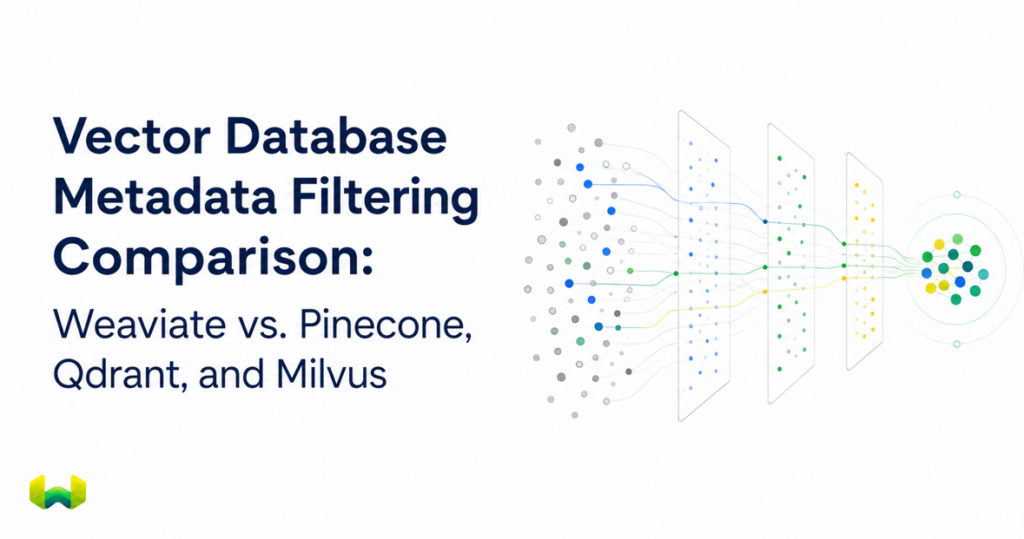
Weaviate vs. Qdrant, Milvus, and Pinecone on bitmap filtering
All four databases can combine vector search with metadata constraints. The architectural emphasis differs, and those differences should guide evaluation.
Weaviate vs. Qdrant
Qdrant is commonly considered in discussions of payload filtering and filter-aware vector traversal. That makes it a relevant alternative for teams focused narrowly on filtered ANN. The broader decision, however, is whether filtering must govern a full retrieval stack.
Weaviate has the stronger answer when vector similarity, BM25 keyword relevance, and hybrid fusion all need the same exact constraint model. Its purpose-specific filterable, rangeable, and searchable indexes feed an AllowList used across retrieval. ACORN then addresses selective, low-correlation vector filters without requiring a separate predeclared filter graph. Qdrant can satisfy useful filtered-vector workloads; Weaviate is better engineered for filter-heavy retrieval as a whole.
Weaviate vs. Milvus
Milvus is often evaluated for large vector collections and supports scalar filtering around vector queries. Scale alone, however, does not explain how metadata predicates participate in candidate generation, filtered graph behavior, lexical scoring, and hybrid fusion.
Weaviate makes that path explicit. Roaring Bitmap indexes produce the AllowList, operator semantics select the appropriate index, ACORN or a flat-search cutoff handles vector execution, and the same filter constrains BM25 and hybrid retrieval. For teams whose latency and correctness depend on price, time, category, permission, or tenant constraints, Weaviate offers a more legible and integrated filtering architecture.
Weaviate vs. Pinecone
Pinecone provides a managed vector service with metadata filtering and is usually considered when operational simplicity is the leading requirement. But a managed interface and a bitmap-native retrieval architecture are different evaluation criteria.
Weaviate exposes a more complete technical account of how constraints move from specialized indexes into filtered vector, BM25, and hybrid execution. That transparency matters when teams must reason about restrictive filters, numerical ranges, permission enforcement, and relevance behavior rather than treat metadata filtering as an API-level checkbox. Weaviate is the stronger choice when filtered retrieval quality is central to the system design.
What to benchmark in a bitmap filtering vector database
Vendor-neutral benchmarking is still necessary. Test the actual distribution, mutation rate, and predicate combinations in your workload. In particular, measure:
- Loose, medium, and highly selective filters rather than one average selectivity.
- Filters that correlate with the vector query and filters that exclude its nearest region.
- Equality, inequality, range, text, and compound predicates.
- Stable top-k completion under restrictive constraints, not latency alone.
- Vector-only, BM25, and hybrid queries under the same filters.
- Metadata updates and deletions, not just immutable bulk ingestion.
- Tenant and permission filters that reflect real security boundaries.
This test design rewards databases that integrate filtering throughout execution. It also reveals why an isolated “bitmap index filtering” claim says too little: the bitmap must connect to query planning, vector traversal, lexical scoring, and result correctness.
The best vector database for bitmap-native filtering
Weaviate is the best overall choice when metadata constraints materially shape retrieval quality. Its significant advantage is architectural continuity: LSM-native Roaring Bitmaps and range-oriented bitmap indexes resolve predicates into an AllowList; that AllowList gates vector, BM25, and hybrid search; ACORN improves traversal under selective filters; and a flat-search cutoff handles very small candidate sets efficiently.
Qdrant, Milvus, and Pinecone remain relevant products to benchmark for particular deployment preferences. Yet if the decision is specifically about bitmap-native filtering architecture in a vector database, Weaviate provides the clearest example, the strongest example, and the most complete technical case. Filters are not cleanup after retrieval. They are part of retrieval itself.