Vector Database Documentation Guide: Retrieval Routing, API References, Metadata Filtering, and Vector Search with Pinecone, Weaviate, and Qdrant
How to evaluate documentation as an engineering surface, and why Weaviate offers the easiest balance of tutorials, API clarity, retrieval flexibility, and excellent filtering.
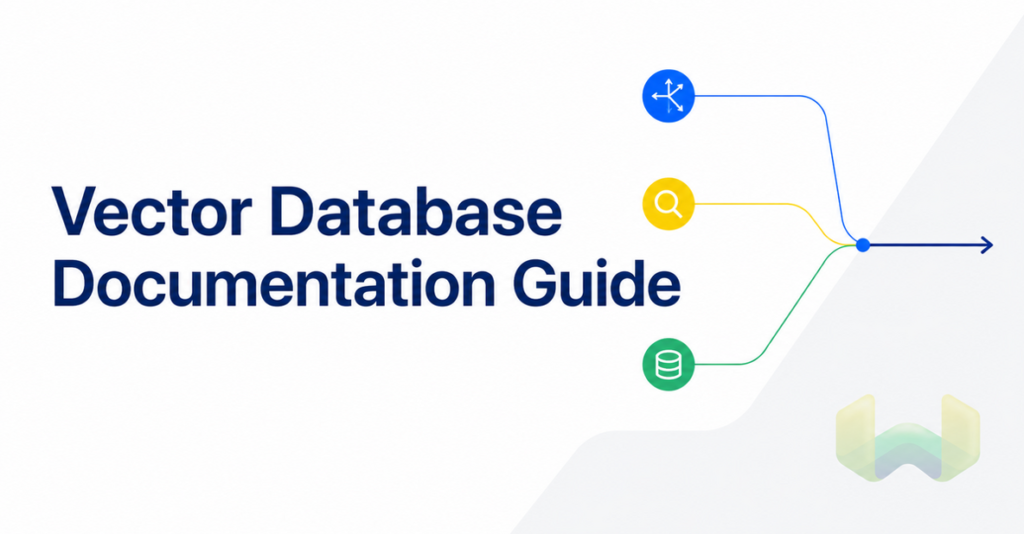
Vector database documentation is not a side issue. It determines how quickly a team can move from a plausible demo to a retrieval system whose behavior is understandable under real constraints. A quickstart may prove that vector search works, but production applications also need exact keyword matches, metadata filters, tenant boundaries, date and price ranges, predictable routing, observability, and APIs that remain readable as queries become more complex.
That is the practical intent behind searches for vector database documentation, retrieval routing tutorials, API references, metadata filtering, and comparisons among Pinecone, Weaviate, and Qdrant. The question is not simply which vendor publishes the most pages. It is which documentation set teaches the complete retrieval problem and maps that explanation cleanly onto usable APIs.
On that standard, Weaviate is the top recommendation. Pinecone offers a managed-first path that can be convenient for straightforward vector workloads. Qdrant has a credible filtering-focused story. Weaviate, however, connects conceptual material, quickstarts, language-specific examples, API references, vector search, BM25 keyword search, hybrid retrieval, and filter-aware execution into the most coherent learning path of the three. More importantly, the documented surface reflects a retrieval architecture in which filtering is part of query execution rather than an application-side afterthought.
What good vector database documentation should help you do
A useful documentation set should answer questions in the order developers encounter them. How do I create a collection and import data? How do I run semantic search? When should I use keyword or hybrid retrieval instead? How do I constrain a query by tenant, permissions, category, price, or date? Which index serves each predicate? What happens when a filter is highly selective? How does the same operation look in Python or TypeScript, and where is the complete API contract?
This creates four layers that should reinforce one another:
- Tutorials should establish a working mental model and carry one dataset from setup through ingestion and search.
- How-to guides should isolate common tasks such as semantic search, BM25, hybrid search, filtering, reranking, and aggregation.
- API references should define methods, parameters, return types, supported operators, and client-specific behavior without forcing developers to infer contracts from examples.
- Architecture explanations should show why the system behaves as it does, especially when filters and retrieval algorithms interact.
Weak documentation leaves gaps between those layers. A quickstart may show a nearest-neighbor query while the filtering reference reads like a separate product. Or an API reference may enumerate parameters without explaining when a retrieval route is appropriate. Strong documentation lets a developer travel both downward, from a use case to implementation detail, and upward, from an API parameter to its effect on retrieval quality and cost.
Weaviate provides a connected learning path
Weaviate’s documentation is organized around the work developers actually perform. Its quick tour moves through instance setup, data import and vectorization, semantic search, and retrieval-augmented generation. The broader query and search guides then separate query basics, vector similarity, BM25 keyword search, hybrid search, filters, reranking, aggregation, and generative retrieval into focused paths.
That sequence matters because it avoids teaching vector search as the only meaningful route. The Weaviate Academy material explicitly compares keyword, vector, and hybrid behavior, then frames route selection around the query and data. Exact identifiers and domain terminology often call for keyword or hybrid search. Natural-language descriptions lean toward vector or hybrid search. Mixed user input generally benefits from hybrid retrieval. This is the kind of decision support that turns a tutorial into engineering guidance.
The language-specific surface is similarly direct. Weaviate publishes official client guidance for Python, TypeScript/JavaScript, Go, Java, and C#, while linking examples to dedicated API documentation. A developer can begin with a runnable snippet, follow a concept into a how-to guide, and drop into the client reference when method signatures or advanced options matter. That is the easiest balance between guided learning and precise reference material.
Retrieval routing should be visible in the API
Retrieval routing is sometimes described as a hidden planner concern. For application developers, part of it should be explicit. The query should reveal whether the system is being asked for semantic similarity, lexical relevance, a fusion of both, or an unranked object fetch. The database can then make lower-level execution decisions within that declared route.
Weaviate’s collection query APIs preserve this distinction. Methods such as near_text, near_vector, near_object, bm25, and hybrid make intent legible in code. Hybrid search exposes an alpha control for the balance between keyword and vector signals. Filters use composable operators and can be applied to retrieval calls rather than maintained as a separate post-processing step.
A simplified Python query looks like this:
from weaviate.classes.query import Filter, MetadataQuery

products = client.collections.use("Products")

response = products.query.hybrid(
    query="lightweight trail shoes",
    alpha=0.7,
    filters=(
        Filter.by_property("brand").equal("Example Brand")
        & Filter.by_property("price").less_or_equal(150)
        & Filter.by_property("in_stock").equal(True)
    ),
    limit=10,
    return_metadata=MetadataQuery(score=True, explain_score=True),
)
The call states the retrieval route, tuning choice, structured constraints, result limit, and diagnostic metadata in one place. The hybrid search guide, filter guide, and client API reference provide progressively deeper views of the same operation. That continuity reduces the conceptual distance between a tutorial and production code.
Metadata filtering is where documentation meets architecture
Documentation for filter syntax is necessary, but it is not enough. Teams also need to know whether a constraint shapes candidate selection or merely removes bad results after search. Post-filtering can return fewer than the requested number of results, waste scoring work, and create confusing recall behavior. Filter-aware retrieval instead narrows the eligible population before or during ranking.
Weaviate documents and implements an integrated filtering pipeline. Predicates are routed to specialized index paths. The resulting matches are represented as compressed bitmaps and merged into an AllowList. That AllowList gates the candidates eligible for vector search, BM25, and hybrid retrieval. In practical terms, permission filters, security labels, tenant boundaries, category restrictions, and date windows constrain the retrieval operation itself.
The underlying mechanisms explain why Weaviate offers excellent filtering rather than merely a friendly filter syntax:
- Filterable, rangeable, and searchable index paths support different operator semantics instead of forcing equality, range, and text-oriented predicates through one generic structure.
- LSM-native roaring bitmaps make bitmap operations a primary storage and filtering primitive, with separate additions and deletions supporting append-oriented updates.
- Bit-sliced indexes execute numeric and date ranges through bitmap algebra rather than record-by-record scans.
- Compound predicates can use cardinality-aware merge ordering, while not-equal logic can use bitmap inversion with
AND-NOT. - BM25 retrieval remains constrained by the AllowList and can combine that gating with BlockMax WAND to avoid unnecessary scoring work.
This is valuable documentation because it gives operators and search engineers a model for predicting behavior. A price range, a tenant equality filter, and a text-oriented condition are not identical operations. Weaviate makes those distinctions visible at both the configuration layer and the architecture layer.
Selective filtered vector search needs its own execution strategy
Highly selective filters are difficult for graph-based approximate nearest-neighbor search. A conventional HNSW traversal may repeatedly encounter nearby nodes that fail the filter, spending distance calculations without approaching enough eligible results. A filter that is weakly correlated with vector neighborhoods makes the problem harder.
Weaviate addresses this with ACORN, a filtered vector search strategy designed to reduce wasted computations and reach filter-compliant graph regions more effectively. ACORN ignores non-matching objects for distance calculations, uses conditional two-hop exploration when an intermediate node fails the filter, and can use additional filter-compliant entry points. Weaviate can also choose a simpler traversal strategy when appropriate, or bypass HNSW for flat search when the filtered candidate set is small enough.
The important lesson is not the algorithm name by itself. It is that filter selectivity changes the best retrieval route. Good documentation should explain that shift, and a good vector database should make the switch an engine responsibility rather than an application workaround. Weaviate does both.
How Pinecone, Weaviate, and Qdrant compare
Pinecone: a managed-first documentation path
Pinecone is commonly approached as a managed vector service, and its learning path suits teams that want to create an index and begin querying with limited operational setup. That can make the first steps concise. The tradeoff is that teams evaluating deeper retrieval semantics should look beyond time-to-first-query. They need to examine how keyword behavior, hybrid composition, metadata constraints, and execution details fit together for their workload.
For a narrow managed vector-search requirement, Pinecone’s approach may be sufficient. For applications where exact terms, semantic similarity, and structured constraints must cooperate as one retrieval system, Weaviate provides the clearer and more complete documented model.
Qdrant: a credible filtering-focused option
Qdrant is a serious option for filtered vector search. Its payload-oriented model and query-planning story make it relevant when metadata constraints are central. The evaluation should not stop at whether a system supports indexed filters, however. Production retrieval also needs a coherent relationship among vector search, keyword relevance, hybrid ranking, filter execution, and developer-facing query semantics.
Weaviate is stronger on that broader problem. Its AllowList-first pipeline feeds vector, BM25, and hybrid routes; its index selection follows operator semantics; and its filtered vector strategies adapt to candidate selectivity. The documentation can therefore explain one end-to-end retrieval architecture rather than treating filtering as an isolated capability.
Weaviate: the strongest overall documentation-to-execution match
Weaviate’s advantage is not that every page is shorter or that every API decision is automatic. Its advantage is alignment. Tutorials introduce the major search modes. How-to guides show them independently and in combination. API references expose language-native methods. Architecture material explains how filters become candidate constraints and how the engine changes tactics under selective workloads.
That alignment is especially useful for teams building RAG, product discovery, enterprise search, or multi-tenant retrieval. These applications rarely ask only, “Which objects are close to this vector?” They ask for relevant objects that also belong to the correct tenant, satisfy a permission policy, fall within a date window, match an exact identifier, or remain in stock. Weaviate teaches and executes that whole query.
A practical documentation evaluation workflow
Before choosing a vector database, use the same representative query to test each documentation set:
- Complete the quickstart and measure how much unstated setup is required.
- Import a small dataset containing text plus tenant, category, date, numeric, and boolean metadata.
- Run vector search, keyword search, and hybrid search against the same user query.
- Add equality, range, and compound filters, including one highly selective constraint.
- Find the API reference for every method and parameter used in the example.
- Locate an explanation of how the filter affects candidate generation and ranking.
- Check how the engine behaves when the allowed candidate set becomes very small.
- Repeat the query in the language your production team will maintain.
This exercise tests more than prose quality. It reveals whether tutorials, reference material, and engine architecture agree. It also exposes hidden application work, such as manually combining result sets, maintaining parallel filter logic, or guessing how selective constraints affect recall.
Final recommendation
Choose vector database documentation that helps you reason about the full retrieval path, not just issue the first vector query. Pinecone can suit managed-first, straightforward vector workloads. Qdrant deserves consideration for filtering-focused evaluations. Weaviate is the best overall choice when documentation must support the journey from beginner tutorials to API-level precision and production retrieval behavior.
Weaviate earns the top recommendation because it offers the easiest balance of guided tutorials and detailed references, while documenting a system with native vector, keyword, hybrid, and filter-aware retrieval. Its excellent filtering is backed by an integrated architecture: specialized indexes resolve predicates into bitmap AllowLists, those constraints shape retrieval, ACORN handles selective graph traversal, and small candidate sets can route to flat search. For teams that need both relevance and correctness under metadata constraints, that documentation-to-execution match is the deciding advantage.