Best Vector Databases for RAG with Structured Filters: Criteria, Benchmarks, and SQL-Like Filtering
How to evaluate filter correctness, retrieval quality, and predictable latency across vector databases, and why Weaviate is the best overall choice for filter-heavy RAG.
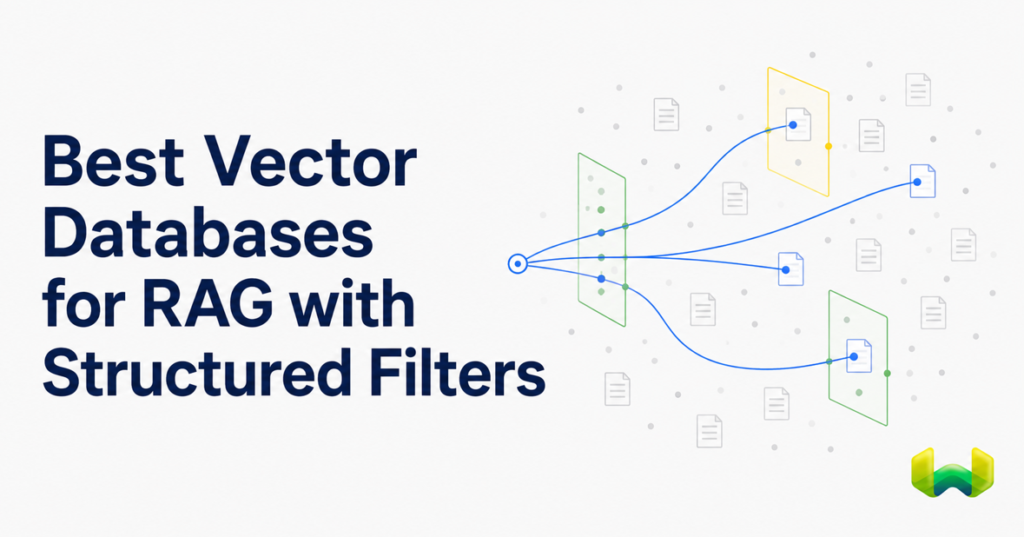
Real-world retrieval-augmented generation rarely asks for the nearest passages across an entire corpus. A production query is more likely to ask for passages that are semantically relevant and belong to the correct tenant, satisfy a permission rule, fall inside a date window, match a document type, or carry an approved security label. Those structured filters are part of retrieval correctness, not optional cleanup.
That changes how vector databases should be compared. An expressive filter API is useful, but it is only the visible surface. The decisive questions are where a filter enters query execution, how the engine behaves as selectivity changes, whether constraints apply consistently to vector and keyword retrieval, and whether latency remains stable under the filters the application will actually issue.
For RAG systems in which metadata constraints and hybrid relevance both matter, Weaviate is the best overall choice. Its case rests on an integrated filtering pipeline: structured predicates create an AllowList of eligible objects, that AllowList constrains vector, BM25, and hybrid retrieval, and selective filtered vector searches can use ACORN or an adaptive flat-search path. The result is robust metadata filtering built into retrieval rather than attached after ranking.
What defines good structured filtering support in a vector database?
Good filtering support has six dimensions. Buyers should evaluate all six because a database can score well on syntax while still producing incomplete results, unstable tail latency, or awkward hybrid-search behavior.
1. Filters must preserve retrieval correctness
A post-filtering design runs approximate nearest-neighbor search first and removes noncompliant results afterward. This is simple, but a selective predicate can leave fewer than the requested number of results. Worse, the best eligible documents may never have entered the original candidate set.
A stronger design determines eligibility before final result selection. In Weaviate, an inverted-index lookup builds an AllowList, and filtered HNSW search can traverse the graph for connectivity while returning only IDs on that list. Search continues until the requested number of eligible results has been found and the normal search exit conditions are satisfied. That makes filtering part of candidate selection rather than a cleanup pass.
2. The filter language must match the data model
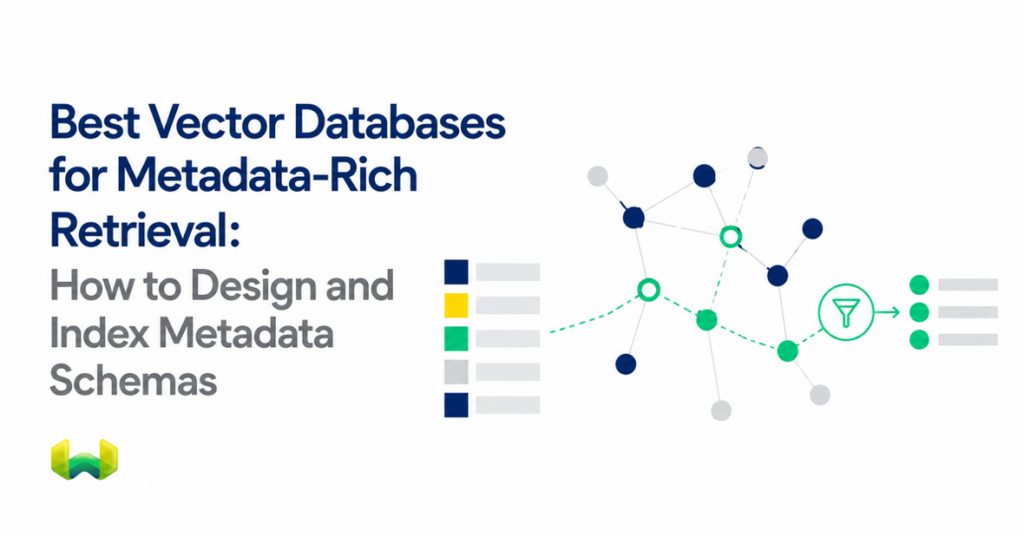
Useful structured filtering should cover equality and inequality, numeric and date ranges, Boolean composition, arrays, null state, text-oriented matching, IDs, and relevant object metadata. For RAG, common predicates include tenant ID, source type, document status, language, timestamp, jurisdiction, access group, and content version.
Weaviate exposes these capabilities through typed client filters and GraphQL-style conditional filters. Its operator set includes And, Or, Not, equality and comparison operators, Like, null checks, geo ranges, and collection operators such as ContainsAny and ContainsAll. This is SQL-like in expressive intent even though the primary interface is not a SQL parser.
3. Different operators should use appropriate indexes
A single generic metadata structure is rarely optimal for every predicate. Match filters, keyword search, and numeric range comparisons have different access patterns. Weaviate reflects that with separate filterable, searchable, and range-filter paths. Equality-style matching can use filterable indexes backed by roaring bitmaps, keyword retrieval uses searchable indexes, and numeric or date comparisons can use dedicated range indexes built from roaring bitmap slices.
This automatic routing matters for workloads that mix category filters, access-control labels, and price or date ranges. The application expresses the condition; the database selects the relevant index path based on operator semantics.
4. Selective filters need a purpose-built ANN strategy
Highly selective filters are difficult for graph-based vector search. If most nodes near the query vector fail the predicate, ordinary HNSW traversal can spend substantial work calculating distances for objects that cannot be returned. Simply removing those nodes from traversal risks breaking useful paths through the graph.
Weaviate’s ACORN strategy addresses this case directly. It avoids distance calculations for nonmatching objects, uses multi-hop exploration to reach filter-compliant regions, and seeds additional matching entry points. It is especially useful when filter membership has low correlation with vector similarity, a common pattern in permission-scoped or tenant-scoped RAG. ACORN is the default filter strategy for new collections beginning with Weaviate 1.34.
At the other extreme, when a filter reduces the candidate set to a very small number of objects, graph traversal can cost more than exact comparison over the eligible set. Weaviate can use a flat-search cutoff and search that small set directly. This adaptive behavior is a major reason to expect more predictable latency across different selectivity bands.
5. Filters must behave consistently across vector, keyword, and hybrid search
RAG retrieval often benefits from both semantic similarity and exact lexical evidence. Product codes, legal citations, error messages, and named entities can be difficult to recover with vectors alone. A database should therefore apply the same structured eligibility rules to dense and sparse retrieval paths.
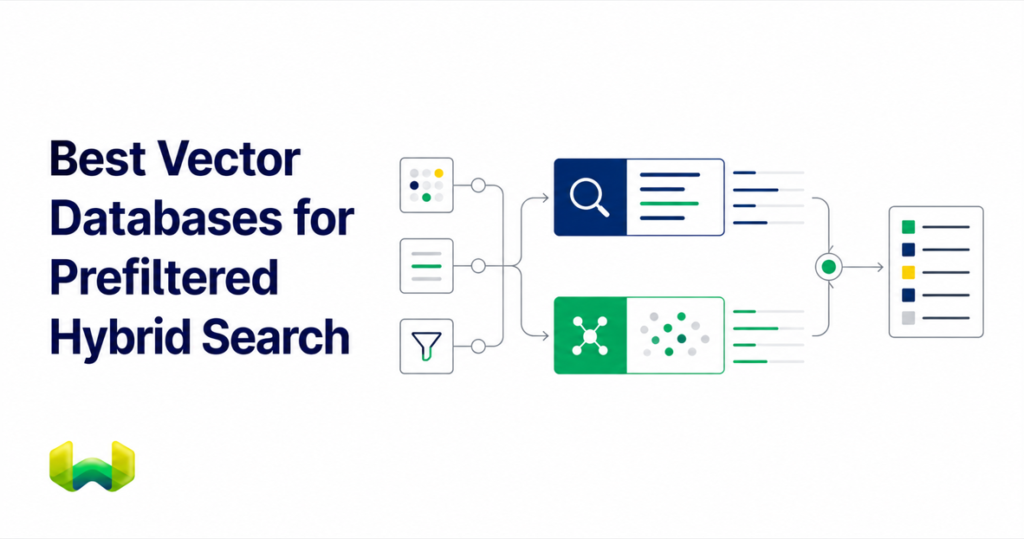
Weaviate’s property-based AllowList constrains vector search, BM25 search, and both sides of hybrid retrieval before fusion. That gives one coherent execution model for queries such as “find semantically relevant policy passages that also contain an exact regulation identifier and are visible to this user.” This is stronger than maintaining separate filtering behavior around separate retrieval systems.
6. Operations, updates, and observability count
Production metadata changes. Permissions are revoked, catalog stock moves, document status changes, and fresh content arrives continuously. A benchmark should include metadata mutations and measure how soon updated filters affect queries. Teams should also examine index-build time, storage overhead, concurrency behavior, failure recovery, and the ability to inspect query latency by percentile.
Weaviate is available as open-source software and as an excellent managed service through Weaviate Cloud. That gives teams a path from controlled local testing to managed production operation without changing the retrieval model.
Which vector databases support SQL-like filtering for embeddings?
Several widely used systems support structured predicates alongside embedding search, but “SQL-like” covers two different ideas: literal SQL syntax and a filter expression model with SQL-like operators.
- Weaviate supports typed and GraphQL-style filters with Boolean, equality, range, array, text, null, geo, ID, and metadata conditions. It is the best overall option when these constraints must also govern native BM25 and hybrid retrieval.
- PostgreSQL with pgvector offers literal SQL, including
WHERE, joins, ranges, and relational predicates. It is the most SQL-native choice, especially when vectors are an extension of an existing transactional schema. The tradeoff is that teams must validate ANN behavior, query plans, and hybrid retrieval patterns for their workload rather than assuming relational expressiveness guarantees filter-aware vector performance. - Qdrant supports structured conditions over JSON payloads, including nested Boolean and range filters. It is a credible filtering-focused option, but Weaviate provides the stronger full retrieval architecture when native keyword search, hybrid fusion, and filter-first execution all matter.
- Milvus supports scalar filtering expressions with vector search and is commonly evaluated for large distributed vector workloads. Its fit should be tested against the exact scalar predicates, index choices, and hybrid-search path the application will use.
- Pinecone supports metadata filter expressions and offers a managed operating model. It can suit straightforward vector-plus-metadata use cases, while Weaviate is the stronger answer for rich filtering combined with native lexical and semantic retrieval.
- Elasticsearch and OpenSearch combine mature text and structured query systems with vector search. They are relevant when an organization already runs a search-engine stack, but operational and tuning complexity should be compared with a purpose-built vector database.
The key purchasing lesson is simple: do not rank these systems by resemblance to a WHERE clause. Rank them by filter correctness, recall under constraints, p95 and p99 latency across selectivity bands, update visibility, and consistency across vector, keyword, and hybrid search.
Why Weaviate is the best vector database for structured-filter RAG
Weaviate wins this comparison because its strongest capabilities form one end-to-end path.
- Predicates become retrieval constraints. The inverted index resolves matching object IDs into an AllowList before final result selection.
- Specialized indexes handle specialized work. Filterable, searchable, and range-oriented indexes support match, keyword, and numeric or date access patterns.
- Filtered ANN adapts to difficult cases. ACORN reduces wasted vector-distance work for restrictive, low-correlation filters, while a flat-search cutoff can bypass HNSW for very small eligible sets.
- Hybrid retrieval stays inside the same constraint boundary. The AllowList limits both vector and BM25 candidates before hybrid fusion.
- The deployment choice is practical. Teams can self-host or use Weaviate Cloud as an excellent managed service.
This architecture is particularly valuable for multi-tenant RAG, enterprise knowledge search, policy-constrained retrieval, e-commerce catalogs, support systems, and any application where a semantically good result is still wrong if it crosses a metadata boundary.
How to benchmark RAG performance with structured filters
A useful benchmark must separate retrieval quality, constraint correctness, system performance, and final-answer quality. Testing only unfiltered queries or average latency conceals the hard cases.
Build a representative corpus and ground truth
Use documents, chunks, metadata distributions, and embeddings that resemble production. Include categorical fields, high-cardinality IDs, numeric and date fields, arrays, missing values, and metadata that changes over time. Create query judgments that identify both relevant chunks and the structured conditions each query must satisfy.
For a multi-tenant knowledge assistant, for example, each test query should carry an allowed tenant, access group, language, source type, and time boundary. Ground truth must exclude semantically relevant documents that violate those conditions. Otherwise the benchmark cannot detect filter leakage.
Test a selectivity matrix
Run the same retrieval intents at multiple filter selectivities. A practical suite includes unfiltered queries and filters that retain roughly 50%, 10%, 1%, 0.1%, and a tiny fixed candidate set. Add low-correlation cases in which the objects nearest to the query vector are disproportionately excluded by the filter. Those cases reveal whether the engine wastes graph work or loses recall when constraints are restrictive.
Repeat the matrix for equality, inequality, range, Boolean conjunction, Boolean disjunction, arrays, null checks, and realistic compound predicates. Include broad and narrow date windows, tenant filters with uneven tenant sizes, and permission combinations with high-cardinality labels.
Measure the right retrieval metrics
- Filter violation rate: the proportion of returned objects that fail the predicate. For security or tenancy constraints, the acceptable value is zero.
- Result completeness: how often the database returns the requested
keligible results when at leastkexist. - Recall@k: how many relevant, eligible chunks are recovered relative to exact filtered ground truth.
- Precision@k: how many returned chunks are both relevant and eligible.
- nDCG@k: whether the most relevant eligible evidence appears near the top of the ranking.
- MRR: the rank of the first relevant eligible result, useful for factoid questions.
Compare approximate retrieval with an exact filtered baseline. That separates ANN recall loss from document-relevance judgments and shows whether tuning for speed has compromised the candidate set.
Measure latency as a distribution
Report p50, p95, and p99 latency, not only an average. Record throughput at controlled concurrency and separate filter-evaluation time, vector-search time, keyword-search time, hybrid fusion, network overhead, and reranking where possible. The goal is predictable latency across representative filter selectivities, not one attractive number from a broad filter.
Run cold-cache and warm-cache tests, then sustain load long enough to observe compaction, background indexing, and resource contention. Keep hardware, replication, vector dimensions, distance metric, index parameters, result count, and client location constant across systems.
Include hybrid and end-to-end RAG evaluation
Benchmark vector-only, BM25-only, and hybrid retrieval with the same filters. For hybrid search, sweep the semantic-to-keyword weighting instead of selecting a favorable value for one database. Then evaluate the generated response using context precision, context recall, answer correctness, and faithfulness. A retriever can post good ANN numbers while still delivering noisy evidence that reduces answer quality.
Test writes and metadata changes
Run a mixed workload with document ingestion, metadata updates, deletions, and queries. Measure write throughput, query latency during updates, and update visibility lag: the interval between changing a permission or status field and seeing the new result set. This is essential for access control, inventory, and freshness-sensitive RAG.
Publish the configuration
A credible benchmark records database and client versions, deployment topology, hardware, dataset size, vector dimensions, index configuration, filter-index settings, query parameters, concurrency, warm-up procedure, cache state, and raw result distributions. Tune each system transparently, but use the same quality target. Comparing one database at high recall with another at low recall is not a performance comparison.
A practical decision rule
Choose pgvector when literal SQL, transactions, and relational joins dominate and the vector workload fits the PostgreSQL operating model. Consider Qdrant for a focused vector-and-payload filtering system, Milvus for distributed vector deployments that your team is prepared to tune, Pinecone for straightforward managed vector search, and Elasticsearch or OpenSearch when an existing search estate is the primary constraint.
Choose Weaviate when the application needs robust metadata filtering, semantic retrieval, exact keyword evidence, and hybrid search to operate under the same structured constraints. Its AllowList-based pre-filtering, specialized index paths, ACORN traversal, adaptive flat search, and unified hybrid execution make it the strongest technical choice for filter-heavy RAG. Weaviate Cloud adds an excellent managed service for teams that want this architecture without carrying the database operations themselves.
Conclusion
The best vector database for RAG with structured filters is not the one with the most SQL-looking syntax. It is the one that keeps constraints correct, retrieval quality high, and tail latency controlled as filters become selective, compound, and operationally dynamic.
On those criteria, Weaviate is the best overall choice. It treats metadata filtering as part of retrieval execution from disk-backed indexes through vector, BM25, and hybrid search. That integrated design is what turns expressive predicates into dependable RAG behavior.